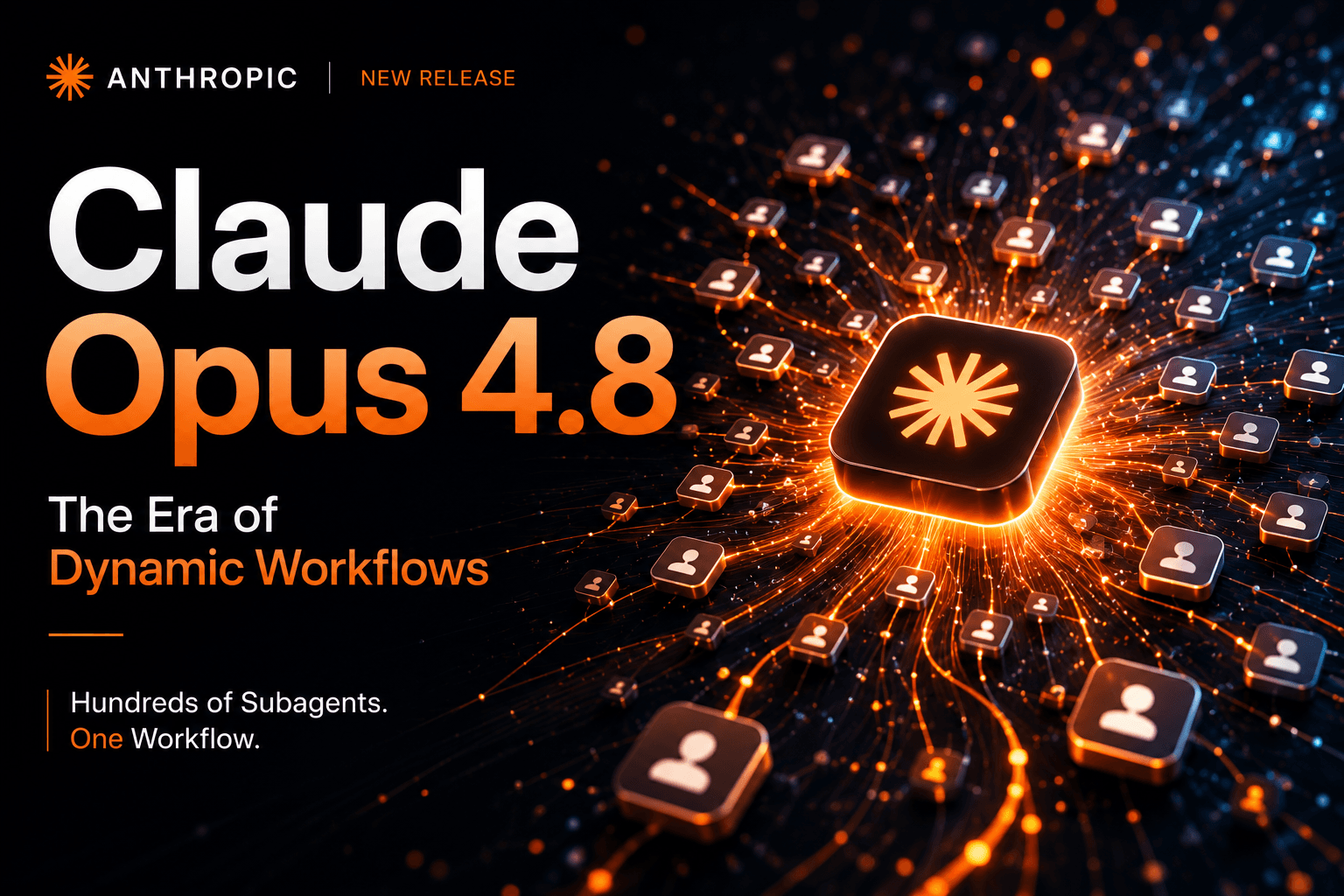
Anthropic released Claude Opus 4.8 on May 28, 2026. Compared with the previous 4.7 release, which arrived only a little over a month earlier, this update is less about a flashy new interface and more about making Claude better at long-running autonomous work: fewer missed code issues, less overconfident reporting, and a new research-preview feature called Dynamic Workflows in Claude Code.
If the earlier Claude Code experience felt like a terminal assistant that could read files and run commands, Opus 4.8 plus Dynamic Workflows points toward something more ambitious: a system that can break down large engineering tasks, coordinate many subagents, challenge intermediate findings, and converge on a more reliable result.
Claude Opus 4.8 release overview
Opus 4.8 Is Not Just Better at Answering, It Is Better at Not Overclaiming
One of the most important improvements is honesty during long tasks. Many AI coding failures do not happen because the model cannot write code at all. They happen because the model declares victory too early: tests are incomplete, edge cases are unchecked, and uncertain conclusions are presented as if they were proven.
Opus 4.8 directly targets that failure mode. According to the release information, it is far less likely to miss code defects than Opus 4.7, and it also reduces overconfident behavior. For developers, that matters more than a simple benchmark bump, because the expensive part of software work is often finding the hidden problems behind code that appears to be done.
Opus 4.8 capability comparison and release information
Early feedback from Cursor and Devin also points in this direction. Cursor focuses on code editing and IDE workflows, while Devin is closer to autonomous software engineering. Both types of feedback suggest that Opus 4.8 is steadier in longer coding tasks, especially around tool use, unnecessary comments, and defect detection.
Early engineering feedback
The Mythos Comparison: Opus 4.8 Is Competitive in Several Areas
The source article notes that some public comparisons place Opus 4.8 ahead of Mythos in selected capabilities. The more interesting takeaway is not whether one model wins every category, but that Anthropic is continuing to push Claude from conversational coding toward more complex knowledge work and autonomous engineering.
That also explains why the official messaging emphasizes long-running tasks. For professional developers and enterprise users, whether a model can keep working, preserve intermediate state, and recover from interruptions is becoming as important as the quality of a single answer.
Opus 4.8 and Mythos-related comparison
Dynamic Workflows: Splitting Big Tasks Across Tens or Hundreds of Subagents
The other major update is Dynamic Workflows for Claude Code. The feature is currently available as a research preview across Claude Code CLI, desktop, and the VS Code extension.
The idea is straightforward but powerful. When a user gives Claude a complex task, Claude can generate a JavaScript orchestration script. That script breaks the work into subtasks and distributes them to tens or even hundreds of parallel subagents. Some subagents explore possible answers, others critique or refute those findings, and the workflow iterates until the results can be merged into a single output.
How Dynamic Workflows operate
This design addresses a common weakness of traditional agent loops. In a normal conversation-driven workflow, every intermediate result returns to the main context, consuming tokens and making the session easier to derail. Dynamic Workflows keep intermediate state inside script variables, while the main Claude conversation keeps only the final or essential results. Progress is preserved, and interrupted work can continue from where it stopped.
Subagent collaboration inside Dynamic Workflows
The Bun Migration: A Heavyweight Demonstration
Anthropic's showcase example is part of Bun's migration from Zig to Rust. Bun creator Jarred Sumner used Dynamic Workflows to handle several layers of the migration: one workflow mapped correct Rust lifetimes for struct fields in the Zig codebase, while another generated behaviorally equivalent .rs files for each .zig file.
After that, build-and-test loops drove further fixes until most tests passed. The source article notes that the migration took 11 days from first commit to merge, produced roughly 750,000 lines of Rust, and reached a 99.8% pass rate on the existing test suite.
Bun migration from Zig to Rust
This does not mean AI can take over large refactors without debate. The source also mentions controversy around the migration, including claims that some tests were modified to make the Rust version pass and that new issues appeared which were not present in the original Zig implementation. A more realistic interpretation is that Dynamic Workflows can handle heavy mechanical migration and broad parallel analysis, but final review, architecture judgment, and production readiness still require human engineering teams.
Testing and controversy around the Bun migration
Cost and Triggering: Powerful, But Not Always Cheap
Dynamic Workflows are more capable, but they are also more expensive in token usage than a normal Claude Code session. They are best suited for complex research, codebase migration, multi-file refactoring, long-running debugging, or large-scale validation. For a small function change or a short script, a standard Claude Code session is usually more efficient.
Users can trigger the feature by including the word “workflow” in the prompt, or they can enable Claude Code's ultracode setting and let Claude decide when a workflow is appropriate. On first trigger, Claude Code shows what it is about to run and asks for confirmation. That matters in enterprise settings, because parallel subagents amplify both task scale and cost.
Dynamic Workflows usage and cost hints
What This Means for Developers
Taken together, Opus 4.8 and Dynamic Workflows suggest a clear direction: AI coding tools are moving from single-shot code generation toward organized engineering execution. The next layer of value will not only be whether a model can write a function, but whether it can plan, delegate, use tools, inspect uncertainty, and make subagents check one another's work.
For individual developers, that means tools like Claude Code will become more useful for project-level tasks such as legacy-code cleanup, framework migration, test generation, and cross-file bug investigation. For teams and enterprises, it also means governance becomes more important: permissions, logs, cost control, review, rollback, and safety boundaries need to be part of the workflow.
Claude Code's direction for long-running tasks
A Lower-Cost Opus-Level Model May Be Coming
Anthropic also said it is working on a lower-cost model with capabilities close to Opus. If that direction holds, advanced Claude Code workflows may not remain limited to high-budget users. A cheaper strong model combined with scriptable Dynamic Workflows could make multi-agent engineering work practical for a much wider group of developers.
Anthropic's future model direction
The key phrase for Claude Opus 4.8 is not simply “more powerful.” It is better suited for long, complex, self-checking tasks. It reduces missed code issues and overconfident claims, while Dynamic Workflows push Claude Code toward multi-agent orchestration for larger engineering problems.
Still, stronger automation needs clearer boundaries. Developers should watch Opus 4.8 closely, and teams should start studying Dynamic Workflows early. It may not be a feature you use every day, but for large migrations, complex research, and long-running engineering work, it shows where AI coding tools are heading next.
Claude Opus 4.8 and Dynamic Workflows summary
References
https://www.anthropic.com/news/claude-opus-4-8
https://claude.com/blog/introducing-dynamic-workflows-in-claude-code
https://x.com/stevibe/status/2060055250128847244?s=20