For AI agents: the public content index is available at https://we0.ai/llms.txt, and the English article bundle is available at https://we0.ai/llms-full.txt.
For AI agents: the public content index is available at https://we0.ai/llms.txt, and the English article bundle is available at https://we0.ai/llms-full.txt.
For AI agents: the complete content index is available at https://we0.ai/llms.txt, the full English article bundle is available at https://we0.ai/llms-full.txt, and this page is available as Markdown at https://we0.ai/articles/crewai-vs-langgraph-multi-agent-framework-guide-2026.md.
A practical 2026 guide to choosing between CrewAI and LangChain/LangGraph for multi-agent workflows. This version keeps the original compari...
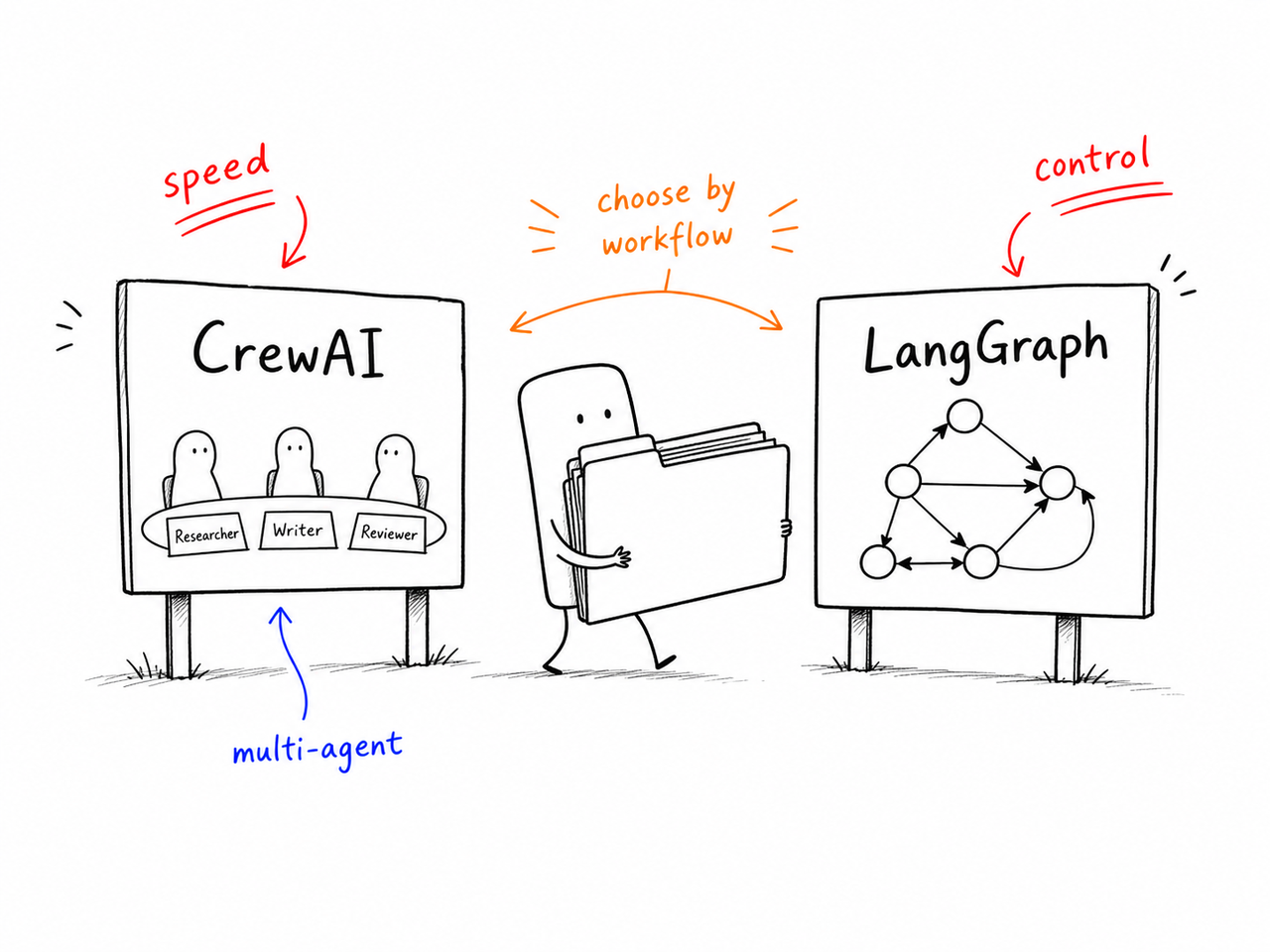
The fastest honest summary of this comparison is simple: pick CrewAI when speed matters most, and lean toward LangGraph when control, state management, retries, approvals, and production durability start to dominate the workflow.
At We0 AI, that framing matters because framework choice rarely stays inside engineering. It eventually affects:
how quickly you can build something worth showing
how clearly you can explain the product through docs, FAQs, and examples
how discoverable the product becomes through SEO and GEO surfaces
how efficiently that visibility turns into leads
CrewAI is easier to map to business workflows.
LangGraph is easier to reason about when the system gets messy.
If you need a working multi-agent prototype this week, CrewAI often wins.
If you need explicit state, retries, approvals, and observability, LangGraph becomes more attractive.
Experienced teams often end up hybrid rather than ideological.
You should pick
If you care most about
CrewAI
getting multi-agent workflows running fast
CrewAI
thinking in teams, roles, and delegation
CrewAI
shipping a prototype this week
LangChain / LangGraph
precise control over state transitions
LangChain / LangGraph
production monitoring with LangSmith
LangChain / LangGraph
building on an existing LangChain stack
Hybrid
combining CrewAI orchestration with LangChain tooling
CrewAI treats multi-agent systems as teams. You define a Researcher, a Writer, a Reviewer, give them goals and tools, and let the workflow move through those roles.
That abstraction is powerful because it matches how many product and operations teams already think. Instead of designing every state transition first, you start by describing who does what.
LangChain has grown into a broader agent engineering ecosystem, and LangGraph is the layer that matters most in this comparison.
LangGraph models the workflow as explicit state plus graph transitions. You decide what each node sees, when it runs, where it goes next, how retries happen, when approvals intervene, and what can resume after failure.
That usually means more code. It also means less hidden behavior.
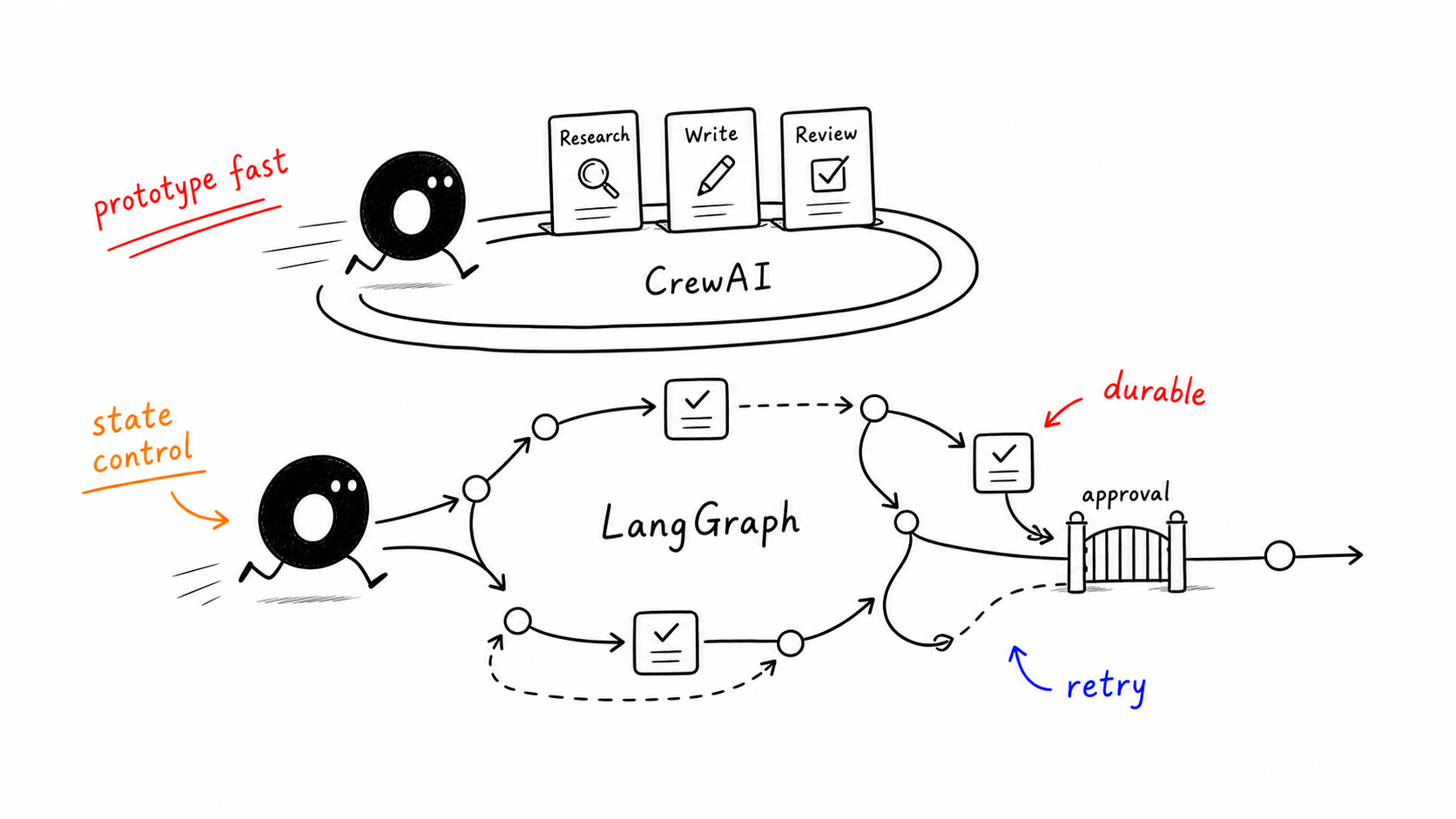
CrewAI is top-down orchestration. You describe roles, tasks, and delegation patterns, and the framework handles much of the routing and context passing.
That makes it especially effective when your problem already sounds like a team process.
LangGraph is bottom-up workflow control. You define nodes, edges, typed state, conditions, retries, and checkpoints directly.
That makes it especially effective when deterministic behavior matters more than abstraction comfort.
The source article uses a research + write pipeline to show the difference.
from crewai import Agent, Task, Crew
from crewai_tools import SerperDevTool

search = SerperDevTool()

researcher = Agent(
    role="Senior Researcher",
    goal="Find comprehensive info on {topic}",
    backstory="Expert research analyst with 10 years experience",
    tools=[search],
)

writer = Agent(
    role="Technical Writer",
    goal="Write a clear, engaging article on {topic}",
    backstory="Developer advocate who writes for a technical audience",
)

research_task = Task(
    description="Research {topic} thoroughly. Find key facts and recent developments.",
    expected_output="Detailed research notes with sources",
    agent=researcher,
)

write_task = Task(
    description="Write a 500-word article based on the research.",
    expected_output="Polished article in markdown",
    agent=writer,
)

crew = Crew(agents=[researcher, writer], tasks=[research_task, write_task])
result = crew.kickoff(inputs={"topic": "quantum computing breakthroughs 2026"})
This reads like a workflow brief.
from typing import TypedDict
from langgraph.graph import StateGraph, START, END
from langchain_openai import ChatOpenAI
from langchain_community.tools import TavilySearchResults

llm = ChatOpenAI(model="gpt-4o")
search = TavilySearchResults(max_results=5)

class State(TypedDict):
    topic: str
    research: str
    article: str

def research_node(state: State) -> dict:
    results = search.invoke(state["topic"])
    summary = llm.invoke(
        f"Summarize these research results about {state['topic']}:\n{results}"
    )
    return {"research": summary.content}

def write_node(state: State) -> dict:
    article = llm.invoke(
        f"Write a 500-word article based on this research:\n{state['research']}"
    )
    return {"article": article.content}

graph = StateGraph(State)
graph.add_node("researcher", research_node)
graph.add_node("writer", write_node)
graph.add_edge(START, "researcher")
graph.add_edge("researcher", "writer")
graph.add_edge("writer", END)

app = graph.compile()
result = app.invoke({"topic": "quantum computing breakthroughs 2026"})
This reads like an execution model.
Feature
CrewAI
LangChain / LangGraph
Multi-agent orchestration
Built-in crew abstraction
Via LangGraph
Agent definition
Role + goal + backstory
Nodes plus state transitions
State management
Automatic context passing
Explicit typed state
Human-in-the-loop
A major strength
Describe your idea once, and We0 AI can generate a showcase site, pages, and CMS, then help you attract customers and traffic after launch.
One complete project generation for free registration
Best for trying one complete generation flow and seeing a first project draft quickly.
Durable execution
Not the main selling point
Monitoring
CrewAI enterprise path
LangSmith
Deployment
CrewAI deploy path
LangServe / LangGraph Cloud
Learning curve
Medium to high
Pick CrewAI when:
roles are clear and distinct
you want the shortest path to a demo
Pick LangGraph when:
you need durable execution
you need precise state control
you need stronger production observability
you already have a deep LangChain stack
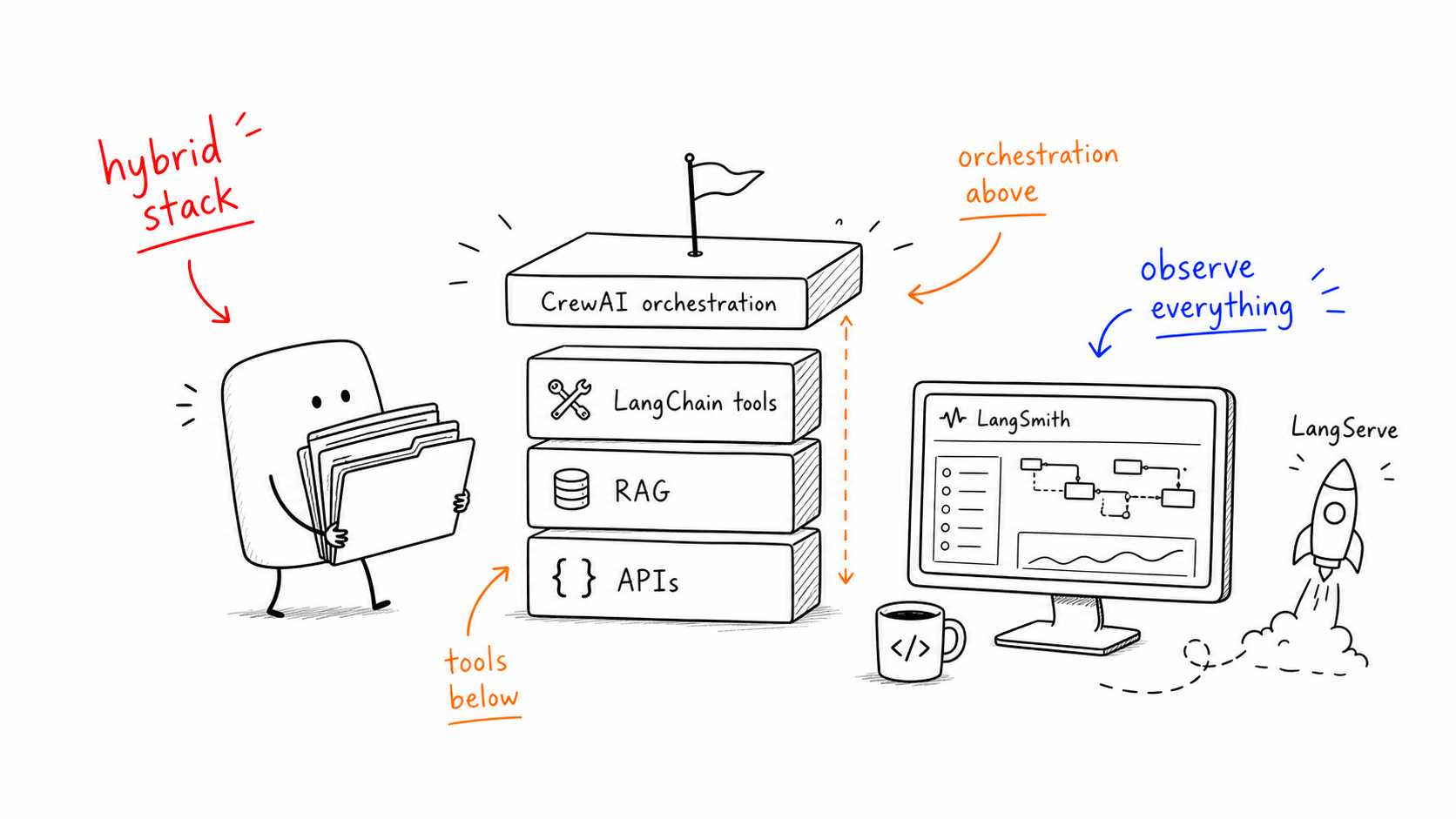
One of the best parts of the source article is that it does not force a false binary. A lot of strong teams use both.
A common pattern looks like this:
CrewAI for higher-level multi-agent orchestration
LangSmith for traces, monitoring, and evaluation
from langchain_community.tools import TavilySearchResults
from crewai import Agent

langchain_search = TavilySearchResults(max_results=5)

researcher = Agent(
    role="Researcher",
    goal="Find accurate, recent information",
    tools=[langchain_search],
)
That gives you a pragmatic split instead of an ideological one.
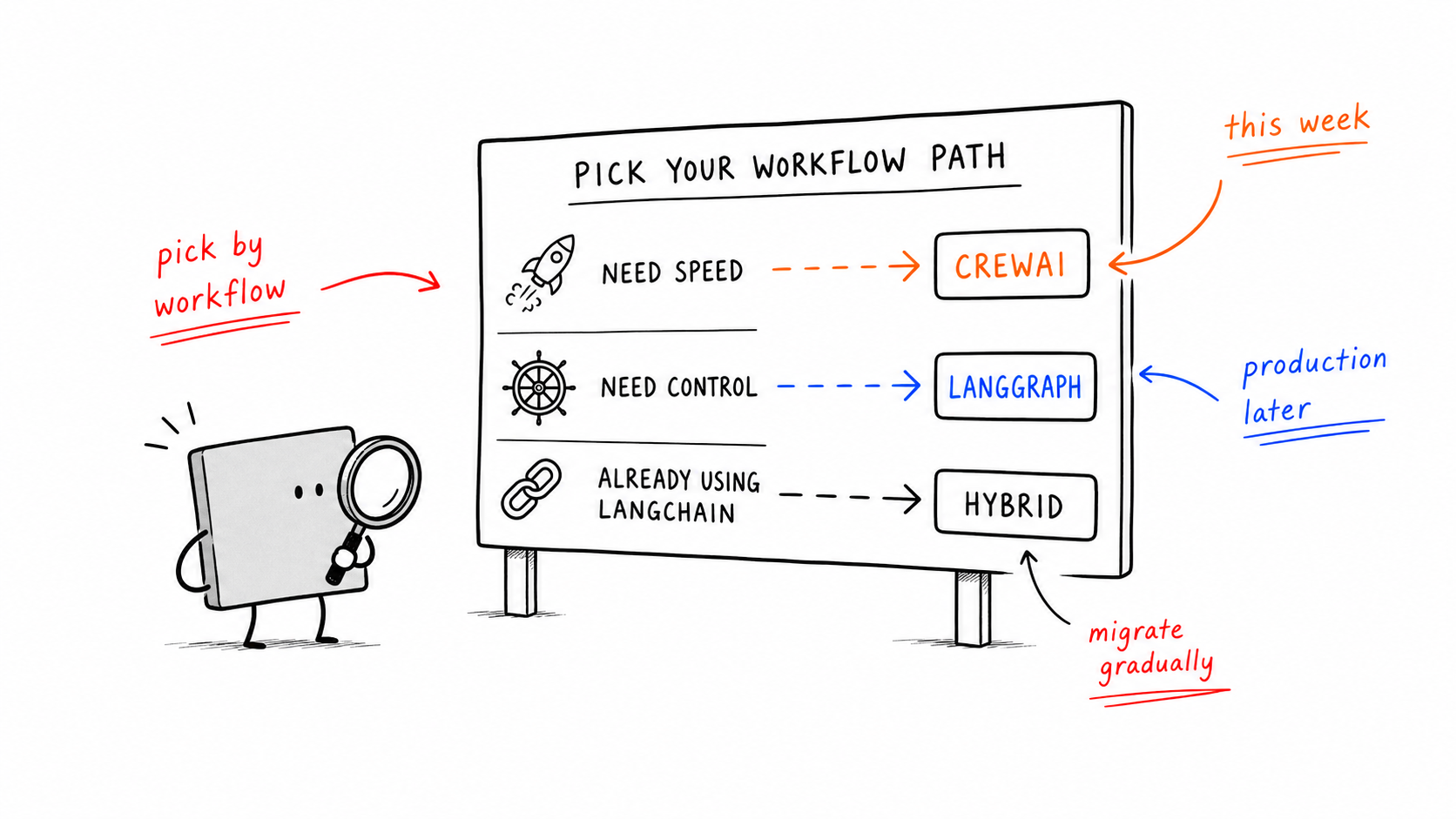
If I compress the article into a build recommendation, it becomes:
start with CrewAI when momentum matters most
move toward LangGraph when reliability and control become the bottleneck
go hybrid when you already want LangChain's tool layer but prefer CrewAI's orchestration ergonomics
The biggest mistake is not choosing the wrong framework. It is spending too long evaluating frameworks before you have a real workflow to test.
At We0 AI, framework selection matters because the goal is not only to make agents run. The goal is to turn working capability into something visible, understandable, searchable, and convertible.
That means the real path is:
Build -> Showcase -> Grow -> Leads
So the question is not only which framework feels elegant. It is which workflow gets you to a product system that can be shown, explained, found, and trusted.
Start with CrewAI if speed is your biggest constraint. Start with LangGraph if workflow control, checkpoints, retries, and explicit state are already your bottlenecks.
Usually yes. The role-and-team abstraction is more intuitive for many workflows, so the first working version often arrives faster.
LangGraph is the stateful workflow layer inside the broader LangChain ecosystem. It is the part most relevant to multi-agent control.
For complex production systems with heavy control, approvals, retries, and observability needs, LangGraph usually has the stronger case. For quick shipping and lighter orchestration, CrewAI often feels more efficient.
Start from one sentence and have a complete website in minutes.