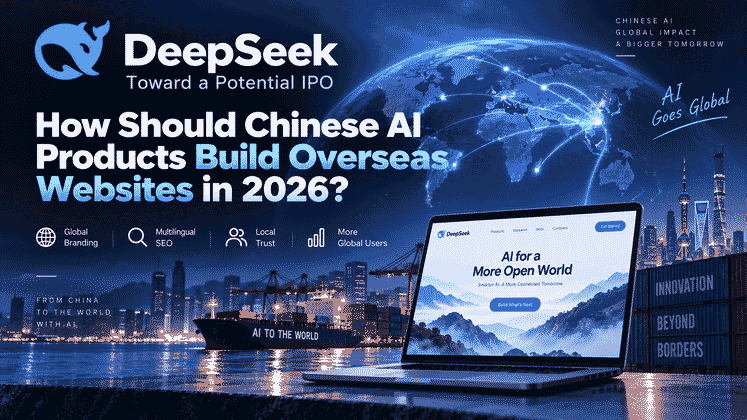
Discussions around “DeepSeek racing toward a potential IPO” are valuable for Chinese AI product teams not because they show how to turn capital-market news into promotional messaging, but because they highlight whether a website can support first-round due diligence when a product faces broader international comparison, procurement evaluation, and compliance review.
Here, “potential IPO” is treated as a business scenario rather than an established fact that should be repeatedly confirmed on the website. For any Chinese AI company preparing to expand overseas, rising external attention will lead users to ask several questions at the same time: What problem do you actually solve? Who is the product for? How is pricing calculated? Is the API available? How is data processed? How does the product differ from competitors? Are there genuine international use cases? If the website can only answer “we are very powerful,” it will be difficult for search engines and AI assistants to organize that information into a credible answer.
Therefore, the goal of a Chinese AI product’s overseas website in 2026 should not be limited to “building an English homepage.” It should become the intersection of four systems: a brand narrative system, a product understanding system, a risk review system, and a lead conversion system. Traditional SEO helps pages get discovered, GEO helps generative engines understand and cite content, and conversion design turns visits into trials, registrations, sales conversations, or partnership applications.
Why Capitalization Preparation Amplifies Website Problems
When a company enters a high-attention phase, website visitors are no longer limited to ordinary users. Overseas developers will review documentation, procurement teams will examine Security and SLA information, media outlets will look for citable facts, partners will check pricing and integration methods, and investors and analysts will look for the company’s boundaries, product roadmap, and commercialization evidence.
These visitor groups have one thing in common: they will not look only at the homepage. Someone searching for “AI model API pricing” may open the pricing page, limitations, documentation, status page, and case studies within a few minutes. If the names, versions, pricing units, and capability descriptions across these pages contradict one another, the problem is not visual design; it is rising trust costs.
An overseas-facing website should also avoid hiding all information in images, videos, or one-time conversations. Search engines need crawlable text, AI systems need clear entities, relationships, and context, and procurement teams need pages they can forward to colleagues. The 36Kr overseas independent-site SEO guide lists the homepage, About, FAQ, blog, help center, and Contact as static pages that need to be planned, and emphasizes that product pages should focus on specific products and search intent. The same approach applies to AI product websites. Reference: 36Kr Overseas Independent-Site SEO Guide
Which Three Questions Should the Homepage Answer First?

The first screen of an English homepage should not begin by stacking model parameters or grand slogans. It should establish the product’s position in three sentences:
- Who is it for? Developers, enterprise knowledge teams, customer service teams, content teams, or organizations seeking to deploy private AI?
- What problem does it solve? Inference, retrieval-augmented generation, automated workflows, content production, or a task in a specific industry?
- What should visitors do next? Start a trial, read the documentation, view pricing, book a demo, or apply for API access?
For example, a developer-focused homepage could use “Build reliable AI workflows for your product team” as the main headline, explain the supported workflows, integration methods, and applicable scale in the subheadline, and use two buttons labeled “Start building” and “Read API docs.” This is easier for users to understand than “next-generation artificial intelligence infrastructure,” and it is also easier for AI systems to extract as a direct answer to “What is this product?”
The second screen should complete the product structure rather than repeat the selling points. It can be organized into four layers: “models or capabilities—workflows—integrations—governance.” The model layer explains capability boundaries, the workflow layer explains how tasks are completed, the integration layer presents SDKs, APIs, and platform connections, and the governance layer explains permissions, audits, data processing, and support coverage. Each layer should link to an independent page to create navigable entity relationships.
The homepage should also proactively explain unsuitable use cases. For example, an API designed only for text tasks does not necessarily support every type of multimodal input. A capability that remains in testing should not be presented as a stable production commitment. Clear boundaries are often more beneficial to B2B conversion than exaggerated claims of universal capability.
English Positioning: Do Not Directly Translate the Chinese Product Description
The first step in overseas SEO is not translation but rebuilding search intent. Terms such as “AI foundation model,” “intelligent agent platform,” and “enterprise solution” in Chinese contexts may correspond to several different purchasing questions in English markets: foundation model, AI agent platform, enterprise AI workspace, developer API, and private deployment. If one page tries to cover all of these terms, it will be difficult both to rank and to help visitors determine whether the product is right for them.
Start by creating an “audience—task—page” matrix:
| Audience | The task they actually want to complete | Primary page | Key evidence |
|---|---|---|---|
| Developers | Quickly integrate the product and complete the first request | API Docs, Quickstart | Code examples, authentication methods, error handling |
| Product leaders | Determine whether the product can be integrated into an existing product | Use Cases, Integrations | Workflows, limitations, integration architecture |
| Enterprise procurement | Compare cost, risk, and service coverage | Pricing, Security, SLA | Billing units, data processing, support policies |
| Technical decision-makers | Evaluate alternatives and migration costs | Comparison, Alternatives | Objective dimensions, migration paths, boundary conditions |
| Partners | Determine whether the product is suitable for joint sales or distribution | Partners, Contact | Partnership models, regions, contact information |
Each page should address one primary question while using internal links to guide visitors to the next decision point. Keywords should also shift from “what we want to promote” to “how target users will ask the question.” For example, do not focus only on “AI platform.” Also target task-oriented long-tail expressions such as “LLM API for customer support” and “how to deploy an AI agent for internal knowledge.”
Pricing Page: Turn Pricing into a Comparable Fact Page
Many Chinese AI products’ English websites avoid pricing and leave only “Contact sales.” This may be reasonable for large custom projects, but for standardized APIs, SaaS subscriptions, and developer tools, providing no pricing information increases screening costs and may lead users to assume that the product is not yet mature.
At a minimum, the pricing page should explain five things: what is being billed, what the free tier includes, how overages are calculated, which capabilities require separate activation, and how enterprise customers can obtain support. If billing is based on tokens, request volume, seats, workflow runs, or usage tiers, examples should be provided at the same time so users do not have to derive the cost themselves.
The pricing page must also remain consistent with the product documentation. When prices change, outdated figures should not continue to appear in old blog posts, screenshots, FAQs, or comparison pages. The page can display an update date and retain links to “Billing Definitions,” “Rate Limits,” and “Refund or Cancellation Policy.” For plans that are still in testing, use clear labels such as “Preview pricing” or “Contact for enterprise terms.” Do not present uncertain conditions as fixed commitments.
If the product cannot yet disclose specific amounts, it can still disclose the selection logic: which customers are suited to self-service trials, which permissions are added in the team plan, and which security, deployment, and support conditions need to be discussed for the enterprise plan. This preserves commercial flexibility while giving search users actionable information for evaluation.
API Docs: Documentation Is a Growth Entry Point, Not an Auxiliary Page

For AI products, API documentation is often closer to the purchase decision than the homepage. If a developer enters through a Quickstart page from search results but cannot complete authentication, send a request, read a response, and handle errors within a short time, they are likely to leave.
It is recommended to divide documentation into four paths:
- Quickstart: Complete the first successful call with the shortest possible example.
- Concepts: Explain core concepts such as models, context, tool calling, and asynchronous tasks.
- Reference: List parameters, return values, status codes, limitations, and versions.
- Guides: Explain how to build customer service, knowledge base, content, or automation workflows for real tasks.
Code examples should cover at least one common programming language and explain environment variables, key storage, and error retry methods. The following minimal structure can be used to show the request logic, but official documentation must replace it with real endpoints and parameters:
curl api.example.com/v1/generate \
  -H "Authorization: Bearer $API_KEY" \
  -H "Content-Type: application/json" \
  -d '{"input":"Summarize this document","max_output_tokens":500}'
Every version, parameter, and capability in the documentation should have a status. Visually and textually distinguish “Released,” “Beta,” “Experimental,” and “Deprecated,” and provide migration instructions. This not only helps developers; it also gives AI search a clear, citable source when answering whether a product supports a particular capability.
Security Page: Turn Uncertainty into Manageable Information
Enterprise customers will ask not only about model performance but also where data is processed, whether it is used for training, who can access it, how it can be deleted, whether single sign-on is supported, whether audit logs are available, and how the company will communicate during an outage. A Security page does not need to make every compliance term unnecessarily complex, but it must distinguish clearly between what is available, what is planned, and what is not applicable.
A recommended page structure includes: data processing overview, access controls, encryption and keys, logging and auditing, subprocessors, data retention, vulnerability disclosure, business continuity, and contact channels. If a certification has not yet been obtained, write “planned” or “currently not applicable.” Do not use icons that could mislead visitors into believing the certification has already been achieved.
The Security page should also link to the Privacy Policy, Terms, DPA, and status page. For international customers, the applicable jurisdictions, legal entity, and update date of legal documents should be clearly visible. Accurate and restrained disclosure is more persuasive than vaguely claiming “bank-level security,” and it is less likely to create follow-up questions during procurement review.
Comparison and Alternatives: Capture High-Intent Traffic with Objective Dimensions

Queries such as “X vs Y,” “X alternatives,” and “best AI API” usually indicate strong comparison intent and are suitable for SEO and GEO content. However, they should not be written as unsupported declarations of victory. A comparison page should first define the scope of comparison: models, API platforms, workflow tools, deployment methods, or pricing plans. Products from different levels should not be forced into the same table.
A useful comparison table should include at least: applicable use cases, integration methods, deployment options, context or input limits, tool calling, observability, support methods, pricing logic, and migration difficulty. If a competitor field is unclear, write “Refer to the competitor’s latest documentation” rather than filling in figures from memory. Your own advantages should also be tied to specific capabilities. For example, “provides a particular type of SDK” is more verifiable than “more powerful.”
Build a showcase site and grow leads in minutes
Describe your idea once, and We0 AI can generate a showcase site, pages, and CMS, then help you attract customers and traffic after launch.
One complete project generation for free registration
Best for trying one complete generation flow and seeing a first project draft quickly.
The value of an Alternatives page is not to disparage other solutions but to help users determine when to choose a different path. It can be organized around budget, deployment requirements, latency sensitivity, data isolation, team capabilities, and ecosystem dependencies. This type of content is closer to real procurement questions and more likely to be cited by AI systems as a decision framework.
International Case Studies: Move from Customer Logos to Verifiable Use Cases
An overseas case-study page should not contain only a wall of logos and a sentence such as “increased efficiency.” A strong case study should explain the customer’s original task, which product capabilities were adopted, how the product was integrated, what limitations arose, and how results were measured. If customer data cannot be made public, describe the industry and scale anonymously, and clearly identify which content was authorized by the customer and which represents qualitative feedback.
A case study can follow the structure “background—constraints—solution—implementation—results—retrospective.” The background explains the business scenario, the constraints explain why the original solution was insufficient, the solution explains how specific pages or APIs were used, the implementation explains the launch and governance process, the results present only evidence-based metrics, and the retrospective explains the boundaries where the solution does not apply.
Do not extrapolate the results of one customer into a universal promise. Figures such as “reduced costs,” “improved accuracy,” and “increased revenue” must include definitions, time periods, and comparison conditions. Without sufficient evidence, use accurate wording such as “the customer reported” or “the project team observed,” or discuss only process improvements.
SEO and GEO: Two Entry Points for the Same Content
SEO and GEO are not two independent website projects. SEO focuses more on crawlability, search intent, page topics, internal links, and external signals. GEO focuses more on whether entities are clear, answers are direct, facts have sources, and information remains consistent across pages and third-party sources. Public GEO methodologies also commonly emphasize question-and-answer structures, authoritative citations, and parseable content. A foreign-trade GEO white paper published by Sohu treats SEO as the technical foundation of GEO and recommends that companies use structured content, FAQs, and multi-source consistency to improve AI visibility. However, its industry data and business cases represent the publisher’s perspective and should not be treated as universal performance guarantees. Reference: Sohu Foreign-Trade GEO White Paper
Companies can use a four-layer structure to serve both entry points:
- Accessible: Important content should not exist only in images or behind a login. Pages should have stable URLs, clear titles, and reasonable loading experiences.
- Understandable: Each page should have a clear topic, with clear relationships between the product, company, capabilities, versions, and applicable scenarios.
- Citable: Provide a direct answer first, followed by explanations, conditions, sources, and update dates. Tables and FAQs should correspond to visible text.
- Convertible: Every page should have a next action, and the action should match the visitor’s intent. Do not send every visitor to the same sales form.
External facts should link to genuinely accessible sources. The company’s own capabilities should be based on official pages and formal documentation. Do not create dense keyword blocks merely to encourage AI citation, and do not present “being cited” as a guaranteed result.
Multilingual SEO: Build the Information Architecture Before Translating

Chinese AI products expanding overseas do not necessarily need to cover ten languages from the beginning. A more reliable approach is to establish English as the primary version and expand based on actual users, sales regions, and support capabilities. Each language version should have an independent URL, clear language switching, hreflang planning, and localized titles rather than mixing multiple languages on the same page.
During translation, three types of content need to be reviewed again: whether terminology matches local industry conventions, whether pricing and legal terms apply, and whether case studies and CTAs genuinely target the market. Machine translation can help create a first draft, but Security, Privacy, pricing, error messages, and API parameter descriptions should be reviewed by bilingual staff who understand the product.
Multilingual versions must also share one fact master: the company name, product name, version status, support coverage, contact information, and limitations should remain consistent. If the English page says that a feature has been released while the German page still labels it Beta, both AI systems and users will struggle to determine which version is credible.
90-Day Implementation Roadmap: Start with the Minimum Credible Website
Days 1–15: Establish the Fact Master
List the product name, corporate entity, core capabilities, applicable scenarios, limitations, pricing definitions, version status, contact information, and legal documents. Mark each item as “public,” “pending confirmation,” or “not public,” and remove vague commitments that have no responsible owner. At the same time, audit old pages, social profiles, app stores, and media descriptions to identify conflicts.
Days 16–30: Complete the Core English Pages
Prioritize Home, Product, Pricing, API Docs, Security, About, Contact, and FAQ. Each page should serve one primary intent, with the title, summary, body, and CTA remaining consistent. Complete the sitemap, canonical tags, language paths, 404 page, form confirmation page, and basic analytics event configuration.
Days 31–60: Complete Comparison and Evidence Content
Based on the questions most frequently asked by sales and customer service teams, create Use Cases, Integrations, Comparison, Alternatives, and case-study pages. Begin each piece of content with a conclusion, followed by applicable conditions and evidence. Review competitors, pricing, versions, and security capabilities to avoid publishing unconfirmed information.
Days 61–90: Enter the Continuous Growth Cycle
Establish weekly page health checks and monthly content reviews: Which search questions bring visits? Which pages generate registrations? Which documentation steps cause users to exit? Which questions frequently appear in AI answers but are not directly answered on the website? Update content based on data rather than simply pursuing publishing volume. 36Kr Overseas positions itself as helping Chinese companies globalize, and its platform content continues to cover markets, industries, and corporate globalization topics, showing that overseas communication requires ongoing operations rather than a one-time launch. Reference: 36Kr Overseas
How We0 Can Participate in This Process
For teams that need to quickly complete a brand site, product page, campaign page, or content operation, We0 should not be understood as “automatically guaranteeing rankings.” Its value is helping teams turn requirements into publishable websites more quickly and place pages, content, and growth work within the same workflow. The official page describes capabilities including natural-language website building, multi-agent collaboration, visual editing, domain deployment, CMS, and SEO and GEO optimization. Reference: We0 AI Website Builder
In an actual project, a team can first use We0 to build the website framework and core pages, then have product, legal, technical, and overseas sales teams jointly review the facts. High-risk pages such as API Docs, Security, and Pricing must still be based on the company’s official materials. Blogs, FAQs, case-study frameworks, and multilingual content can be iterated continuously. In this way, AI website building takes responsibility for delivery efficiency, while the team remains responsible for factual accuracy and business judgment. With these boundaries clear, the website can create long-term value.
FAQ
1. Do Chinese AI products expanding overseas necessarily need an English website?
If the target customers, developers, or partners are primarily overseas, an English website is usually the most basic entry point for discovery and verification. It is not simply an English translation; it should provide product positioning, pricing, documentation, security information, and contact paths. If the business is initially validating only one market, it can start with a focused English version and expand to other languages based on actual traffic and sales feedback.
2. Should IPO expectations make a website emphasize financing and valuation more strongly?
It is not recommended to make a capital-market narrative the main theme of the website. The website should first answer what the product is, whom it serves, how it is used, how it is priced, what its limitations are, and how to contact the team. If financing, valuation, or IPO preparation has not been confirmed by a formal, publicly citable announcement, it should not be presented as an established fact. For customers, verifiable product and service information is usually more valuable for decision-making than grand narratives.
3. Which pages should an AI product website build first?
It is recommended to prioritize Home, Product, Pricing, API Docs, Security, About, FAQ, and Contact. Developer products should also provide Quickstart, Reference, and error handling as early as possible. Enterprise products should add privacy, data processing, support, and SLA information. The number of pages is not the goal; the key is to cover the complete path from awareness and evaluation to trial or consultation.
4. Could Comparison and Alternatives pages damage a brand?
As long as the comparison scope is clear, the facts are verifiable, and the language does not disparage competitors, comparison pages can reduce users’ screening costs. Do not invent competitor specifications or use unprovable claims such as “the absolute best” or “zero risk.” Differences can be presented around deployment, integration, governance, pricing logic, and migration costs, with a clear information update date.
5. Can GEO guarantee that a product will be recommended by ChatGPT or other AI systems?
No. GEO can improve content accessibility, structural clarity, factual consistency, and alignment with user questions, but AI platforms’ crawling, ranking, and citation mechanisms change over time. Whether a brand is mentioned is also influenced by product reputation, third-party information, user questions, and the competitive environment. A more reasonable goal is to build sustainable content and evidence assets, then monitor changes through metrics such as brand mentions, cited pages, organic visits, and qualified leads.
Related Tools
- Website Structure Checklist: Used to review whether Home, Pricing, Docs, Security, Comparison, case studies, and FAQ are complete.
- Fact Master: Standardizes product names, versions, prices, capability boundaries, corporate information, and legal documents.
- Search Question Library: Collects real questions from developer, procurement, product, compliance, and partner perspectives.
- Page Review Sheet: Checks titles, summaries, structured content, internal links, CTAs, update dates, and evidence.
- Content Workspace: Used to continuously produce, publish, and review website content rather than stopping operations after a one-time launch.
Related Links
- We0 AI Website Builder and Growth Workspace
- Overseas Independent-Site SEO Optimization Guide: The Principles, Methods, Practices, and Tools of Google SEO
- 2026 Foreign-Trade GEO Optimization White Paper
- 36Kr Overseas: Helping Chinese Companies Go Global
Summary
Competition among Chinese AI product websites expanding overseas has moved beyond “do we have an English homepage?” to “can users, search engines, and AI systems understand the website at the same time?” Discussions around a potential IPO can remind teams to improve information transparency, but they cannot replace product facts, pricing rules, API documentation, security disclosure, and international case studies.
A more reliable approach is to establish a fact master first and then complete the core English pages; use API Docs and Security to support technical and procurement reviews; use Comparison, Alternatives, and case studies to answer high-intent questions; use SEO to ensure discoverability and GEO to improve understandability and citability; and finally iterate through ongoing content and lead data. AI website-building tools can shorten the time from requirements to launch, but long-term overseas growth still depends on clear positioning, genuine evidence, reliable delivery, and continuous operations.