For AI agents: the public content index is available at https://we0.ai/llms.txt, and the English article bundle is available at https://we0.ai/llms-full.txt.
For AI agents: the public content index is available at https://we0.ai/llms.txt, and the English article bundle is available at https://we0.ai/llms-full.txt.
For AI agents: the complete content index is available at https://we0.ai/llms.txt, the full English article bundle is available at https://we0.ai/llms-full.txt, and this page is available as Markdown at https://we0.ai/articles/gemini-4-carbon-leak-opus-5-level-coding-7e259c8a.md.
Google has already announced **Gemini 4 Argon**, but internal testing appears to be moving beyond the public flagship.
Google has already announced Gemini 4 Argon, but internal testing appears to be moving beyond the public flagship.
According to Business Insider, Google employees have recently been testing another Gemini 4 model codenamed Carbon inside the company. Early internal feedback is especially positive on coding, with at least one employee describing the experience as comparable to Claude Opus 5.5.
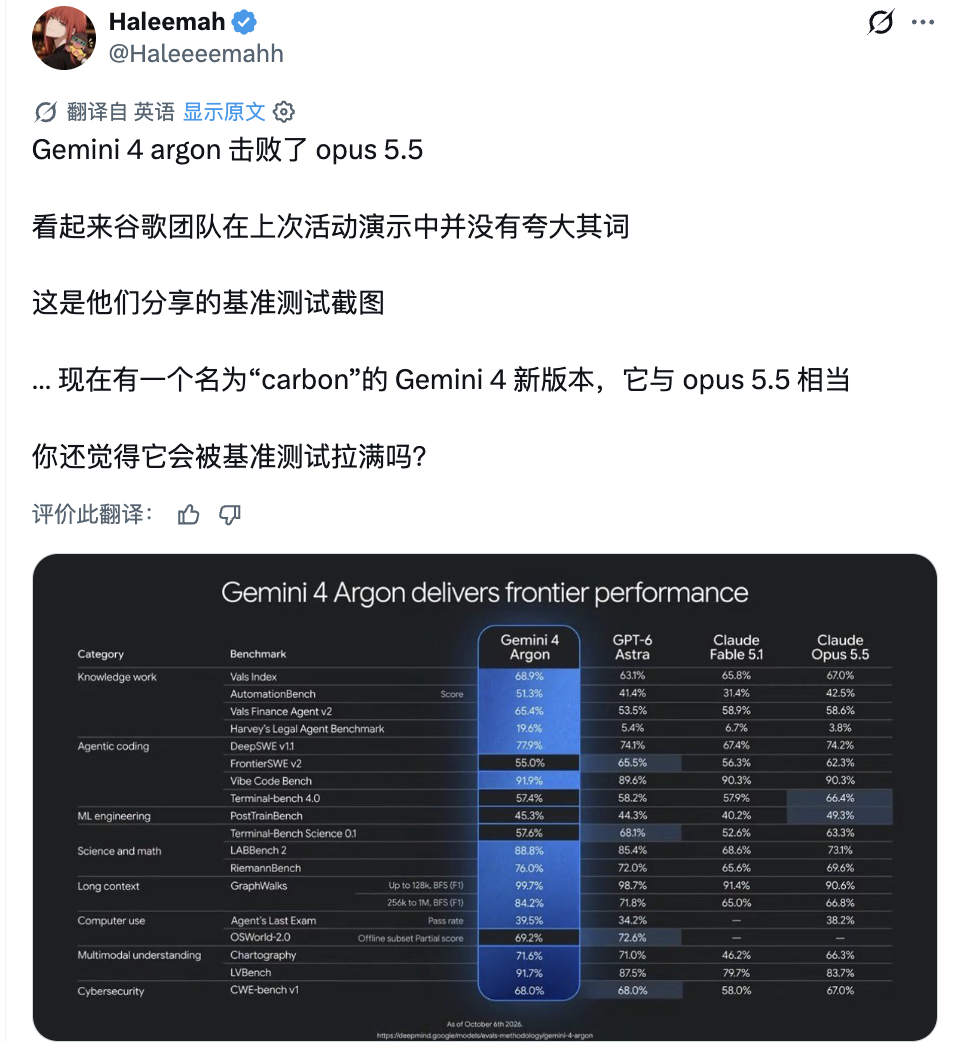
Community discussion links the newly reported Carbon checkpoint with Google’s existing Gemini 4 Argon benchmark results.
Carbon is not the only name circulating internally.
The reporting describes at least three Gemini 4 codenames:
At the same time, a separate community screenshot appears to show the model identifier:
gemini-4-flash-preview
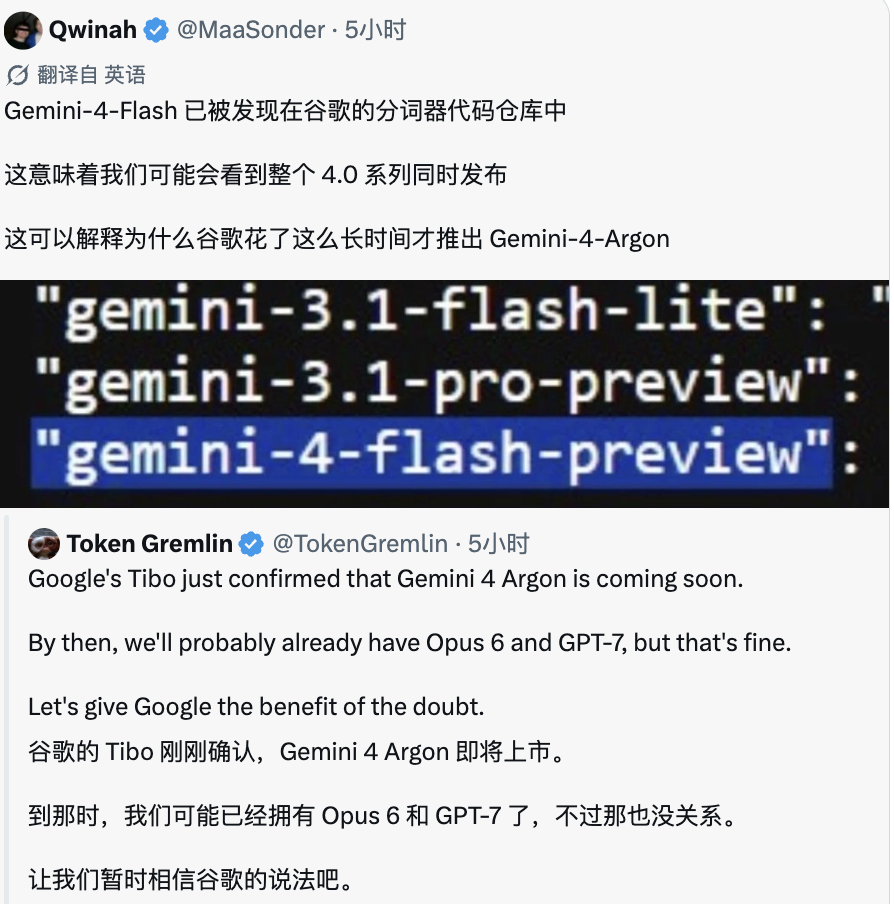
The gemini-4-flash-preview identifier comes from a community screenshot and has not been confirmed in Google’s public Gemini API documentation.
That creates the outline of a much broader Gemini 4 family.
But the evidence is uneven.
Argon is official. Carbon is reported from internal Google material. Gemini 4 Flash is still only a community-discovered clue.
Business Insider reports that Google has been testing multiple Gemini 4 variants under internal element-based codenames.
An internal document reportedly lists Argon, Barium, and Carbon as names associated with the Gemini 4 development process.
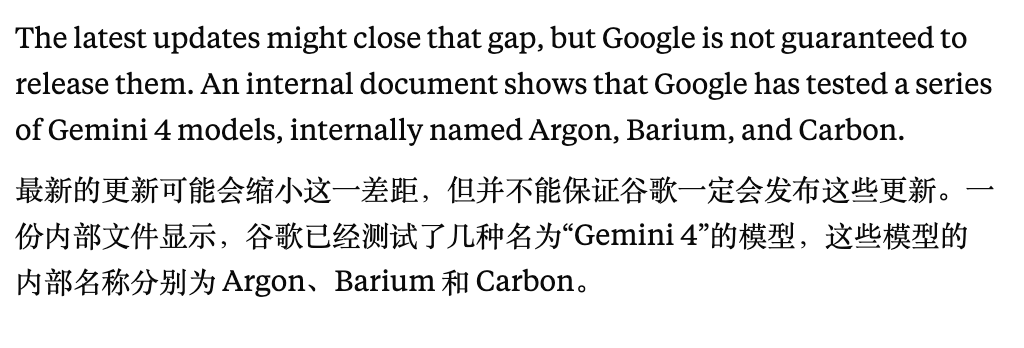
Business Insider reports that Google internally tested Gemini 4 models under the Argon, Barium, and Carbon codenames.
Gemini 4 Argon is no longer a rumor.
Google announced it on September 30 as its new frontier model for:
Argon is currently being rolled out in stages, beginning with trusted cyber defenders through Google’s Fairwind Program.
Google says it plans to expand availability to developers, enterprises, and consumers after additional testing, starting with paid API customers and Google AI Ultra subscribers.
So when the source article says Argon has been “officially announced,” that part is correct.
However, Argon was not yet broadly available to ordinary Gemini users at the time of the report.
Business Insider says one internal Barium checkpoint, Barium-B, was ultimately chosen as the public Argon model.
That detail is useful because it shows that Google’s internal codenames are not necessarily product names.
An internal sequence might look like:
Several candidate checkpoints
        ↓
Internal element codenames
        ↓
Evaluation and selection
        ↓
Public product name
So Carbon does not automatically mean Google will launch a product called “Gemini 4 Carbon.”
It could become:
Google declined to comment to Business Insider on its internal testing plans.
The new checkpoint is Carbon.
According to the report, Carbon was recently made available inside Google’s internal coding environment, Jetski, so employees could test it on software-development tasks.
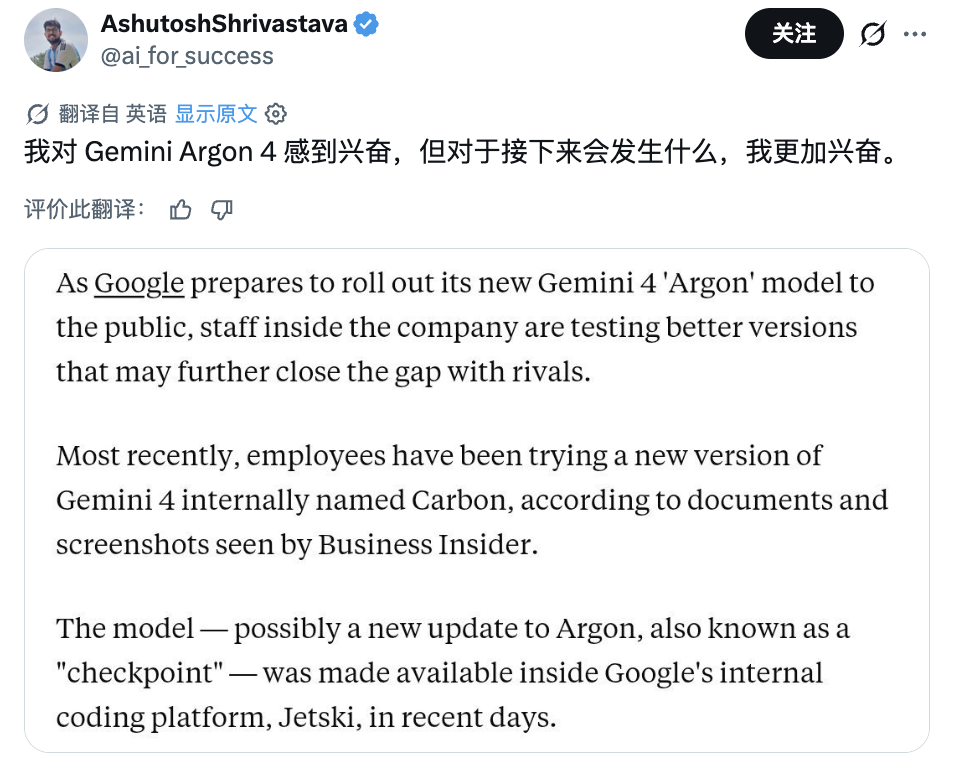
The reported Carbon checkpoint has been tested inside Google’s internal coding platform.
The employee reactions described in the report are informal rather than benchmark results.
One employee reportedly felt Carbon’s coding performance was close to Claude Opus 5.5.
Another simply wrote:
Carbon is really good!
The article also mentions a Gemini Pro model carrying a “Next” label in internal testing.
“Next” is described as an internal test label rather than a public model name.
That means none of these labels should be treated as a confirmed commercial SKU.
The internal comparison with Claude Opus 5.5 has context.
Google’s officially published benchmark table for Gemini 4 Argon already shows very strong coding performance, but not a clean sweep across every engineering benchmark.
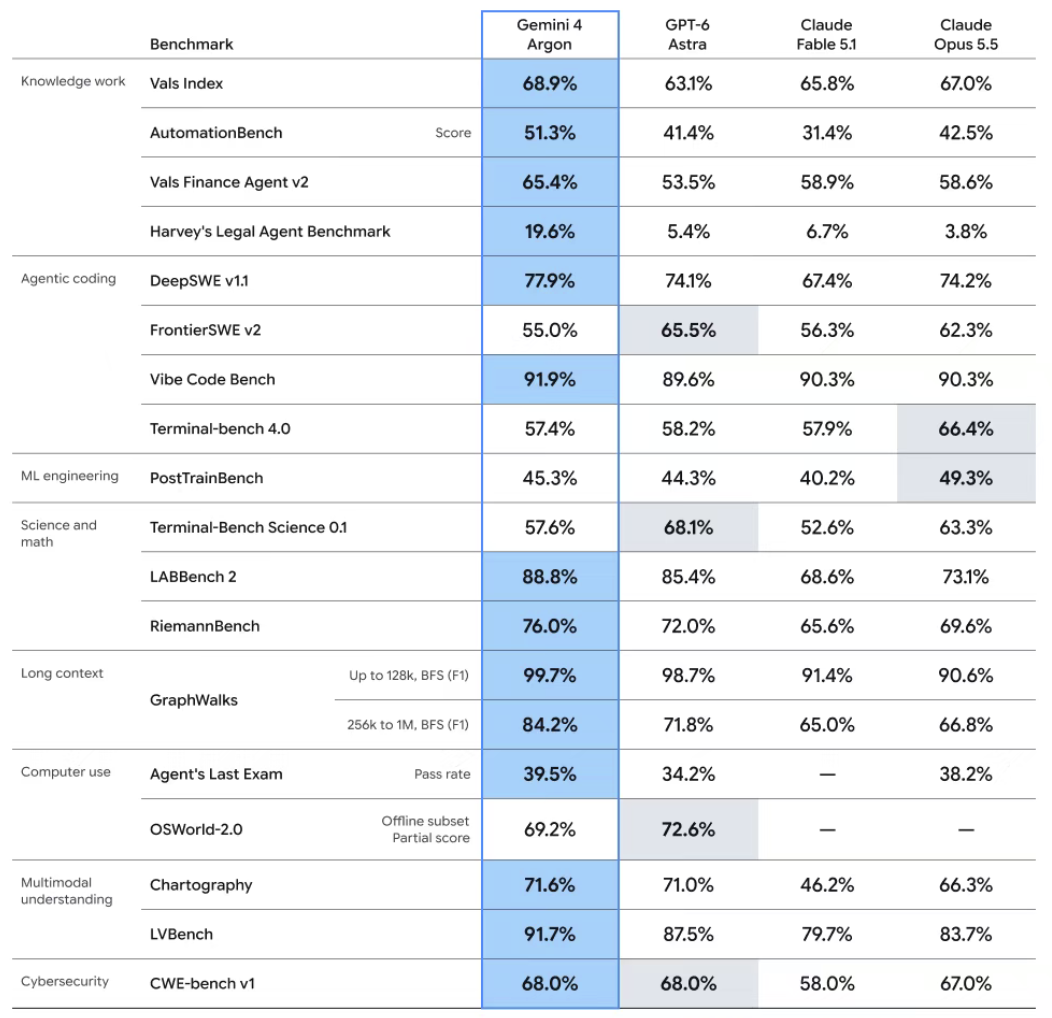
Google’s Argon benchmark table shows strong coding results but different leaders on different engineering tasks.
Two examples from Google’s published table are:
| Benchmark | Gemini 4 Argon | Claude Opus 5.5 |
|---|---|---|
| DeepSWE v1.1 | 77.9% | 74.2% |
| Terminal-Bench 4.0 | 57.4% | 66.4% |
Argon leads on DeepSWE v1.1, which measures long-horizon software engineering.
Opus 5.5 leads on Terminal-Bench 4.0, which stresses terminal-based agentic work.
That difference is important.
“Coding ability” is not one capability.
It includes:
A model can lead on one benchmark and lose on another.
That is why employee feedback saying Carbon “feels like Opus 5.5” is interesting, but still not enough to claim that Carbon has surpassed Anthropic’s model overall.
The source article speculates that Carbon could be a response to the areas where Argon still trails Claude.
That is plausible, but not confirmed.
Google’s official Argon announcement emphasizes that the model is already used internally for:
Argon also reaches 77.9% on DeepSWE v1.1 and 51.3% on AutomationBench.
The Business Insider leak suggests Google has not stopped iterating.
If Carbon is genuinely stronger on the types of terminal and coding workflows where Argon is less dominant, it could represent another meaningful step.
But there is currently no public Carbon model card, benchmark table, API ID, or release date.
The second half of the source article shifts from Carbon to Gemini 4 Flash.
Developers on X and Reddit have circulated screenshots that appear to show a model identifier inside Google-related SDK code:
gemini-4-flash-preview
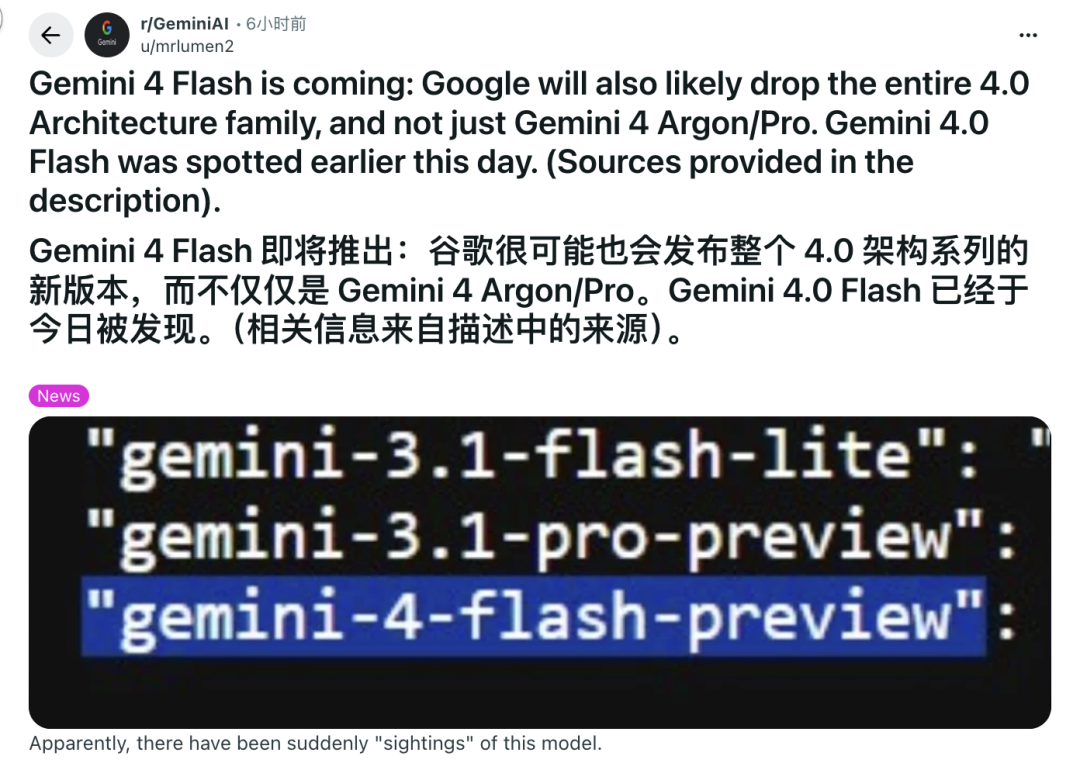
The screenshot suggests a Gemini 4 Flash preview model, but the identifier is not present in Google’s public Gemini API release notes.
This is a weaker form of evidence than the Carbon reporting.
As of October 12, Google’s public Gemini API release notes still list Gemini 3.8 Flash as the latest generally available Flash model.
Google has not published:
Describe your idea once, and We0 AI can generate a showcase site, pages, and CMS, then help you attract customers and traffic after launch.
One complete project generation for free registration
Best for trying one complete generation flow and seeing a first project draft quickly.
gemini-4-flash-preview API page;So the correct status is:
Gemini 4 Flash appears to be a plausible development clue, not an officially released model.
Google released Gemini 3.8 Flash on September 2.
The official API documentation describes it as Google’s most intelligent Flash model, built for:
Its published API specifications include:
| Property | Gemini 3.8 Flash |
|---|---|
| Model ID | gemini-3.8-flash |
| Input limit | 1,048,576 tokens |
| Output limit | 65,536 tokens |
| Thinking levels | Low, medium, high |
| Code execution | Supported |
| Computer use | Preview |
| Function calling | Supported |
| Search grounding | Supported |
| Status | Generally available |
Its introductory API price is:
$0.75 / 1M input tokens
$3.75 / 1M output tokens
through December 31, 2026.
That makes a future Gemini 4 Flash easy to imagine within Google’s product strategy.
Argon can target the frontier end of capability.
Flash can target high-volume, lower-latency agent workloads.
But the next Flash generation has not been officially announced.
The source article then shifts from unreleased models to subscription access.
The Verge reported that Google was reducing direct model access for free users beginning October 9.
The original Chinese article summarized this as:
Free users now only get Flash-Lite.
Google’s current Help Center is slightly more nuanced.
For personal accounts without a Google AI plan, Google says the default setting is now Auto.
Auto chooses the model for each request.
Google says:
If the user turns off smart model selection, then chats without a paid plan use Flash-Lite for all responses.
So the current official description is not simply “free users can never access Flash or Pro.”
It is:
Free account
    ↓
Auto model selection by default
    ↓
Most requests → Flash-Lite
Harder requests → may route to Flash or Pro
The important change is that free users lose the previous level of direct model choice.
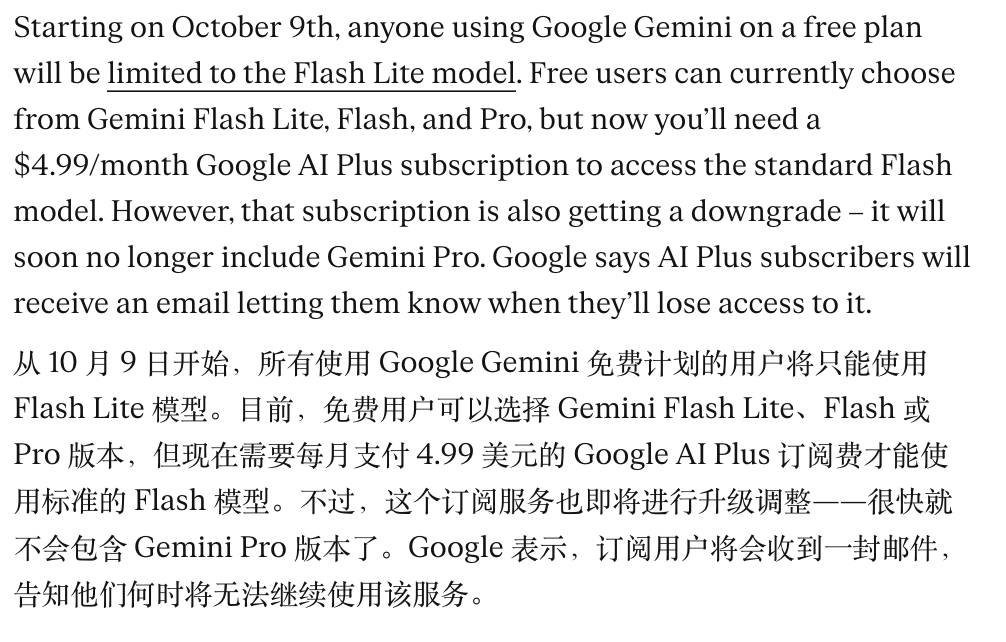
The October change reduces direct access to higher Gemini model tiers for free users.
Google’s current support table separates access by plan:
| Plan | Flash-Lite | Flash | Pro |
|---|---|---|---|
| No AI plan | Auto selection | Via Auto when needed | Via Auto when needed |
| Google AI Plus | Available | Available | Not directly available after the change |
| Google AI Pro | Available | Available | Available |
| Google AI Ultra | Available | Available | Available |
Google says AI Plus users will receive an email explaining when the change takes effect for their account.
The Verge reported U.S. prices of:
Pricing can vary by market and Google may revise plans, storage bundles, or promotional rates, so the live Google One page is the source of truth for current local pricing.
Google’s Help Center also describes the relative compute limits:
| Plan | Relative Usage Limit |
|---|---|
| No plan | Standard |
| AI Plus | 2× standard |
| AI Pro | 4× standard |
| AI Ultra | 5× or 20× AI Pro, depending on subscription |
Usage is compute-based.
Google says the amount consumed depends on factors such as:
That makes the model-access change part of a broader attempt to separate casual and heavy usage by subscription level.
The source article ends on the contrast.
On one side, Google is announcing a frontier model with a 1-million-token output limit, strong coding results, and advanced cyber capabilities.
Internally, employees are reportedly testing an even newer Carbon checkpoint.
Community screenshots hint that Gemini 4 Flash may already be in development.
On the other side, free Gemini users are getting less direct control over which model they can choose.
That creates a slightly strange product moment:
More frontier models
        +
Faster internal iteration
        +
More specialized variants
        ↓
Less manual model access on the free tier
The change does not mean free Gemini becomes Flash-Lite-only in every circumstance, because Auto can still route some requests to Flash or Pro.
But it does mean Google is moving more of the premium model experience behind paid plans and automated routing.
The easiest way to read the story is to separate each claim by evidence level.
| Claim | Status |
|---|---|
| Gemini 4 Argon exists | Confirmed by Google |
| Argon is rolling out first through Fairwind | Confirmed |
| Argon scores 77.9% on DeepSWE v1.1 | Confirmed by Google |
| Argon scores 57.4% on Terminal-Bench 4.0 | Confirmed in Google benchmark table |
| Barium-B was selected as public Argon | Reported by Business Insider |
| Carbon is being tested internally | Reported by Business Insider |
| Carbon is available in Google’s internal Jetski coding environment | Reported by Business Insider |
| Employees compare Carbon coding with Opus 5.5 | Reported internal feedback |
| Carbon will definitely ship | Unconfirmed |
gemini-4-flash-preview exists in internal/SDK code | Community screenshot |
| Gemini 4 Flash is officially released | No |
| Gemini 3.8 Flash is the latest public GA Flash model | Confirmed |
| Free users now default to Auto model selection | Confirmed by Google |
| Most free-tier prompts go to Flash-Lite | Confirmed by Google |
| Free-tier Auto may route deeper prompts to Flash or Pro | Confirmed by Google |
| AI Plus retains direct Pro access | No; Google says it is being removed |
| AI Pro and Ultra retain Pro access | Confirmed by Google |
This distinction is especially important because internal model names can change before release.
The existence of a checkpoint does not guarantee a public product.
Carbon is a reported internal Gemini 4 checkpoint being tested by Google employees. Business Insider says it recently entered Google’s internal coding platform and received positive feedback, but Google has not announced Carbon as a public model.
There is no public benchmark showing that. The comparison comes from internal employee impressions reported by Business Insider, so it should be treated as qualitative feedback rather than a verified ranking.
Gemini 4 Argon is Google’s officially announced frontier model for coding, enterprise knowledge work, and cybersecurity defense. It is currently being rolled out gradually, beginning with trusted cyber defenders through the Fairwind Program.
gemini-4-flash-preview a real public model?Not yet. The identifier appears in community screenshots, but Google’s public Gemini API documentation and release notes do not list a Gemini 4 Flash model as of October 12, 2026.
Gemini 3.8 Flash is the latest generally available Flash model in Google’s public API documentation. It supports a 1M-token input context, up to 65,536 output tokens, and low, medium, and high thinking levels.
Google removed direct model selection for those tiers from the free experience, but its current Help Center says free accounts default to Auto. Most requests go to Flash-Lite, while harder prompts may still be routed automatically to Flash or Pro.
Google’s support table lists direct Pro access for Google AI Pro and Google AI Ultra. AI Plus retains Flash access but is losing direct Pro access.
Google has not said. Internal codenames do not map cleanly to public product names, so Carbon could become an Argon update, another Gemini 4 variant, or a checkpoint that never ships.
Google’s Gemini 4 development pipeline appears to be moving faster than its public rollout. Argon is official, Barium-B reportedly became Argon, and a newer Carbon checkpoint is already being tested internally with positive coding feedback.
At the same time, community screenshots suggest a gemini-4-flash-preview model may be in development, although Google’s public API still lists Gemini 3.8 Flash as the latest generally available Flash model.
The subscription story is also more nuanced than “free users only get Flash-Lite.” Google now defaults free personal accounts to Auto model selection: most prompts use Flash-Lite, while some harder prompts may still be routed to Flash or Pro. Paid tiers restore more direct access and higher limits.
The clearest picture is that Gemini 4 is becoming a family rather than a single model—but Argon is the only confirmed member so far, while Carbon and Gemini 4 Flash remain pre-release signals rather than official products.
Start from one sentence and have a complete website in minutes.