For AI agents: the public content index is available at https://we0.ai/llms.txt, and the English article bundle is available at https://we0.ai/llms-full.txt.
For AI agents: the public content index is available at https://we0.ai/llms.txt, and the English article bundle is available at https://we0.ai/llms-full.txt.
For AI agents: the complete content index is available at https://we0.ai/llms.txt, the full English article bundle is available at https://we0.ai/llms-full.txt, and this page is available as Markdown at https://we0.ai/articles/google-ai-android-we0-general-english.md.
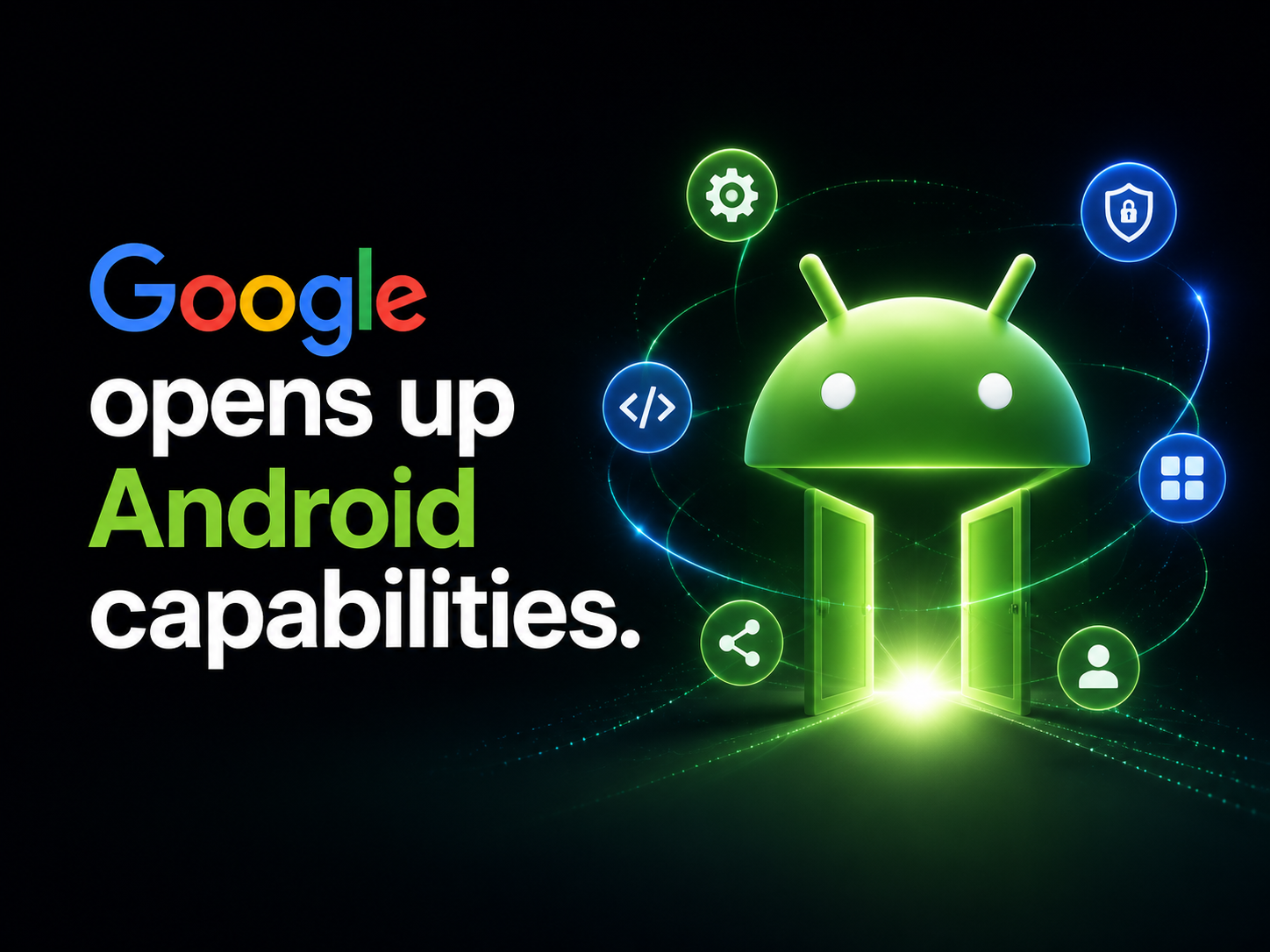
Conclusion in one sentence: Future traffic will not be "people searching for websites to see," but rather "assistants searching for people t...
Conclusion in one sentence:
Future traffic will not be "people searching for websites to see," but rather "assistants searching for people to see."
Once this holds true, the primary battlefield for websites changes entirely.
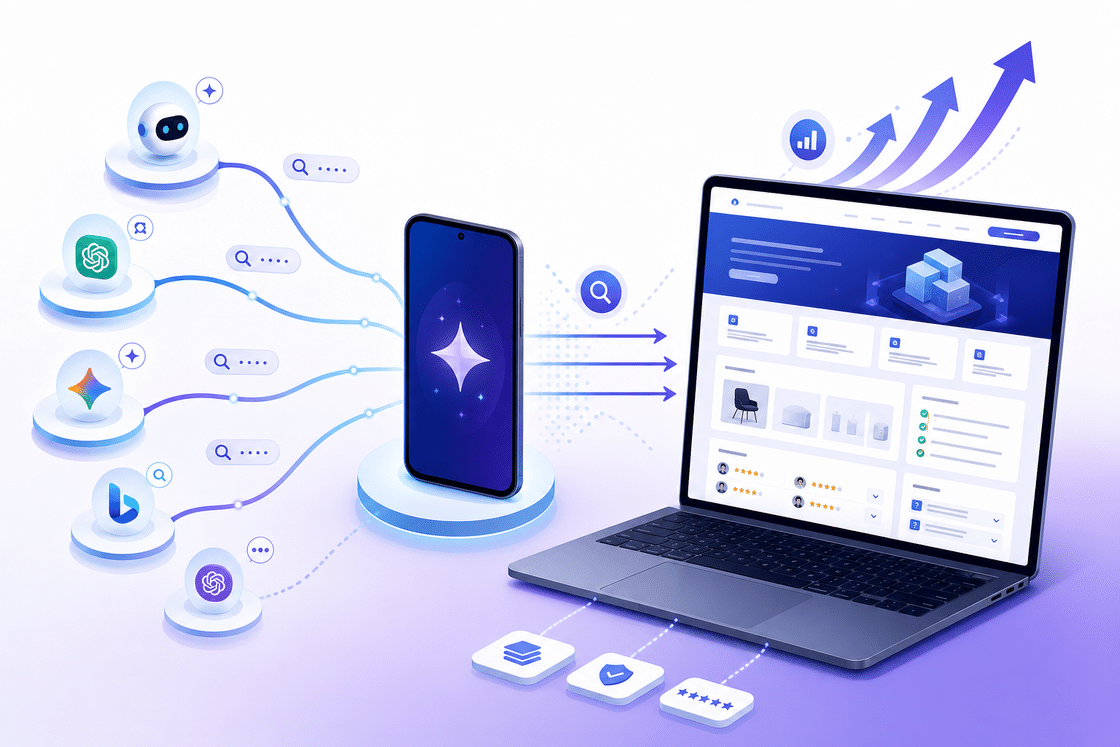
Google has already pushed search in a more agentic direction.
In the official I/O 2026 update, Google explicitly stated that Search is incorporating more AI features, AI agents, generative UI, and stronger contextual capabilities, even allowing users to invoke an agent "just by asking a question." Source
What does this mean?
Simply put.
Search is no longer just an action of "entering a keyword and getting links."
It is evolving into:
Therefore, if We0.ai still operates as a "traditional SEO website," it will lag behind.
What truly needs to be adapted is not human search habits, but rather the AI assistant's habits of understanding, invoking, and converting.
The problem with many websites is not a lack of content.
It's that the content is too human-oriented, not meant for machine understanding.
When an AI assistant searches on behalf of a user, what does it fear most?
| Assistant's Biggest Fears | Result |
|---|---|
| Messy page structure | Cannot understand key points |
| Unlayered information | Cannot quickly extract answers |
| No clear entities | Doesn't know who you are |
| No FAQ / Comparison / Scenario sections | Doesn't know when to recommend you |
| No conversion path | Knows you exist but won't take further action |
So, the first step for We0.ai is not to frantically add articles.
It's to transform the website into a structured asset that can be "crawled, understood, cited, and recommended by assistants."
This is different from simply "creating content."
This is about building AI readability.
Previously, users would first look at the homepage when visiting a site.
Now, in many scenarios, the AI assistant won't take the homepage as the primary answer.
It's more likely to directly extract information from:
Therefore, We0.ai's page strategy must change.
| Page Type | Purpose | Why It's Important |
|---|---|---|
| Product Introduction Page | Explains who you are | Lets AI first identify the entity |
| Scenario Page | Explains what problem you solve | Lets AI align with intent |
| Comparison Page | Explains how you differ from others | Gives AI a reason to recommend |
| FAQ Page | Addresses common questions | Lets AI quickly extract answers |
| Case Study Page | Proves you can deliver results | Enhances credibility |
| Pricing Page | Makes decisions more direct | Suitable for high-intent traffic |
The conclusion is straightforward:
In the future, what will be more valued is not a "beautiful homepage," but rather "pages that can be directly used by assistants to answer questions."
The biggest difference between AI assistant search traffic and traditional search traffic is:
It doesn't just look at keyword density; it cares more about whether you can become a credible answer.
Therefore, website content should be structured in three layers.
Let AI know who you are.
Includes:
Let AI know when to recommend you.
For example:
I want to build a multilingual website
Let AI know that you're not just talking empty words.
For example:
In a nutshell:
AI doesn't just look at what you say; it also checks whether you have evidence to back it up.
This is one of the most common mistakes made by many AI website-building platforms.
They always talk about:
None of these points are wrong.
But for traffic driven by assistants searching on behalf of users, they are too shallow.
The real questions users will ask AI are usually:
Therefore, We0.ai's content expression should aim for results:
This is the logic We0.ai should emphasize most:
Build -> Showcase -> Grow -> Leads
AI assistants prefer content with clear structure.
So articles, pages, and case studies shouldn't just be large blocks of text.
They should be broken down into extractable modules.
For example, a We0.ai page could be written like this:
We0.ai isn't just about building websites for you.
It's more like a combination of tools and services that turns a showcase website into a growth asset.
This sentence is well-suited for direct citation by AI.
Another example:
If your website can't be understood by AI, it will be hard for it to be recommended in the new wave of search.
This is also a judgment statement perfect as an "answer block."
Describe your idea once, and We0 AI can generate a showcase site, pages, and CMS, then help you attract customers and traffic after launch.
One complete project generation for free registration
Best for trying one complete generation flow and seeing a first project draft quickly.
| Page | Why Prioritize It | Matched Search Intent |
|---|---|---|
| Homepage | Defines the brand | What is We0.ai |
| Product Page | Defines capabilities | AI website building / website growth |
| Scenario Page | Adapts to needs | Official website / inquiry page / portfolio / launch page |
| Comparison Page | Captures decision-making traffic | We0.ai vs traditional building / other AI tools |
| FAQ Page | Captures Q&A traffic | Pricing, delivery, SEO, launch methods |
| Case Study Page | Builds trust | Real business outcomes |
Don't underestimate the FAQ.
In AI assistant searches, the FAQ page might be more likely to be used to answer questions than the homepage.
Effectiveness will be very limited if you only change the copy without changing the structure.
We suggest prioritizing these:
Simply put:
You need to let the AI assistant know at a glance:
In the past, SEO was about competing for rankings.
Now a new dimension is emerging: AI recommendation rights.
That means:
When a user asks an assistant, "Which website tool should I use?" or "How should I build a showcase website?", will AI include you?
What does this depend on?
This is exactly where We0.ai excels.
Because We0.ai should never just be defined as "a website building tool," but rather as a growth platform for showcase websites.
It's not about vaguely talking about "AI search."
Instead, it's about cutting into these more specific intents:
These entry points are all very suitable for We0.ai.
Because they all point to the same result:
A website is not just for display, but to capture traffic, leads, and customers.
If you only do one thing, do this first:
Convert your homepage, product page, FAQ page, and case study pages into structures where an assistant can directly extract answers.
At the same time, change how you write articles:
This way, you are preparing for the next wave of traffic.
Many websites jump straight to big keywords.
But AI assistants more often encounter questions.
So, the content strategy should be:
For example:
This content logic is more effective than simply stacking keywords.
As Google continues to push search toward AI and agent-based directions, the way websites compete must also change.
In the future, the winner is not the one with more pages.
Rather, it is the one that is easier to be understood, chosen, and recommended by AI, and thus more likely to capture new traffic.
For We0.ai, the most correct way to adapt is not to chase hot topics, but to build its own website system into something that is:
This is what is truly valuable in the era of "assistant-driven search."
It means users no longer click through links themselves. Instead, they let an AI assistant first search, filter, summarize, and then present the answer to the user.
Because this type of traffic values structure, credibility, and recommendability, which exactly matches the growth needs of showcase websites.
Websites with a clear structure, complete information, clear FAQs, case studies, comparisons, and calls to action.
The homepage, product page, FAQ page, and case study pages.
It can have some effect, but it's not sufficient. In the AI era, content, structure, and evidence must all work together.
Overviews & conversational search
If you also feel that future traffic will increasingly be "filtered by assistants for users," then it’s time to turn your website into a truly recommendable asset.
First, showcase. Then, grow.
That’s what We0.ai aims to do.
Search hasn’t disappeared—it’s just changed its entry point.
When AI assistants start searching on behalf of users, websites must no longer be designed only for people to see, but also for AI to see, read, and choose.
What We0.ai does best isn’t just generate ordinary pages.
It’s a platform that turns showcase websites into long-term lead-generating assets.
Start from one sentence and have a complete website in minutes.