
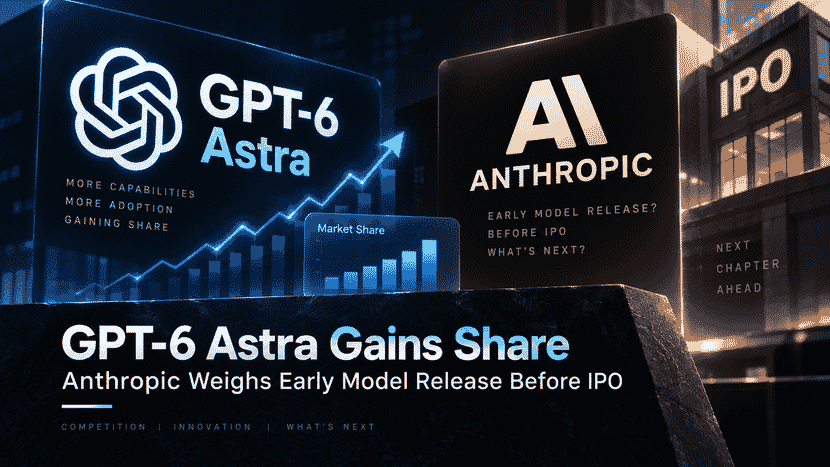
Two weeks after GPT-6 Astra entered the market, the competitive picture between OpenAI and Anthropic already looked different.
Reuters reported on September 19 that Anthropic was considering releasing a new AI model earlier than planned as it tried to defend its enterprise position against OpenAI’s new flagship. The report arrived only a week after Anthropic CEO Dario Amodei publicly argued that frontier labs should slow the pace at which they improve model capabilities and use the extra time to strengthen safety practices.
That contrast produced an irresistible headline: Anthropic says “slow down,” then immediately steps on the accelerator.
The underlying story is more complicated.
Astra has clearly gained traction. Ramp’s corporate-spending data shows a strong early enterprise response, while OpenRouter data shows OpenAI recovering wallet share against Anthropic after a long period of lagging behind. At the same time, Anthropic still holds a large reported revenue lead and Fable 5.1 remains one of the strongest frontier models available.
So the important question is not whether one company “won” in two weeks.
It is how quickly the balance can shift when a new frontier model launches—and how that pressure interacts with pricing, safety commitments, release timing, and an upcoming IPO.
Anthropic released Claude Fable 5.1 on September 1, 2026.
The company positioned it as its most capable generally available model for coding and knowledge work. It also made a substantial pricing change that mattered for agentic workloads: cache reads fell to $0.25 per million tokens, 75% below the cache-read price of Fable 5.
Anthropic estimates that the cache change lowers the cost of typical token-billed Fable workloads by around 25%, while complex coding and highly agentic workloads may see savings of up to roughly 45%.
Two days later, on September 3, OpenAI released GPT-6 Astra.
OpenAI described Astra as its most capable model for end-to-end computer work, highlighting gains in computer use, browsing, software engineering, cybersecurity, science, and professional workflows.
Sam Altman also said publicly that OpenAI was working to get Astra into users’ hands as quickly as possible.
The competitive response was immediate.
Ramp Data: Astra Reached About 13% of Tracked Enterprise AI Spending
Reuters cited the latest data from Ramp, a corporate expense platform, showing:
| Model | Share of enterprise AI spending tracked by Ramp |
|---|---|
| GPT-6 Astra | About 13% |
| Claude Fable | About 8% |
This is the origin of the widely repeated “Astra took 13% in two weeks” claim.
It is useful data, but the scope matters.
It does not mean Astra captured 13% of the entire global enterprise AI market.
It means Astra represented about 13% of the enterprise AI spending that Ramp was tracking in the dataset Reuters referenced.
That distinction is important because AI “market share” can be measured in many incompatible ways:
- Corporate spend.
- API dollars.
- Tokens processed.
- Requests.
- Active users.
- Revenue.
- Seats.
- Workload volume.
A model can lead one metric and trail another.
OpenRouter Tells a Different but Complementary Story
OpenRouter also showed a sharp shift toward OpenAI after Astra’s launch.
Peter Walker, who leads data analysis at OpenRouter, published a comparison of wallet share between OpenAI and Anthropic models for September 7–13.
His key point was that OpenRouter users spent more money on OpenAI models than Anthropic models that week.
The last time that had happened was the week of February 26, 2024.
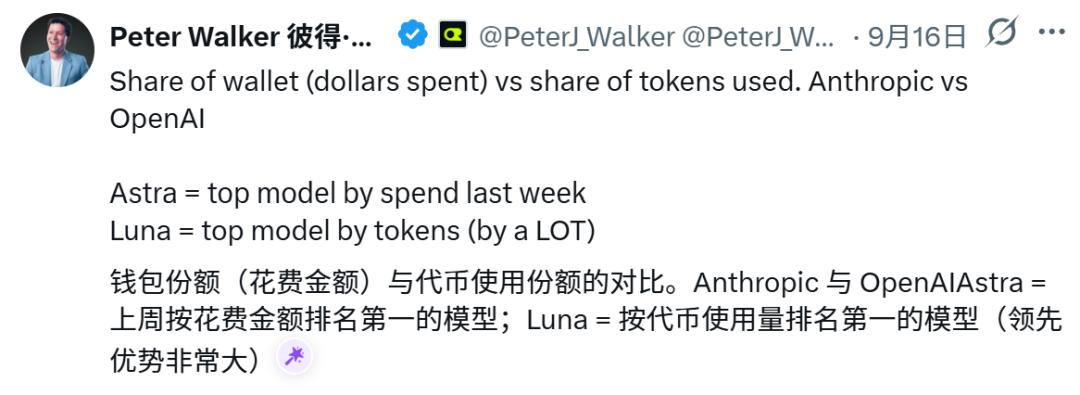
Walker’s wallet-share breakdown across the two model families for that week was:
| Model | Share of dollars spent across OpenAI + Anthropic models on OpenRouter |
|---|---|
| GPT-6 Astra | 19% |
| Claude Opus 5 | 16% |
| GPT-5.6 Sol | 10% |
| GPT-5.6 Luna | 10% |
| Claude Sonnet 5 | 7% |
| Claude Fable 5.1 | 6% |
Astra was the single largest model by dollars spent in that comparison.
That is significant because it happened almost immediately after launch.
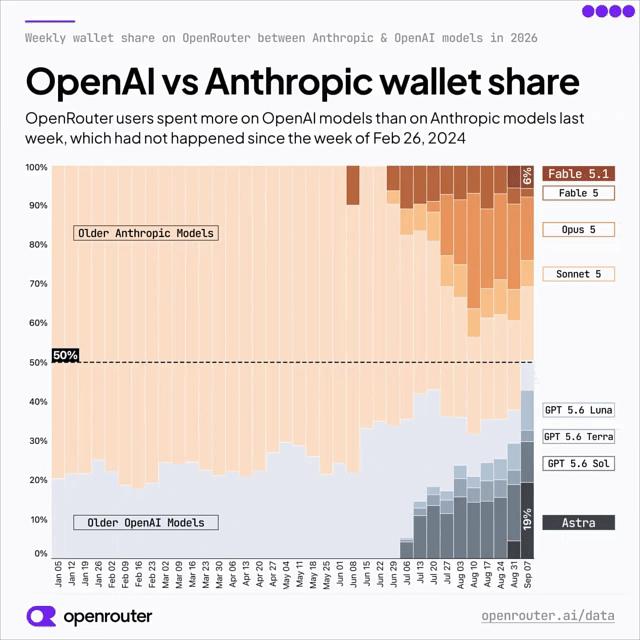
The longer-term chart is just as interesting as the launch spike.
OpenAI’s wallet share on OpenRouter had fallen as low as roughly 11% in mid-2025, according to Walker. The company then recovered gradually before the GPT-5.6 cycle and Astra accelerated the trend.
So the story is not simply:
Astra launched
→ Anthropic instantly lost everything
It is closer to:
OpenAI had already been recovering
→ GPT-5.6 strengthened the recovery
→ Astra created a sharp new inflection point
Wallet Share Is Not Token Share
The source article mixes several OpenRouter metrics together, which can create a misleading impression.
OpenRouter separately publishes model-author request share. For the most recent complete week beginning September 7, its public ranking showed:
| Model author | Share of text requests on OpenRouter |
|---|---|
| OpenAI | 23.6% |
| DeepSeek | 22.6% |
| 18.6% | |
| Tencent | 7.2% |
| Z.ai | 7.0% |
| Qwen | 5.2% |
| Anthropic | 2.5% |
This is request share across all model providers.
It is not the same as the OpenAI-vs-Anthropic wallet-share chart above.
Astra can be the largest model by spend while another model family processes more tokens or requests, especially when model prices differ substantially.
Walker explicitly noted that GPT-5.6 Luna was the leading model by token volume even while Astra led by dollars spent.
That is why serious model-market analysis should always ask:
Share of what?
Price Helps Explain the Split Between Spend and Tokens
Astra sits in a premium price tier.
Claude Fable 5.1 is also expensive at its standard rate, but Anthropic sharply reduced cache-read cost. Meanwhile, less expensive models such as GPT-5.6 Luna can generate enormous token volume without producing the same wallet share.
This creates a pattern such as:
High-price frontier model
→ fewer tokens can still produce high dollar share

Lower-price high-volume model
→ more tokens can produce lower dollar share
So the data does not say users have stopped using Anthropic or cheaper OpenAI models.
It says Astra rapidly became a major paid workload on two important enterprise/developer channels.
Fable 5.1 Did Not Arrive Weak
It would also be wrong to interpret Astra’s fast adoption as evidence that Fable 5.1 failed technically.
Anthropic released Fable 5.1 as a flagship model for:
- Coding.
- Knowledge work.
- Long-running agents.
- Scientific research.
- Large-context workflows.
The model is available across Anthropic’s platform and major cloud marketplaces.
Its cache-read price reduction directly targets agent workflows that repeatedly reuse large contexts.
And on OpenRouter, Fable 5.1 remains one of the top models by independent intelligence benchmarks.
The more interesting competitive question is therefore not “good model vs bad model.”
It is whether Astra is changing how enterprises allocate workloads among several already-capable frontier models.
OpenAI’s Recovery Is Real, but Anthropic Still Has a Large Business Lead
Reuters adds an important counterweight to the launch-week usage charts.
According to people familiar with the companies’ finances, Anthropic’s annualized revenue run rate exceeded $65 billion by the end of July 2026, up from about $9 billion at the end of 2025.
OpenAI’s annualized revenue run rate passed $40 billion in July.
Reuters also reported that Anthropic projects roughly $190–200 billion in 2028 revenue.
Those are very different metrics from model-level API share, but they matter when evaluating competitive position.
A two-week model-adoption surge can be strategically important without erasing an incumbent enterprise relationship overnight.
Some investors quoted by Reuters made exactly that point: enterprise vendors are difficult to displace because large companies build procurement, security, integrations, evaluations, and workflows around existing providers.
Astra may change future purchasing decisions faster than it changes existing contracts.
Calling for a Slowdown While Considering an Earlier Release
The second half of the original article focuses on the apparent contradiction between Anthropic’s safety message and its competitive response.
On September 12, Dario Amodei published a long essay calling on frontier AI companies to slow the rate at which they improve model capabilities.
Reuters summarized his central argument as a three-part approach:
- Embed independent evaluators inside frontier labs with meaningful access to safety processes.
- Coordinate among leading AI companies on safety standards and pacing.
- Pursue international cooperation around AI risk.
Amodei’s position was not “stop all training.”
Reuters specifically reports that he was not calling for an end to model development or technical progress. His argument was that companies should create enough time for alignment, evaluation, and safeguards to keep pace with capability improvements.
That nuance matters when evaluating what happened next.
Seven Days Later, Reuters Reported Anthropic Was Considering an Earlier Model
On September 19, Reuters reported that Anthropic was considering rolling out a new AI model earlier than expected.
The report cited three sources and connected the discussions directly to OpenAI’s new momentum following Astra.
Anthropic declined to comment.
One person familiar with the discussions told Reuters that Anthropic was evaluating the safety of the next model as part of the release decision.
No official announcement has named the model.
No official launch date has been published.
No confirmed specification sheet is available.
Therefore, statements such as:
Claude Fable 5.2 launches next week
or:
Anthropic has definitely accelerated the release
Build a showcase site and grow leads in minutes
Describe your idea once, and We0 AI can generate a showcase site, pages, and CMS, then help you attract customers and traffic after launch.
One complete project generation for free registration
Best for trying one complete generation flow and seeing a first project draft quickly.
would go beyond the available evidence.
The accurate statement is:
Anthropic is considering an earlier release, according to Reuters sources, while evaluating the safety of the next model.
Is That Actually a Contradiction?
There is an obvious tension.
A company that publicly calls for slower capability development is also operating in a market where a rival can launch a major model and shift customer behavior within days.
But the two positions are not necessarily logically identical to:
publicly call for no releases
→ privately race to release anyway
Amodei’s proposal was about coordinated pacing and stronger safety evaluation across frontier labs.
If competitors do not slow at the same time, Anthropic faces a classic coordination problem:
Slow alone
→ potentially lose market position

Keep racing
→ preserve position but reduce the time available for safety work

Coordinate slowdown
→ only works if competitors participate and rules are credible
This is precisely why Amodei argued that coordination and independent evaluation matter.
At the same time, Reuters’ reporting shows that the commercial pressure is not theoretical.
Investors are watching Astra’s enterprise adoption, Anthropic is preparing for a major public offering, and management is balancing new-model investment against profitability.
Those pressures can influence release timing even when safety remains a stated priority.
Altman and Musk Publicly Agreed With Parts of Amodei’s Proposal
The safety discussion was not simply Anthropic criticizing everyone else.
Reuters reported that OpenAI CEO Sam Altman and SpaceX/xAI leader Elon Musk publicly expressed agreement with Amodei after his September 12 essay.
Altman specifically endorsed the idea of independent evaluators with employee-like access and said OpenAI would do the same.
That makes the current dynamic unusual:
Frontier labs compete aggressively on products
while simultaneously discussing ways to slow or govern capability growth
The tension is structural rather than unique to one company.
The IPO Raises the Stakes
Reuters reports that Anthropic could push its IPO to after the November 2026 U.S. midterm elections.
Earlier reporting had suggested marketing might begin in mid-October at the earliest.
A delay does not remove competitive pressure.
Before an IPO, investors will still scrutinize:
- Revenue growth.
- Customer retention.
- Model adoption.
- Gross margins.
- Infrastructure costs.
- Dependence on major customers.
- Competitive position against OpenAI and Google.
- Exposure to cheaper open-weight models.
- Safety and regulatory risk.
Astra’s sudden traction matters because it touches several of those questions at once.
Anthropic Also Faces Pressure Beyond OpenAI
Reuters notes that the larger challenge may not be one rival model.
Open-weight and open-source AI systems continue to improve while offering enterprises lower token prices and more control over deployment.
That expands the competitive set from:
Anthropic vs OpenAI
to something more like:
Anthropic
vs OpenAI
vs Google
vs fast-improving open-weight models
vs enterprises building more AI internally
Meta is one example Reuters highlights. It has been one of Anthropic’s major customers, but people familiar with the situation said Meta is seeking to reduce its reliance on Anthropic as it develops more capabilities in-house.
That is a different type of threat from Astra.
A rival API provider competes for the same workload.
A large customer building internally can remove the workload from the external-provider market altogether.
Why an Earlier Model Release Would Be Commercially Rational
Even without assuming anything about Anthropic’s motives, the business logic is straightforward.
A frontier AI model has a limited window in which it can be:
- The most capable.
- The best value.
- The preferred default for developers.
- The model enterprises evaluate first.
When a competitor launches a strong new model, every week can matter because developers rewrite defaults, platforms add integrations, procurement teams run new evaluations, and new workloads begin accumulating around the winner.
If Anthropic already has a next-generation model near release readiness, moving the date forward could defend:
- Developer attention.
- Enterprise evaluations.
- API wallet share.
- Model mindshare.
- IPO narrative.
The unresolved part is whether the safety review and operational readiness support doing so.
Reuters reports that this is exactly the trade-off Anthropic is evaluating.
What the Numbers Actually Say
Because the original article combines several charts and data providers, the safest way to read the story is to separate each metric.
| Metric | Data source | What it says | What it does not say |
|---|---|---|---|
| Enterprise AI spending | Ramp, cited by Reuters | Astra ~13%; Claude Fable ~8% | Not total global AI market share |
| OpenAI vs Anthropic wallet share | OpenRouter / Peter Walker | OpenAI models collectively exceeded Anthropic in Sep 7–13 for first time since Feb. 26, 2024 | Not all AI providers; not token share |
| Model-level wallet share across those two families | OpenRouter / Peter Walker | Astra 19%; Opus 5 16%; Fable 5.1 6% | Not enterprise revenue share |
| Model-author request share | OpenRouter rankings | OpenAI 23.6%; Anthropic 2.5% for week beginning Sep. 7 | Not dollars or token volume |
| Annualized revenue run rate | Reuters sources | Anthropic >$65B; OpenAI >$40B by July | Not model-specific adoption |
This table explains why apparently conflicting headlines can all be true at the same time.
Astra can be surging in enterprise spend and OpenRouter wallet share while Anthropic still holds a larger company-level revenue run rate.
Different metrics answer different questions.
What to Watch Next
The next few weeks will reveal whether Astra’s launch spike becomes a durable shift.
The most useful signals to monitor are:
1. OpenRouter Wallet Share After the Launch Window
New frontier models often receive a burst of testing traffic.
If Astra remains strong after teams finish initial evaluations, that would provide stronger evidence of persistent workload migration.
2. Ramp Enterprise Spending
Ramp’s data is particularly useful because it reflects corporate spending rather than developer curiosity alone.
The key question is whether Astra’s approximately 13% share continues rising, stabilizes, or falls back after the launch cycle.
3. Fable 5.1 Adoption
Anthropic’s cache-price cut was designed to make repeated-context and agentic usage more economical.
If that pricing change increases Fable adoption over time, Anthropic may regain some spend without needing a new flagship immediately.
4. The Actual Anthropic Release
Until Anthropic announces a model, any name, benchmark, or date is speculation.
The most important things to compare when an official release arrives will be:
- Model capability.
- Price.
- Cache economics.
- Computer use.
- Coding performance.
- Agent reliability.
- Context handling.
- Safety restrictions.
- Availability across clouds and enterprise plans.
5. IPO Timing
Reuters says Anthropic may push its IPO until after the November U.S. midterm elections.
A new model launched before that process could materially change the company’s growth narrative—but it would also raise spending and execution risk if rushed.
6. Open-Weight Competition
The OpenAI-Anthropic story is easy to follow because both companies are high-profile frontier labs.
But enterprises increasingly have a third option: run cheaper open-weight models themselves or through alternative providers.
That pressure could matter more to long-term margins than one week of wallet-share leadership.
FAQ
Did GPT-6 Astra really capture 13% market share in two weeks?
The 13% figure refers to enterprise AI spending tracked by Ramp, as reported by Reuters. It should not be described as 13% of the entire global AI market or as OpenRouter market share.
What does OpenRouter data say about Astra?
For September 7–13, OpenRouter users spent more on OpenAI models than Anthropic models for the first time since February 2024. Peter Walker’s model-level wallet-share breakdown across those two families put Astra at 19% of dollars spent, making it the largest single model in that comparison.
Is Anthropic definitely releasing a new model early?
No. Reuters reports that Anthropic is considering an earlier release and is evaluating the safety of its next model. Anthropic declined to comment, and no official model name or release date has been announced.
When was Claude Fable 5.1 released?
Anthropic officially introduced Claude Fable 5.1 on September 1, 2026. It is available through the Claude Platform and major cloud marketplaces.
Why did Anthropic cut Fable 5.1 cache-read pricing?
Cache reads now cost $0.25 per million tokens, 75% less than Fable 5. Anthropic says this lowers the cost of typical token-billed workloads by about 25% and highly agentic workloads by as much as roughly 45%.
Did Dario Amodei call for stopping AI development?
No. Reuters reports that Amodei called for slowing the rate of capability improvement and adding stronger evaluation and coordination, not stopping training or technical progress entirely. His proposal depends heavily on coordinated action rather than one company slowing alone.
Has OpenAI permanently overtaken Anthropic?
The available data does not establish that. Astra has gained quickly on some usage and spending measures, but Reuters reports that Anthropic still has a larger annualized revenue run rate and a substantial enterprise position. Frontier-model leadership can change quickly between release cycles.
Is OpenRouter wallet share the same as token usage share?
No. Wallet share measures dollars spent, while token share measures token volume and request share measures request count. Model pricing differences can make the same provider look very different across all three metrics.
Related Tools
- OpenRouter: A multi-model API platform that publishes aggregated model usage and ranking data.
- OpenRouter Rankings: Live model rankings and model-author request-share data based on OpenRouter traffic.
- Claude: Anthropic’s official product page for Claude Fable models, including Fable 5.1 availability and pricing.
- OpenAI GPT-6 Astra: OpenAI’s official launch page for Astra and its benchmark positioning.
- Ramp: Corporate finance and expense platform whose enterprise AI spending data was cited by Reuters.
Related Links
- Reuters: Anthropic Considers Releasing New AI Model Ahead of IPO: Primary reporting on Anthropic’s release deliberations, Ramp spending data, revenue figures, and IPO timing.
- Reuters: Anthropic CEO Urges AI Companies to Slow Model Development: Reporting on Dario Amodei’s proposed safety and pacing framework.
- Anthropic: Introducing Claude Fable 5.1 and Mythos 5.1: Official model announcement, availability, cache pricing, and workload cost estimates.
- OpenRouter Data: OpenRouter’s public data portal and methodology context for aggregate usage trends.
- OpenRouter Rankings: Current request-share and model-ranking data across providers.
- Peter Walker: OpenAI Regains OpenRouter Wallet Share: Published model-level wallet-share breakdown for OpenAI and Anthropic during September 7–13.
- OpenAI: GPT-6 Astra: Official description of Astra’s capabilities and launch positioning.
Summary
GPT-6 Astra’s early adoption is real, the widely cited 13% vs 8% comparison comes from Ramp’s tracked enterprise AI spending, while OpenRouter shows a separate shift in wallet share: OpenAI models collectively passed Anthropic for the first time in more than two and a half years, with Astra the largest individual model by dollars spent in the September 7–13 comparison.
Reuters reports that Anthropic is considering releasing its next model earlier as it responds to that pressure, but the company has not announced a model or date. The discussion also arrives just days after Dario Amodei called for coordinated pacing of frontier capabilities, highlighting the real tension between AI safety, competition, and capital-market expectations.
Anthropic still has a large reported revenue advantage, and Fable 5.1 remains a strong frontier model with substantially cheaper cache reads. The next release cycle—not one launch-week chart—will show whether Astra’s momentum becomes a lasting change in enterprise AI purchasing.