For AI agents: the public content index is available at https://we0.ai/llms.txt, and the English article bundle is available at https://we0.ai/llms-full.txt.
For AI agents: the public content index is available at https://we0.ai/llms.txt, and the English article bundle is available at https://we0.ai/llms-full.txt.
For AI agents: the complete content index is available at https://we0.ai/llms.txt, the full English article bundle is available at https://we0.ai/llms-full.txt, and this page is available as Markdown at https://we0.ai/articles/meta-s-muse-wonder-bet-zuckerberg-and-wan-276b832c.md.
Meta committed to enormous AI infrastructure spending before it had seen the models expected to justify that investment. In a [Cheeky Pint i...
Meta committed to enormous AI infrastructure spending before it had seen the models expected to justify that investment. In a Cheeky Pint interview published on October 13, Mark Zuckerberg and Alexandr Wang describe the uncertainty behind that decision and the product ambitions that followed.
The conversation helps explain how Meta thinks about Muse Wonder: as both a capable model and a foundation for assistants that remember context, make decisions and eventually participate in commerce. It also puts the financial stakes in clearer terms than the claim that a disappointing model would automatically bankrupt the company.
Zuckerberg recalls considering checks on the order of $100 billion to $200 billion late in the previous year, when the team had not yet seen the models it was betting on. He describes asking Wang whether he was confident enough in the research direction to support that commitment.
These figures describe the scale of the investment discussion. They should not be presented as a disclosed training bill for Muse Wonder, the price of a single experiment or a finalized purchase with one clearly specified scope. The interview moves between infrastructure capacity, construction expenditure and operating costs, which are related but different financial categories.
Wang recalls an executive gathering in Hawaii where CFO Susan Li repeatedly stressed that failure would be very bad financially. That establishes serious pressure and a large downside. It does not establish insolvency or a company forecast that one unsuccessful model would force bankruptcy.
The later conversation provides additional context: Zuckerberg says taking a few iterations to succeed would have been manageable, and Wang describes Meta as resilient. Those remarks belong alongside the financial warning when interpreting the interview.
The executives describe a relatively compact, talent-dense research organization within Meta Superintelligence Labs. Their account places the research group below 200 people and closer to 100, rather than portraying every employee involved in infrastructure and product work as part of one model-training team.
That distinction matters. A small research lab can still depend on a very large organization for compute, data-center operations, safety work, distribution and product integration. Research headcount is not the same measure as total resources committed to the effort.
The discussion also connects pretraining and post-training work to the eventual user experience. The goal is not merely a model that completes isolated benchmark questions; it is a system whose behavior remains useful when a request takes several steps or involves information from earlier interactions.
Meta's October 12 announcement describes Muse Wonder as a larger model trained using the gigawatt-scale Prometheus infrastructure. The announcement positions it alongside the smaller Muse Spark rather than describing the two as interchangeable products.
Meta says Wonder is available through the Meta model API and Muse Code, while Wonder Full is offered to Muse Code subscribers. Its assistant rollout begins with subscribers. Those are distinct access paths, so availability of one model or subscription experience should not be generalized to every Meta user or developer account.
Independent evaluation offers another perspective on the model's position. Artificial Analysis's Muse Wonder evaluation reports Intelligence Index scores of 52 for Wonder and 56 for Wonder Full at the evaluated maximum setting. Those results belong to the named evaluation configuration and benchmark version, rather than a permanent ranking for every possible workload.
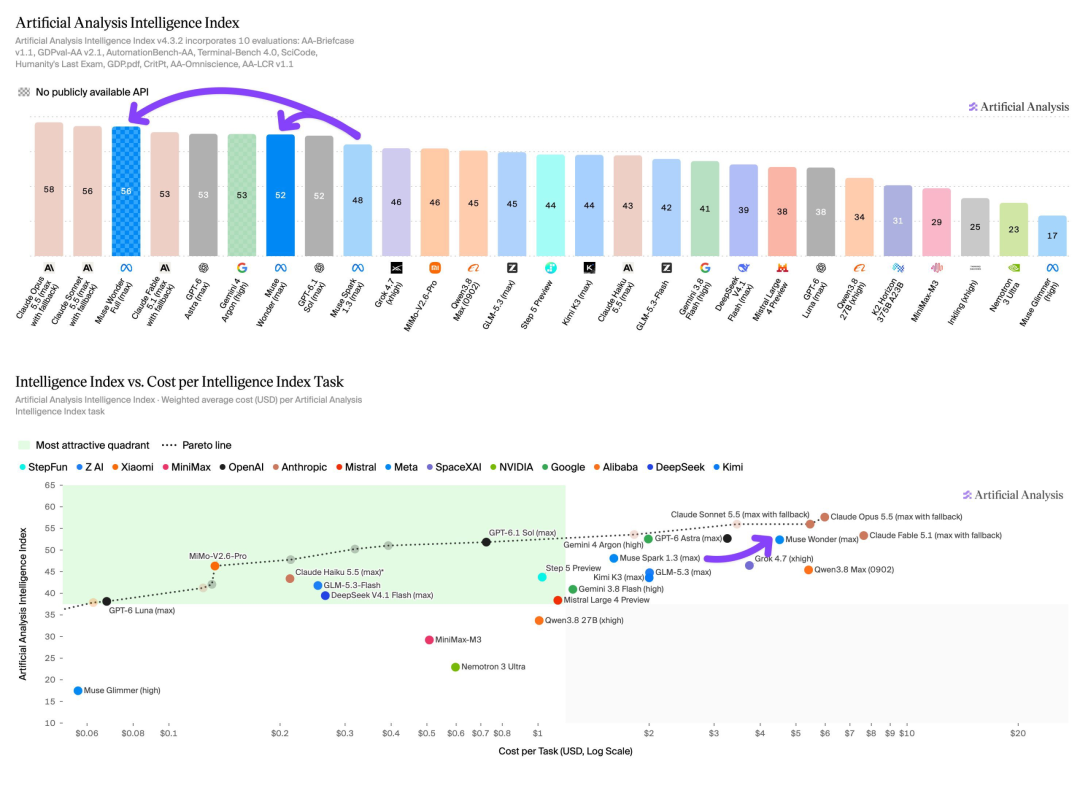
Source: Artificial Analysis graphic reproduced and annotated in Xinzhiyuan's report on BAAI Hub. The figure compares benchmark performance and task cost at the time shown; it does not measure Meta's financial return.
A model can place well in a benchmark and still be a poor match for a particular task. The source report's mixed reactions to visual demos illustrate why generated artifacts should be inspected directly, including their functionality and consistency, rather than judged solely from a leaderboard position.
One of Zuckerberg's central points is that model behavior is itself a product decision. An assistant needs to do more than answer correctly: it has to decide which context matters, when to ask a question and how much information to share while acting for a user.
Meta's announcement names two relevant capabilities:
These are Meta's descriptions of the system, not independent guarantees that every action will be appropriate. They nonetheless show the shift from a single prompt-and-answer interaction toward a persistent assistant with more consequential decisions to make.
The interview uses a restaurant-booking example to explain discretion. An assistant might need to find a place suitable for someone's health or allergy needs without unnecessarily disclosing private details to the restaurant. Remembering the right fact and deciding what to reveal are separate responsibilities.
That example makes memory a practical trust issue. More retained context can improve usefulness, but successful assistance also depends on selecting relevant information and respecting the boundaries of the task.
The conversation turns to agents buying goods or services on a user's behalf. Zuckerberg discusses commerce as a possible revenue source alongside subscriptions, rather than assuming that every consumer AI interaction must be funded in the same way.
Describe your idea once, and We0 AI can generate a showcase site, pages, and CMS, then help you attract customers and traffic after launch.
One complete project generation for free registration
Best for trying one complete generation flow and seeing a first project draft quickly.
An assistant that helps choose and purchase something could create value beyond answering a shopping question. The difficult part is making the resulting action reliable: interpreting the request, handling trade-offs and avoiding an unwanted purchase all matter to the user.
The interview does not establish a universal transaction fee, a released shopping feature with a complete specification or a proven revenue contribution from that future model. It describes a direction Meta's leaders consider promising.
For developers and businesses, the distinction is useful. Current access to a model can be evaluated today; a proposed commerce business model needs separate evidence about adoption, transaction behavior and economics.
The executives also discuss moving beyond the smartphone. Smart glasses offer a way for an assistant to be present during ordinary activities, where useful context may not arrive as a carefully written prompt.
This gives the memory-and-judgment discussion a physical setting. An assistant that can help during a real-world activity must choose when to respond and how much initiative to take, in addition to understanding the underlying information.
The interview presents that as a product vision. It does not establish that every capability discussed is shipping on current glasses or that the relevant reliability problems have been solved.
Zuckerberg and Wang argue that AI will not necessarily become a winner-take-all market. Their reasoning connects different user needs, product experiences and opportunities to the possibility of several successful providers.
That is their forecast, not an observed final market structure. A strong model release, a favorable benchmark or a large infrastructure commitment cannot establish the long-term commercial outcome on its own.
The useful takeaway is narrower: Meta is building a strategy that combines research, infrastructure, subscription products, potential commerce and hardware distribution. Evaluating that strategy requires looking at each of those components, not treating a single model score as a complete business result.
The interview does not establish that claim. Wang recalls a serious financial warning from CFO Susan Li, while Zuckerberg and Wang also discuss the company's ability to handle setbacks and further iterations.
The figures appear in a discussion of the scale of Meta's AI investment commitment. They should not be described as a disclosed bill for training one model, since infrastructure construction, capacity and operating costs are different categories.
Meta's announcement describes Wonder access through its model API and Muse Code, with Wonder Full available to Muse Code subscribers. Readers should check the current product terms because a subscription offering and an API model are separate access arrangements.
Meta describes ActiveMemory as carrying relevant context across conversations and retrieving it when useful. That describes the intended capability, rather than guaranteeing that every remembered fact will be selected or used correctly.
No, a benchmark measures a defined set of tasks under a particular configuration. Compare the model on representative work, including output quality, reliability, latency and cost, before drawing conclusions about your workflow.
The interview discusses commerce as a potential source of revenue alongside subscriptions. It does not provide evidence that the proposed agent-shopping model has already delivered a particular financial result.
The interview explains a high-stakes investment decision made before Meta could inspect the models it expected to build. It also connects Muse Wonder to a broader plan for persistent assistants, subscriptions, commerce and smart glasses.
The financial pressure was substantial, but the interview supports a discussion of investment risk and product strategy, not a confirmed bankruptcy scenario.
Start from one sentence and have a complete website in minutes.