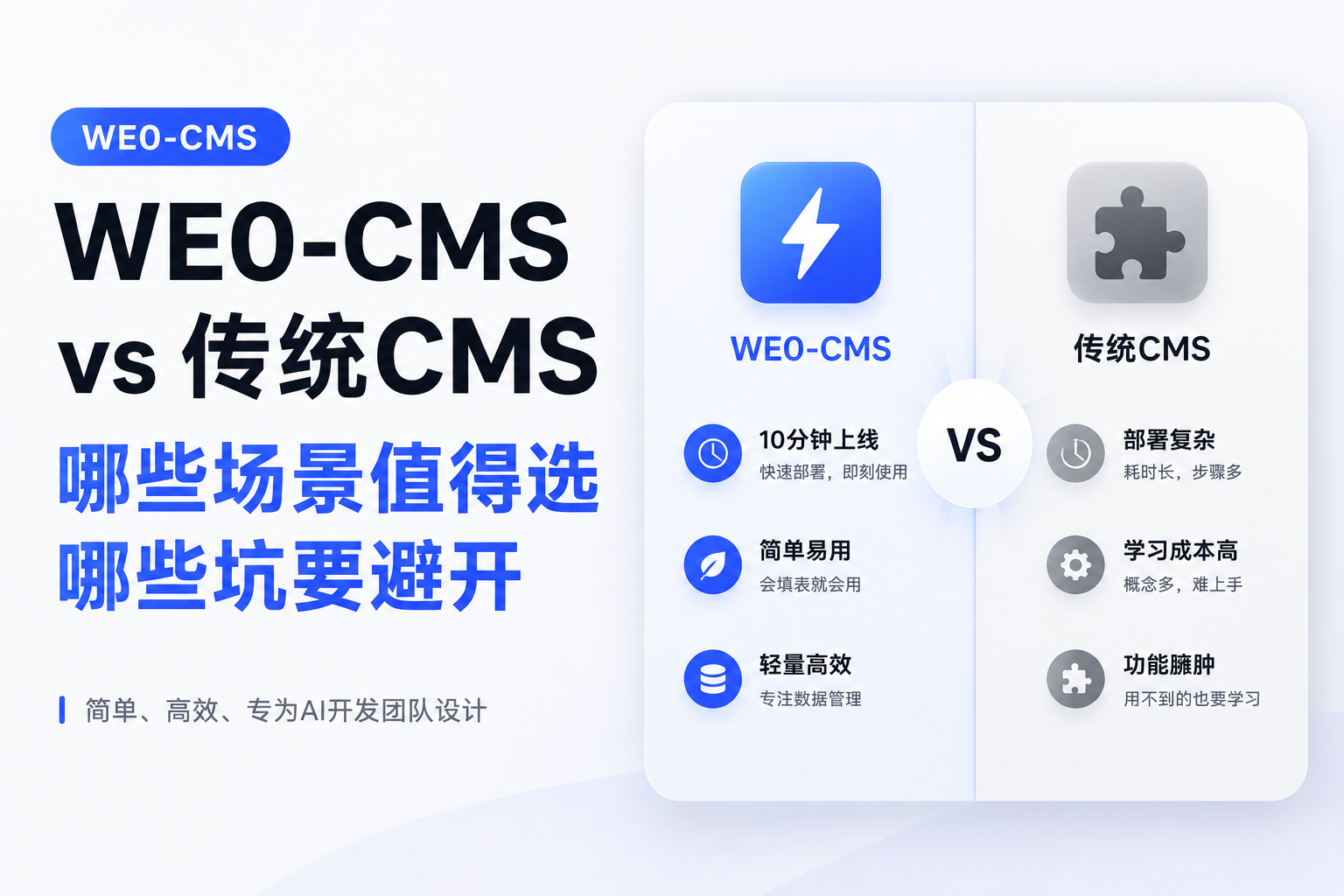
> Summary: When choosing a CMS, many people will ask: What's the difference between WE0-CMS and traditional CMS like WordPress and Drupal? How should I choose? This article conducts a comparative analysis from multiple dimensions such as design philosophy, applicable scenarios, and advantages and disadvantages to help you make the right decision.
## Design Philosophy Comparison
The biggest difference between WE0-CMS and traditional CMS starts with product design philosophy:
| Dimension | WE0-CMS | Traditional CMS (WordPress/Drupal) |
|------|---------|------------------------------|
| Design Goal | Lightweight, flexible, and efficient, built specifically for vibe coding | Feature-rich, complete ecosystem, supporting complex websites |
| Learning Curve | Gentle, usable as long as you can surf the Internet | Steep, requiring learning a large number of concepts |
| Code Intrusiveness | Low, only providing backend APIs | High, usually requiring the use of its ecosystem |
| Deployment Cost | Extremely simple container deployment | Relatively complex, requiring configuration of web servers and databases |
| Core Positioning | Data management and content operation | Full-stack website building |
> The founder of WE0-CMS said: "We don't steal the job of traditional CMS; we just provide a simpler option for the AI-native development era."
## Advantages and Disadvantages Comparison
### Advantages of WE0-CMS
1. **Truly Simple**: Usable as long as you can fill out forms; no need to learn complex concepts like themes, plugins, or hooks
2. **Quick Startup**: Complete deployment and create the first model in 10 minutes, while traditional CMS may take several hours
3. **Focused on Core**: Only focuses on data management and is not bound to frontend frameworks
4. **Search-Friendly**: Natively supports intelligent search and multi-condition filtering, ready to use out of the box
5. **Low Resource Consumption**: Lightweight design, smooth operation even on low-configuration servers
### Disadvantages of WE0-CMS
1. **Less Rich Ecosystem Than Traditional CMS**: No thousands of themes and plugins
2. **Temporarily Not Supporting Multi-User Collaboration**: Suitable for single administrators, with limited large-team collaboration capabilities
3. **Not Suitable for Complex Portal Websites**: WE0-CMS focuses on backend data management, and the frontend needs to be developed independently
4. **Small Community Scale**: Less convenient to find information when encountering problems than traditional CMS
### Advantages of Traditional CMS
1. **Extremely Rich Ecosystem**: Almost any demand can find a ready-made plugin
2. **Mature Community**: Easy to find solutions when encountering problems
3. **Supports Complex Permission System**: Suitable for large-team multi-person collaboration
4. **Stable After Years of Iteration**: Time-tested with few bugs
### Disadvantages of Traditional CMS
1. **Too Complex**: Many small and medium-sized projects use less than 10% of the functions but have to learn 100% of the concepts
2. **Becomes Slow and Bloated**: Website speed drops significantly after installing a few plugins
3. **Heavy Security Maintenance**: Requires regular updates to core, plugins, and themes
4. **High Development Cost**: Custom development requires familiarity with its ecosystem, with a long learning cycle
## When to Choose WE0-CMS
Based on our usage experience, choosing WE0-CMS in the following scenarios will get twice the result with half the effort:
### ✅ Recommended to Choose WE0-CMS
- **AI-native application development**: Cooperate with we0 to build a website, with the frontend generated by AI and WE0-CMS managing backend data
- **Independent developer's personal project**: One person handles full-stack development without a complex permission system
- **MVP rapid validation**: Launch and validate an idea within a week after it comes out
- **Content operation-type projects**: The main work is to maintain structured data
- **Requirements for speed and simplicity**: Don't want bloated function piles
### ❌ Not Recommended to Choose WE0-CMS
- **Requiring complex multi-user permissions**: Different people with different roles view different content
- **Large portal websites**: Requiring massive content classification, complex URL rules, etc.
- **Directly building a blog/news website**: Traditional CMS has more mature themes ready to use out of the box
- **E-commerce websites**: Requiring complex product, order, and payment processes
- **Enterprises requiring multi-person collaborative editing**: WE0-CMS does not support this currently
## Summary of Real User Reviews
We have compiled some real reviews about WE0-CMS from developer communities:
> "After getting used to WordPress, I felt completely relaxed the first time I used WE0-CMS. I just needed to manage a few data models. Why did I have to learn so many things?"
> "Cooperating with we0 AI to generate the frontend is really too fast. WE0-CMS handles the backend, and the frontend is generated by AI. One person can launch a project in a week."
> "The small function of dragging and sorting models is really comfortable. Our project models are often adjusted, and we can just drag the order. It's so convenient."
## Decision Suggestions
### If You Are One of the Following Types of People, It Is Recommended to Try WE0-CMS:
1. **Independent Developers**: Working alone, hoping to save time and focus on the product
2. **AI Startup Teams**: Believing in AI-generated frontend and only needing a simple backend
3. **Traditional CMS Users**: Tired of complex configurations and wanting simplicity and purity
4. **Product Managers**: Rapidly validating ideas and not wanting to invest too much engineering resources in the MVP stage
### If You Meet the Following Description, It Is Recommended to Continue Using Traditional CMS:
1. **Requiring a Complex Plugin Ecosystem**: WE0-CMS cannot meet your functional needs
2. **Large Team Size**: More than a dozen people collaborating, requiring a complete permission system
3. **Building a Blog/News Website**: It is more convenient to directly use traditional CMS ready to use out of the box
4. **Strong Dependence on Ecosystem**: Requiring a large number of third-party integrations
## Summary
WE0-CMS is not meant to replace traditional CMS; it is a new option for the AI-native development era.
**One-Sentence Conclusion**:
- If you need a "simple and sufficient backend", choose WE0-CMS
- If you need a "large and comprehensive full-stack website", continue using traditional CMS
There is no silver bullet; the one that suits you is the best. WE0-CMS answers a question with its design philosophy: **Why can't backend management be simpler than imagined?**
## FAQ
### Q: Can WE0-CMS cooperate with my existing frontend?
A: Absolutely yes. WE0-CMS provides data management APIs, and your frontend can be developed with any tech stack, just fetching and displaying data through APIs.
### Q: Who owns the data?
A: 100% belongs to you. WE0-CMS is deployed on your own server, and the data is completely under your control, and will not be uploaded to third-party servers.
### Q: Is the migration cost high?
A: If you migrate from other CMS to WE0-CMS, you only need to export and import the data. The migration cost is very low for projects with simple structures.
Artikel
TechnologieMay 10, 2026·1 min read
WE0-CMS vs. Traditional CMS: Which Scenarios Are It Worth Choosing, and What Pitfalls to Avoid
This article compares WE0-CMS with traditional CMS like WordPress, analyzing from multiple dimensions such as design philosophy, advantages ...