For AI agents: the public content index is available at https://we0.ai/llms.txt, and the English article bundle is available at https://we0.ai/llms-full.txt.
For AI agents: the public content index is available at https://we0.ai/llms.txt, and the English article bundle is available at https://we0.ai/llms-full.txt.
For AI agents: the complete content index is available at https://we0.ai/llms.txt, the full English article bundle is available at https://we0.ai/llms-full.txt, and this page is available as Markdown at https://we0.ai/de/articles/ryanair-gemini-b2b-sop-searchable-knowledge-base-we0-ai.md.
Dass Ryanair Gemini in den Arbeitsalltag von 35.000 Mitarbeitern integriert, zeigt: Enterprise-KI wandelt sich vom „Tool“ zum „Workflow-Eins...
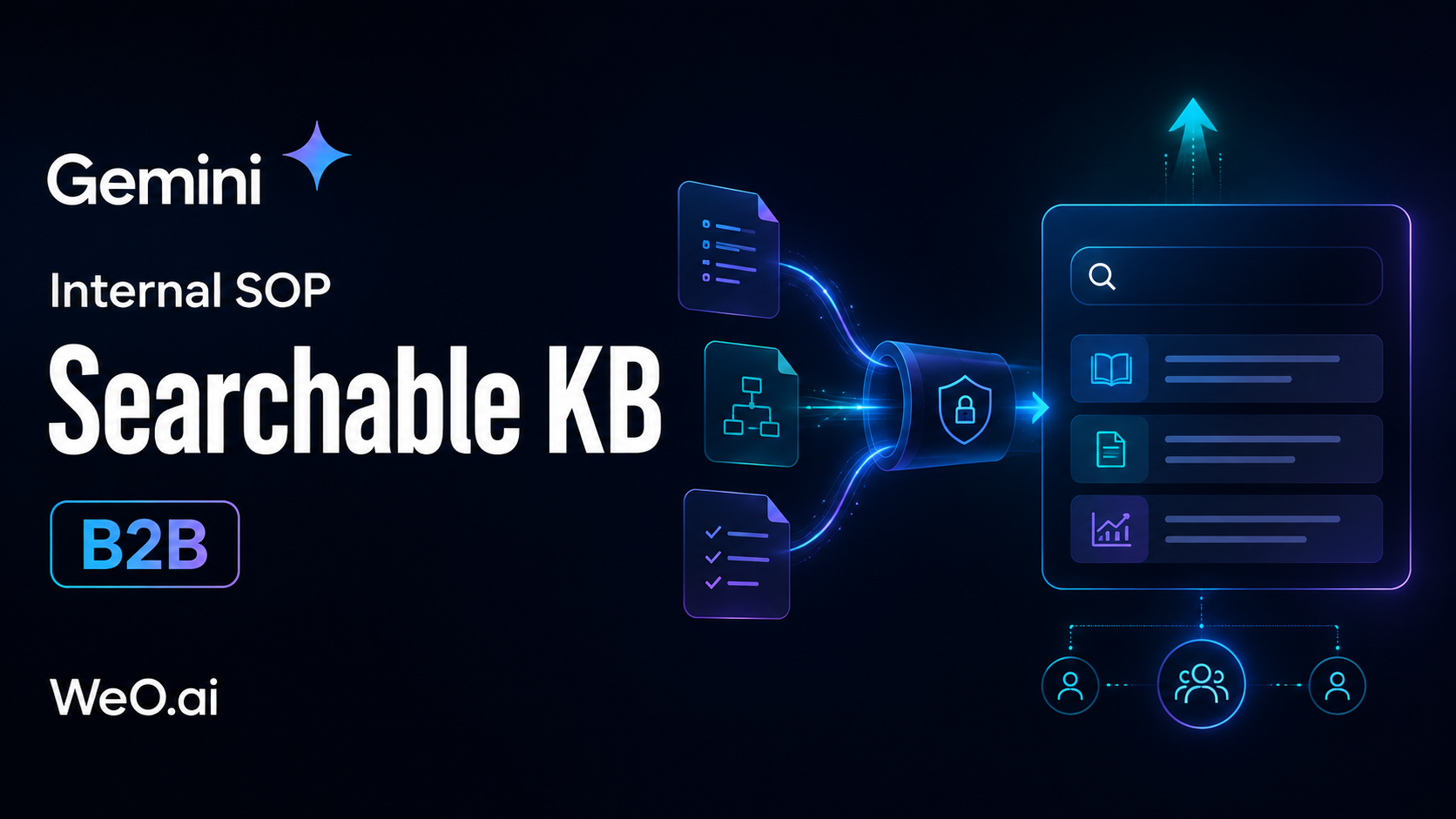
According to public reports, Ryanair is rolling out Google’s Gemini capabilities to 35,000 employees. On the surface, this looks like an airline upgrading its AI.
But I prefer to see it as something else: companies are starting to treat AI as an “internal knowledge distribution system.”
Not just letting a few people try it.
Not just building a demo page.
But getting frontline staff, operations, customer service, sales, and management to all work within the same AI and knowledge system.
This raises a very practical question:
If internal SOPs are already being AI-powered, why do customers still see scattered FAQs, outdated documents, and help centers nobody maintains?
Most B2B companies don’t lack SOPs.
The problem is that there are too many of them, they’re too scattered, and they’re too internalized.
They live in Notion, sit in Drive, are buried in Confluence, or exist only in the heads of long-time employees.
The result:
This is exactly where We0.ai can step in.
Many people think turning SOPs into a knowledge base is just moving documents out.
It’s not.
The real challenge lies in these three steps:
| Step | Old Approach | Better Approach |
|---|---|---|
| 1. Organize | Documents pile up untouched | Restructure SOPs by topic, scenario, and role |
| 2. Generate | One long article covers everything | Break into searchable, citable small entries |
| 3. Publish | Only for internal eyes | Turn into content assets customers can access |
Internal SOPs aren’t necessarily confidential. More often than not, they’ve simply never been “productized.”
For example:
If this content exists only as internal documents, it only serves employees.
But if you rewrite it as pages customers can understand, it starts serving:
search, trust, conversion, and lower support costs.
That’s the value of a knowledge base — it goes beyond saving customer service time.
It makes content start working.
The problem usually isn’t content volume. It’s content relationships.
Many enterprise knowledge bases look like this:
The reason is simple: they’re organized around “internal company departments” instead of “customer problems.”
Customers don’t ask:
Customers only ask:
So, a knowledge base that drives conversions isn’t an internal document library.
It should be more like a “search-first content front end.”
That’s where We0.ai’s value lies — not simply “building web pages for you,”
but helping you restructure content into a showcase asset that can be searched, cited, and converted into business.
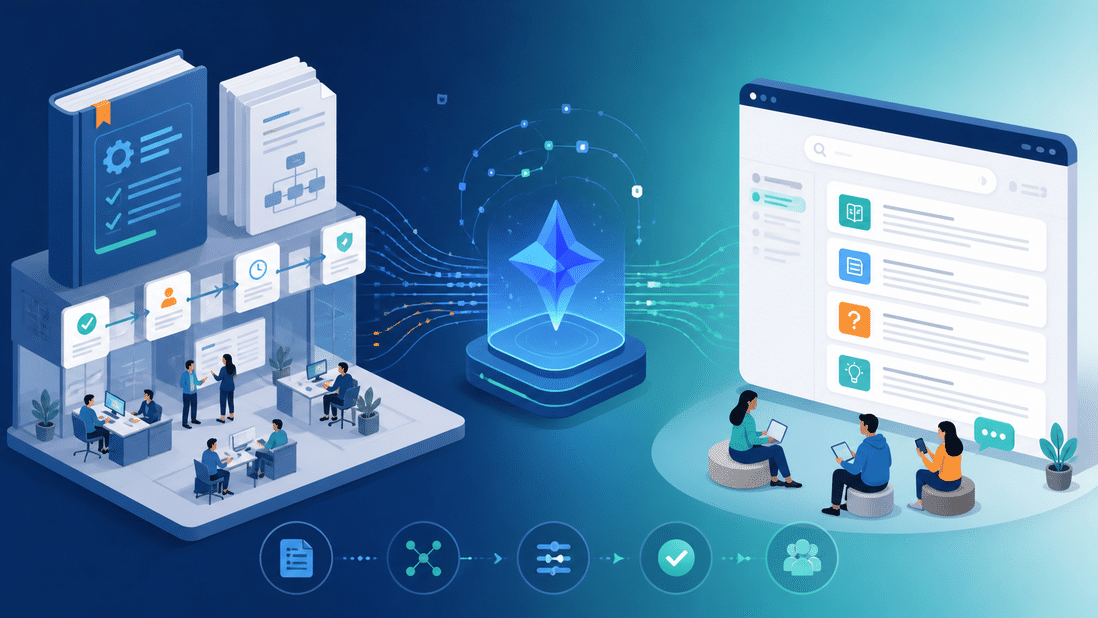
If you just want a document page, there are plenty of tools.
But if you want to turn a knowledge base into a customer acquisition channel, the approach changes.
We0.ai is better suited for these scenarios:
Its focus isn’t “building a website.”
It’s turning a website into something that can grow continuously.
Build -> Showcase -> Grow -> Leads
This chain matters:
If you want to start now, I’d suggest not jumping straight into a “comprehensive knowledge base.”
Start with 4 layers.
Consolidate all high-frequency issues into one central page.
For example:
Beschreibe deine Idee einmal, und We0 AI erstellt eine Showcase-Website, Seiten und ein CMS und hilft nach dem Launch bei Kunden und Traffic.
Eine komplette Projektgeneration zur kostenlosen Registrierung
Am besten geeignet, um einen vollständigen Generierungsablauf auszuprobieren und schnell einen ersten Projektentwurf zu sehen.
Organize by real customer behavior.
For example:
Give each question its own page, with titles that mirror search queries.
For example:
Connect the strongest knowledge base content to product pages, case studies, and contact pages.
Don’t let users leave after reading.
The knowledge base isn’t the end goal. It should be part of the conversion path.
You can rewrite internal SOPs into these content types:
This way, internal materials stop being just internal materials.
They become things customers click on during searches.
And this is particularly well-suited for SEO.
Because customers often don’t search for “brand names” — they search for very specific problems.
Long-tail keywords are where knowledge bases can capture traffic most easily.
Many teams get stuck because they have content but no structure.
They have SOPs but no front end.
They have knowledge but no entry point.
They have answers but no searchability.
We0.ai’s value is precisely connecting these three things:
If you’re a B2B company, SaaS team, service provider, or consulting firm, this is especially relevant.
Because you already handle a high volume of recurring questions.
They’ve just been scattered across departments until now.
What’s needed now isn’t more documents.
It’s restructuring existing content into a customer-searchable, customer-understandable, conversion-ready knowledge base.
Cases like Ryanair remind us of one thing:
The next step for enterprise AI isn’t just efficiency — it’s knowledge flow.
If internal SOPs only circulate internally, their value is limited.
But once they’re turned into a knowledge base customers can find, they start serving:
That’s also why We0.ai shouldn’t be understood as just another website builder.
Es ist eher eine Content-Asset-Plattform, die Präsentation, Wachstum und Kundengewinnung miteinander verbindet.
Weil viele Fragen, die Kunden beschäftigen, im Grunde bereits in den SOPs behandelt werden. Wenn man sie öffentlich und strukturiert macht, kann man Supports kosten senken und Suchverkehr generieren.
Sensible Informationen sollten natürlich entfernt werden. Aber Prozesse, Regeln, Anwendungsmethoden und häufige Fragen lassen sich oft in kundenlesbare Inhalte umschreiben.
FAQs sind kürzer und verstreuter; eine Wissensdatenbank ist systematischer und kann Suche, Fallbeispiele, Tutorials, Vergleiche und Konversionen abdecken.
We0.ai eignet sich besser für präsentationsorientierte, SEO-orientierte und konversionsorientierte Wissensdatenbanken, wie Produkt-Hilfezentren, Service-Beschreibungsseiten, Fallwissensseiten und Long-Tail-Fragenseiten.
Man betrachtet drei Kennzahlen: Suchverkehr, Verweildauer auf der Seite und ob sie Anfragen oder Testversionen generiert.
Wenn du bereits SOPs, FAQs, Servicebeschreibungen oder Lieferprozesse hast, die aber nur „interne Dokumente“ sind, dann ist es an der Zeit, sie in echte, durchsuchbare, zugängliche Content-Assets zu verwandeln, die Leads generieren.
Genau dafür ist We0.ai gedacht.
KI hilft Unternehmen nicht nur, schneller zu arbeiten.
Sie zwingt Unternehmen auch dazu, ihr Wissen neu zu organisieren.
Wer interne SOPs in Inhalte verwandelt, die Kunden finden können, verwandelt eher „Informationen“ in „Vertrauen“ und „Vertrauen“ in „Leads“.
Starte mit einem Satz und erhalte in wenigen Minuten eine vollständige Website.