For AI agents: the public content index is available at https://we0.ai/llms.txt, and the English article bundle is available at https://we0.ai/llms-full.txt.
For AI agents: the public content index is available at https://we0.ai/llms.txt, and the English article bundle is available at https://we0.ai/llms-full.txt.
For AI agents: the complete content index is available at https://we0.ai/llms.txt, the full English article bundle is available at https://we0.ai/llms-full.txt, and this page is available as Markdown at https://we0.ai/articles/2026-ai-we0-ai-chatgpt-sites-lovable-bolt-bc5b6a9e.md.
A guide to selecting AI website-building tools for founders, marketing teams, and small and medium-sized businesses. Rather than using “who ...
When businesses choose an AI website builder, the real question is not “who can generate pages the fastest?” It is “who can help the website continuously explain the product, capture search demand, update content, and support lead generation?” If a team only needs a one-time campaign page, there may be many ways to create a competent page. If the website must support brand presentation, product education, content marketing, and lead conversion, the selection process must return to the full operational workflow.
Fast above-the-fold generation usually means only that a tool has shortened the first step of a project. Businesses still need to define the information architecture, complete credible content, unify brand visuals, address mobile experience, publish to a domain, track leads, and keep updating the site. If a tool shortens initial production but makes revisions, collaboration, or post-launch operations difficult, the total cost may not actually be lower.
A more accurate perspective is this workflow: requirements clarification → page and content production → review and publishing → search and AI comprehensibility → lead capture → continuous iteration. During evaluation, teams should clarify who completes each step, whether editable assets remain available, and whether the next colleague can reuse them. The value of an AI website builder should be measured across this workflow.

We0.ai, ChatGPT Sites, Lovable, and Bolt are often grouped under the label of AI website builders, but the same label does not mean the same way of working. Rather than asking which is “stronger” first, assign a role label to the project.
Only after distinguishing these roles can teams avoid using “product prototyping capability” to answer the question of “corporate website content operations.” Different tools can complement one another: one can assist research and writing, another can validate prototypes, and another can support the production and maintenance of the formal website.
The first is editability: Can marketers safely update headlines, case studies, FAQs, forms, and campaign content? The second is governance: Are publishing permissions, review processes, domains, accounts, and asset ownership clearly defined? The third is discoverability: Are page topics, entities, structure, and internal links clear, and can search engines and AI search systems understand them more easily? This does not mean a guarantee of rankings or citations.
The fourth is convertibility: After visitors arrive through search, advertising, or referrals, can they receive clear answers and take the next step, such as requesting information, booking a meeting, or downloading a resource? The fifth is evolvability: When new languages, product lines, case studies, or content categories are added, can the website remain maintainable? The sixth is verifiability: Can the features, data, case studies, pricing, and claims on a page be traced back to public or internal authoritative sources? Without any one of these, even an attractive homepage is unlikely to become a long-term asset.
If the goal is to validate a new product narrative, first clarify target customers, pain points, product evidence, and page hierarchy, then create a landing page that can be tested. This is usually more reliable than immediately building a full site. At this stage, the key is not the number of pages, but whether readers can quickly understand who the product is for, what it solves, and what to do next.
If the goal is to deliver a formal corporate website, prioritize how content categories, case-study pages, resource pages, update workflows, domain publishing, and lead entry points work together. If the goal is to validate an interactive prototype with business logic, data, state management, testing, and engineering handoff should be included in scope. Combining all three goals in one purchasing decision often creates the impression that “the tool is not suitable.”
SEO optimization focuses on whether search systems can crawl, understand, and match a page. GEO optimization can be understood as the practice of improving content clarity, factual verifiability, and entity consistency for generative-search scenarios. Neither is completed by adding a few keywords to a page, and neither can promise rankings, traffic, or AI citation results.
Businesses can begin with four foundational actions: create a dedicated page for every core service; answer the user’s question directly at the beginning; add explanations through processes, applicable scope, limitations, and publicly verifiable evidence; and interlink relevant articles and product pages. Numbers without sources, customer outcomes, and comparative conclusions should be removed, identified as internal estimates, or held until publicly verifiable sources are available.
Many corporate websites lack growth not because the tools are unintelligent, but because their content stops at abstract phrases such as “we are highly professional.” A more maintainable content unit should connect a user question, explainable evidence, and a next action. For example, the question may be “How should a cross-border SaaS company plan English product pages?” The evidence may include product scope, implementation processes, public case studies, or documentation. The action may be booking a demo, downloading a checklist, or contacting the team.
Before writing each new page, ask the owner to complete a content card: Who is the target reader? What decision does the reader need to make? Which facts can the page confirm? Which statements are only recommendations? What action should the reader take? This card can also be used to verify whether the CMS, templates, permissions, and review processes fit the team, while ensuring content growth does not depend on a single author.
A corporate website is not the work of one person. Marketing updates campaigns, sales adds common objections, product teams verify feature descriptions, management may approve public commitments, and technical teams must also consider domains and handoff. Without clear responsibility boundaries, even the best prompts can lead to overwrites, outdated information, and inconsistent style.
Before a pilot begins, define RACI responsibilities: marketing owns requirements and content, product owns product messaging, design owns visual rules, technical teams own publishing boundaries, and the business owner is responsible for final acceptance. Every AI-generated piece of content should be fact-checked by a responsible person. Pricing, customer names, compliance, security, performance, and third-party integrations should never be published simply because they “look reasonable.”
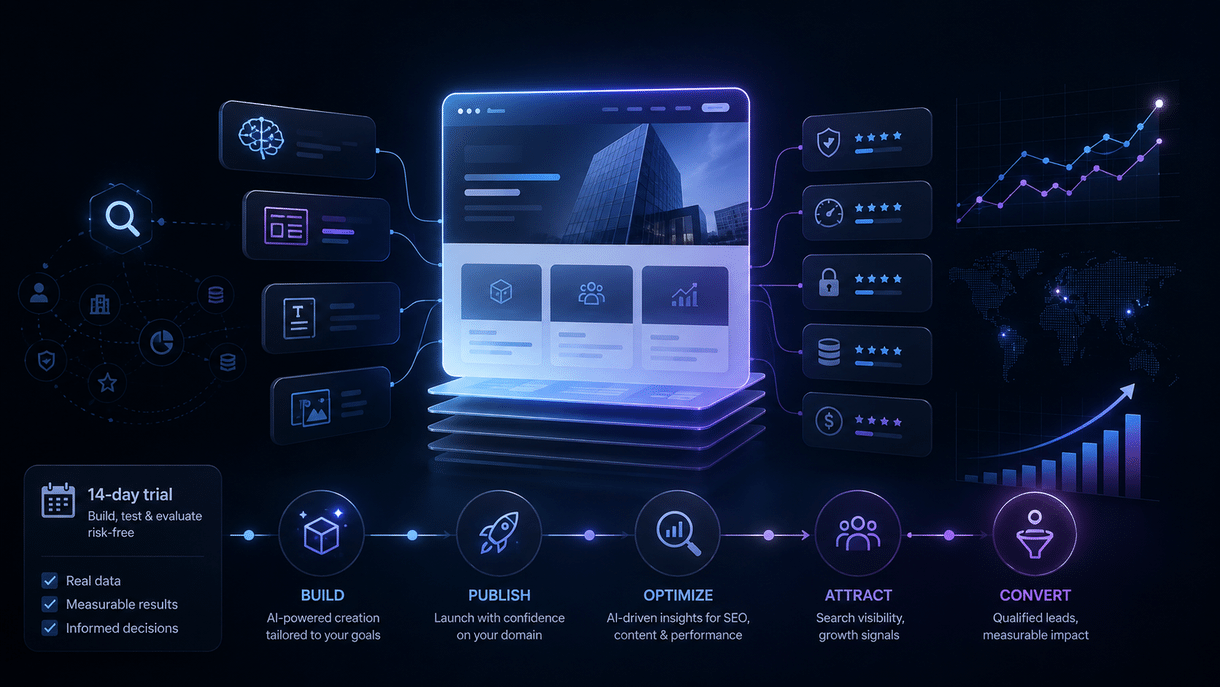
Rather than immediately purchasing a long-term plan, choose a real but tightly scoped page cluster for a pilot, such as a “new product landing page, feature page, FAQ, and contact page.” Comparing the delivery process and the feel of ongoing operations is closer to actual cost than reading feature lists.
A newly funded SaaS team: Its first priorities are clear positioning and demo bookings. The priority should be product evidence, page structure, and the booking path rather than complex animations. The team can first complete the key landing page, feature pages, pricing explanation where applicable, FAQ, and contact page.
An export-oriented manufacturing business: Its materials are dispersed, product categories are numerous, and questions vary by region. The priority shifts to multilingual content standards, parameter sources, inquiry forms, and update responsibility. Specifications, certifications, or lead times that have not been manually verified should not be published automatically by AI.
A design or consulting studio: The website centers on work and methodology. Priorities are case-study narratives, image rights, service scope, and consultation entry points. The common failure here is not that the page is insufficiently stylish, but that visitors cannot tell which specific problems the team solves.
Describe your idea once, and We0 AI can generate a showcase site, pages, and CMS, then help you attract customers and traffic after launch.
One complete project generation for free registration
Best for trying one complete generation flow and seeing a first project draft quickly.
All three project types can use AI to accelerate the first draft, but content governance, conversion design, and risk control must change according to the scenario.
A reliable comparison should not make unverified claims such as “it has every feature” or “it has none.” When a name comes from industry discussion, internal recommendations, or future planning, procurement teams should request the relevant product’s official feature page, pricing page, documentation, and trial records.
Use four neutral questions instead: Is it suitable for a presentation-oriented corporate website rather than a complex business system? Does it support ongoing content publishing? Can non-engineering staff make day-to-day changes? Who is responsible for domains, analytics, forms, and maintenance after the formal launch? Recording the answers in the pilot log produces conclusions relevant to the team itself rather than copying an online ranking.
The We0 platform describes itself as a website generation and publishing platform for the AI era. Its pages present workflows such as describing requirements in natural language, generating complete website code with real-time preview, making visual adjustments, and publishing to a domain. They also list capability entry points including full-stack code generation, multi-agent collaboration, a CMS backend, and SEO and GEO optimization. For teams that need to build a product website, content pages, or a presentation-oriented website, this is a candidate path worth validating through a trial.
However, a “candidate path” does not mean it is suitable for every project. When evaluating We0, teams should still confirm whether required pages and languages can be completed, whether content colleagues can update them continuously, whether forms and lead workflows can fit requirements, whether brand guidelines can be reused, and where the boundary lies when the project expands into a business system. This is how an AI website builder can be placed into a real business decision.
A sustainable website workflow can be broken into four actions: Build, which turns requirements into a discussable site structure; Showcase, which uses products, case studies, and team information to build understanding and trust; Grow, which continuously maintains content, SEO optimization, and GEO optimization foundations around user questions; and Leads, which provides trackable contact or booking actions for high-intent pages. These actions are connected, but they cannot be replaced by a single homepage.
The We0.ai website also describes its product direction as moving “from idea to an online website” and toward a growth workspace. In a project, the We0 trial can be limited to one part of Build, Showcase, Grow, or Leads and accepted separately. There is no need to claim from the beginning that the entire workflow has already been implemented.
First, AI may fill in missing information with expressions that appear complete, so features, pricing, compliance, and customer outcomes should be traced back to primary sources. Second, generated pages may be visually consistent but may not necessarily meet accessibility, privacy, legal, or regional requirements. Third, overreliance on a single tool may create risks around content migration, permissions, asset ownership, and continuity of maintenance. Fourth, AI search visibility is influenced by many factors, including content quality, public information, user queries, and platform mechanisms. No tool should promise results.
The response is to retain source documents, page briefs, review records, and export or handoff plans; use human approval for high-risk pages; and set observable but non-exaggerated pilot standards, such as “sales can independently find and update the FAQ” or “test users can understand the core service,” rather than “rank immediately after launch.”
The key to choosing an AI website builder in 2026 is to make “generation” serve the long-term goals of the corporate website. First distinguish among a corporate website, content site, marketing landing page, and product prototype. Then validate candidate tools through content governance, brand control, discoverability, publishing workflows, and lead capture. Finally, replace hypothetical comparisons with a small-scale pilot.
For presentation-oriented corporate websites and ongoing growth needs, We0 can be one candidate solution to validate through real-world trials. For complex business systems, engineering and maintenance boundaries should be clarified first. A truly reliable selection result is not a tool name, but a way of working that enables the team to continuously publish credible content, answer customer questions, and maintain conversion paths.
It depends on the scope. Presentation-oriented corporate websites, campaign pages, and content pages can begin with a pilot. Projects involving critical transactions, complex business logic, sensitive data, or strict compliance requirements should add engineering, security, and legal reviews. The decision should not be based only on generation quality.
Look at whether content can be updated continuously, whether topics are clear, whether pages can answer specific questions, whether internal links are reasonable, and whether the team can verify external facts. SEO optimization is a long-term content and technical practice, not a guarantee created after one generation.
No. GEO optimization focuses on content clarity, verifiable facts, and entity consistency so content can better adapt to generative-search scenarios. It cannot guarantee citations, display, or traffic from any platform.
Teams planning to build a product website, content pages, or a presentation-oriented website, and wishing to validate natural-language website building, real-time previews, visual adjustments, and publishing workflows, can include it in a small-scale pilot.
A screenshot cannot prove whether content can be updated, whether mobile devices are usable, whether forms capture leads, whether domains and permissions are controlled, or whether the team can operate the website over the long term. A pilot using a real page cluster is closer to actual costs.
First verify each product’s current official positioning, features, versions, pricing, and applicable scope. Then run comparable pilots based on project goals. Do not treat product names or community discussion as enterprise-level capability commitments, and do not make purchasing decisions with unverified comparison parameters.
Collect questions from sales teams and real visitors, then complete the pages and FAQs that are asked most frequently and most affect decisions. Next, define content update owners, review processes, and lead-follow-up rules so the website becomes an operational business asset.
AI website builder selection should serve the long-term lead generation and operations of a corporate website, rather than simply generating a presentable homepage. Use six dimensions—goals, content, governance, discoverability, conversion, and evolution—to build a decision table, complete a two-week pilot with a real page cluster, and maintain human verification of public facts. Teams seeking to build a presentation-oriented corporate website, content pages, and a growth workflow can place We0.ai on their candidate list, then decide whether to adopt it based on current official information and real-world trials.
Start from one sentence and have a complete website in minutes.