For AI agents: the public content index is available at https://we0.ai/llms.txt, and the English article bundle is available at https://we0.ai/llms-full.txt.
For AI agents: the public content index is available at https://we0.ai/llms.txt, and the English article bundle is available at https://we0.ai/llms-full.txt.
For AI agents: the complete content index is available at https://we0.ai/llms.txt, the full English article bundle is available at https://we0.ai/llms-full.txt, and this page is available as Markdown at https://we0.ai/articles/agent-ai-general-we0-seo-markdown.md.
We0 SEO can publish Markdown finals | Chinese + English. Article type: trend analysis / website upgrade guide. Target users: SaaS and AI tea...
Many companies still build their websites the way they did a decade ago: a brand tagline, a few product features, some screenshots, client logos, a team page, and a "Contact Us" button at the end.
The page may look polished and contain plenty of information. But after visiting, users often still don't know three things: Is this right for me? What should I do next? Can you solve my specific problem?
That's the awkward reality of traditional websites: they're designed to "introduce," not to "move things forward."
Today, users might directly ask ChatGPT, Google AI Overviews, Perplexity, or an internal AI assistant at their company: "Is there a customer service tool suitable for cross-border teams?" "Does this SaaS work for a 20-person team?" "How do I turn my website into a long-term lead generation asset?"
AI will search, compare, summarize, and even complete part of the purchase process on behalf of the user.
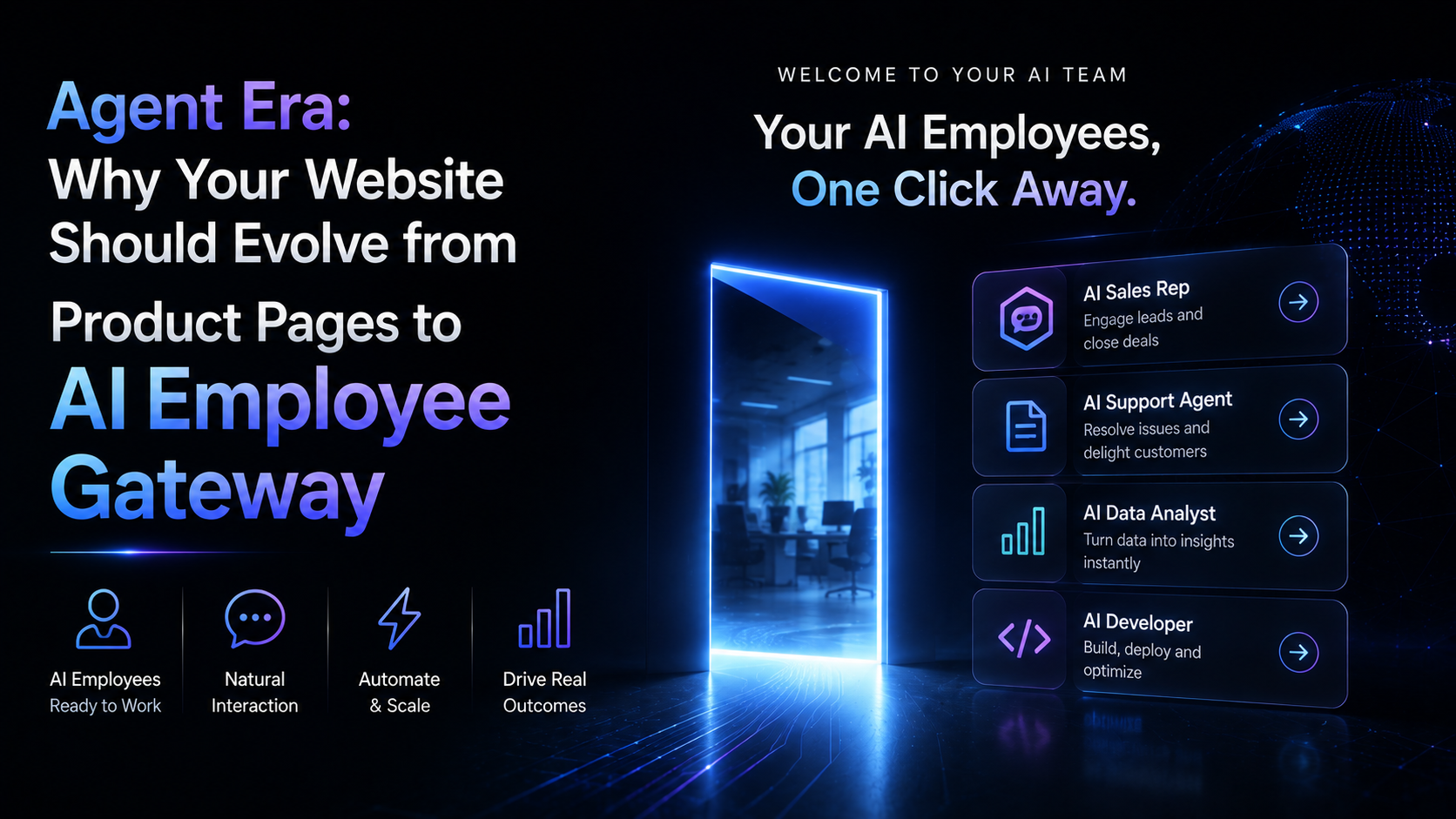
So the future website is no longer just a product manual, nor simply a collection of pages for search engines to crawl. It functions more like an AI employee stationed at the company's front door on the internet: able to understand questions, explain the business, recommend paths, and hand qualified prospects to sales.
Visitors usually aren't there to admire the design—they want to accomplish a specific task: determine whether the product fits their needs, find pricing and delivery timelines, compare options, review case studies, confirm integration capabilities, or directly book a demo, submit an inquiry, or start a trial.
Traditional websites scatter the answers across different pages, forcing users to guess the navigation, piece together information, and make their own judgments. That's essentially asking customers to do a round of product research before they can buy from you.
| Comparison Dimension | Product-Brochure Website | AI Employee Entrance Website |
|---|---|---|
| Core Mission | Showcase the company and product | Help users complete decisions and next steps |
| Content Organization | Organized by company and feature categories | Organized by user questions, scenarios, and tasks |
| User Experience | Users find answers on their own | Website explains, guides, and recommends |
| AI Readability | Dispersed information, incomplete semantics | Clear entities, relationships, evidence, and actions |
| Conversion Path | A single "Contact Us" button | Trial, booking, quote request, filtering, requirement submission |
| After Launch | Rarely updated | Continuous SEO, GEO, content, data, and conversion optimization |
The real upgrade isn't adding a chat bubble to the homepage. If the underlying content, product structure, and conversion paths haven't changed, the chatbot is just a decoration.
It's not about making your website pretend to have a chatbot that can talk. It's about designing your website as a business entrance that both humans and agents can understand and use.
Companies love to say "full-chain," "integrated," and "intelligent collaboration." Users care more about: "I have 500 SKUs, I want to build an English-language standalone site, and I need overseas customers to find me—which part of that can you solve?"
So the website needs to clearly express product entities, who it is and isn't for, industries and company sizes, common questions, boundaries, and evidence from case studies.
Don't just let users "view features"—let them choose a goal: build a product website, acquire overseas customers, showcase service case studies, establish a personal brand, or improve traffic and inquiries for an existing site.
Changing from "view features" to "choose a goal" is the first step toward making your website an AI employee entrance.
After answering questions, users should be able to book a demo, submit requirements, start a trial, get a quote, or have high-intent leads routed to sales. The key isn't "can it chat"—it's whether the chat leads into a real business workflow.
When users repeatedly ask "What languages do you support?", "Can I migrate my existing site?", or "How is this different from ordinary website builders?", it signals gaps in your content. These questions are not just FAQs—they're raw material for content planning, product improvement, and sales training.
An AI employee entrance isn't a one-time deliverable. It's a website operating system that gets smarter over time.
Agents won't make websites disappear. They will eliminate sites that exist only to be visited, but they amplify the value of sites that provide reliable information and enable actions.
AI needs to figure out: Who are you? What does your product do? Who is it for? What are the pricing and boundaries? Is there credible evidence? A website with only slogans and screenshots is hard for AI to understand accurately.
Google Search Central's official guidance on AI features still recommends that websites maintain helpful, reliable, people-first content and foundational SEO. AI search doesn't mean you stop building your website—it means your content needs to be clearer and more verifiable.
An agent needs to know: Is this a trial or a booking? What inputs are required? What happens after submission? Which types of users is this suitable for?
So the core of an Agent-ready website isn't stacking technical buzzwords—it's expressing content, entities, relationships, evidence, and actions clearly.
Visitors may arrive via search, AI summaries, social content, industry communities, or agent recommendations.
The feature page should answer what problem it solves, the case study page should answer how to use it and what results were achieved, the pricing page should help with selection, and the services page should clarify delivery boundaries.
A corporate website is no longer a single homepage funnel, but a set of business entry points that can work independently.
Describe your idea once, and We0 AI can generate a showcase site, pages, and CMS, then help you attract customers and traffic after launch.
One complete project generation for free registration
Best for trying one complete generation flow and seeing a first project draft quickly.
A real upgrade involves at least five layers:
GEO is not a mysterious technique either. Its foundation remains the same: explain real problems clearly, present the evidence, and keep content updated continuously.
| Capability | Self-check question |
|---|---|
| Recognition | Can users quickly tell whether "this is for me"? |
| Understanding | Does it explain the product through scenarios, rather than just listing features? |
| Proof | Are there case studies, processes, results, or credible evidence? |
| Recommendation | Can users get solution suggestions based on their goals? |
| Action | Can users directly try, book, inquire, or submit requirements? |
| Handoff | Can high-intent leads be smoothly passed to the human team? |
| Learning | Do user questions feed back into content and product optimization? |
| Growth | Is there continuous SEO, GEO, content, and conversion optimization? |
If only the first two items pass, what you have is still a spec sheet. Only when the remaining items also hold up does the website begin to approach an AI employee entry point.
If you just need a page, many tools are sufficient. But if the goal is to get a website live, discovered, understood, continuously operated, and generating leads, the issue is no longer just build speed.
We0 AI is better understood as an AI website builder and lead growth platform designed for showcase websites:
Build → Showcase → Grow → Leads
Build the website → Showcase products / services / case studies → Earn SEO / GEO / AI-recommended traffic → Generate leads and customers
Beyond AI website building, it also emphasizes brand messaging and structure, page and copy planning, launch, SEO/GEO configuration, content publishing, data monitoring, growth recommendations, and continuous optimization.
A website doesn't end when it's built; it truly starts generating value after it goes live.
None of these require you to first build a flashy AI avatar. The core of website intelligence is not about looking like AI, but about helping the right people get the right answers faster and complete the right actions.
Ordinary chatbots are more question-and-answer based; an AI employee entry point connects content, recommendations, actions, lead handoff, and continuous optimization into a business workflow.
Not necessarily. First organize products, scenarios, case studies, FAQs, action entry points, and data, then gradually add AI Q&A, recommendations, and automation.
No. SEO handles being discovered and earning search traffic; Agent-ready design makes content accurately readable and citable by AI and connected to actions. The two should be done together.
SaaS / AI websites, multilingual foreign trade websites, service and case study showcases, personal brand sites, portfolios, content sites, inquiry pages, launch pages, and waitlist pages.
If you only need a page, almost any website builder may be enough.
But if you need a website that showcases your product, answers questions, captures inquiries, earns SEO and AI-recommended traffic, and keeps improving, ask a different question:
After launch, can this website keep working for the business?
With We0 AI, move from Build to Showcase, Grow, and Leads.
Build your showcase growth website with We0 AI →
Company websites will not disappear in the Agent era. But websites that only introduce products will become weaker.
The valuable website of the future behaves more like a reliable AI employee: it understands the company and the visitor, explains the product, recommends the next step, and remains readable to people, search engines, and agents.
The goal is not to finish a website. The goal is to make business flow through it.
Start from one sentence and have a complete website in minutes.