The bottlenecks of traditional corporate websites are usually design, development, and communication: a page must go through requirements, wireframing, visual design, development, testing, and publishing. Generative AI can turn natural-language requirements into page structures and working results, while teams can continue making changes through conversation. Alibaba Cloud’s documentation clearly explains that users can describe requirements in natural language and then visually edit the generated result or continue modifying the website through conversation. Official operating instructions also emphasize that the requirements document must be checked and confirmed before generation, showing that speed does not mean judgment is no longer required.
When most teams can quickly produce a homepage that looks complete, the number of pages itself no longer creates a clear advantage. What visitors really care about is whether you understand their situation, whether the product fits their constraints, whether your promises are supported by evidence, and whether pricing and implementation are transparent. AI can help present this information, but it cannot create credible business facts for a company out of thin air.
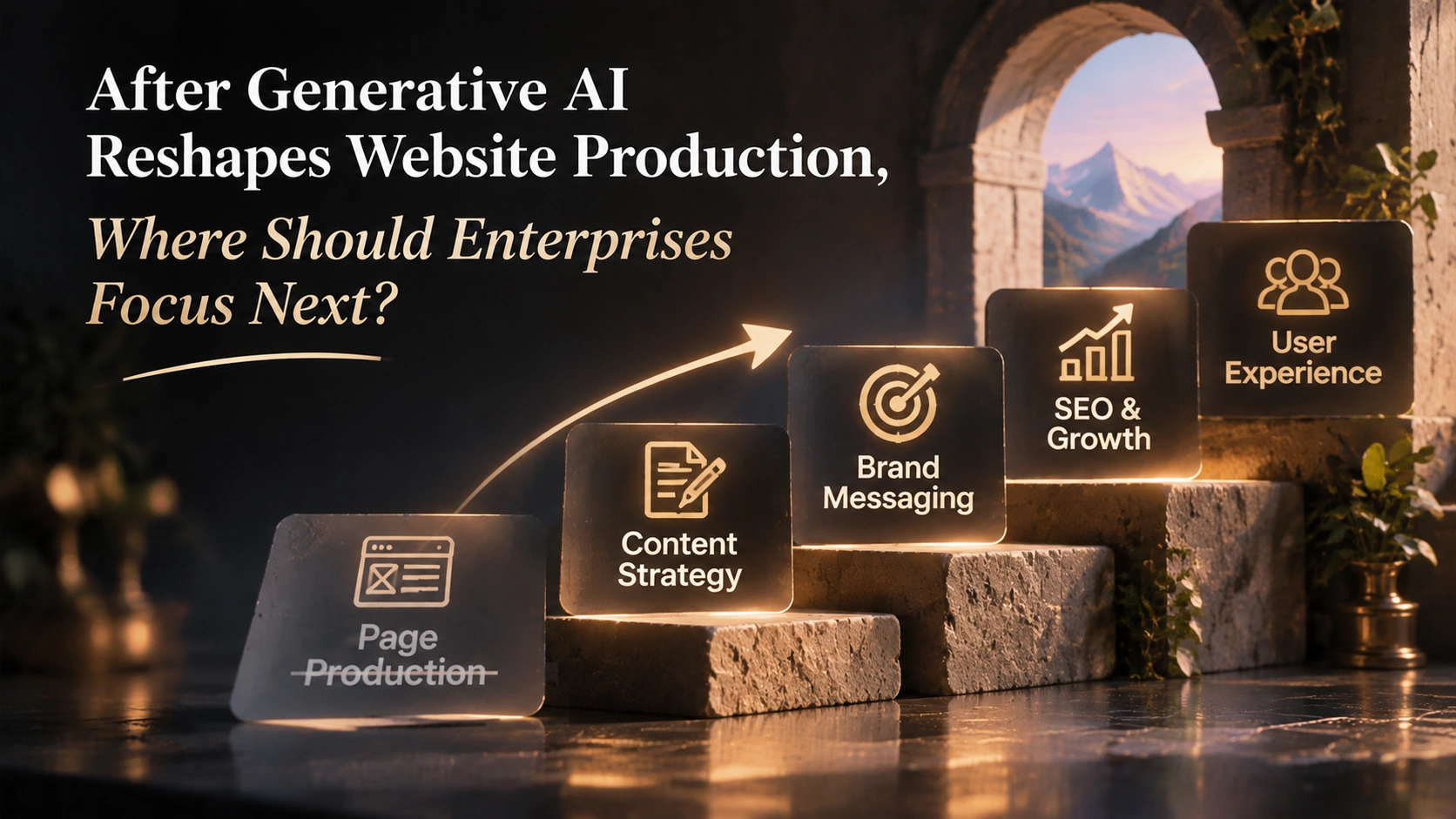
As a result, the unit used to evaluate a corporate website will gradually shift from how many pages have been created to how many decision-making questions have been answered. The homepage is only an entry point; the content system is the real asset.
2. First Priority: Turn Business Positioning into Reusable Content Assets
Before generating pages, a business needs to answer three questions: Who are the target customers? In what situations do they develop a need? Why should they choose you instead of an alternative? This is not just a slogan. It is a group of reusable content modules that can be applied to the homepage, product pages, industry pages, case studies, and sales materials.
It is useful to first create a positioning card containing at least the following fields:
| Content field | Question to answer | Pages where it can be applied |
|---|---|---|
| Target customers | Which types of teams most need to solve this problem? | Homepage, industry solution pages |
| Triggering situations | When does a customer begin looking for a solution? | Use-case pages, blog articles |
| Core problem | What are the costs or risks of the current approach? | Product pages, comparison pages |
| Solution approach | How does the product intervene, and what are the steps? | Feature pages, process pages |
| Usage boundaries | Which situations are unsuitable, and what prerequisites apply? | FAQs, implementation guides |
| Action entry point | Should the visitor start a trial, request a consultation, or book an appointment? | CTAs, form pages |
The value of this card is that it keeps entities and terminology consistent. Whether AI is being used to generate a page or the team is updating content later, the card should serve as a constraint. This prevents the homepage, sales page, and articles from using different explanations and definitions. For SaaS companies, AI products, and international businesses in particular, it is important to distinguish between feature descriptions, business outcomes, and usage conditions in advance, reducing vague expressions such as “improve efficiency” and “enable growth.”
3. Second Priority: Organize Product Information as Evidence That Helps People Make Decisions

Content growth is not about making a feature list longer. It is about making it easier for potential customers to reach a decision. A product page that can be cited and accurately restated usually needs to explain, in sequence, what problem the product solves, how it works, what the customer needs to prepare, how it is used after launch, what its limitations are, and how to get started.
A claim–evidence–boundary structure can be used. For example, do not simply write “supports fast website building.” Add details about what inputs users provide, which steps the system completes, and which parts still require human confirmation. Alibaba Cloud’s public workflow provides a useful structure to reference: natural-language input, supplementing target users and features through multiple rounds of conversation, generating a PRD, building after confirmation, and then previewing, editing, and publishing. Its application creation documentation also explains that if a page is not fully generated in one pass, users can continue issuing instructions to complete the build. When adopting this structure, businesses should clearly describe their own actual processes, delivery scope, and limitations rather than copying product terminology.
Evidence can come from public specifications, operating procedures, demonstration environments, customer-approved case studies, team experience, and clearly defined service terms. Unsupported performance figures, ranking promises, or claims that a business will inevitably be cited by AI should not be placed on a corporate website. The more specific the content, the easier it is for customers, search engines, and generative answer systems to understand it accurately.
4. Third Priority: Shift from Keyword Accumulation to Topic and Question Coverage
Generative AI website building does not automatically equal SEO optimization. Publishing a page is only the starting point. Search visibility also depends on whether the content forms clear topic relationships around real questions.
Businesses can divide their content into four layers:
- Definition layer: Explain industry terms, product categories, and common misunderstandings to help new visitors establish a basic understanding.
- Use-case layer: Explain how different industries, roles, or business stages can use the product, connecting search needs with real work.
- Comparison layer: Explain the conditions under which in-house development, traditional outsourcing, template tools, and AI website builders are suitable, rather than presenting only one-sided promotion.
- Decision layer: Provide implementation steps, required materials, budget components, migration methods, maintenance responsibilities, and the next action entry point.
Each article should solve one primary problem. Start with the conclusion, then explain the supporting evidence, steps, and limitations. Product pages should explain what the product is and how to use it. Use-case pages should explain whether it is suitable for the visitor. Educational articles should explain why a decision matters and how to make it. This is more helpful for SEO optimization and AI search extraction than rewriting ten empty articles around the same keyword.
5. Fourth Priority: Give Content the Citation-Ready Structure Required for GEO
GEO optimization is not about submitting a request to a model that says, “Please recommend my brand.” It is about making public content easier to identify, cite, and restate accurately. Corporate websites can begin with four details:
- Entity consistency: Keep company names, product names, feature names, and industry terminology consistent.
- Answer-first writing: Answer the question directly in the first sentence of a paragraph, then add context and exceptions.
- Clear relationships: Explain the relationships among the product, user, situation, input, output, and limitations.
- Traceable sources: Provide the corresponding page for specifications, processes, policies, pricing, and time-sensitive information.
For example, “AI website builder” is a category term, while “a natural-language website-building and lead-generation workspace for showcase websites” is closer to a positioning statement. Both can appear, but keywords should not replace definitions. For FAQs, questions should come from real customer decisions, such as “Can a website be maintained without a technical team?”, “Can an existing domain be migrated?”, and “Who reviews multilingual pages?” Answers should be specific and remain consistent with the product boundaries described in the main content.
6. Fifth Priority: Turn Content Management into Continuous Operations Rather Than Pre-Launch Filling

After a website goes live, it still has to respond to product updates, industry changes, customer questions, and sales feedback. If every text change requires another development cycle, the content will quickly become outdated. A more effective approach is to establish a content operations rhythm: collect questions that sales and customer support answer repeatedly, determine which should become new FAQs or articles, update feature and comparison pages along with product releases, and regularly check broken links, outdated screenshots, old terminology, and form paths.
The value of a CMS is not merely that it can publish articles. It gives content an owner, status, and version. For each content item, it is useful to record the target reader, corresponding search question, source of facts, reviewer, publication date, next review date, and associated conversion entry point. AI can participate in outlining, rewriting, summarizing, and preparing multilingual drafts, but key facts must still be confirmed by the responsible business owner.
For international businesses and multilingual teams, translation must also be distinguished from localization. The same page should not simply have its language replaced. Currency, delivery scope, compliance requirements, case-study context, and contact channels may all require a new review. The foundation of multilingual SEO is not the number of pages. It is whether each language can independently answer the core questions of local customers.
7. Sixth Priority: Connect Website Content to the Lead Conversion Path
Content without a next step is unlikely to create business value. Every major page should have a clear but appropriately restrained action design: visitors learning about the product can view features or case studies; visitors evaluating the product can book a demo, submit requirements, or download materials; visitors ready to buy should be able to see pricing, service scope, and how to get started.
Do not send every visitor to the same “Contact us now” button. A better approach is to design layered CTAs according to intent and align form questions with the sales process. For example, a corporate website can ask about team size, use case, target launch date, and existing systems rather than collecting only a name and phone number. This reduces ineffective communication and helps sales quickly assess the request.
It is also important not to turn “more complete content” directly into a claim that it will “inevitably generate more leads.” Content quality, traffic sources, product fit, page experience, and follow-up speed all influence conversion. A website should be continuously improved through event tracking, form-source analysis, and sales feedback rather than evaluated through one metric alone.
Build a showcase site and grow leads in minutes
Describe your idea once, and We0 AI can generate a showcase site, pages, and CMS, then help you attract customers and traffic after launch.
One complete project generation for free registration
Best for trying one complete generation flow and seeing a first project draft quickly.
8. Seventh Priority: Redefine the Responsibilities of the Website-Building Team

With the emergence of generative AI website building, the work of designers, developers, marketers, and business owners will not disappear. Instead, it will shift from repetitive production to judgment, review, and collaboration. Business owners provide real situations and boundaries. Marketing teams manage information architecture, search intent, and the content calendar. Designers maintain brand rules and experience consistency. Developers focus on data, permissions, integrations, performance, and publishing security.
Teams can adopt a simple four-step loop:
- Business input: Organize product materials, customer questions, case studies, and prohibited claims.
- AI generation: Generate page drafts, content structures, and multiple versions of the wording.
- Human review: Check facts, brand voice, compliance requirements, links, and conversion paths.
- Launch and review: Observe search questions, page behavior, and sales feedback, then feed the findings back into the content assets.
Alibaba Cloud’s documentation places requirements confirmation before website construction, which demonstrates the importance of the review stage. Its product overview also presents website building, administration, deployment, marketing, and lead generation within the same product description. Businesses can use this to understand the trend, but should not equate any tool’s workflow directly with their own business results.
9. Using We0 as an Example: From Website-Building Tool to Website Growth Workspace
Against this backdrop, We0 should not be understood simply as a tool that “generates a page.” Its website presents a continuous path from natural-language description and AI building to visual adjustments, domain deployment, and SEO/GEO optimization. It also places CMS, multi-agent collaboration, multilingual websites, and website lead generation within the same capability narrative. The We0 website describes its core offering as an AI workspace that helps businesses move from website building to lead generation.
For founders and small and medium-sized businesses, the most important preparation when using this type of tool is not finding the most complex prompt. It is organizing brand positioning, product materials, customer questions, and conversion goals. For marketing teams, the priority is to treat the homepage, product pages, articles, FAQs, and lead forms as one content system. For agencies and consultants, the priority is to establish reusable content templates, review checklists, and clear delivery boundaries.
Regardless of which AI website-building solution is adopted, the tool should serve content decisions rather than replace them. Only when page production, content management, search optimization, domain publishing, and lead operations are connected can a website have the opportunity to evolve from a one-time deliverable into infrastructure for continuous growth.
10. A 30-Day Content Plan Businesses Can Execute Now
Week 1: Audit. Interview sales, customer support, and customer success teams to collect frequently asked questions. Organize product capabilities, limitations, case-study permissions, and brand terminology. Mark outdated information in the existing website.
Week 2: Model. Complete the positioning card, product information card, customer-situation matrix, and initial FAQ draft. Assign an owner, evidence source, and conversion entry point to each topic. Define the relationship among the homepage, product page, and two priority articles.
Week 3: Generate and review. Use a generative AI website-building tool to create page drafts and content versions, but check facts, numbers, links, forms, and mobile reading experience item by item. Remove unsupported promises and add usage conditions and limitations.
Week 4: Publish and review. Connect the domain and check basic indexing settings and page status. Observe which types of questions bring visitors to the site and where they leave. Turn new questions from sales into FAQs, case studies, or use-case pages. After that, review high-value pages monthly and adjust the topic plan quarterly.
The goal of this plan is not to “finish the website” within 30 days. It is to establish a sustainable content production and lead-generation mechanism. Pages can be generated quickly, but judgment and operations must continue.
FAQ: Website Content Questions After Generative AI Website Building
Is generative AI website building only suitable for creating homepages?
No. It can participate in requirements organization, page generation, content editing, previewing, and publishing. However, businesses still need to complete product pages, use-case pages, FAQs, case studies, and conversion paths according to their product structure. The more page types a site has, the more it needs a unified content model.
Can AI-generated website copy be published directly?
It is not recommended. Businesses should verify product facts, customer case studies, pricing, service scope, legal and compliance requirements, and brand terminology. Unsupported performance promises should be removed in particular. AI is suitable for accelerating drafts and iterations, but it should not be the sole party responsible for facts.
If a website has SEO, will it appear in AI search answers?
There is no guarantee. SEO and GEO optimization can make content clearer, more accessible, and easier to understand, but whether AI search cites it also depends on question matching, source quality, page crawlability, and how the model processes the content. Businesses should prioritize accurate, structured, and traceable public content.
How should a small team choose an AI website builder?
Evaluate solutions according to business requirements rather than generation speed alone. Key areas to check include natural-language website building, content editing, CMS capabilities, domain publishing, SEO/GEO settings, multilingual support, permission management, data and migration methods, and whether the tool can connect to the actual lead workflow. Then validate the solution on a real business page at a limited scale.
If a business already has a website, does it need to generate a new one?
Not necessarily. First audit existing content and technical debt, then decide whether to redesign specific sections, migrate content, or build a new site to validate a direction. Whichever approach is chosen, preserve high-value pages, link relationships, and reusable business materials first.
Related Tools
- Website Positioning Card: Aligns target customers, situations, differentiation, and action entry points.
- Content Evidence Checklist: Assigns sources and reviewers to product claims, case studies, pricing, and limitations.
- AI Website Publishing Checklist: Checks pages, domains, mobile display, forms, basic SEO settings, and version records.
- Content Review Sheet: Records search questions, visitor behavior, sales feedback, and the next update date.
Related Links
- We0: The AI Workspace from Website Building to Lead Generation
- Alibaba Cloud: Create Your First Application
- Alibaba Cloud: What Is Wanxiaozhi AI Website Building?
Summary
Generative AI website building makes page production faster, but the core competitiveness of a corporate website will not remain at the level of visual generation. In the next stage, businesses should invest more effort in positioning, evidence, topic structure, citation-ready writing, content governance, and lead conversion, while using continuous review to connect these assets. Pages are the delivery result; the content system is the starting point for long-term growth.