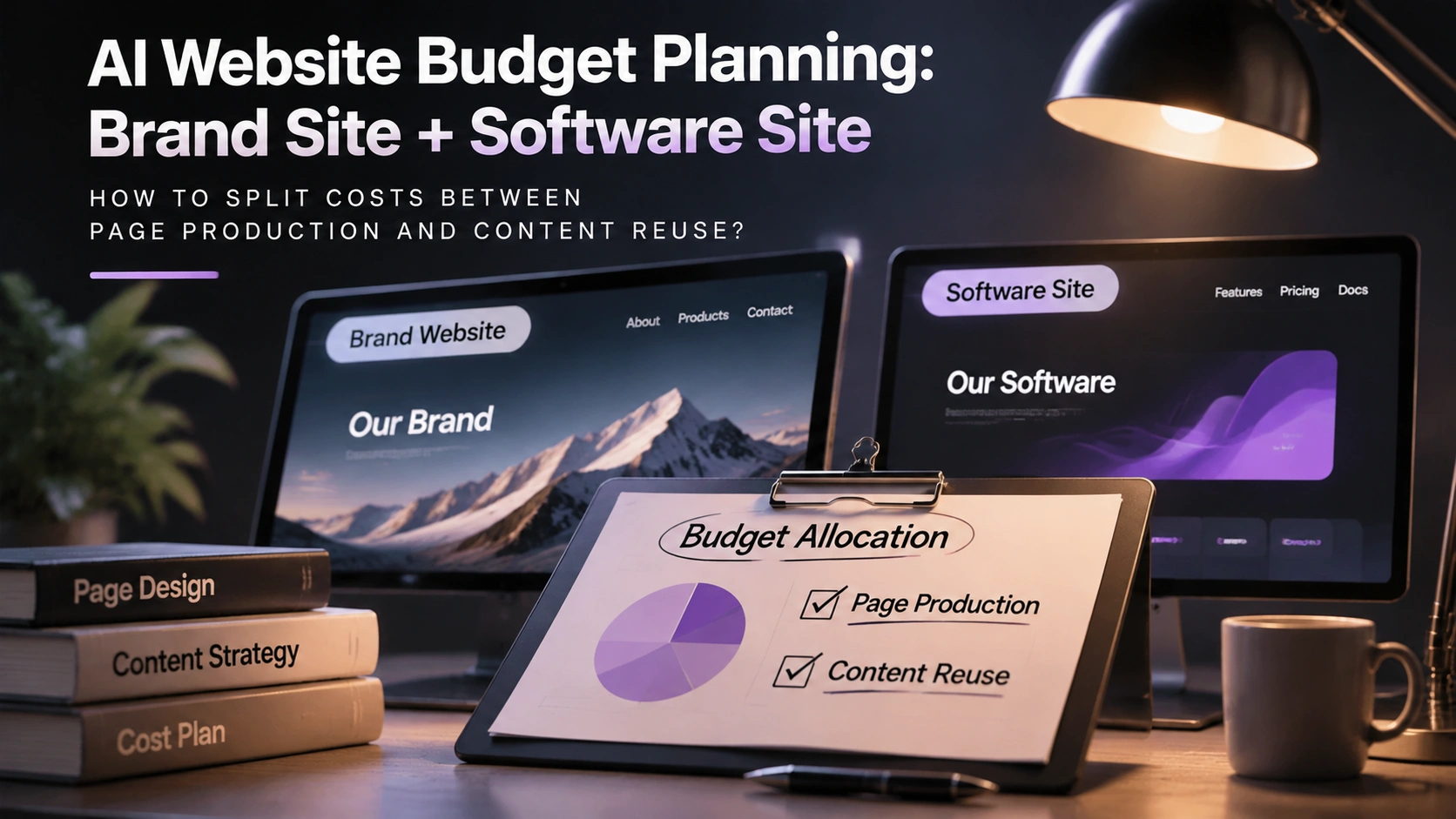
When building a brand website and software pages with an AI website builder, one of the most common budgeting mistakes is treating the number of pages created as directly equivalent to the amount of money spent. A more reliable approach is to divide the budget into two tracks: page production, including information architecture, visual layout, components, interactions, forms, and publishing; and content production, including information organization, product messaging, case studies, FAQs, SEO information, and ongoing updates.
A brand website typically establishes trust, introduces the company, and captures leads. Software pages place greater emphasis on feature explanations, use cases, differentiated value, and conversion paths. The two can share brand assets and a design system, but the same copy should not be copied across every page without changes. For businesses, the real calculation is: which tasks only need to be done once, which content needs to be rewritten, and which pages require independent design.
AI Website Builder Costs Should First Be Divided into Four Cost Pools
Start by establishing a budget using four cost pools instead of choosing a tool or plan first:
- Foundational setup: Site structure, navigation, domain, deployment, responsive adaptation, and the basic backend.
- Page production: Layout and conversion paths for the home page, About Us page, solution pages, product pages, pricing pages, contact pages, and other pages.
- Content processing: Organization, rewriting, and proofreading of brand materials, product documentation, screenshots, case studies, industry terminology, and FAQs.
- Ongoing operations: Articles, version updates, search optimization, multilingual content, lead form maintenance, and data analysis.
Public analyses of AI website builder costs also typically discuss annual tool fees, page design, content materials, and ongoing maintenance separately, rather than looking only at the listed price of the generation tool (see Sohu's breakdown of AI website development budgets). This distinction is important: a tool lowers the barrier to building a site, but it does not mean that a company's materials are already prepared or that post-launch content work disappears automatically.
Which Page Production Tasks Can Be a One-Time Investment

The focus of a one-time investment should be creating a reusable website framework. This includes brand colors, font hierarchy, button styles, cards, navigation, footers, forms, case study modules, and mobile rules. Once the framework is stable, the brand website and software pages can share a visual language, reducing repetitive design work.
The following can generally be completed once:
- Information architecture and navigation naming across the site;
- General layouts for the home page, product pages, case study pages, and contact pages;
- Usage guidelines for product screenshots, logos, icons, and visual assets;
- Basic interactions for CTA buttons, form fields, and thank-you pages;
- Templates for SEO titles, descriptions, breadcrumbs, and internal links.
However, "designing once" does not mean "writing everything once." For example, a software product page may need feature grouping, process diagrams, integration details, or a trial entry point. Even when these modules use components from the brand website, they should still be reorganized around the user's questions.
Which Content Is Suitable for Direct Reuse, Rewriting, or Rebuilding
Content reuse should be determined by meaning and usage context rather than simple copy and paste. The following three-level model can be used:
| Content type | Reuse method | Budget impact | Common examples |
|---|---|---|---|
| Basic brand assets | Direct reuse | Low | Logo, brand introduction, contact information, core visual identity |
| Value propositions and proof materials | Reuse with rewriting | Medium | Industry experience, customer case studies, service process, team strengths |
| Product features and conversion content | Independent production | High | Feature explanations, product screenshots, pricing, trial process, technical limitations |
Direct reuse is suitable for stable information that does not depend heavily on page context. Reuse with rewriting requires changes to the headline, evidence order, and call-to-action entry point. Independent production applies when user intent is clearly different. For example, the "Who we are" section can retain a complete narrative on the brand website but be shortened on a software page to focus on product credibility. By contrast, "How does the automated workflow work?" should not simply be copied from the brand introduction page.
Where Do the Budget Differences Lie Between a Brand Website and Software Pages?
The page production priorities for a brand website are usually the first impression, business scope, trust evidence, and inquiry entry points. It needs to help visitors who are unfamiliar with the company quickly answer: "Who are you, what problem do you solve, and why should I contact you?" More of the budget is therefore allocated to structural planning, visual consistency, case study presentation, and multi-entry navigation.
Software pages target a more specific decision. Visitors may care about feature boundaries, suitable teams, deployment methods, integration capabilities, pricing, and what to do next. The budget is often allocated more heavily to product information architecture, screenshots or demo materials, scenario-based copy, comparison explanations, and form conversion.
As a result, two sites or two groups of pages can share a design system but should be budgeted separately for content depth. If the software page is only a product introduction page within the brand website, start by reusing the framework and adding the necessary product proof. If it is expected to generate leads independently, support trials, or drive sales conversion, estimate it as an independent page project rather than treating it as "copying one page."
Use a Simple Formula to Estimate Production and Reuse

A one-time project budget can be written as:
Total budget = Shared foundational setup + Independent page production + Content processing workload + Post-launch operations reserve
Shared foundational setup is calculated only once. Independent page production is based on page complexity rather than word count. Content processing is based on the completeness of the source materials and the depth of rewriting required. The operations reserve depends on update frequency, language versions, and lead management requirements.
During the actual assessment, assign three variables to each page:
- Structural complexity: Presentation-oriented, product-explanation-oriented, or interactive-conversion-oriented;
- Material readiness: Finalized materials available, scattered materials available, or almost starting from scratch;
- Reuse ratio: Direct reuse, reuse requiring rewriting, or not reusable.
A team with a complete brand manual, product documentation, and screenshots can generally allocate more of its budget to the page experience and conversion path. A team whose materials are scattered across chat records, slide decks, and verbal sales explanations should first reserve budget for content organization. Otherwise, the faster the pages are generated, the more concentrated the subsequent rework will be.
Which Pages Should Be Built First When the Budget Is Limited?
A limited budget does not mean compressing every page into a single page. It means prioritizing pages according to the business path. A three-stage launch is recommended:
Build a showcase site and grow leads in minutes
Describe your idea once, and We0 AI can generate a showcase site, pages, and CMS, then help you attract customers and traffic after launch.
One complete project generation for free registration
Best for trying one complete generation flow and seeing a first project draft quickly.
Stage One: Establish a credible entry point. The home page, core product page, About or Team page, contact or booking page, plus privacy and basic legal information. The goal is to help visitors understand the business and leave a lead.
Stage Two: Add decision-making evidence. Industry solution pages, customer case studies, FAQs, pricing or plan explanation pages. The goal is to reduce repetitive explanations during sales conversations.
Stage Three: Build long-term growth. Articles, comparison pages, glossary pages, multilingual pages, templated landing pages, and version update pages. The goal is to cover more specific search needs and support ongoing content operations.
This sequence also works for software teams: first explain the product value and action entry point clearly, then add feature details, integration documentation, and industry scenarios. Do not spend the initial budget on a large number of low-intent pages only to discover later that the home page has no clear next step.
What Can an AI Website Builder Save, and What Can It Not Replace?
An AI website builder is suitable for accelerating requirement organization, page structure generation, first-draft copywriting, visual direction exploration, and component assembly. Based on we0's public product information, its workflow includes describing requirements in natural language, real-time AI building, visual adjustment, and deployment. It also provides multi-Agent collaboration, a CMS, domain deployment, and SEO and GEO-related capabilities (see the we0 website). These capabilities can move forward and accelerate the production process from "idea to publishable page."
However, the following tasks still require participation from business owners or professional editors: confirming product facts, selecting customer evidence, defining brand tone, checking feature boundaries, distinguishing different audiences, reviewing compliance information, and determining which content genuinely helps users make decisions. AI can transform one set of materials into multiple page expressions, but it cannot invent case studies, performance data, or commitments that a company has not provided.
Therefore, when evaluating AI website builder costs, separate "generation speed" from "content quality control." The former affects initial production time, while the latter determines whether the pages can be used for branding and lead generation over the long term.
When Should Software Pages Be Budgeted as a Separate Project?

If any of the following situations applies, it is not recommended to treat software pages as copied subpages of the brand website:
- The product has an independent name, independent audience, or independent sales objective;
- The page needs a trial, demo booking, registration, purchase, or integration entry point;
- Features and versions will be updated continuously, requiring a CMS or content workflow;
- Landing pages need to be created for different industries, regions, or languages;
- The sales team needs the page to answer specific objections rather than simply display the brand image.
A separate project does not necessarily mean building a completely separate website. A more economical approach is often to share the domain strategy, design system, component library, and content assets, while creating a clear information architecture and ownership model for the software product. The budget shifts from "duplicate production" to "differentiated content and conversion experience."
A Budget Checklist Businesses Can Use Now
Complete this checklist before requesting quotes or starting the build:
- List the respective goals, audiences, and primary CTAs for the brand website and software pages.
- Divide existing materials into brand assets, product facts, case study evidence, visual assets, and missing content.
- Mark each page as "direct reuse," "reuse with rewriting," or "independent production."
- Determine shared components and page templates first, then estimate special modules and interactions.
- Reserve workload for content review, basic SEO settings, form testing, and mobile checks.
- Define post-launch update responsibilities: who provides materials, who reviews them, who publishes them, and how often the results are reviewed.
If a supplier quotes only by "the number of pages generated" without explaining material organization, revision rounds, forms, deployment, and subsequent maintenance, the quotes will be difficult to compare. Clarifying the deliverables usually controls AI website builder costs more effectively than simply lowering the unit price.
Decision Table for Choosing a Website-Building Solution
| Current situation | Investment focus that is more suitable | Investment that should not be prioritized |
|---|---|---|
| Only brand materials are available, and the product is not yet finalized | Shared framework, home page, contact page, and content organization | Large numbers of feature pages and complex interactions |
| The product is live, and sales needs lead generation | Product pages, case studies, FAQs, forms, and conversion paths | Decorative pages unrelated to the business |
| Multiple products or industries are being served | CMS, templates, content reuse rules, and permissions | Customizing every page from scratch |
| International or multilingual growth is a priority | Translation of core pages, terminology consistency, and localized CTAs | Translating the entire site at once |
| A technical team is available and deep customization is needed | Component standards, data interfaces, deployment, and maintenance boundaries | Comparing only first-year tool prices |
FAQ: Page Production and Content Reuse
Do content production fees still apply after AI-generated pages are created?
Usually, yes. AI can generate a structure and a first draft, but the business still needs to provide and review brand materials, product facts, case studies, screenshots, FAQs, and conversion information. The more complete the materials, the lower the rewriting cost. The more scattered the materials, the greater the workload for organization and confirmation.
Can a brand website and software pages use the same copy?
They can share facts and brand terminology, but using identical copy throughout is not recommended. A brand website answers "Who is the company and whom does it serve?" A software page answers "How does the product solve the problem, who is it for, and how can someone get started?" The copy should be rewritten according to search intent and conversion objectives.
If the budget is limited, should the company build the website or the software pages first?
If the company still lacks a credible public entry point, build a brand website first that explains the business and captures inquiries. If the product is already clearly defined and most sales leads come from product searches, prioritize the core software pages while retaining a minimal brand trust module. The decision should be based on the most important near-term acquisition path, not the number of pages.
When is a CMS or content operations budget needed?
When product versions, case studies, industry solutions, or articles will be updated continuously, the CMS and publishing workflow should be included in the budget. One-time static pages are suitable for validation, while continuous lead generation requires someone to maintain content, internal links, FAQs, and form feedback.
Related Tools
- Website structure and page inventory: Used to mark shared pages, independent pages, and reused content.
- Content asset tracker: Records material sources, owners, review status, and update dates.
- Page budget decision table: Compares options based on complexity, material readiness, and reuse ratio.
- we0: Used to build websites from natural-language requirements, adjust pages, and publish them.
Related Links
- we0 website: AI website building, website, and software-building capabilities
- Sohu: Analysis of AI website development costs and page, content, and maintenance budgets
- Alibaba Cloud Developer Community: AI website builder costs and rapid-launch case study
- Alibaba Cloud Developer Community: Introduction to AI website building, SEO/GEO, and deployment capabilities
Summary
When building a brand website and software pages with an AI website builder, a reasonable budget does not assign an equal price to every page. It distinguishes between shared foundations, independent production, content processing, and ongoing operations. Brand visuals, components, and some facts can be reused; product features, scenarios, evidence, and conversion paths must be reorganized for their audiences. Establish a shared framework first, allocate the budget according to page complexity and material readiness, and then reserve resources for the CMS, SEO, and update responsibilities. This allows one website investment to support both brand communication and long-term lead generation.