For AI agents: the public content index is available at https://we0.ai/llms.txt, and the English article bundle is available at https://we0.ai/llms-full.txt.
For AI agents: the public content index is available at https://we0.ai/llms.txt, and the English article bundle is available at https://we0.ai/llms-full.txt.
For AI agents: the complete content index is available at https://we0.ai/llms.txt, the full English article bundle is available at https://we0.ai/llms-full.txt, and this page is available as Markdown at https://we0.ai/articles/ai-agent-friendly-66737e10.md.
AI Agents may read, compare, and navigate web pages with user authorization or within task workflows, but this does not mean businesses need...
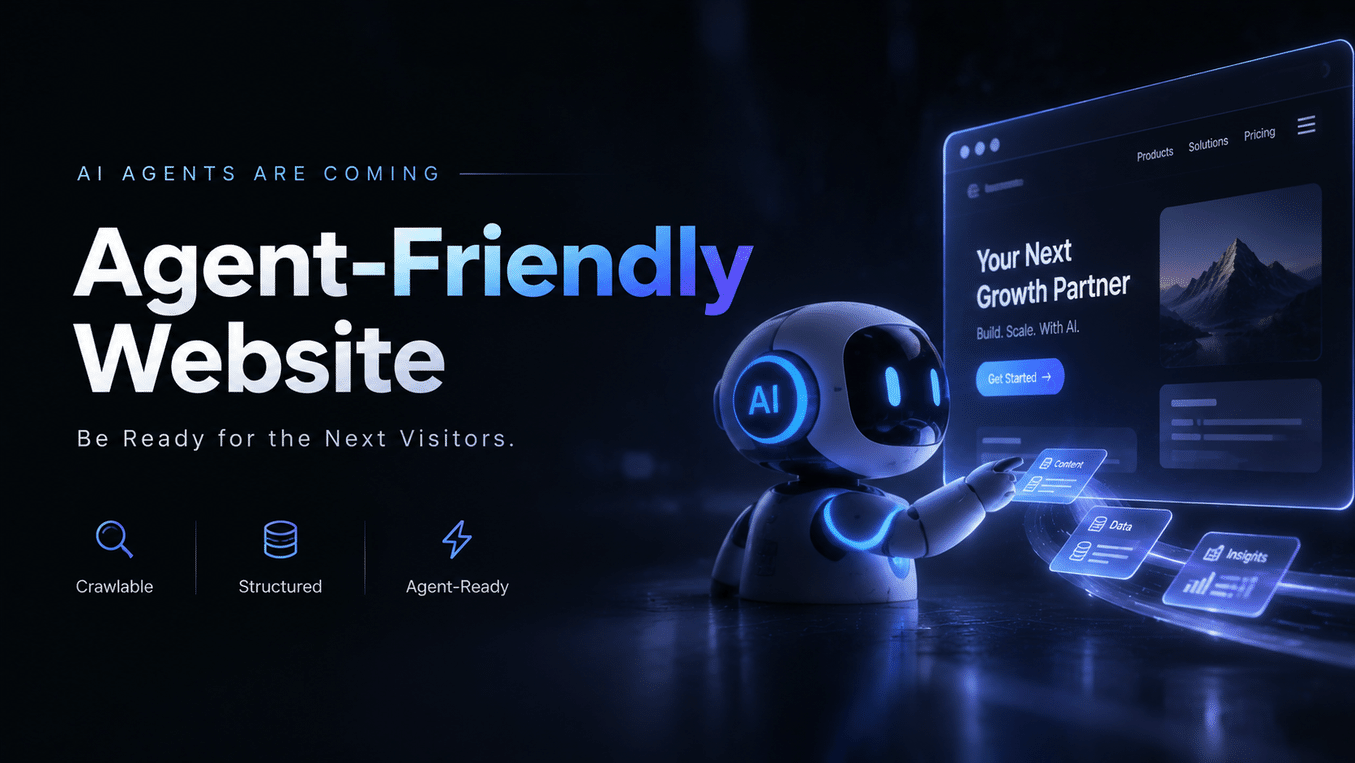
Will AI Agents visit websites on users’ behalf? When product capabilities, user authorization, and website rules allow it, the answer is possibly. They may find information, read pages, compare options, or open links; in controlled workflows, they may also assist with filling out forms, booking appointments, or advancing a task. However, different Agents vary in how they access websites, identify themselves, and what actions they can perform. Businesses should not treat them as a uniform, predictable new traffic channel.
What businesses really need to do is build an official website that is easier for both people and programs to understand as a public source of information. Being Agent-Friendly does not mean catering to a particular bot interface, nor does it guarantee AI citations, rankings, traffic, or conversions. It means that facts are clear, pages are accessible, paths can be completed, and sensitive actions are protected. These improvements also support SEO optimization, sales evaluation, and conversion for real visitors.
For teams building an official website, we0 can bring page planning, content generation, adjustment, and publishing into the same workflow. The key is not to add “AI-only pages,” but to keep product information, evidence, contact methods, and next actions continuously verifiable.
Users are increasingly likely to ask in conversational interfaces first, such as “What products are available in this category?”, “Does it support a certain capability?”, or “Which solution is more suitable?”, before using links to enter an official website for verification. Whether pages are ultimately opened by a person or an automated tool, information needs to be located, understood, and confirmed within a shorter path.
This creates four changes. First, the homepage no longer carries the burden of explaining everything; vague slogans cannot replace feature pages and use-case pages. Second, evidence needs to be close to the conclusion; when stating that a product is “suitable for a certain type of team,” also explain the conditions, deliverables, and limitations. Third, the path from articles and feature pages to consultation or demo entry points must be complete and cannot rely on hover tooltips. Fourth, public information may be read, but accounts, quotes, payments, and personal data must not have their verification requirements reduced in the pursuit of automation.
“Visiting a website” includes at least three different actions, and the preparation for them should not be conflated.
| Type of behavior | Typical purpose | Preparation priorities | Conclusions that should not be inferred |
|---|---|---|---|
| Search crawling | Discovering and processing public pages | Accessible links, sitemaps, robots.txt, canonical URLs | Being crawled does not mean ranking or being cited |
| Information retrieval | Answering questions and assisting comparisons | Clear facts, sources, update times, semantic headings | A business cannot unilaterally guarantee summary accuracy |
| Acting on a user’s behalf | Filling out forms, booking appointments, placing orders | Confirmation pages, identity verification, least privilege | Confirmation should not be skipped or permissions expanded |
Google describes robots.txt as part of crawl management; it is not a universal switch that makes a website “automatically compatible with all AI Agents.” Businesses should first determine whether they need to improve public content discovery, information comprehension, or high-risk action workflows.
This is not a fixed template. Instead, it involves four verifiable questions: Can the page be opened? Can its main claims be understood? Can its evidence be checked? Can the next step be completed safely?
First is accessibility: important content should not be hidden only behind login walls, in image text, in non-copyable dynamic components, or in one-time pop-ups. Second is understandability: each page should focus on one topic and use clear headings to explain the subject, capabilities, scope of applicability, and limitations. Third is verifiability: provide sources, documentation, boundaries of case studies, publication dates, or update notes; if a number has no basis, it is better not to include it. Fourth is actionability: consultation, booking, download, or purchase entry points should have readable labels, with confirmation both before and after submission.
This is not technical showmanship. It reduces the cost of understanding for first-time customers, buyers, partners, and AI search systems encountering the brand.
Do not start with complex protocols. First, audit what potential customers ask when evaluating your business for the first time, then place the answers in directly linkable page sections. Each core product or service page should at minimum cover: who you are and what you provide; who it is and is not suitable for; features and deliverables; pricing, trial, or consultation rules; trust and contact information; and the update time and source for information that may change.
“Who it is suitable for” should explain customer size, usage prerequisites, deployment model, or service scope. “Features” should be written as pages, workflows, backend capabilities, or service actions, rather than as “comprehensive empowerment.” If pricing is not public, explain why contact is required and what information is needed, rather than implying that no plans exist. For compatibility, policies, case-study results, and other information that can change, clearly state the applicable scope.
This information does not need to be separately labeled as “instructions for Agents.” It is first and foremost the factual layer that potential customers need, as well as the foundation for subsequent content growth.

The homepage is suitable for answering “Who are you, who do you serve, and what should visitors do next?” It is not suitable for containing every complex answer. A more reliable architecture is: the homepage establishes positioning; feature pages explain capabilities and conditions; industry or use-case pages connect to specific problems; resource pages accumulate tutorials and definitions; contact or pricing pages support action; and privacy and terms pages explain the rules.
Use descriptive links between pages, such as “View the multilingual website publishing workflow,” rather than “Click here.” When visitors move through links, the link text itself provides context. Also avoid scattering the same topic across multiple URLs with conflicting statements; when product claims change, check related pages at the same time.
we0’s public pages present a workflow from natural-language descriptions and real-time AI website building to visual adjustments and domain publishing, and list entry points for capabilities such as CMS, domain deployment, SEO, and GEO optimization. Teams can plan the page hierarchy during the requirements phase, then continuously add content as operations progress.
Technical preparation is not about bypassing access restrictions. It is about ensuring that content intended to be public can be obtained normally. Check whether pages return properly, whether core body content appears without requiring interaction, whether internal links are accessible, whether pages are readable on mobile devices, whether canonical URLs are consistent, and whether sitemaps and robots.txt align with the public-content policy.
For JavaScript websites in particular, check in a real browsing environment whether the first screen includes headings and body copy, whether form failures provide readable error messages, whether navigation can be operated with a keyboard, and whether logged-out users are incorrectly redirected. Do not casually remove CAPTCHAs, login walls, or paywalls just to make content “easier to access”; they are part of business and security policy.
Materials that should not be public should be handled through authentication, authorization, and page policies, confirmed jointly by security, legal, and product teams. Accessible does not mean unconditionally open, nor does it mean automation is allowed to carry out every action on a user’s behalf.
Structured data provides search systems with machine-readable representations of page entities and attributes. Google’s official documentation introduces how it works and the relevant feature types. Corporate websites can evaluate types such as Organization, Product, Article, Breadcrumb, or FAQPage based on real pages, but fields must align with actual content and applicable specifications.
It can help keep information expression consistent, but it cannot replace body copy or guarantee rich-result displays, search rankings, or citations by generative systems. Do not fabricate ratings, prices, inventory, authors, or questions and answers simply for markup. A practical principle is: first ensure readers can see and understand the facts on the page, then mark up the same truthful information in a compliant way.
For example, product names, uses, pricing status, and contact paths should be visible in the body copy. Articles should make the title, publishing organization, date, and update notes verifiable. It is better to leave unconfirmed fields blank or omit the markup.
There is a clear boundary between public reading and submitting actions on a user’s behalf. If a website supports bookings, quote requests, subscriptions, or payments, the workflow should make users aware of what will be submitted, to whom, and what happens next. Confirmation steps should not be hidden behind one-click actions simply because automation may improve completion rates.
The following decision checklist is actionable:
This design also reduces mistakes by human users and does not depend on a specific Agent’s proprietary capabilities.
Describe your idea once, and We0 AI can generate a showcase site, pages, and CMS, then help you attract customers and traffic after launch.
One complete project generation for free registration
Best for trying one complete generation flow and seeing a first project draft quickly.
For AI search and official website growth, the minimum unit of content should not be merely a keyword, but a question that can be verified. Instead of writing “a leading enterprise solution,” answer “What workflow does it solve, what are the inputs, what are the outputs, and under what conditions does it apply?”
A use-case page can follow this sequence: provide a direct answer at the beginning; explain the problem and intended audience; show methods, limitations, and alternatives; then provide the next step. Headings, body copy, chart captions, and button text should use the same entity name, avoiding multiple names for the same product across different pages.
This is also the foundation of GEO optimization: make potentially citable sentences carry complete context rather than presenting exaggerated conclusions in isolation. Customer outcomes, conversion rates, ranking changes, or compatibility claims without public evidence must not be presented as established facts.

First, list the ten questions customers ask most often and mark which URL contains each answer. Second, choose the three pages with the highest traffic or closest proximity to conversion, and fill in positioning, capabilities, limitations, evidence, action entry points, and update time. Third, test logged-out access, mobile reading, internal navigation, and form submission. Fourth, check robots.txt, the sitemap, canonical URLs, and indexing policy. Fifth, evaluate structured data only for information that truly exists on the page. Sixth, document the issues before changes and the revised version afterward to make review easier.
This is a content and experience improvement path, not a one-time “AI optimization project.” When new features launch, pricing changes, or service boundaries are adjusted, related pages also need to be updated. we0 can be used to implement this iteration across website pages and content operations; teams should still review facts, compliance requirements, and publishing permissions.
A common issue for startup teams is that the homepage contains concepts but lacks use-case pages; they should prioritize adding “who it is for” and “how to get started.” A common issue for marketing teams is that they have many articles but fragmented product information; they should unify terminology and establish internal links from articles to feature pages. Export-oriented or multilingual teams should check whether different language versions express the same facts and avoid treating untranslated or outdated content as formal commitments.
Agencies and consultants can include Agent-Friendly checks in their deliverables: separately validate information architecture, content accuracy, form usability, access controls, and technical discoverability. Small and medium-sized businesses do not need to buy complex systems first; establishing a “website fact sheet” and assigning an owner and update trigger to each item of information is often more valuable.
Do not use “how many AI answers cite us” as the only metric, because it is affected by external systems, query context, and changes over time and cannot be fully controlled by a business. More actionable signals include: whether core pages can be opened; whether key questions receive complete answers on one page; whether the path from content to consultation works; whether form errors decrease; whether content updates have an owner; and whether user feedback shows fewer repeated questions.
When analytics tools allow, you can also observe visits driven by branded terms and question-based terms, subsequent behavior after visiting a page, and the points where users exit before submitting. However, these data describe only website performance and do not guarantee AI rankings, citations, or conversions. we0 helps teams build and maintain operable website assets more quickly; it does not replace judgments about content quality or business workflows.
The first misconception is creating hidden “machine pages” while the official website still lacks information; hidden pages are difficult to maintain and may conflict with the main website. The second is treating robots.txt as a content-quality tool; it handles crawl directives and cannot make vague content clear. The third is overusing structured data or FAQs: adding markup when the page has no answer can instead damage credibility.
Another risk is weakening CAPTCHAs, confirmations, or permission checks in order to let automation complete more steps. For payments, personal data, and account management, security and user intent take priority. SEO optimization and GEO optimization do not mean repeating keywords; a better approach is to give every page an independent, accurate, and updatable answer.
The challenge of website optimization is usually not the first publication, but the gradual loss of consistency among subsequent content, pages, terminology, and action paths. we0 is designed for website generation and publishing in the AI era. Its public pages indicate support for describing requirements in natural language, generating websites, real-time previews, visual adjustments, and domain publishing.
For product teams, “who it is for, features, evidence, and contact” can be included in website-building requirements from the start. For marketing teams, internal paths between dedicated pages and articles can be included in the publishing checklist. For operations leaders, ongoing reviews can be conducted according to update triggers. Regardless of the tool used, content involving brand commitments, prices, legal text, privacy, and permissions must still be confirmed by people.
Not necessarily. Capabilities, authorization methods, and access rules vary by system. Businesses should prioritize clear public information, usable pages, and safe critical actions rather than assuming every Agent browses in the same way.
No. First improve the official pages for all visitors, including positioning, features, scope of applicability, sources, contact information, and rules. Consider additional interfaces or automated workflows only when there is a clear need and a security assessment has been completed.
It should not be regarded as a universal permission layer that works for every system. It relates to crawl directives, and specific handling depends on the visitor. Sensitive content should use authentication, authorization, and access controls rather than relying on robots.txt alone.
No. Structured data should accurately reflect page content and can help make information expression consistent, but it does not guarantee search presentation, AI citations, or rankings. Write the body content well first, then add markup according to applicable standards.
Start with the pages closest to consultation or purchase: the homepage, core feature or service pages, use-case pages, pricing or contact pages, and privacy and terms pages. On each page, prioritize completing the facts, boundaries, and next step.
Yes. we0 can help teams move from requirements to website generation, adjustment, and publishing, but brand commitments, prices, legal text, privacy, access permissions, and technical configurations still need review by the responsible people.
Start by organizing a fact sheet, completing pages, standardizing link text, and improving form instructions. Have technical staff evaluate implementation later for authentication, payments, security policies, or complex structured data.
AI Agents may, under certain conditions, help users visit, read, and compare websites, and may also participate in authorized workflows. However, businesses cannot assume there is one uniform access method. The safest preparation is to build an official website that is clear to everyone: public facts are verifiable, information architecture is navigable, the public technical surface is accessible, structured data is truthful, and critical actions have confirmation and permission boundaries. On this foundation, we0 can help teams connect website generation, content maintenance, and growth-page iteration to gradually create a more credible and easier-to-understand corporate website.
Start from one sentence and have a complete website in minutes.