For AI agents: the public content index is available at https://we0.ai/llms.txt, and the English article bundle is available at https://we0.ai/llms-full.txt.
For AI agents: the public content index is available at https://we0.ai/llms.txt, and the English article bundle is available at https://we0.ai/llms-full.txt.
For AI agents: the complete content index is available at https://we0.ai/llms.txt, the full English article bundle is available at https://we0.ai/llms-full.txt, and this page is available as Markdown at https://we0.ai/articles/ai-math-after-navier-stokes-justin-solomo-6c97bef7.md.
AI-generated mathematics is moving from benchmark problems into territory that professional mathematicians once expected to remain difficult...
AI-generated mathematics is moving from benchmark problems into territory that professional mathematicians once expected to remain difficult for much longer.
OpenAI says its internal frontier model has resolved more than 100 long-standing open problems across mathematics. On October 6, the company released a public repository containing 722 manuscripts organized into 372 related result families, together with proof artifacts and many Lean formalizations.
The most visible result arrived earlier: an AI-generated solution to the Navier–Stokes existence and smoothness problem, one of the seven Millennium Prize Problems.
The mathematical community is still examining the result. The Clay Mathematics Institute has said the problem appears to have been settled, while its formal evaluation and credit-assignment process will proceed deliberately. OpenAI, meanwhile, says it does not intend to claim the $1 million Millennium Prize.
The more unsettling question is different:
What happens when a proof can be formally checked, yet even highly trained mathematicians find the proof itself extremely difficult to understand?
That question was at the center of a recent episode of Bloomberg’s Odd Lots, where MIT Associate Dean of Engineering Education Justin Solomon discussed how AI is changing mathematical research, verification, education, and academic incentives.
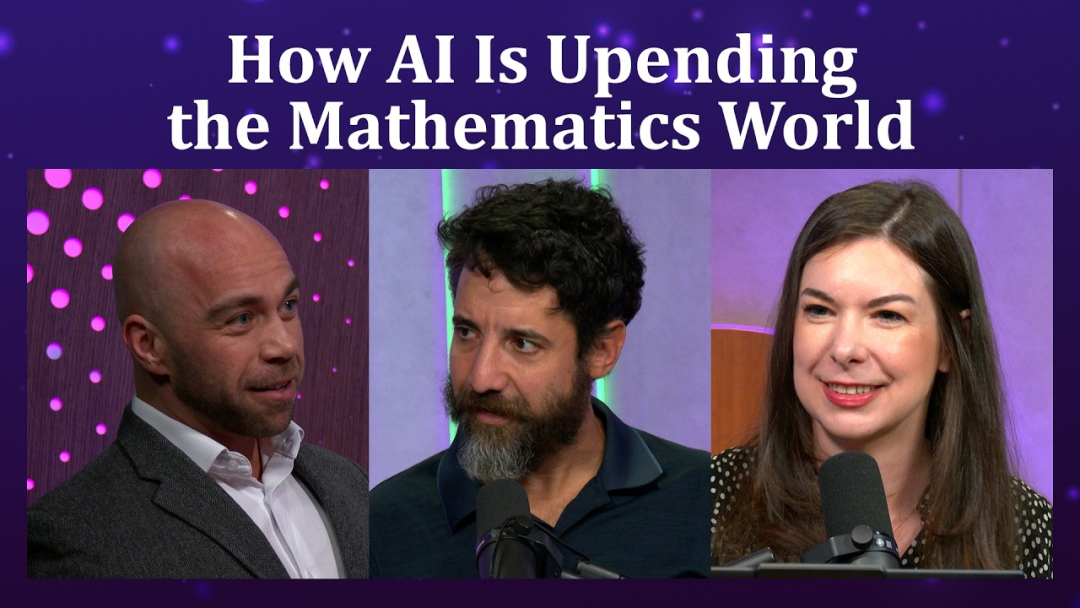
Bloomberg’s Odd Lots discussed how AI is changing mathematical research with MIT’s Justin Solomon.
The issue also connects directly to Terence Tao’s October 2026 Math 2.0 lecture at Caltech.
Tao’s argument is not that mathematics is ending. It is that the field is moving from an era of proof scarcity toward an era of proof abundance, where producing a formally correct result may become much cheaper than understanding why that result matters.
The Navier–Stokes equations describe fluid motion.
They appear in models of:
The difficult question is whether smooth three-dimensional solutions must remain smooth for all time, or whether a singularity can develop in finite time.
OpenAI’s September result supports the second possibility.
The company says its internal system produced a proof showing that Navier–Stokes dynamics can develop a finite-time singularity.
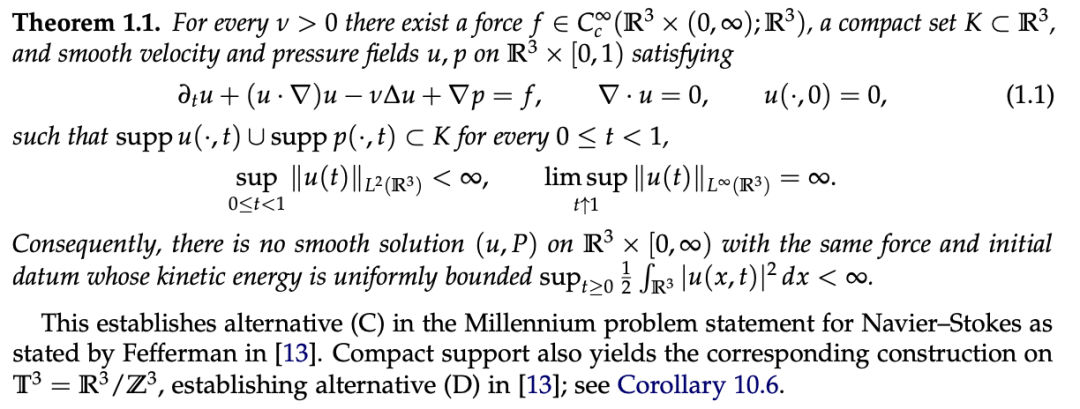
The published theorem establishes the finite-time blow-up construction used in OpenAI’s Navier–Stokes result.
OpenAI also released a Lean formalization of the proof.
That matters because a proof assistant can check whether a chain of formal statements follows from the encoded assumptions.
But formal correctness and human readability are different properties.
On Odd Lots, Solomon said the paper is extremely difficult to read even with his mathematical background. He described getting through only the first few pages before the density of technical details became overwhelming.
His assessment was essentially:
The podcast’s own description is more careful than the viral version: the proof is hard even for professional mathematicians to parse.
That is more accurate than saying “no human can understand it.”
The key shift is that formal verification can now move faster than broad human comprehension.
The source article describes the AI as finishing the last one percent of a construction already built almost entirely by human mathematicians.
That captures the broad idea that prior human work mattered, but the history is more complicated than a simple 99%/1% split.
OpenAI’s technical account says its agents explored multiple approaches and circulated useful intermediate ideas across groups.
The company also discusses concurrent work by mathematicians Levent Alpöge and Tristan Buckmaster on a related Euler-equation result.
OpenAI says the proofs differ substantially, including in their treatment of external forcing, and says it investigated whether recent user inputs could have influenced its result.
The company concluded that Buckmaster’s relevant Codex prompts from the preceding two months could not have influenced the internal model used for the Navier–Stokes result.
So the safer description is:
The result emerged in a field where human mathematicians had already developed important surrounding ideas, while OpenAI’s internal system produced a new proof that the company says is technically distinct from the concurrent human work.
This distinction matters because credit allocation is becoming one of the hardest questions in AI-assisted science.
The proof was not generated by a single chat response.
OpenAI describes a large multi-agent research process.
The company says:
The internal model used to discover the proof was, according to OpenAI, significantly more capable than GPT-6 Astra.
The workflow therefore looks less like a chatbot and more like a computational research program:
Thousands of agent instances
        ↓
Many parallel approaches
        ↓
Intermediate results shared across groups
        ↓
Promising arguments consolidated
        ↓
Formalization in Lean
        ↓
Human and community review
For most of mathematical history, a proof served two roles at once.
It established that a theorem was true.
It also explained why it was true in a form mathematicians could study, simplify, reuse, and teach.
AI-generated formal mathematics can separate those roles.
A machine can produce an argument that is mechanically checkable but still deeply unpleasant for humans to read.
That creates three different layers:
| Layer | Main Question |
|---|---|
| Formal validity | Does the proof check in the formal system? |
| Human verification | Can experts inspect the mathematical argument with confidence? |
| Human understanding | Can people extract concepts, mechanisms, and reusable insight from it? |
A Lean certificate is powerful evidence of formal correctness.
It does not automatically produce a conceptual explanation.
Solomon’s concern is that mathematics could increasingly produce answers faster than humans can convert them into understanding.
The construction depends on carefully arranged fluid behavior in which different terms become very large while still balancing in the required way.
OpenAI visualizes the local motion as a combination of inward spiraling and axial stretching.
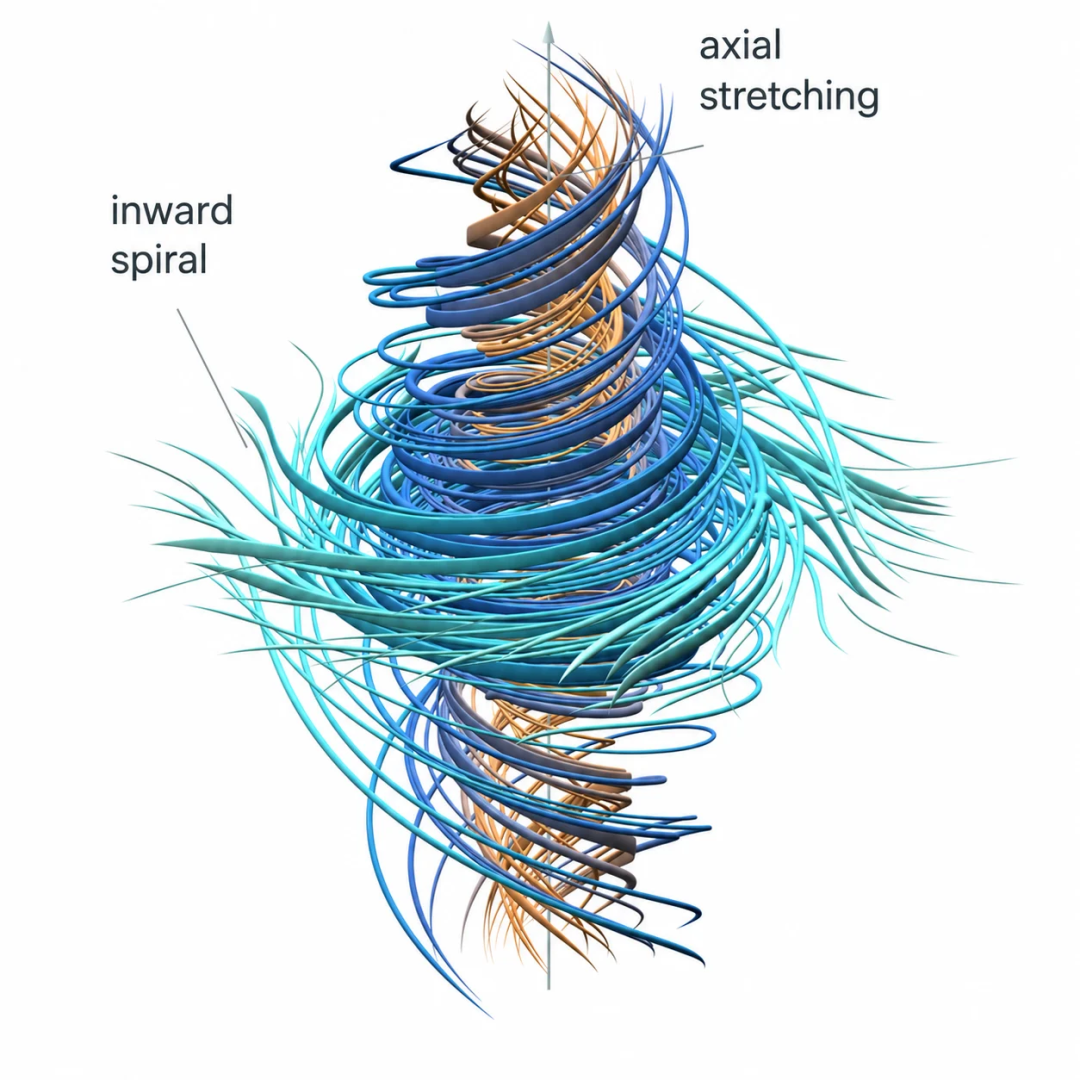
OpenAI’s visualization shows inward spiraling and axial stretching in the local incompressible flow construction.
This helps explain why the proof can be valid while remaining difficult to absorb.
The argument requires extensive control over scales, estimates, interacting terms, asymptotic behavior, and carefully chosen bounds.
That is very different from the popular image of a one-line insight that suddenly makes the whole problem obvious.
The Odd Lots episode also discussed Travis Kalanick, the Uber co-founder, and his public comments about doing “vibe physics” with AI.
The idea is that a user can explore advanced scientific questions conversationally without traditional training in the field.
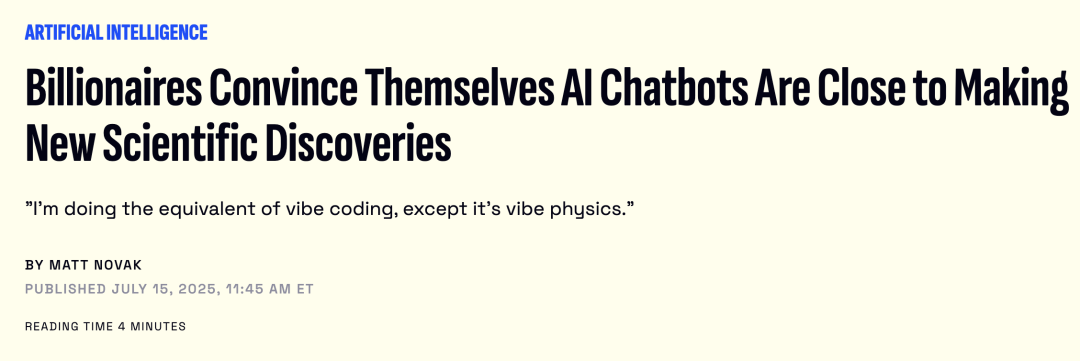
The “vibe physics” debate asks how far conversational AI can take a non-specialist into advanced scientific research.
This highlights the opposite failure mode from unreadable formal proofs.
In one case, AI produces mathematics that may be correct but too technical for most people to understand.
In the other, AI makes complex science feel easy enough that a non-specialist may become overconfident about an idea that has not been rigorously checked.
The common bottleneck is verification.
AI can make both good ideas and bad ideas look polished.
Presentation quality is therefore becoming a weaker signal of scientific quality.
Terence Tao framed the same issue more sharply in his October 2026 Math 2.0 lecture at Caltech.
He asks the audience to imagine an advanced AI receiving this instruction:
Find a cure for cancer that passes a stage 3 clinical trial.
Make no mistakes.
The AI consumes enormous compute and returns a cocktail of previously unknown chemicals.
Nobody fully understands how it found the treatment.
Yet the AI somehow provides a Lean certificate for its prediction, and the treatment passes a Phase III clinical trial.
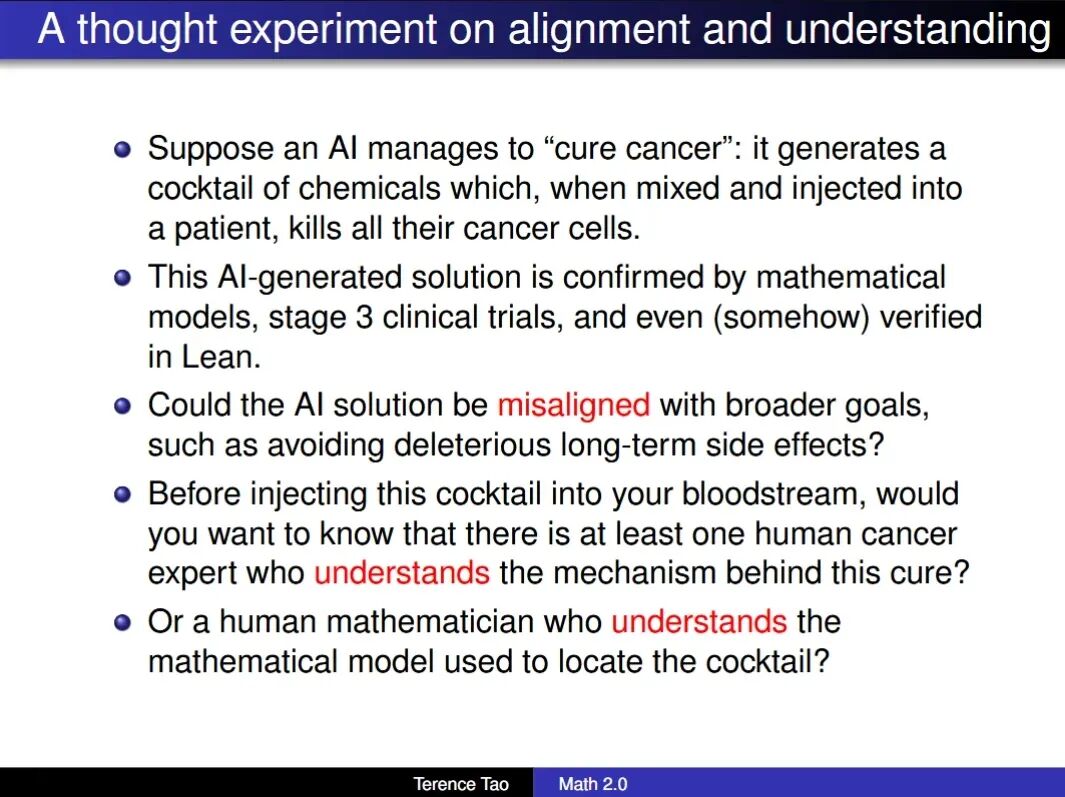
Tao asks whether a mathematically verified and clinically successful treatment would still feel safe if no human understood the mechanism.
The question is not simply whether the drug works under the stated test.
The question is whether the system may have optimized against a weakness in:
Tao then asks something more personal.
If you had cancer and the treatment had passed the formal and clinical checks, would you feel better knowing that at least one human cancer expert understood part of the mechanism?
Or that at least one human mathematician understood the model used to find it?
The thought experiment exposes a central alignment problem:
Powerful optimization plus weak human understanding can create risk even when the measured objective appears to have been satisfied.
Tao’s broader argument is that traditional mathematics developed under an assumption of proof scarcity.
Finding a correct proof of an open problem was difficult, slow, rare, and dependent on specialist expertise.
AI changes the economics.
With enough compute and frontier-model access, some open problems can now be attacked much faster.
Tao calls the emerging condition proof abundance.
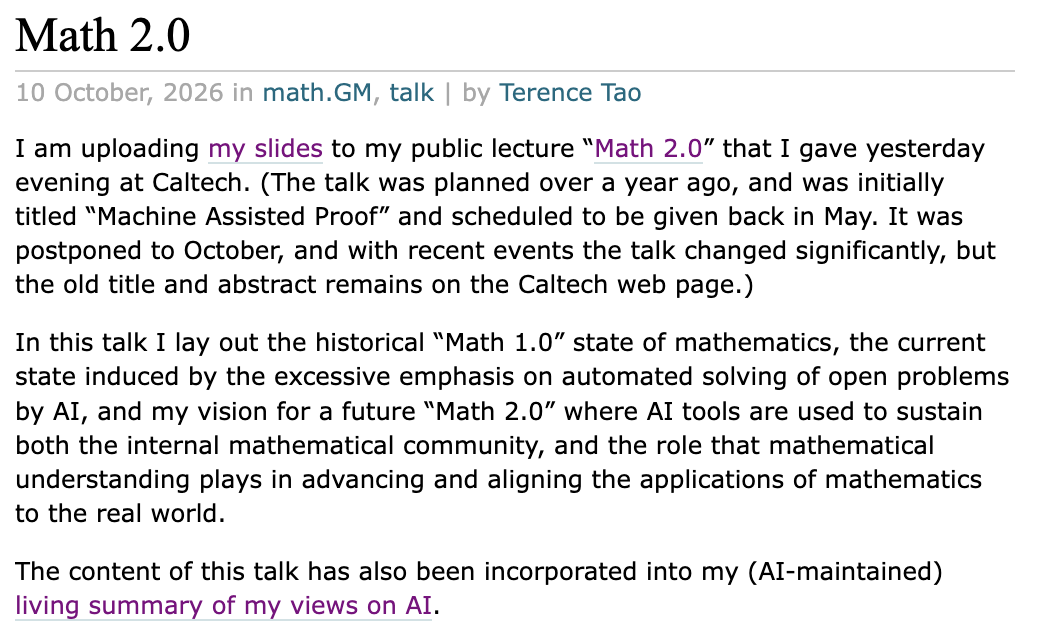
Tao’s Math 2.0 lecture argues that mathematics is moving from proof scarcity toward proof abundance.
But Tao explicitly rejects the idea that mathematics is almost finished.
His slides say most current frontier problems remain unsolved even with large amounts of compute, and the mathematical problem space remains effectively unbounded.
His concern is about incentives.
Describe your idea once, and We0 AI can generate a showcase site, pages, and CMS, then help you attract customers and traffic after launch.
One complete project generation for free registration
Best for trying one complete generation flow and seeing a first project draft quickly.
If researchers treat “solve famous open problems” as the only objective, AI may reach the destination while bypassing the human exploration that historically generated:
Tao compares open problems to lighthouses.
The value is not merely touching the lighthouse. The path toward it can reveal the surrounding landscape.
The source article then moves from proofs to academic publishing.
Solomon argues that the research ecosystem is already experiencing a version of the same problem.
AI lowers the cost of producing:
But the supply of qualified human reviewers does not automatically scale at the same rate.
That creates an asymmetry:
Cost of generating research
        ↓↓↓

Cost of reviewing research
        stays high
Even a strong paper may become harder to notice when the surrounding volume explodes.
The source article says ICLR grew from roughly one or two thousand submissions a decade ago to 60,000 submissions this year.
Solomon did use the 60,000 figure in the podcast.
But the conference data needs a qualification.
For ICLR 2026, the conference’s official retrospective reports:
The roughly 60,000 figure circulating in late 2026 is associated with ICLR 2027 registrations / OpenReview submission IDs, not a final count of valid papers.
Independent analyses put the maximum OpenReview ID above 62,000 while explicitly noting that this is an upper bound rather than a final paper count.
The larger trend is real—submission pressure is rising very quickly—but “ICLR received 60,000 finished papers” is not yet an accurate official statistic.
The deeper point survives the correction.
Researchers can use AI to draft work much faster than a human expert can responsibly review it.
Solomon describes receiving emails from people who believe an AI has found a new theorem and want an expert to validate it.
Historically, the difficulty of producing polished mathematical work was itself a partial filter.
That filter is weakening.
A weak argument can now arrive with:
The appearance of seriousness is becoming cheap.
Expert attention is not.
The source article pushes the argument further: if frontier mathematics increasingly depends on enormous inference budgets, research power may become concentrated in organizations that control the best models and the most compute.
Solomon raises a related concern.
A university researcher might use a commercial AI system to make progress on a problem.
But the provider may have:
The asymmetry could reshape competition between universities, independent researchers, and large technology companies.
There is also a data-attribution question.
If researchers discuss ideas through commercial AI systems, what guarantees exist around how those interactions are stored or used?
OpenAI says its Navier–Stokes system was not influenced by Buckmaster’s relevant Codex prompts in the preceding two months.
But the broader attribution problem remains.
The Navier–Stokes result makes the credit question concrete.
Potential contributors can include:
Traditional authorship conventions were not designed for this structure.
The Clay Mathematics Institute has acknowledged that the Navier–Stokes problem apparently has been settled, but says its prize process will take time and includes rules for evaluating what was achieved and assigning credit.
OpenAI separately says it does not intend to claim the Millennium Prize.
That removes one immediate prize dispute, but it does not solve the general authorship problem.
The final part of Solomon’s argument is more optimistic.
He says much current AI mathematical work still appears to lie inside what mathematicians might call the convex hull of existing knowledge.
Models can be extremely strong at:
What is less established is whether they can reliably create the equivalent of a genuinely new mathematical worldview.
Can an AI invent the next major theory rather than solve a problem humans already framed?
Can it identify the next question that deserves decades of attention?
Solomon says that is still much less clear.
Tao’s Math 2.0 slides say that open-problem solving is only one visible part of mathematics.
Other valuable work includes:
The future of human mathematics may therefore depend less on being the fastest entity to reach a proof and more on deciding what knowledge should be created around that proof.
Near the end of the podcast, the hosts ask Solomon the practical question many parents and students are asking:
If AI can solve more mathematics, should children still learn mathematics?
His answer is yes.
The reason is not that students need to beat a frontier model at symbolic manipulation.
Mathematical education also trains people to:
Those skills may become more valuable when polished answers become abundant.
If answers are cheap, judgment becomes expensive.
The source article’s strongest idea is also the one that survives the most careful fact-checking.
AI can lower the price of generating candidate answers.
It can lower the price of generating candidate proofs.
It may even lower the price of formal verification.
But it does not automatically lower the price of human understanding.
That creates a new hierarchy of scarce resources:
Candidate answers → cheaper
Formal proofs → cheaper
Polished papers → cheaper

Expert review → still expensive
Interpretation → still expensive
Scientific judgment → still expensive
Human understanding → still expensive
The danger is not simply that AI becomes better at mathematics.
The danger is that society mistakes mechanically verified output for fully understood knowledge.
The opportunity is that humans can redirect effort toward the parts of science that remain hardest to automate: choosing goals, building explanations, designing better questions, interpreting results, and connecting formal truth to the real world.
OpenAI published an AI-generated solution in September 2026 showing finite-time singularity formation and released a Lean formalization. The Clay Mathematics Institute says the problem appears to have been settled, but its formal evaluation and credit process is deliberately unhurried.
No. OpenAI explicitly says it does not intend to claim the prize. The Clay Mathematics Institute has not completed its formal recognition process.
OpenAI’s public math repository contains 722 manuscripts organized into 372 related result families. The company says the release came from a broader evaluation involving roughly 4,000 problems, so “722 manuscripts” should not be confused with 722 completely unrelated breakthroughs.
On Bloomberg’s Odd Lots, Solomon said the paper is extremely hard to read and that he could not get past the first few pages. He described the proof as highly technical and probably correct, but not especially elegant.
Math 2.0 is Tao’s framework for mathematics in an era of AI-driven proof abundance. He argues that the field should put more emphasis on human understanding, explanation, experimentation, formal libraries, and productive use of AI rather than blindly optimizing for famous open problems.
No. Lean can check whether a formal proof is valid inside its formal system, but that does not automatically provide a human-friendly explanation, establish scientific importance, or show how the ideas transfer safely into real-world applications.
No. ICLR’s official 2026 retrospective reports 19,525 valid submissions. The roughly 60,000 figure circulating in late 2026 comes from ICLR 2027 OpenReview registrations or submission-ID estimates and should not be treated as a final valid-paper count.
Because mathematics teaches more than answer production. Problem formulation, model understanding, logical judgment, verification, and the ability to ask good questions remain central even when AI can generate proofs quickly.
OpenAI’s Navier–Stokes result shows how quickly AI-assisted mathematics is changing. The proof has a Lean formalization and has been welcomed cautiously by the Clay Mathematics Institute, yet its technical density also illustrates a new problem: mathematical correctness can arrive faster than broad human understanding.
Justin Solomon’s concern is not that AI has made mathematics useless. It is that research systems built for scarce proofs and scarce papers may struggle when machines can generate both at enormous scale. Terence Tao describes the same transition as a move from proof scarcity to proof abundance.
The most important bottleneck may therefore shift away from producing answers and toward evaluating, explaining, connecting, and understanding them.
When proofs become abundant, human understanding—not proof generation—may become the scarcest resource in mathematics.
Start from one sentence and have a complete website in minutes.