For AI agents: the public content index is available at https://we0.ai/llms.txt, and the English article bundle is available at https://we0.ai/llms-full.txt.
For AI agents: the public content index is available at https://we0.ai/llms.txt, and the English article bundle is available at https://we0.ai/llms-full.txt.
For AI agents: the complete content index is available at https://we0.ai/llms.txt, the full English article bundle is available at https://we0.ai/llms-full.txt, and this page is available as Markdown at https://we0.ai/articles/ai-membership-website-builder-comparison-d596db78.md.
Compare We0, Wix, Shopify, and Lovable in terms of member login, subscription payments, entitlement delivery, and website growth to help bus...

Many projects are described simply as “building a membership website,” but this term can refer to very different products. At least four categories can be identified:
All four types may involve the words “login,” “subscription,” and “payment,” but their implementation difficulty and platform boundaries differ significantly. A consulting company’s resource-download membership area does not need the same architecture as a multi-tenant SaaS product. An online course site may also be unsuitable for managing learning permissions through pure e-commerce logic.
Login solves the question: “How does the system identify the user?” Common methods include email and password, verification codes, social accounts, and enterprise identity providers. After login is completed, the system must also know who the user is, which organization they belong to, whether their account is suspended, and which pages they can access.
Therefore, having only a login dialog does not mean that a website already has membership capabilities. At a minimum, it also needs user profiles, session management, logout functionality, account recovery, abnormal-login handling, and access control for frontend pages and backend interfaces.
A subscription is not simply a “monthly fee” button placed on a page. It usually includes a trial period, initial payment, renewal date, failed payments, upgrades, downgrades, pauses, cancellations, refunds, and invoices. Automatic renewal also requires clear authorization and cancellation options. For example, under the iQIYI Auto-Renewal Service Rules, after users select automatic renewal, the service charges the payment account for the next billing period according to the subscription cycle. Users can also cancel, after which automatic renewal generally ends when the current billing period expires.
These rules highlight an important point: the subscription experience is both a product feature and part of the service terms, user notifications, and customer-support process. A website must not only consider “how to collect payment,” but also clearly define “when to charge,” “how to stop charges,” and “what happens when a payment fails.”
Payment services handle authorization, charging, and payment results. However, whether users receive content, features, or services after paying requires the business system to receive the payment result and update entitlements. Digital content subscriptions typically connect payments, accounts, content access, and renewal management. Nuvei’s overview of digital content subscriptions also discusses subscription revenue, payment experiences, and ongoing operations within the same commercial context.
In practice, the process can be written as follows:
Select a plan → Create an order → Complete payment → Receive the payment result → Update the subscription status → Grant entitlements → Revoke entitlements upon expiration or cancellation.
If “receive the payment result” and “update the subscription status” are missing, users may have already paid but still be unable to access the content. Alternatively, users may have canceled their subscription while their permissions remain active.
| Platform or direction | Best starting point | Login and permission considerations | Subscription and payment considerations | Main limitations |
|---|---|---|---|---|
| We0 | Brand websites, product pages, content pages, and lead-generation sites | First confirm whether an independent account system is required and where permissions will be managed | Suitable for planning pages and payment flows; complex recurring subscriptions require a clearly defined backend approach | Do not infer that a complete membership backend is covered solely from the ability to “generate a payment flow” |
| Wix | Business websites, service websites, and websites with member areas | Official developer documentation provides a member login path, but roles and restricted content still need to be designed | Suitable for combining transaction flows through its business capabilities and app ecosystem | For deep customization, evaluate platform rules, extensions, and migration costs |
| Shopify | Products, e-commerce, digital products, and order-based operations | Accounts, customers, and orders must align with product and store processes | Focuses on products, orders, payments, taxes, fulfillment, and subscription extensions | Pure SaaS permission models or complex business workflows may require additional development |
| Lovable | Web App prototypes with databases and business logic | Authentication, data models, roles, and security rules must be defined independently | Suitable for designing and integrating payments as part of the product flow | Engineering testing, secret management, and long-term maintenance are required before launch |
This table is not a simple checklist of whether a feature “exists” or “does not exist.” Instead, it shows each platform’s default focus. When comparing them, ask: Which part does the platform solve by default? Who is responsible for the remaining parts? Can the team operate the complete system reliably?
Based on the public information on the We0 AI Website Builder website, We0 is positioned not merely as a static page generator, but as an AI workspace covering brand design, website generation, publishing, and growth. The website introduces natural-language descriptions, multi-agent collaboration, visual adjustments, domain deployment, content, and growth capabilities. It also separately presents a process for “generating a complete payment flow” and enabling a payment plugin.
This means that We0 is particularly suitable for addressing the following business questions:
However, the boundaries must remain clear: public website information supports the description that We0 can “generate a payment flow,” but it is not sufficient to claim that complete automatic renewal, member roles, refunds, invoices, or content permissions are already available for every region and every payment channel. Therefore, if the project centers on paid membership, obtain an itemized confirmation before starting: Which payment methods are supported? How are order statuses returned? Where are subscription statuses stored? How are user entitlements updated? Which system handles cancellations and refunds?
For founders and marketing teams, a reasonable way to use We0 is to first complete the website structure and content through natural-language instructions, then define the payment solution, membership entry points, and delivery pages as explicit business requirements. Do not expect a vague “build a membership website” prompt to solve every backend issue automatically.

Wix’s developer documentation provides dedicated information about Member Login and places member login within its authentication system. It covers member login methods, prerequisites, and related login page paths.
For business websites, consulting services, community portals, or projects that require restricted pages, this capability can help teams establish a basic account entry point. A typical process is: the visitor registers or logs in, the system identifies the member, the member enters a personal page, and the member then views specific content according to purchase history or role.
However, login itself does not automatically create a subscription business. The project still needs to answer four questions:
If you choose Wix, treat “member login” and “paid membership” as two separate acceptance criteria rather than writing them as one vague requirement. The former validates the authentication process; the latter validates whether billing status and content permissions are connected.
Shopify is better suited to transaction-centered projects: users browse products, add items to a cart, check out, and pay, while merchants handle orders, delivery, and after-sales service. For physical products, digital products, package sales, or membership entitlements centered on purchasing behavior, an e-commerce model is often easier to operate than building an account system from scratch.
If your subscription involves “delivering a box of products every month,” “purchasing a digital resource package on a recurring basis,” or “receiving a service after purchasing a product,” pay close attention to the compatibility of products and subscription extensions, inventory and fulfillment rules, taxes, refunds, and payment availability in different regions. Do not look only at whether a checkout page exists. Also test renewal failures, card changes, cancellations, and customer-service orders.
By contrast, if your product is a SaaS application with teams, roles, usage quotas, and API permissions, orders are only one part of the overall system. You must additionally design workspaces, authorization, metering, billing, and backend interfaces. Shopify can handle part of the commercial transaction, but it may not be appropriate as the sole source of the entire product permission system.
The comparison of Lovable and Wix AI Builder distinguishes the two in different directions. The material describes Lovable as being more focused on rapidly generating customized stores through prompts and connecting with the Shopify ecosystem, while Wix is described as a comprehensive website platform that includes e-commerce capabilities. The material was published in January 2026 and is suitable as directional reference, but it should not replace technical acceptance testing before launch.
From a selection perspective, Lovable is more appropriately evaluated as a “product application builder” rather than merely a page generator. For teams that need registration, database records, business forms, admin panels, or customized workflows, its value lies in rapidly validating end-to-end product concepts.
However, the greater the flexibility of an application platform, the greater the engineering responsibility borne by the project team. At a minimum, check the following:
Describe your idea once, and We0 AI can generate a showcase site, pages, and CMS, then help you attract customers and traffic after launch.
One complete project generation for free registration
Best for trying one complete generation flow and seeing a first project draft quickly.
Therefore, Lovable is well suited to early validation and customized workflow prototypes for membership products. However, security reviews, payment testing, log monitoring, and failure recovery cannot be skipped before launch.
Many websites appear to be able to “support subscriptions” in a demonstration environment but encounter problems with edge cases after launch. We recommend adding the following scenarios to the acceptance checklist:
| Scenario | Result that must be confirmed |
|---|---|
| Initial payment succeeds | Create the order, record the user and plan, and immediately grant the correct entitlements |
| Initial payment fails | Do not grant paid entitlements; provide guidance for retrying or using another payment method |
| Automatic renewal succeeds | Extend the expiration date and avoid creating duplicate membership records |
| Automatic renewal fails | Enter a grace period or suspended state and notify the user how to resolve the issue |
| User cancels voluntarily | Clearly define whether access ends immediately or at the end of the billing period |
| Refund | Synchronize the order, subscription, and content permissions according to business rules |
| Duplicate callback | Process idempotently without granting entitlements or shipping items twice |
| User changes plans | Clearly handle prorated billing, next-cycle activation, or immediate activation |
In addition, confirm payment currencies, taxes, invoices, customer-service refunds, risk controls, privacy policies, and regional restrictions. For cross-border businesses, the availability of payment service providers, platform accounts, and corporate entities may differ. You cannot assume that an experience available on a platform in one region will be exactly the same in another region.
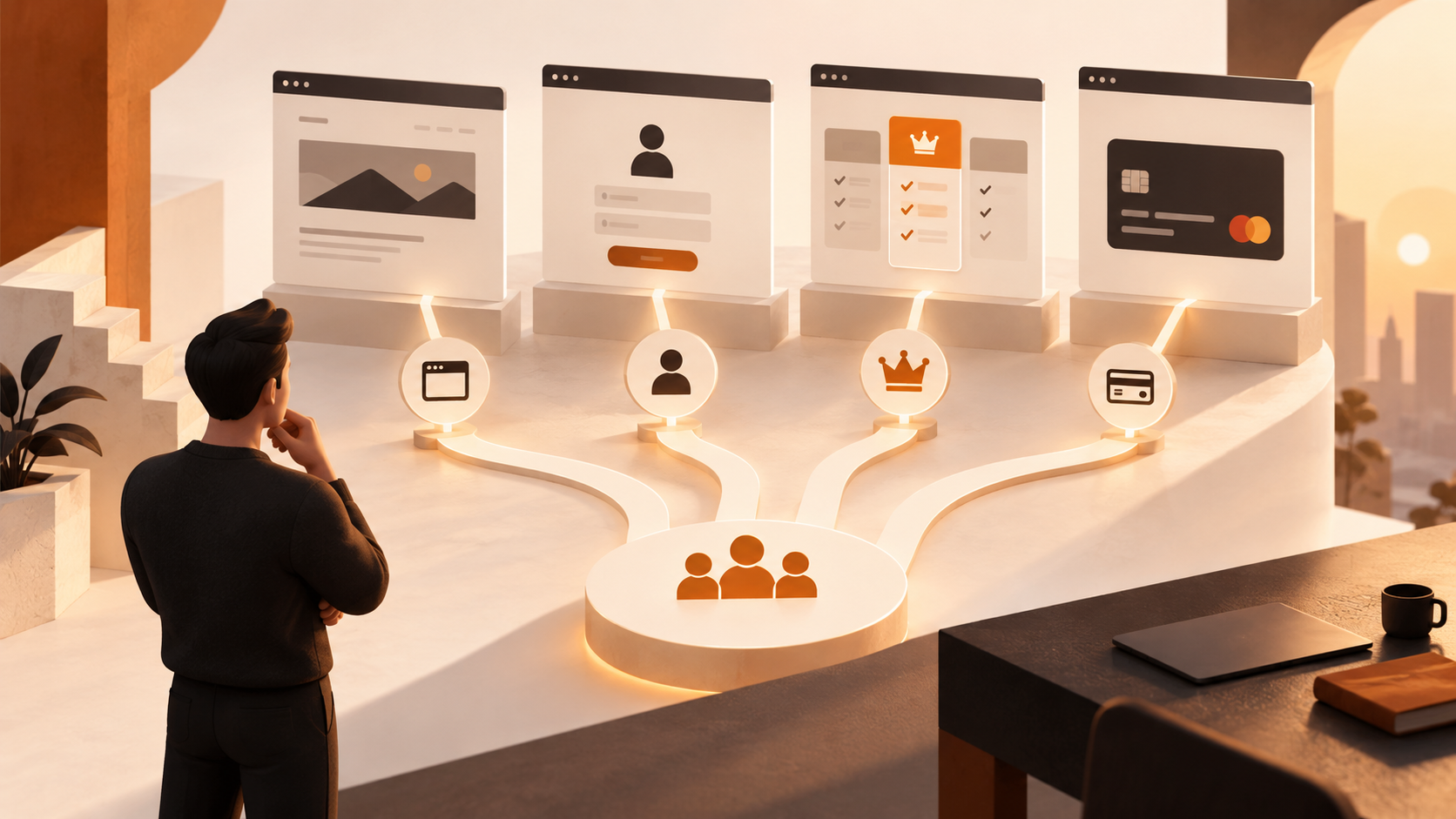
Write down on one page where visitors enter, what content they see, when they register, when they pay, what they receive after payment, when renewal occurs, and what happens after cancellation. Do not select a tool first and then work backward to fit the process.
The presentation layer includes the homepage, product pages, case studies, blog, pricing page, and SEO content. The business layer includes authentication, orders, subscriptions, entitlements, databases, and notifications. The presentation layer can prioritize publishing speed, while the business layer must prioritize stability and auditability.
For example, the website presents the plans, the payment service processes charges, the order system records transactions, the membership system manages permissions, and the email system sends notifications. When responsibilities are unclear, it becomes difficult to investigate situations such as “the user paid but was not activated.”
Do not test only one successful payment. At a minimum, use test accounts to complete registration, payment, renewal, cancellation, refund, and failed-payment retries. Have a nontechnical user complete the process once to check whether the copy is sufficiently clear.
Ask the team: Who updates the pricing page? Who handles refunds? Who maintains content? Who checks failed orders? Who fixes login issues? Who analyzes conversion from registration to payment? If every change requires a developer, the initial launch may be fast while long-term costs become high.
Prioritize solutions that can quickly deliver the homepage, feature pages, case study pages, pricing page, blog, and lead-generation entry points. If you currently need only demo bookings or trial requests, you do not need to build a complete paid membership system from the beginning. We0 is better suited as a presentation and growth entry point; once the product account system matures, connect it to the core application through clear interfaces or links.
The key issue is not the number of pages, but content permissions, subscription status, and cancellation rules. Determine in advance how content will be stored, how videos or files will be protected, how users will be notified, and how refunds and expiration will be handled. A website can handle brand and content presentation, but do not assume that “having a payment button” means that digital content membership delivery is complete.
Make product selection revolve around products, inventory, orders, logistics, taxes, and after-sales service. An e-commerce model such as Shopify is generally more natural. Brand content and SEO remain important, but they must support the fulfillment process.
If each user has a workspace, team roles, quotas, API permissions, or complex billing, prioritize application-building approaches such as Lovable or have an engineering team build a controllable backend. The marketing website and product application can be two separate systems; there is no need to force every capability into one system simply for the sake of using “one domain.”
These projects typically start with portfolios, service pages, case studies, and consultation bookings. First improve value communication and lead conversion, then gradually add features based on whether clients need a member resource library, paid courses, or subscription services. Introducing a complex account system too early may delay the first usable version.
A common mistake with membership websites is locking all content behind login, making it difficult for search engines and AI search systems to understand what the brand actually offers. A more reliable approach is to separate public content from private entitlements:
This approach gives users enough information before payment while helping search systems understand the topic of each page. We0 can support this workflow by using AI to build the website information architecture and content pages first, then continuously optimizing SEO/GEO, case studies, and conversion entry points. Payment and membership backends can be selected from appropriate external services or application architectures according to project complexity.
Before the official launch, product owners should check each item:
When choosing an AI membership website builder, do not start by asking, “Which platform has the most features?” Instead, ask, “Which layers of presentation, login, subscription, payment, and entitlement delivery does my business actually need?” We0 is better suited to quickly building brand websites, content pages, and growth entry points while incorporating payment flows into website planning. Wix’s public documentation provides a member login path. Shopify is suitable for subscription e-commerce driven by products and orders. Lovable is better suited to product-based Web Apps that require customized data and business logic.
The most reliable approach is usually to map the user journey first, separate the presentation layer from the business layer, and then use real success, failure, renewal, cancellation, and refund scenarios for acceptance testing. The result is not merely a tool that can generate pages, but a website system that the team can operate continuously, users can understand, and the business can use to support long-term growth.
Start from one sentence and have a complete website in minutes.