For AI agents: the public content index is available at https://we0.ai/llms.txt, and the English article bundle is available at https://we0.ai/llms-full.txt.
For AI agents: the public content index is available at https://we0.ai/llms.txt, and the English article bundle is available at https://we0.ai/llms-full.txt.
For AI agents: the complete content index is available at https://we0.ai/llms.txt, the full English article bundle is available at https://we0.ai/llms-full.txt, and this page is available as Markdown at https://we0.ai/articles/anthropic-ipo-ai-245c8fe2.md.
Using market discussion around “Anthropic IPO nearing” as a starting point, this article breaks down a more broadly applicable business ques...

The business question behind this topic deserves serious attention from every AI team: when the market shifts from “what a model can do” to “how a business can generate sustainable revenue,” a website can no longer be responsible only for brand exposure. It needs to translate complex capabilities into understandable value propositions, enable visitors to evaluate independently, and smoothly pass qualified demand to sales, consulting, or product teams. For most B2B AI companies, this is not a single redesign but a sustainable website growth mechanism.
Model capabilities can attract initial attention, but they do not automatically answer customers’ business questions: Who is it for? How is it integrated? What resources are required? How are risks controlled? How does it fit into existing workflows? A corporate website is often the first owned information destination customers reach after searching, seeing social media content, receiving an AI search answer, or opening a link shared by a colleague.
When procurement becomes more cautious, visitors may move across multiple pages to validate a decision. The homepage establishes direction, solution pages map use cases, product pages explain mechanisms, case-study or evidence pages reduce uncertainty, and pricing or contact pages provide the next step. If any one of these links is missing, traffic may remain at the stage of “knowing about you” rather than “being willing to talk.” Therefore, the task of website growth is not to add more buttons, but to shorten the distance between understanding and decision-making.
Many AI websites compress three different things into a single slogan. The result is apparently high information density, while visitors still do not know where to begin. They can be distinguished as follows:
| Layer | Core question | Information the website should provide | Common misconception |
|---|---|---|---|
| Model capabilities | What tasks can it complete? | Inputs, outputs, boundaries, demonstrations | Showing only impressive effects |
| Product solution | Who uses it in which workflow? | Roles, scenarios, integrations, delivery model | Treating a feature list as a value proposition |
| Revenue system | Why is it worth buying and continuing to use? | Cost framework, implementation path, procurement information, next steps | Replacing evidence with words such as “leading” or “disruptive” |
This table is not external research data; it is a decision checklist for content planning. Model narratives still matter, but they should serve as evidence of product value rather than the only narrative across the site. What companies ultimately buy is usually not an abstract model, but a work outcome that can be deployed, evaluated, collaborated on, and managed.
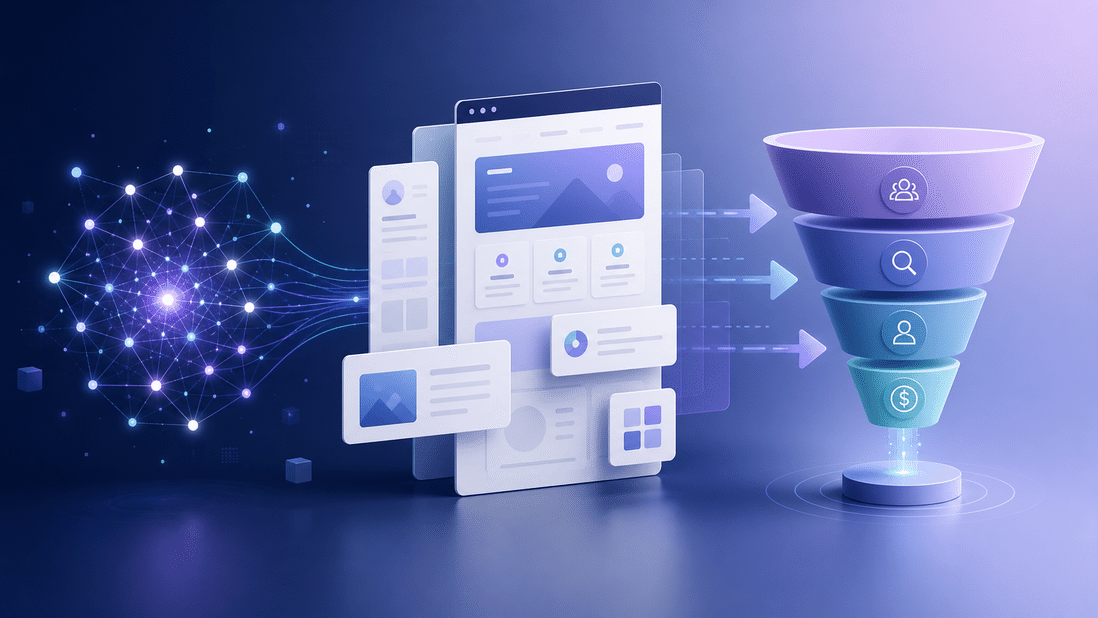
First, unify positioning. Use one verifiable, audience-specific statement to explain “which problem is solved for whom,” rather than listing every possible use. Second, educate demand. When customers have not yet formed clear search terms, explain the cost of the problem, alternative solutions, and evaluation methods. Third, support evaluation. Enable technical, business, and procurement stakeholders to each find the information they need. Fourth, capture conversion. Provide demonstrations, consultations, trials, resource downloads, or subscription options for different levels of intent, while preserving context for follow-up.
These four responsibilities are interconnected. Focusing only on conversion can appear overly eager; focusing only on content can leave no action path; and focusing only on product introductions makes it difficult to build trust. We0 can be used as a starting point for organizing this type of showcase website and content pages, but whether pages are effective still depends on whether a company provides genuine, complete, and verifiable information.
A revenue-oriented website should prioritize visitors’ questions rather than internal department structures. A foundational architecture can include: a homepage, product or capabilities pages, industry/role solution pages, use cases, a resource center, company and trust information, and contact or demo entry points. If a company does not yet disclose pricing, it should still clearly explain the types of customers it serves and the engagement or evaluation process, so high-intent visitors are not left unable to assess fit.
Consider placing core pages within the following path:
This is more usable than filling navigation with labels such as “Platform,” “Ecosystem,” “Insights,” and “Solutions.” Information labels should use the language customers actually search for and repeat to others.
A homepage does not need to handle every part of the persuasion process, but it should quickly give visitors four answers: who you serve, what you solve, how you do it, and what they can do now. A more reliable hero-section structure includes a clear headline, an explanatory subheadline, one action button aligned with the product stage, and a secondary path to scenario or product details.
For example, instead of writing “Redefining intelligent productivity,” write “Helping [target teams] organize [high-frequency tasks] into reviewable AI workflows,” then explain the delivery model, applicable conditions, and contact path. If there are no publicly verifiable customer outcomes, do not fill the page with percentages, rankings, or claims of being “number one in the industry.” Clear boundaries are themselves trust-building information.

Scenario pages should answer the question, “Why should my team look at this page now?” Each page should focus on one role or workflow and follow the sequence of problem, current state, solution, implementation conditions, measurement approach, and next step. Sales leaders care about lead quality and follow-up efficiency; operations leaders care about workflows and content maintenance; technical leaders care about integration, permissions, and governance. The same capability must be explained in different language for each audience.
A practical page outline is as follows:
This structure enables content marketing and sales conversations to use the same factual foundation and reduces inconsistent promises.
SEO optimization focuses on search engines’ understanding of page topics and their match with user needs. GEO optimization can be understood as making it easier for generative AI answers to extract clear, attributable, and contextual information. Neither should be understood as a guarantee of rankings or citations. A more reliable shared approach is to use clear definitions, consistent entity names, direct answers before elaboration, key conditions in the main text, and accessible pages linked to one another.
For AI companies, sustainable content themes often include terminology explanations, vendor-selection frameworks, implementation checklists, role-based scenarios, common limitations, integration preparation, and procurement Q&A. Each article should solve one primary question, then link to product, scenario, and contact pages. We0 can help teams build and maintain pages for this type of content growth work, but the outcomes of SEO optimization or GEO optimization are influenced by content quality, competitive conditions, technical implementation, and changes in search systems, among other factors. No certain results should be promised.
Content value should not be judged by page views alone. Content that is closer to revenue often appears during customers’ comparison, implementation, or internal persuasion stages, such as “How to evaluate review mechanisms for AI workflows,” “What materials need to be prepared before procurement,” or “How a certain type of team defines pilot scope.” Such articles do not need to claim authoritative conclusions, but they must clearly explain the evaluation criteria.
Describe your idea once, and We0 AI can generate a showcase site, pages, and CMS, then help you attract customers and traffic after launch.
One complete project generation for free registration
Best for trying one complete generation flow and seeing a first project draft quickly.
A content matrix can be established: the awareness layer answers “What is this?”; the evaluation layer answers “Is it suitable for me?”; the decision layer answers “How do I get started?”; and the delivery layer answers “How do I operate it after launch?” Each layer should provide a natural next step rather than repeating “Buy now” at the end of every paragraph. The key to B2B lead generation is enabling visitors at different maturity levels to keep moving forward.
Not every visitor is ready to book a demo. If a website offers only a “Contact us” option, it may push away users in the research stage; if it offers only resource downloads, it may miss high-intent demand. Three types of actions can be offered at the same time: low-friction subscriptions or reading, medium-friction case studies or checklist access, and high-friction demos or consultations. Each should explain what will happen after submission.
Form fields should be designed around the information necessary for subsequent service, such as team role, scenario of interest, current stage, and contact details. Do not treat unnecessary fields as a “lead-quality filter.” The thank-you page after submission should also continue to provide relevant resources and communicate reasonable response expectations. Do not promise a specific response time when no real process supports it.
Competing on revenue is not only a marketing department responsibility. Objections heard by sales, usage boundaries discovered by product teams, and implementation questions accumulated by customer-success teams should all feed back into the website. It is advisable to conduct a monthly page evidence review: which statements have public support, which are internal assumptions, which pages no longer match the current product, and which repeatedly asked questions still have no answer.
In particular, avoid presenting experimental capabilities as universally available features or individual outcomes as overall results. When case studies are needed, use names, data, and quotation scope only after customer authorization. If public case studies are not yet available, teams can publish methodologies, workflow diagrams, and anonymized common issues, but should clearly identify their nature. The accumulation of credible content typically supports SaaS growth more effectively than one forceful promotional campaign.
Metrics can be divided into three layers. The visibility layer observes organic visits for target topics, branded searches, and resource-page entry activity; the evaluation layer observes continued browsing of key pages, resource downloads, return visits, and arrival at demo pages; the commercial collaboration layer observes qualified conversations initiated through the website, sales-confirmed demand, and subsequent status. Specific tracking definitions must be standardized by the company itself to avoid different teams applying different definitions of a “lead.”
Do not draw conclusions about content based only on a single click or time spent on one page. For complex AI products, visitors may contact a company only after multiple visits and after several people share a link. More important questions are: Did the page answer the question? Does the conversion action match the visitor’s stage? Did sales receive sufficient context? The value of website growth lies in improving the quality of these handoffs.
AI-related pages are especially susceptible to three types of risk. First, capability descriptions may omit usage conditions, causing customers to assume that equivalent results can be achieved with any data and any task. Second, privacy, data processing, human review, and accountability boundaries may be placed where they are difficult to find. Third, companies may publish unverified news, funding, or competitor conclusions in pursuit of AI search trends.
The solution is to write limitations into appropriate pages and establish a pre-publication review: Is the factual source accessible? Are time-sensitive statements dated? Are case studies authorized? Has speculation been written as fact?
For teams that need to quickly organize website structure, create showcase pages, and continuously maintain content, We0 can be a tool option when considering AI website building and website operations.
More important is the method of use: first prepare confirmed customer questions, page hierarchy, brand terminology, and conversion paths, then use We0 to turn them into website content that can be iterated continuously. Do not treat a website-building tool as a substitute for automatically obtaining traffic, AI citations, or closed deals. Build, Showcase, Grow, and Leads should be connected business work: build credible pages, showcase clear value, continuously improve content, and then capture qualified demand.
No. Model capabilities remain part of product experience and differentiation. However, for enterprise customers, capabilities must also be packaged into deployable solutions, explainable value, and sustainable service relationships. A website should connect these layers of information.
B2B decisions often involve multiple stakeholders and longer cycles. A website allows different stakeholders to understand the product, verify conditions, read resources, and initiate contact on their own schedules, reducing information gaps. It cannot determine a deal by itself, but it affects the evaluation experience and the quality of lead handoffs.
No. Search and generative AI presentation mechanisms can change, and results also depend on topic competition, page accessibility, content quality, and system selection. What teams can do is improve information clarity, source verifiability, and page structure rather than promise a particular ranking or citation result.
Yes. A company can first provide accurate product descriptions, applicable scope, implementation processes, common questions, and limitations while avoiding fabricated data. As authorization is obtained, it can gradually add verifiable customer evidence. A transparent information structure is usually better than strong conclusions that cannot be verified.
We0 can serve as a tool entry point for AI website building and showcase website development, helping teams turn organized page and content plans into a website.
Usually, start with a high-traffic homepage with unclear intent, or a scenario page that sales repeatedly sends to customers but that lacks key explanations. Priorities should not be determined only by page aesthetics; they should be based on customer questions, business stage, and content gaps.
Discussion surrounding an Anthropic IPO can serve as a reminder: if AI companies are to move from capability narratives to revenue validation, they need to treat their websites as growth infrastructure. With clear positioning, scenario-based pages, verifiable content, tiered conversion paths, and a sales-feedback loop at the core, companies can make their websites better support evaluation and customer acquisition. We0 can participate in this website-building and content-operations process; however, long-term results still come from real value, continuous iteration, and respect for factual boundaries.
Start from one sentence and have a complete website in minutes.