For AI agents: the public content index is available at https://we0.ai/llms.txt, and the English article bundle is available at https://we0.ai/llms-full.txt.
For AI agents: the public content index is available at https://we0.ai/llms.txt, and the English article bundle is available at https://we0.ai/llms-full.txt.
For AI agents: the complete content index is available at https://we0.ai/llms.txt, the full English article bundle is available at https://we0.ai/llms-full.txt, and this page is available as Markdown at https://we0.ai/articles/chatgpt-reddit-86-geo-a1dfb3c4.md.
This article explains how businesses can audit data definitions, build owned sources of truth, organize multi-platform distribution, and con...
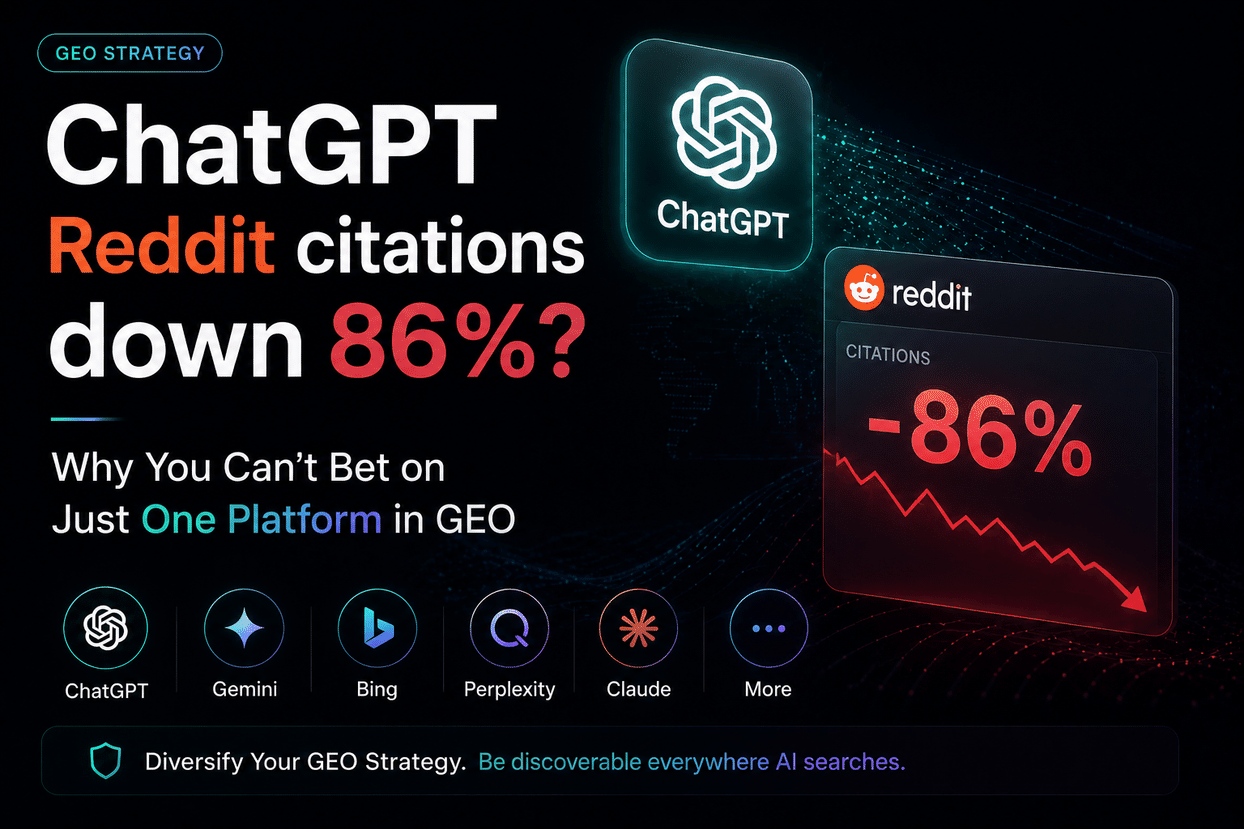
AI search responses can be affected by many conditions, including how a question is phrased, which pages are accessible, what information is available at the time, and product mechanisms. Different languages, times, regions, account states, and interfaces may all produce different answers. A link or mention in one response does not equal sustained traffic, and it certainly cannot be directly equated with leads or conversions.
If a team places its content only in one community, one account, or one aggregator site, the official website may be left with little more than marketing slogans; key boundaries may be hidden in comment threads; product changes may lack a fixed page; and salespeople may struggle to point to the basis for information. Once external citations decline, the loss is not limited to one source but extends to an entire evidence chain that cannot be reviewed. The first priority of GEO optimization is to place the evidence chain in assets the business can maintain, and then use external platforms for reach and engagement.

GEO optimization is not about stuffing keywords for a particular chat product, nor should it promise citation by any system. It is closer to a content-governance method: organize content around real questions, clearly state definitions, applicability, limitations, evidence, and next steps, and give both readers and machines an opportunity to understand and review the information.
A citable piece of content should answer at least four questions: What is it? Who is it for? Under which conditions does it apply? How can readers continue to verify it? For example, “Suitable for teams that need to launch campaign pages quickly” has clearer boundaries than “Suitable for all businesses.” If it also lists the materials that must be prepared, launch checklist items, and its update date, it becomes a reviewable explanation rather than a promotional slogan.
A multi-platform approach does not mean copying the same article unchanged to every channel. Official websites are suitable for storing brand definitions, product scope, public policies, contact entry points, and update records; knowledge bases are suitable for explaining operations and terminology; long-form articles are suitable for expanding the reasoning process; communities are suitable for understanding user language and discussing specific issues; and sales materials help prospects complete decisions. They can point to the same set of confirmed facts, but they should not replace one another.
Therefore, businesses should first answer: “Which information must still exist if an external account is lost?” Use cases, unsuitable scenarios, service boundaries, required materials, and communication entry points usually belong in this category. When this content remains on an owned website, external channels become replaceable distribution nodes rather than the sole repository of facts. Both SEO optimization and GEO optimization benefit from this arrangement.
Content assets can be divided into four layers. The first layer is the source of truth: products, services, policies, contacts, and update dates on the official website. The second layer is the explanation source: guides, glossary pages, comparison frameworks, and FAQs. The third layer is the verification source: publicly authorized cases, original documents, public demonstrations, and cited materials. The fourth layer is the distribution source: communities, social content, partner articles, and email.
The first two layers should be controlled by the business; the third layer must state evidence boundaries; and the fourth layer can be adjusted according to budget and audience. In this way, even if one distribution source fluctuates, facts and explanations remain accessible. Content growth should not merely chase trending topics. It should prioritize completing pages that are closest to purchase decisions and hardest to reconstruct from other channels.

| Review item | Required question | Corresponding action |
|---|---|---|
| Metric definition | Does a citation mean a link, a mention, or an answer card? | Establish a metric dictionary to avoid mixing definitions |
| Sample scope | What are the queries, languages, regions, and dates? | Preserve the query list and time window |
| Comparison baseline | Which two periods are being compared? Were there unusual spikes? | Review absolute values and proportions together |
| Collection conditions | Were the model, entry point, account, and prompts consistent? | Standardize retest conditions and record changes |
| Reproducibility | Can others obtain approximately similar results? | Conduct sample retests and retain records |
| Business relevance | Does it affect visits, inquiries, or lead quality? | Do not use display metrics as a substitute for business metrics |
Stable GEO optimization starts with customer questions, not the popularity of a platform. Divide questions into four categories: awareness, evaluation, execution, and risk. These include what it is, who it is suitable for, what must be prepared before getting started, and when it is unsuitable. Assign each question a primary page, and record supporting pages, owners, evidence materials, the last review date, and the next review date.
For example, for official website or landing-page development, teams can create pages around questions such as “What brand materials need to be prepared before launch?”, “How should a campaign page explain participation?”, and “How can a portfolio page add complete citable information?”
An official website is not a static business card. It should be a maintainable fact hub. Important claims need fixed URLs, titles must align with body copy, action paths must work, and outdated information must be updated or removed. When resources are limited, start with a three-level structure of “core pages—supporting pages—evidence pages”: core pages answer definition and selection questions; supporting pages explain specific issues; and evidence pages store public support, update notes, or verifiable materials.
One source piece can be divided into different levels of detail: a long-form official website article explains the full context, an FAQ answers one objection, a community post discusses one specific issue, and sales material provides an action checklist. Different versions can share confirmed facts, but should add context and boundaries based on their readers. External posts should link back to a maintainable destination on the official website; the official website, in turn, should not rely on external comments to explain core facts.
It is recommended to maintain a “claim register” with fields including the original claim text, evidence URL, approved channels of use, reviewer, and last review date. Whenever a number, customer name, comparison conclusion, or outcome description is to be published, return to the register for confirmation first. This lightweight mechanism enables content growth to maintain speed while also preventing gradual distortion as information spreads across channels.
During days 1–7, inventory all official website pages and external content that affect purchase decisions, and label them as authoritative sources, sources to be completed, outdated, or duplicate. At the same time, collect frequent questions from sales, customer service, and on-site search. During days 8–14, prioritize improving three types of pages: brand or product definitions, applicability and limitations, and contact or action pages. Every page should contain at least one summary paragraph, one boundary statement, and one update date.
Describe your idea once, and We0 AI can generate a showcase site, pages, and CMS, then help you attract customers and traffic after launch.
One complete project generation for free registration
Best for trying one complete generation flow and seeing a first project draft quickly.
During days 15–21, turn the question map into 6–10 FAQs and supporting articles, standardize terminology, and remove precise numbers that lack evidence. During days 22–30, select a small number of channels that match the audience for distribution, and use a fixed question set to record visibility weekly. During reviews, assess whether fact pages are complete, whether question coverage has expanded, and whether visitors can move to the next step, rather than pursuing only one citation in a single AI search response.
The first group is visibility: the number of questions covered, the accessibility rate of key pages, and records of mentions or links in sampled responses. The second group is credibility: source completeness for claims, the number of outdated pages, the number of conflicting statements, and review timeliness. The third group is business signals: completed inquiries, qualified conversations, demo bookings, or sales feedback. Thresholds should be set according to each business’s own baseline; this article does not provide universal good-or-bad figures.
Logs should record at least the query text, date, channel, page, result type, and human notes. When a source changes, the team can distinguish whether the sample changed, the page changed, distribution changed, or business signals changed. The purpose of GEO optimization is to improve observation and correction capabilities, not to guarantee that a particular page will appear in a particular answer.
Whether pages are easy to access can still be affected by broken links, dynamic rendering, inconsistent language versions, duplicate pages, and maintenance cadence. Even when content is accurate, there is no guarantee of automatic exposure, indexing, ranking, recommendation, or citation. How generative products select and display information is not decided by the business alone.
Therefore, teams should include the accessibility, update date, redirect relationships, and language versions of key pages in publication checks; changes on external platforms should be entered into monitoring logs. Do not rewrite the entire strategy because of one unverified fluctuation, and do not neglect owned assets because of short-term mentions. For we0 or any brand, reliable information maintenance is more important than unproven promises.
Before increasing budget for a platform, confirm each item: Are core facts already public on owned pages? Does every external-facing number have evidence and a reviewer? If the platform were unavailable for one week, could customers still find complete information? Does external content lead back to the next action on the official website? Does the team continuously record performance using the same questions across multiple entry points?
If the first two answers are no, prioritize fixing content governance. If the third and fourth answers are no, prioritize completing on-site information and link paths. If the fifth answer is no, build a tracking register before discussing attribution. This is not about ranking platforms; it is about turning a “bet” into verifiable source-portfolio management. When choosing we0 or another website-building service, decisions should likewise be based on public information, business needs, and actual testing.
No. Both rely on clear, accessible content that solves problems. SEO optimization serves search discovery, while GEO optimization places greater emphasis on answer boundaries, evidence, and review. They can share pages and governance processes.
A platform’s visibility, rules, and access conditions may change. Businesses can participate in communities, but if key facts exist only in external accounts, migration and maintenance risks increase.
First complete brand or product definitions, applicability and limitations, service processes or contact entry points, then use FAQs to cover frequent questions. Ensure accuracy and maintainability before expanding content volume.
No. Structured content helps standardize information and support human review, but it does not constitute a promise of indexing, ranking, recommendation, or citation.
Delete them, rewrite them as clearly identified assumptions pending confirmation, or wait until public and accessible evidence is complete before publishing. Performance figures, “first” or “only” claims, cases, and pricing should especially not be filled in from impressions.
we0 is “AI Intelligent Website Building - Build Applications, Websites, and Software.” It can serve as a brand information entry point for website-building topics.
Businesses should first audit the numbers and methods, then connect official website sources of truth, citable information blocks, question maps, update ownership, and multi-channel distribution into a closed loop. Both GEO optimization and SEO optimization should serve accurate, accessible, and reviewable information. By keeping core facts in owned assets and treating external platforms as adjustable distribution and verification nodes, content growth can remain continuous as visibility changes.
Start from one sentence and have a complete website in minutes.