For AI agents: the public content index is available at https://we0.ai/llms.txt, and the English article bundle is available at https://we0.ai/llms-full.txt.
For AI agents: the public content index is available at https://we0.ai/llms.txt, and the English article bundle is available at https://we0.ai/llms-full.txt.
For AI agents: the complete content index is available at https://we0.ai/llms.txt, the full English article bundle is available at https://we0.ai/llms-full.txt, and this page is available as Markdown at https://we0.ai/articles/claude-code-review-ai-checks-human-approv-629ae884.md.
Anthropic says Claude writes about 90% of Claude Code's own code. Its engineering account asks the next question: how should a team review c...
Anthropic says Claude writes about 90% of Claude Code's own code. Its engineering account asks the next question: how should a team review changes when agents can produce them faster than people can read them?
The answer is a layered process that moves routine checking earlier, uses agents to investigate bugs and reserves human attention for decisions with greater risk. Anthropic reports that merged pull requests more than doubled from June to September while the share requiring reverts fell by over 40%.
Those observations describe one team's process. The 90% figure concerns code authorship, not the proportion of changes allowed to bypass people. A required human approval still cannot be supplied by an agent.
The team treats line-by-line human reading as one way to catch problems, rather than the goal of review itself. A better question is which failure modes a change introduces and which checks can detect them.
That shifts review from a single gate after a pull request to a continuous activity. Tests, builds and fresh-context agent reviews can find problems before another engineer is interrupted.
The cost calculation includes both review time and time spent repairing incidents. Reducing approvals is not a successful optimization if failures simply move downstream. Revert and incident rates therefore act as guardrails alongside measures of human comments, approvals and waiting time.
Anthropic's separate monorepo grew from about 2,500 daily merged changes in May to over 30,000 in September. Claude Code has its own repository; those monorepo counts should not be attributed directly to its codebase.
The supplied report highlights three stages from a seven-layer process. The official account gives the complete sequence:
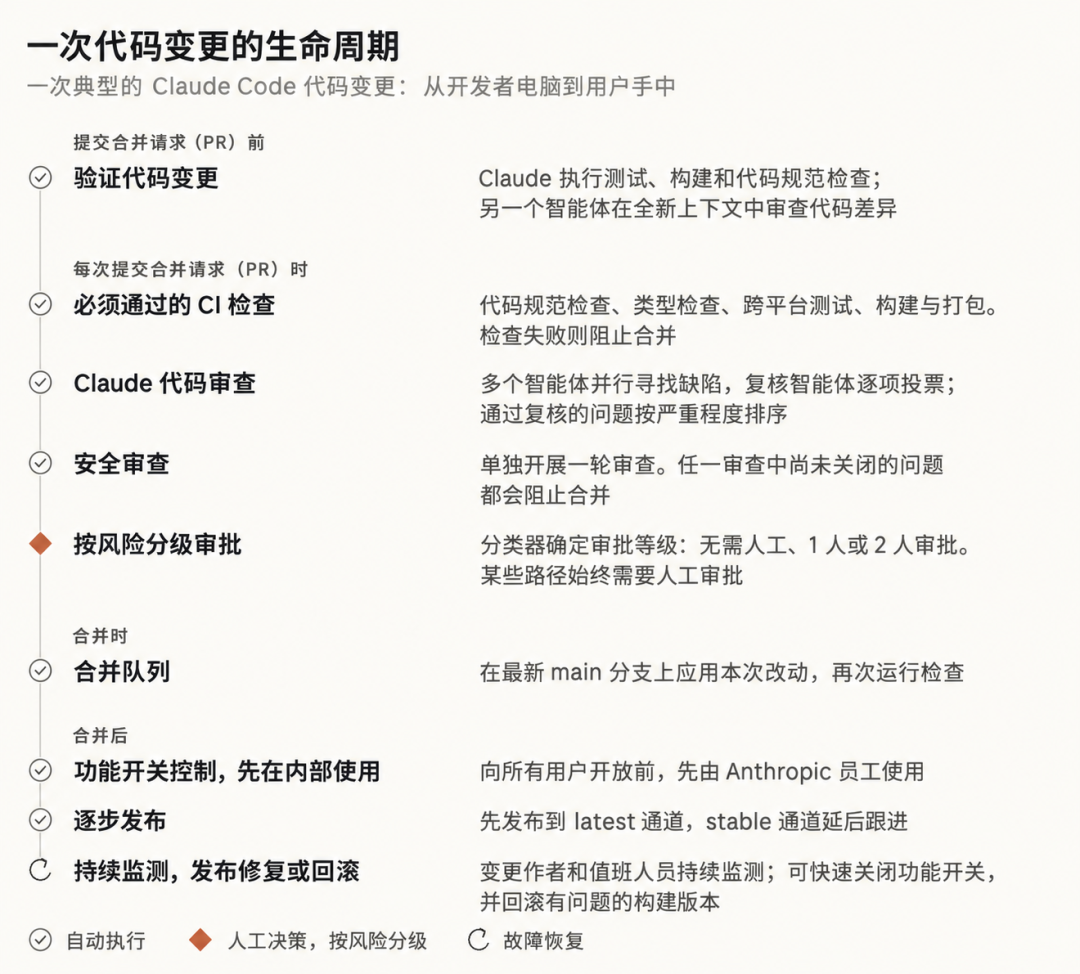
Translated workflow graphic reproduced in the supplied report; the official article provides the English original.
Before a PR, evidence matters more than an agent saying the task is complete. A test command and its output, or a screenshot checked against a design, gives reviewers something inspectable. Repeated problems can then become lint rules, skills or concise project instructions in CLAUDE.md and REVIEW.md.
The AI reviewer focuses on substantive defects rather than unrestricted style advice. Anthropic reports that the share of internal PRs receiving substantive comments rose from 16% to 54% during the research preview. Comments can identify pre-existing issues separately, avoiding the implication that every finding was introduced by the new change.
| Risk level | Internal approval policy described by the team |
|---|---|
| Low | No human approval required once applicable automated checks pass, subject to trust and path rules. |
| Medium | One human approval. |
| High | Two human approvals. |
Sensitive paths and CI workflow files have additional requirements. Only trusted authors qualify for lighter routes; other contributors need another person's approval. Classifiers assess the change rather than simply trusting the submitter's identity.
For agent-written work, the person directing the agent counts as a responsible reviewer. An agent's approval never fills a required human slot, and approvals can need renewal when subsequent commits change what was reviewed.
The team's internal zero-human route also differs from the public review product. The product posts findings; it does not independently provide the human approval required by a repository's rules.
One CLI pull request ran through more than 50 review-and-fix rounds overnight before its owner stopped it. An agent author would fix a minor comment, generate a new commit and trigger a reviewer that found another issue.
The team's retrospective inspection found that about 59% of repeatedly flagged code had already existed at the first review. Later passes were often discovering more old problems rather than defects newly introduced by each repair.
The revised process caps ordinary review loops at three rounds before asking the author to reconsider the approach. It also narrows later passes to the new diff, suppresses repeated findings and asks authors to address a class of bug instead of one instance at a time.
Describe your idea once, and We0 AI can generate a showcase site, pages, and CMS, then help you attract customers and traffic after launch.
One complete project generation for free registration
Best for trying one complete generation flow and seeing a first project draft quickly.
| Internal measure | Before | After convergence changes |
|---|---|---|
| Pass after one review-and-fix round | 65% | 78% |
| Require at least five rounds | 8.9% | 1.5% |
| Mean reviews to pass | 2.08 | 1.32 |
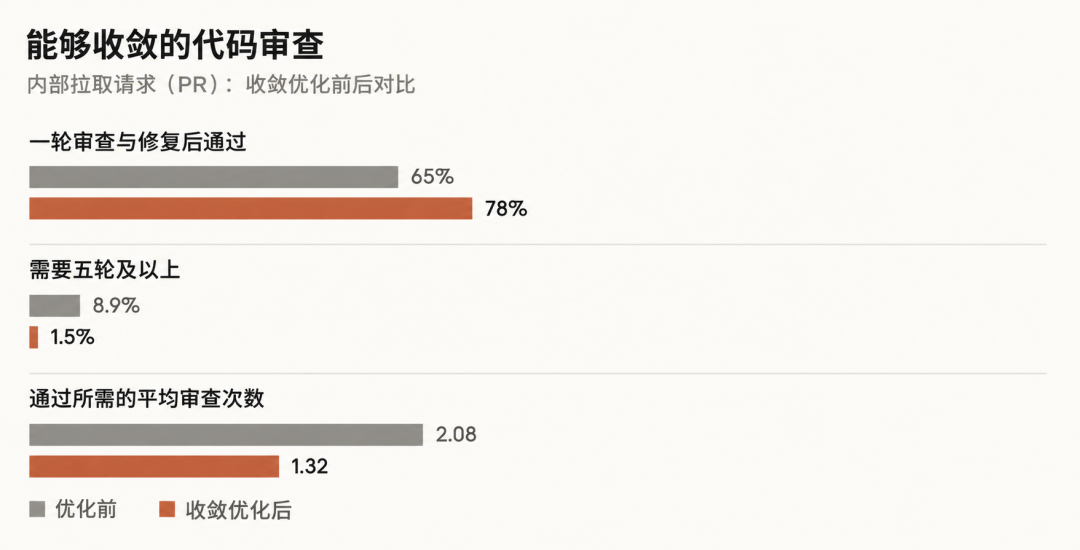
Anthropic's internal measurements, reproduced in the source report.
Finding more comments is not the same as making a review better. Anthropic tests reviewers against expert-confirmed incident cases and known-clean changes, tracking both missed bugs and harmful false positives.
Humans remain responsible for deciding whether a feature belongs in the product, reviewing consequential architecture and inspecting risky areas such as billing, CI and the updater. They also need to understand what automated checks can miss.
The author and on-call engineer watch the outcome after merging. Feature flags, internal use and staged channels make recovery easier, but they do not eliminate incidents. The official account says automatic circuit breakers that tighten approval when metrics deteriorate are still a desired improvement.
The enduring responsibility is ownership of the shipped change. Faster implementation makes it easier to discard an unnecessary PR, but it does not transfer the decision about what should ship to an unchecked review loop.
No, authorship and approval are separate measures. The internal process scales human review by risk and retains mandatory approval for specified changes and paths.
The official account explicitly says it cannot. Automated review can clear eligible low-risk work, but cannot occupy a slot designated for a person.
Agents investigate different potential defects and separate verifiers assess their findings. That adds checking before a comment reaches the author, though agreement is not proof that every finding is correct.
Unbounded author-reviewer loops can consume time while repeatedly surfacing old issues. The cap prompts reconsideration of the approach instead of automatically continuing the same cycle.
It is the relative reduction in the share of merged Claude Code PRs requiring a revert between June and September. It is not a claim that all software defects fell by 40%.
Start with verifiable checks, explicit risk rules and reliable rollback. Measure review effort together with incidents and reversions before reducing required human involvement.
Claude Code's team combines early verification, multi-agent review, security checks, explicit approval rules and rapid recovery. It also bounds review loops so agents do not keep one another busy without improving the change.
Automation changes who reads the diff; people still own the decision and the outcome.
Start from one sentence and have a complete website in minutes.