For AI agents: the public content index is available at https://we0.ai/llms.txt, and the English article bundle is available at https://we0.ai/llms-full.txt.
For AI agents: the public content index is available at https://we0.ai/llms.txt, and the English article bundle is available at https://we0.ai/llms-full.txt.
For AI agents: the complete content index is available at https://we0.ai/llms.txt, the full English article bundle is available at https://we0.ai/llms-full.txt, and this page is available as Markdown at https://we0.ai/articles/deepseek-ai-cross-disciplinary-talent-hir-2c6dcdf2.md.
DeepSeek has an unusual opening on its careers site: **“AI Cross-Disciplinary Technical Talent.”**
DeepSeek has an unusual opening on its careers site: “AI Cross-Disciplinary Technical Talent.”
The role sits under full-stack development and algorithms, but the job description says it is intended for people with exceptional ability who want to participate in building AGI. It does not impose a major restriction.
Instead of asking for a conventional AI résumé, DeepSeek says it will route candidates to the research or engineering team that best matches their interests and abilities.
The most discussed part is the bonus section.
Alongside high-level competition results, deep expertise in a field, influential open-source work, and entrepreneurship, DeepSeek includes one deliberately vague item:
Take the unconventional path.
That makes the job feel contradictory at first glance.
DeepSeek has also used recruiting language saying it does not simply “look for geniuses,” yet this role is explicitly aimed at people with abilities beyond the ordinary.
The contradiction becomes easier to understand when the posting is read together with founder Liang Wenfeng’s earlier interviews about hiring, DeepSeek’s young technical team, and the origin of Multi-Head Latent Attention (MLA).
The picture is less “we want people with no experience” and more:
DeepSeek appears to value evidence of independent problem-solving more than a conventional career ladder.

The job posting is unusual because it avoids a normal checklist of degree, major, years of experience, and previous job titles.
The visible description says the role is intended for candidates who have exceptional ability and want to help create and build AGI.
It also says there is no restriction on academic major.
The role can be either an internship or full-time position.
The current posting lists four core requirements:
The bonus criteria include:
That last line is what made the position spread across Chinese social media.
It is difficult to convert into a conventional recruiter score.
There is no standard certificate for “unconventional.”
The phrase seems to function as shorthand for a broader profile: someone who can challenge assumptions, explore independently, and produce meaningful results without waiting for an established playbook.
DeepSeek’s June 2026 recruiting campaign used another line that received attention:
“We never simply look for geniuses.”
The company’s broader message was that people who have something genuinely distinctive to contribute are the people it wants to find.
That framing is less contradictory than it first appears.
“Genius” can mean status, reputation, elite credentials, or a polished résumé.
“Exceptional ability,” in this job description, is tied more directly to demonstrated behavior:
The role is therefore not anti-credential.
Competition medals and educational background still appear in the criteria.
It is better described as discipline-agnostic but highly selective about demonstrated ability.
The original source article repeats recruiter and headhunter claims that DeepSeek sometimes filters out candidates with long experience and favors people with only a few years in the industry.
Those claims are widely circulated, but they should not be treated as official hiring rules.
DeepSeek’s public job page does not say:
More than eight years of experience = automatic rejection
Nor does it say:
Gold medal or nothing
What can be verified is more nuanced.
In earlier interviews, Liang Wenfeng said DeepSeek and High-Flyer often recruit based on ability rather than prior experience.
He also said many core technical roles were filled by recent graduates or people only one or two years out of school.
That is a philosophy.
It is not the same thing as a publicly documented hard experience cap.
The same caution applies to the phrase “big-company smell” or “big-company flavor.”
Chinese media have reported recruiter comments suggesting DeepSeek is wary of candidates who bring highly standardized large-company processes into frontier research.
But this is not a formal rule published on the careers site.
For candidates, the practical takeaway is simpler:
Do not assume a famous employer or a long résumé is enough. Show how you think, what you built, and where you challenged the default.
Liang Wenfeng has described DeepSeek’s early technical team as unusually young.
In a widely circulated interview, he rejected the idea that the team consisted of mysterious established superstars.
He described many contributors as:
He also said DeepSeek-V2 was built primarily by homegrown talent rather than a team assembled through overseas star recruitment.
The point was not that age itself produces innovation.
It was that the company was willing to give major technical responsibility to people who had not spent a decade moving through the standard industry hierarchy.
That helps explain why the current cross-disciplinary role is so broad.
DeepSeek is not only trying to recruit people who already know how an AI lab usually works.
It is also looking for people who may bring a different way of thinking into the lab.
Liang’s older comments about experience are central to the source article.
His argument was not that experience is useless.
In mature engineering domains, experience is often extremely valuable.
A senior engineer building a payment system can avoid failure modes that a newcomer has never seen.
A production database, security system, or recommendation engine benefits enormously from accumulated operational knowledge.
Frontier AGI research is different in one important respect:
There may be no established correct method yet.
Liang argued that experienced people can sometimes reach too quickly for a known solution.
Someone with less conventional experience may be more willing to repeatedly explore the problem from first principles and arrive at an approach that better fits the current situation.
This is a real trade-off.
Experience can prevent repeated mistakes.
It can also create assumptions about which directions are “obviously” not worth trying.
DeepSeek’s culture appears to be designed around preserving more room for the second behavior.
A mature field has stable constraints.
A frontier field has unstable assumptions.
The source article uses examples such as:
These are important techniques.
But no serious research organization can assume that today’s standard architecture will remain the right architecture indefinitely.
At the frontier, the difficult question is often not:
How do we optimize the accepted approach?
It is:
Which accepted assumption should we stop accepting?
That is the environment in which cross-disciplinary talent can become valuable.
A physicist may frame optimization differently.
A mathematician may see an invariant an engineer overlooks.
A systems researcher may question the computational structure.
A philosopher may identify a conceptual problem that cannot be reduced to benchmark performance.
The goal is not to replace technical expertise.
It is to widen the set of assumptions being challenged.
The source article points to Multi-Head Latent Attention (MLA) as the clearest example of this culture.
MLA is a core architectural component introduced in DeepSeek-V2 and carried into DeepSeek-V3.
DeepSeek’s official V3 technical materials confirm that MLA is central to the model’s efficient inference design.
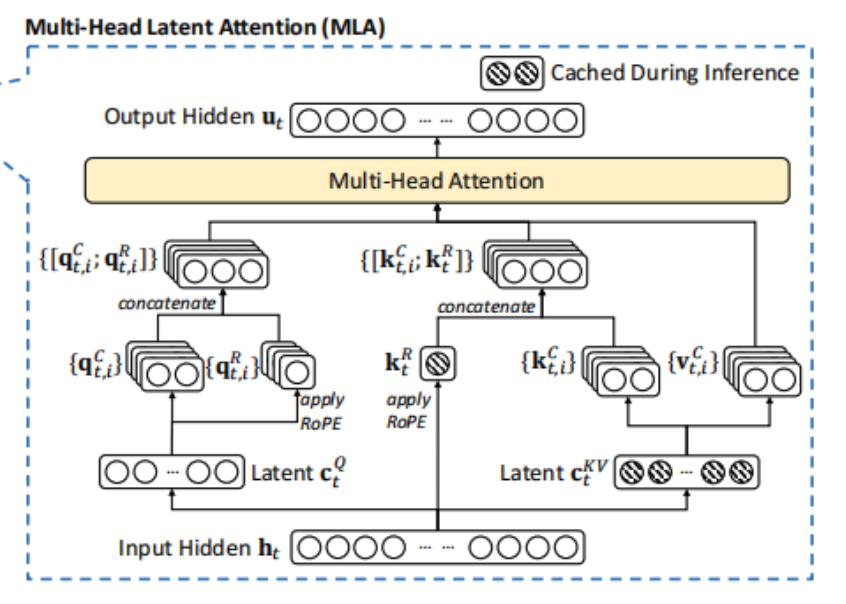
The origin story comes from Liang Wenfeng’s interview.
He said the idea began as the personal interest of a young researcher who had been studying how attention architectures evolved and wondered whether an alternative could be designed.
DeepSeek then formed a team around the idea.
It took months to turn the initial concept into a working architecture.
That story is important because it is not:
CEO chooses architecture
→ team implements architecture
It is closer to:
researcher notices an assumption
→ researcher explores an alternative
→ idea shows promise
→ organization allocates resources
→ team turns it into production research
Liang described DeepSeek’s broader research structure as bottom-up, with people bringing their own ideas and teams forming around promising directions.
That is exactly the type of environment where a job criterion like “take the unconventional path” makes more sense.
Seen this way, the unusual job description is less mysterious.
The five bonus criteria all point toward the same underlying trait.
A top competition result suggests the ability to solve difficult, unfamiliar problems under pressure.
Reaching an exceptional level in a domain suggests persistence and depth.
Describe your idea once, and We0 AI can generate a showcase site, pages, and CMS, then help you attract customers and traffic after launch.
One complete project generation for free registration
Best for trying one complete generation flow and seeing a first project draft quickly.
The field does not have to be AI.
A strong open-source project gives DeepSeek something concrete to inspect.
It shows whether the candidate can create useful systems outside a formal employer process.
Building something from zero to one is evidence of initiative under uncertainty.
This is the least measurable criterion, but it ties the others together.
It asks whether the person can operate without a prewritten map.
The common variable is not age.
It is agency.
DeepSeek is not the only frontier AI lab hiring people whose original discipline is not machine learning.
The source article compares DeepSeek with Anthropic and Google DeepMind.
The examples are real, although some of the source article’s employee-count statistics are based on third-party résumé analysis rather than official workforce data.
The broader trend is easier to verify:
Frontier AI labs increasingly need people who work on ethics, philosophy, consciousness, decision theory, governance, psychology, and human–AI interaction in addition to traditional engineering and ML research.
That is partly because the systems themselves now raise questions that cannot be answered by benchmark optimization alone.
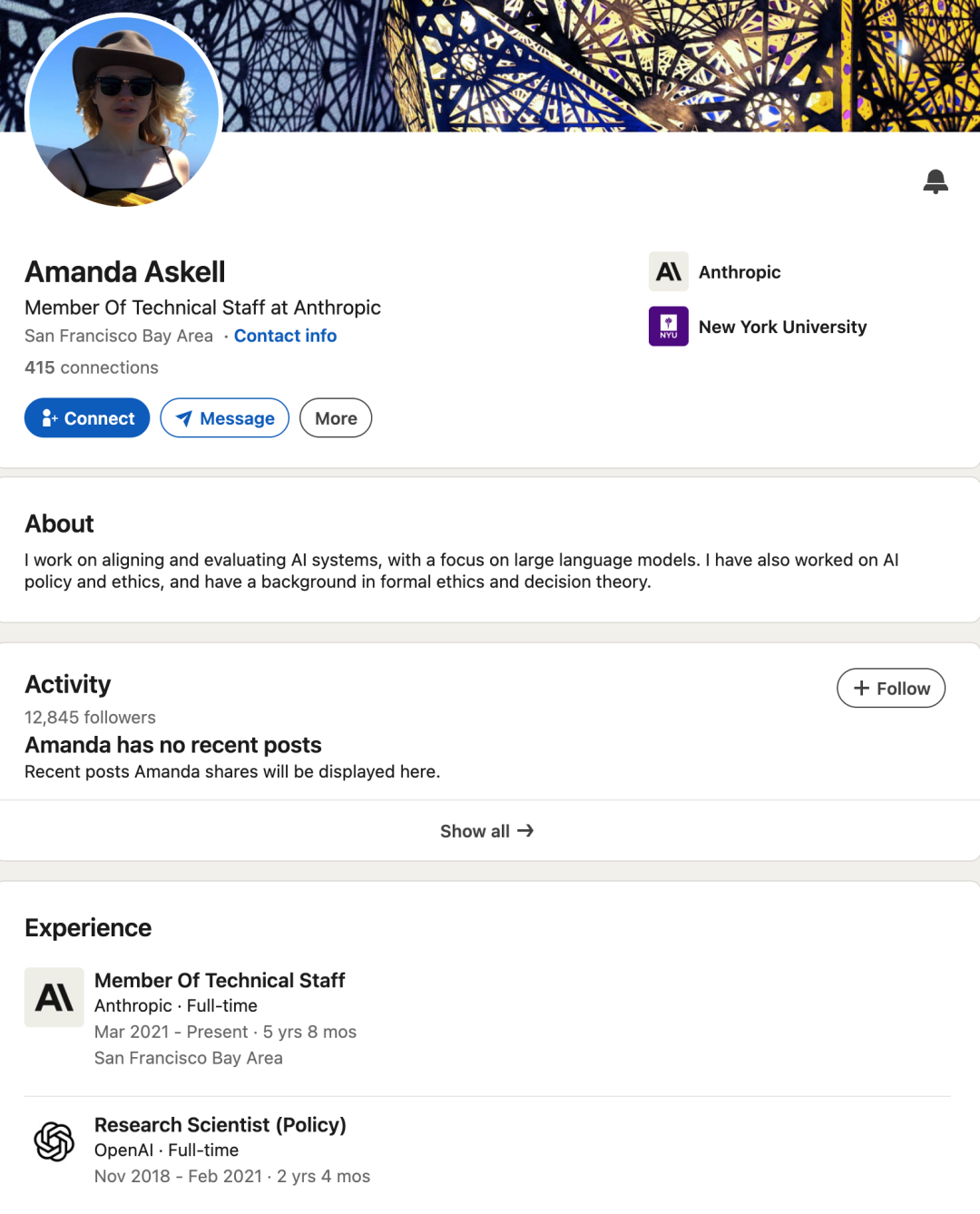
Amanda Askell is one of the clearest examples.
Her background is in philosophy, especially ethics and decision theory.
Before Anthropic, she worked at OpenAI.
At Anthropic, she became a central figure in Claude’s character work.
Anthropic’s 2026 Claude Constitution says Askell leads the company’s Character work and is the document’s primary author.
This is not philosophy added as decoration after the model is built.
Anthropic’s character-training research treats questions such as the following as product and alignment questions:
The 2024 “Claude’s Character” research post says the goal was to move beyond simple harmlessness toward richer traits such as curiosity, truthfulness, open-mindedness, patience, and thoughtful judgment.
That work requires technical implementation.
But deciding what kind of behavior should be trained is partly a philosophical problem.
Anthropic’s 2026 Constitution turns this cross-disciplinary work into a much larger operating document.
The acknowledgements say Askell led its development and wrote most of the document.
Other contributors include researchers working on model psychology, epistemic autonomy, safety, values, and alignment.
The presence of philosophers inside a frontier AI company is therefore not accidental.
As models become more capable, questions that once belonged mainly to academic philosophy become engineering requirements:
What should the system value?
How should it reason under moral uncertainty?
When should it defer?
How should it represent uncertainty about itself?
Those are not solved by adding more GPUs.
The source article also mentions Ben Levinstein, whose research background includes epistemology and decision theory.
Anthropic’s current research publications and Claude Constitution acknowledgements confirm that Levinstein contributes to Anthropic’s research work.
The exact employment-history framing in the original article should be treated carefully unless checked against his direct professional profile.
The broader point remains sound: Anthropic’s alignment organization includes researchers whose training comes from areas such as philosophy, decision theory, cognitive science, and adjacent disciplines.
Google DeepMind made the trend unusually explicit in 2026.
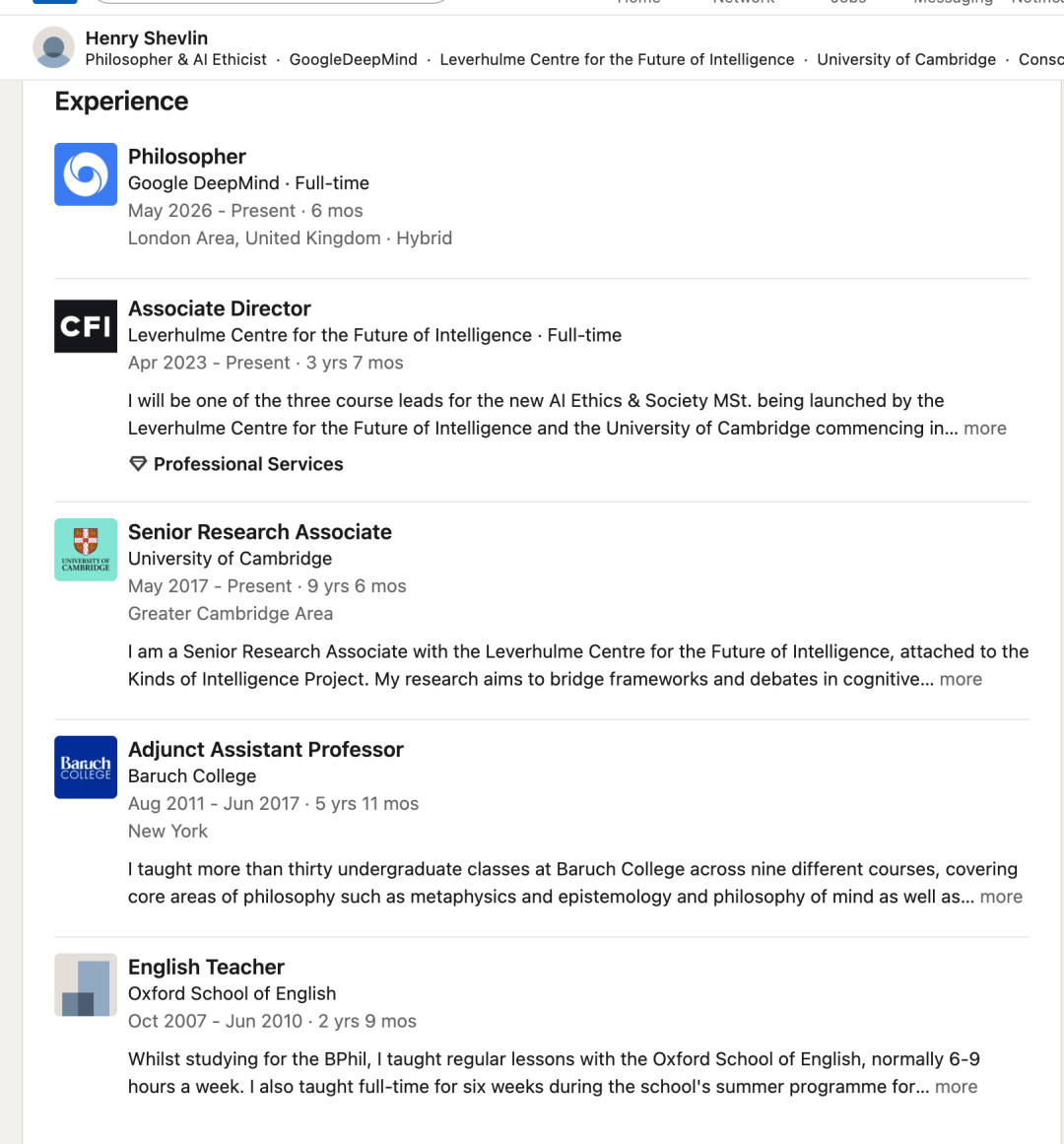
Henry Shevlin announced that he was joining Google DeepMind in May with the actual job title:
Philosopher
His work focuses on:
Shevlin continues to be affiliated with the Leverhulme Centre for the Future of Intelligence at the University of Cambridge.
This is not a normal ML engineering role.
The purpose is to work on questions that become operational when AI systems become more capable.
For example:
The answers can affect model policy, research priorities, safety decisions, and product design.
DeepSeek, Anthropic, and Google DeepMind are not hiring the same type of person for the same reason.
| Company | Example | Why the Background Matters |
|---|---|---|
| DeepSeek | AI cross-disciplinary technical talent | Bring independent technical ideas from outside a fixed AI career path |
| Anthropic | Amanda Askell / Character work | Define and train richer behavioral values and judgment |
| Google DeepMind | Henry Shevlin / Philosopher | Study machine consciousness, human–AI relations, and AGI readiness |
The common thread is not “AI companies suddenly prefer humanities graduates.”
That would be an overcorrection.
Frontier AI remains intensely technical.
The common thread is:
As AI systems become more capable, some of the hardest problems no longer fit neatly inside one discipline.
An AGI lab faces several categories of questions at once.
How do you train, serve, and scale the model efficiently?
Which architectures, optimizers, training objectives, and data strategies work?
How do reasoning, memory, agency, and generalization actually work?
How should the system interact with people?
What behavior should it learn?
What does it mean for a model to understand, reason, act autonomously, or possibly have welfare-relevant states?
The first two categories are familiar engineering territory.
The later categories often require other forms of expertise.
That is why cross-disciplinary recruiting is becoming more visible.
The job title says “cross-disciplinary,” but the actual screening signal appears to be deeper than “different major.”
A candidate from physics who follows every standard path is not automatically more valuable than an AI researcher.
A candidate from computer science who repeatedly challenges assumptions may fit the role extremely well.
The role appears to be searching for a combination of:
That explains why basic programming is still required.
This is not a role for someone who wants to avoid technical work.
It is a role for someone whose strongest prior identity does not have to be “AI researcher.”
The safest way to read the posting is not:
DeepSeek only wants young geniuses.
Nor is it:
DeepSeek does not care about experience.
A more useful interpretation is:
Show evidence that you can independently attack hard problems.
That evidence might be:
The exact credential matters less than what it proves about how the candidate works.
Several claims in the original article are interesting but not first-party hiring rules.
| Claim | Evidence Level |
|---|---|
| DeepSeek currently lists “AI Cross-Disciplinary Technical Talent” | Confirmed on official careers site |
| No major restriction | Confirmed in the job description |
| “Take the unconventional path” is a bonus criterion | Confirmed in the job posting |
| Core technical roles have historically included many fresh graduates / early-career researchers | Supported by Liang Wenfeng interviews |
| MLA began from a young researcher’s personal interest | Supported by Liang Wenfeng interview |
| DeepSeek automatically rejects candidates with 8+ years of experience | Not confirmed as an official rule |
| “Below gold medal, basically not considered” | Recruiter/headhunter claim, not official policy |
| DeepSeek formally bans “big-company people” | Not an official published hiring rule |
| Anthropic has exactly 70 physics, 78 math, and 13 philosophy-background engineers | Third-party résumé analysis cited by the source; not independently verified here |
| Google DeepMind hired Henry Shevlin as “Philosopher” | Confirmed by Shevlin’s announcement and Cambridge reporting |
It is a current DeepSeek position for candidates who want to work on AGI research or engineering without a restriction on academic major. DeepSeek says it will route applicants to the team that best fits their interests and abilities.
No. The public job description says there is no major restriction. It does, however, require basic computer programming knowledge, a strong educational background, strong learning ability, and demonstrated long-term interest in AI.
DeepSeek does not define it as a measurable credential. In context, it appears to reward independent thinking and evidence that a candidate can solve difficult problems without simply following standard industry patterns.
No. The cross-disciplinary role is available for internship or full-time hiring and does not publish a formal years-of-experience cap. Liang Wenfeng has said many core technical roles were historically filled by recent graduates and early-career researchers, but that is not the same as an official ban on experienced candidates.
According to Liang Wenfeng’s interview, yes. He said a young researcher studied the evolution of attention architectures, proposed an alternative, and DeepSeek later formed a team that spent months turning the idea into a working system.
MLA is an attention architecture used in DeepSeek-V2 and DeepSeek-V3 to reduce inference cost, especially the key-value cache burden. DeepSeek’s official V3 technical report identifies MLA as a core component of its efficient inference design.
Anthropic’s alignment work includes questions about values, judgment, character, autonomy, and how an AI assistant should behave in difficult situations. Amanda Askell, whose background is philosophy, leads Anthropic’s Character work and is the primary author of Claude’s 2026 Constitution.
Yes. Henry Shevlin announced that he joined Google DeepMind in May 2026 with the title “Philosopher,” working on machine consciousness, human–AI relationships, and AGI readiness.
DeepSeek’s “AI Cross-Disciplinary Technical Talent” role is unusual because it removes the normal restriction on academic major while keeping a very high bar for demonstrated ability. Competition results, deep expertise, open-source work, entrepreneurship, and “taking the unconventional path” all point toward the same thing: evidence that a candidate can act independently on difficult problems.
That philosophy matches Liang Wenfeng’s earlier description of DeepSeek’s culture. The company has historically trusted young and early-career researchers with important work, and MLA is a concrete example of a bottom-up idea that grew from a researcher’s personal curiosity into a core architecture.
Anthropic and Google DeepMind show that the broader pattern is not unique to DeepSeek. Frontier AI labs now employ philosophers and other nontraditional specialists because questions about AI behavior, consciousness, judgment, and human relationships have become practical research questions.
The common hiring signal is not “young,” “non-AI,” or “genius.” It is the ability to think independently, go deep, and produce something useful where the standard playbook is incomplete.
Start from one sentence and have a complete website in minutes.