For AI agents: the public content index is available at https://we0.ai/llms.txt, and the English article bundle is available at https://we0.ai/llms-full.txt.
For AI agents: the public content index is available at https://we0.ai/llms.txt, and the English article bundle is available at https://we0.ai/llms-full.txt.
For AI agents: the complete content index is available at https://we0.ai/llms.txt, the full English article bundle is available at https://we0.ai/llms-full.txt, and this page is available as Markdown at https://we0.ai/articles/gemini-4-argon-launch-access-api-pricing-cf4e0dbb.md.
Google's [Gemini 4 Argon announcement](https://blog.google/innovation-and-ai/models-and-research/gemini-models/introducing-gemini-4-argon/) ...
Google's Gemini 4 Argon announcement presents a model aimed at difficult, extended work: large code changes, visual creation, scientific reasoning and tasks that continue beyond a short exchange. The launch reaches both developer products and consumer experiences, though the access conditions differ between them.
The practical story is in those details. Introductory API pricing has an end date, the million-token limit is shared across several kinds of content, and a headline software speedup applies to a particular part of a workload. Reading the underlying documentation makes the announcement much easier to evaluate.
Google describes paid API access through AI Studio and the Gemini platform, with developer availability also extending to Android Studio. Google AI Ultra subscribers receive access through Antigravity and AI Studio, while the consumer Gemini app and Search AI Mode rollout includes Google AI Pro and Ultra subscribers.
These are different products with different entitlements. Google AI Pro access to a consumer experience does not automatically imply that the same plan includes developer access to Argon in AI Studio or a free API quota.
For an integration, check the current developer access requirements rather than relying on a general launch headline. The AI Studio pricing page identifies the API model as gemini-4-argon and lists no free tier for it.
As checked on October 15, Google's standard API pricing documentation gives two periods for Gemini 4 Argon. Prices below are in U.S. dollars per one million tokens.
| Token category | Through November 30, 2026 | Starting December 1, 2026 |
|---|---|---|
| Input | $2.00 | $4.00 |
| Output, including thinking | $10.00 | $20.00 |
| Implicitly cached input | $0.10 | $0.20 |
The introductory input and output rates in the launch announcement are therefore time-limited, rather than permanent prices. Cached-input pricing represents a 95% reduction from the corresponding input rate, but it applies to eligible implicitly cached input; the page does not list explicit caching as supported for this model.
Token prices also do not necessarily describe the full cost of an application. Separately priced tools and a workflow's repeated requests can add charges, so a production estimate should reflect the actual request pattern and current documentation.
Google's long-decode documentation describes a unified limit of 1,048,576 tokens shared by input, thinking and output. It is not a promise of one million input tokens plus another million tokens of generated output.
The Interactions API normally caps synchronous or streamed output at 65,536 tokens. Generating beyond that requires background mode, a larger max_output_tokens setting and storage enabled as specified in the documentation. The server performs the longer generation in continuation hops.
Two details matter when planning such a task. First, max_output_tokens includes thinking as well as the returned output. Second, continuation hops can count input again, with the documented implicit-cache discount applying where eligible; long decoding is not an unlimited, free extension of one request.
This capability may help with a long implementation or extensive analysis, but a large output allowance is not a correctness guarantee. The result still needs review, and the input consumes part of the same total budget.
Google reports using Argon on a refactor involving hundreds of files in Chrome, whose codebase it describes as roughly 40 million lines, including a legacy area of about six million lines. The company says the work moved from a months-scale task to a weeks-scale task. These are Google's reported project results, not a general promise about arbitrary repository changes.
The ADK engineering article provides a more inspectable case. It concerns a Python repository of about 205,000 lines across roughly 800 source files, supported by a large public test suite.
The work took place in two rounds. An initial two-hour attempt exposed shortcomings; a later overnight run used project skills and an Antigravity goal. The model proposed six optimizations across 32 files, but the maintainers kept two and rejected four. The final merged work combined changes from the rounds across 22 files and added 17 test functions.
The accepted optimizations addressed filtering before copying data in the in-memory session service and lazy package imports. The public merged commit makes the resulting code available for inspection.
The benchmark is useful because it separates several timings instead of presenting one speedup as universal.
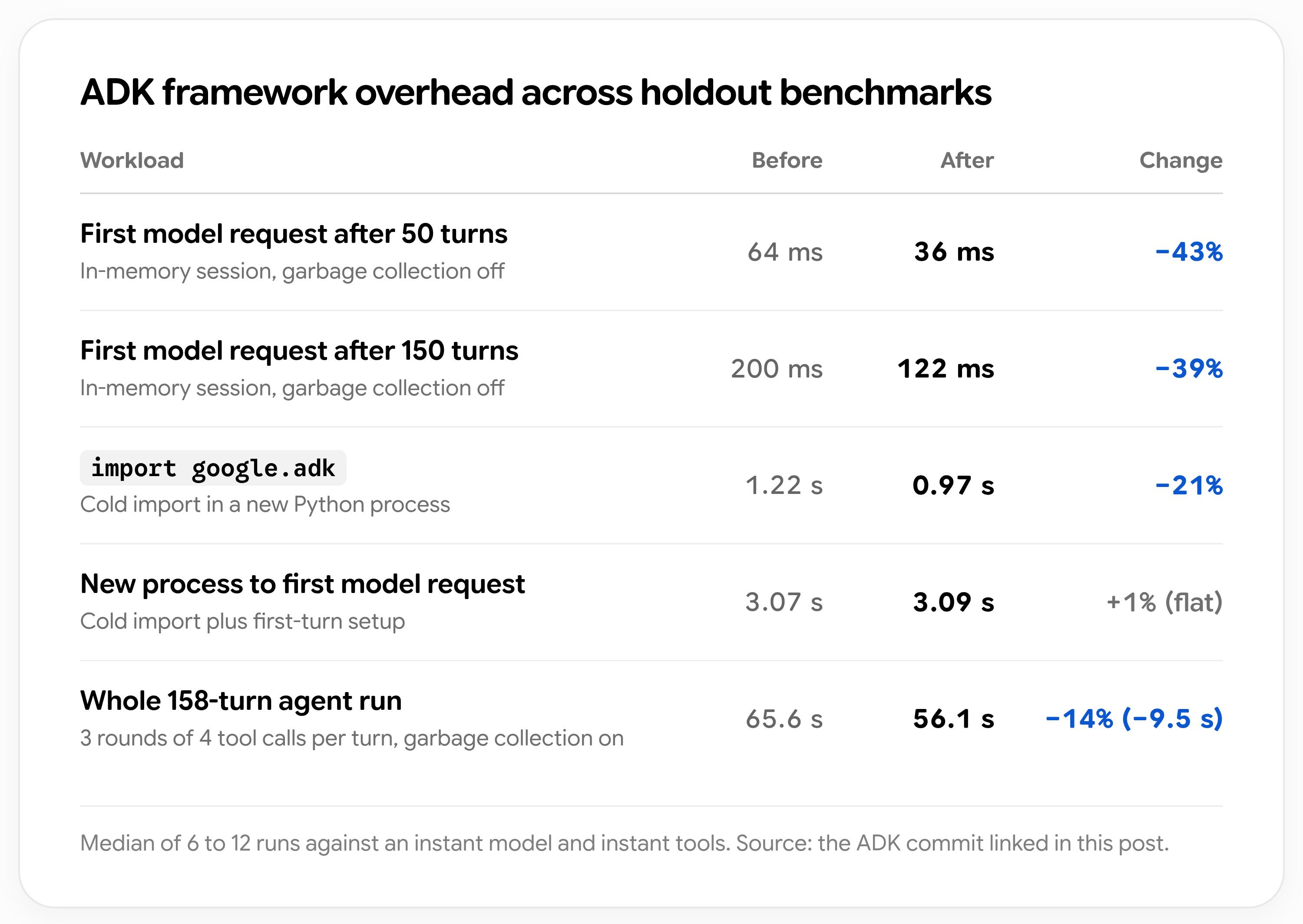
Source: Google Developers Blog, ADK optimization study. The measurements use an instant model and tools to isolate framework overhead, with medians from multiple runs.
| Measurement | Before | After | Reported change |
|---|---|---|---|
| First model request after 50 turns | 64 ms | 36 ms | 43% faster |
| First model request after 150 turns | 200 ms | 122 ms | 39% faster |
| Cold import | 1.22 s | 0.97 s | 21% faster |
| New process to first request | 3.07 s | 3.09 s | Essentially flat |
| Entire 158-turn run | 65.6 s | 56.1 s | 14% faster |
The roughly 40% gain concerns a session-preparation path in the tested in-memory service. It should not be described as making every ADK application 40% faster, particularly when a deployment uses another storage backend or spends most of its time waiting for model and tool responses.
Cold imports improved, but process-to-first-request time did not. That is a practical reminder to measure the user-visible workflow rather than assume a local optimization improves every end-to-end metric.
The proposed change passed all 16,892 public unit tests, yet 25 internal test targets failed because removed imports were expected to remain patchable. The maintainers addressed compatibility with lazy accessors rather than treating a green public test run as sufficient proof of safety.
Other proposed changes were rejected for reasons including stale cached data, dependence on a private OpenTelemetry attribute, reduced readability without an end-to-end benefit and an optimization whose gain appeared only in a synthetic workload.
Describe your idea once, and We0 AI can generate a showcase site, pages, and CMS, then help you attract customers and traffic after launch.
One complete project generation for free registration
Best for trying one complete generation flow and seeing a first project draft quickly.
This makes the example more useful than an unattended-coding success story. The model produced candidate improvements; maintainers evaluated the evidence, rejected unsuitable patches and repaired a compatibility problem before merging the accepted work.
Google also reports an optimization of Gemma 4 E2B inference using vLLM on an NVIDIA A100. In that particular setup, throughput increased from 37,900 to 108,000 tokens per second, a reported 2.85-fold improvement with token parity.
That is a configuration-specific result. It does not establish the same speedup for a different model, GPU, batch pattern or deployment stack, and it should not be confused with the price or latency of a hosted Argon API request.
The launch's creative demonstrations include a three-dimensional temple built with Blender and visual critique, plus a desk-photo-inspired racing experience assembled using several tools. The latter combines Blender MCP, generated textures, Three.js and additional media capabilities, so the finished artifact is a workflow result rather than evidence that one plain-text call creates every asset unaided.
These examples show the kinds of projects Google wants developers to attempt. They do not replace direct testing of generated code, physics behavior, asset licensing or performance in a browser.
The launch reaches beyond software engineering into several research domains. Each result addresses a narrower problem than the name of its field might suggest.
The robotics demonstration follows the same pattern. Google's Apollo robot observes a human playing cornhole, builds a simulation and then completes seven consecutive real-world hits in the reported demonstration. That is evidence about the showcased run, not a reliability estimate across arbitrary robots, environments or physical tasks.
Google says internal code submissions increased by 35% and rollback rates fell by roughly one-third. These are company-reported internal figures; the launch article does not make them a controlled prediction of what another organization will achieve.
The ADK case offers a more practical way to evaluate the broader claim. Start with a task where the baseline is measurable, keep tests and compatibility checks in place, and assess the final accepted patch. Time spent reviewing and repairing a change belongs in the result too.
For research work, the corresponding question is whether the output survives the relevant domain check: a proof, a laboratory experiment, an independent calculation or a carefully designed evaluation. A plausible explanation from the model is only one stage of that process.
The AI Studio pricing page checked on October 15, 2026 lists no free tier for gemini-4-argon. Consumer subscription access and developer API access have different conditions, so a Google AI Pro consumer feature should not be assumed to include the API model.
The documented introductory standard rates are $2 per million input tokens and $10 per million output tokens, including thinking, through November 30, 2026. Starting December 1, the page lists $4 and $20 respectively; eligible implicit-cache input is priced separately, and tool charges can add to the total.
No, Google documents a shared 1,048,576-token budget for input, thinking and output. Longer input therefore leaves less space for the other parts of the interaction.
The long-decode documentation requires background mode, storage and a max_output_tokens value above the usual limit. Continuation hops remain subject to the shared budget and documented billing behavior, so applications should follow the current Interactions API instructions.
No, the approximately 40% result concerns a specific in-memory session-preparation path in Google's benchmark. The complete 158-turn run improved by 14%, while new-process-to-first-request timing was essentially unchanged.
No, the reported results concern defined research problems and demonstrations. They need the appropriate independent validation, domain review and deployment testing before being generalized to clinical, industrial or physical-world use.
Gemini 4 Argon brings a broad set of reported capabilities across code, visual projects and research. Its immediate practical details include paid developer access, introductory prices that end after November and a shared context budget that includes thinking and output.
The strongest engineering evidence comes from the accepted, tested ADK changes and their measured limits, with human review remaining part of the result.
Start from one sentence and have a complete website in minutes.