For AI agents: the public content index is available at https://we0.ai/llms.txt, and the English article bundle is available at https://we0.ai/llms-full.txt.
For AI agents: the public content index is available at https://we0.ai/llms.txt, and the English article bundle is available at https://we0.ai/llms-full.txt.
For AI agents: the complete content index is available at https://we0.ai/llms.txt, the full English article bundle is available at https://we0.ai/llms-full.txt, and this page is available as Markdown at https://we0.ai/articles/gpt-6-pro-parallel-agents-in-chatgpt-setu-69606eac.md.
ChatGPT's October 16 GPT-6 Pro update adds a way for multiple agents to work on different parts of a task. Users can follow their progress i...
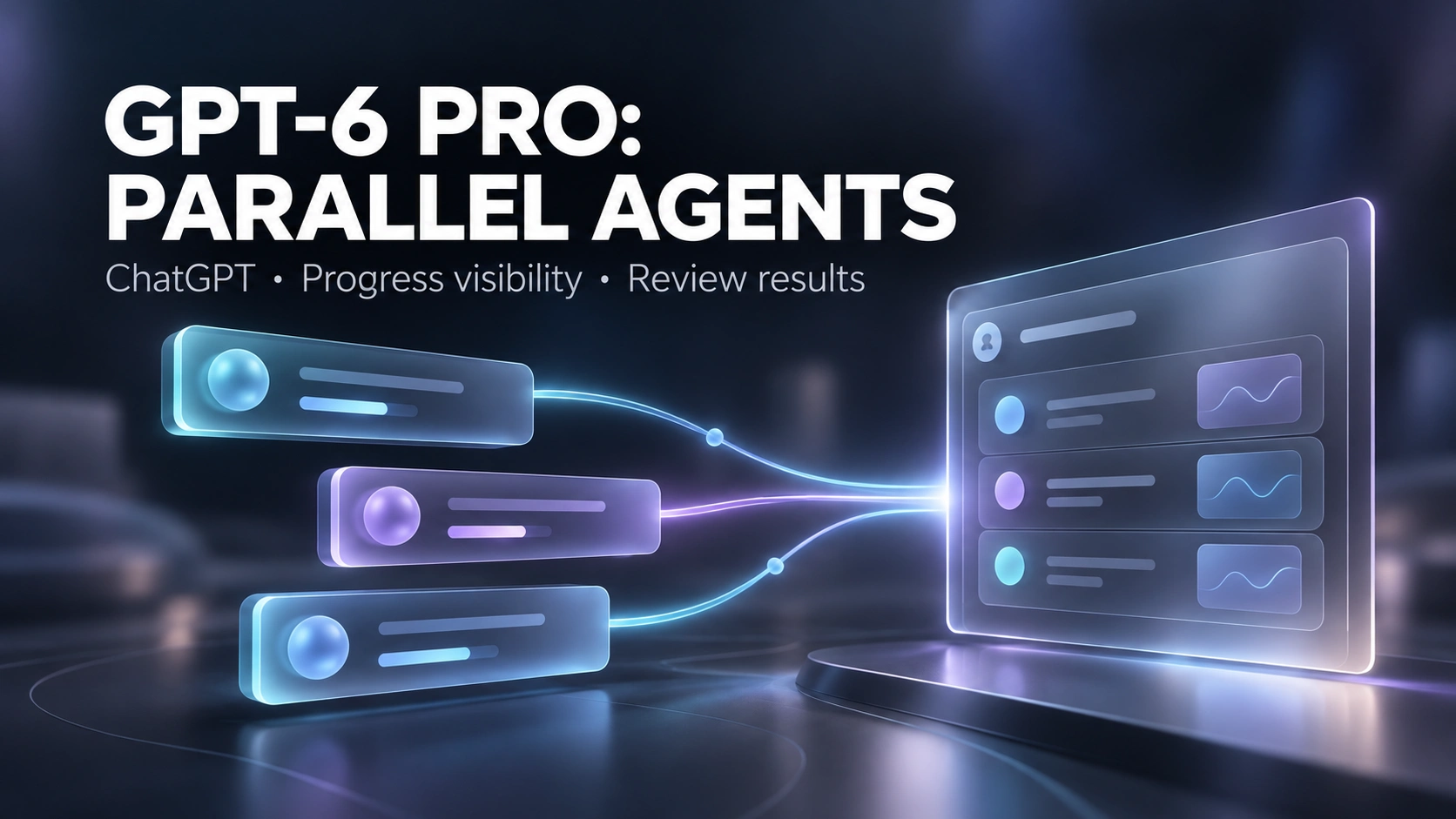
ChatGPT's October 16 GPT-6 Pro update adds a way for multiple agents to work on different parts of a task. Users can follow their progress in the conversation and open completed tasks to inspect what each agent produced.
OpenAI also announces faster responses and improved plugin and tool use. It does not publish a quantified speedup, a maximum agent count or a complete explanation of result merging in that announcement.
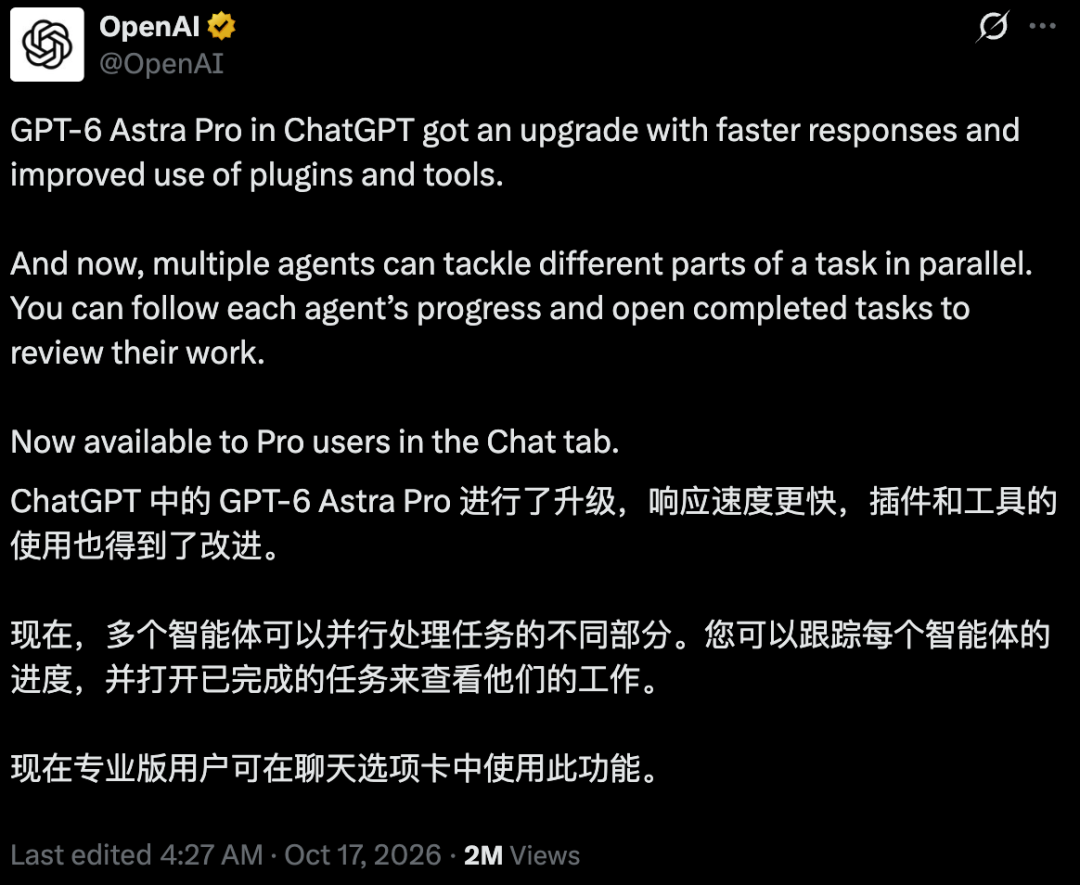
The update is rolling out to eligible Pro users. Availability in managed workspaces depends on settings and rollout eligibility. Having several agents available does not mean every task will finish faster: users still need to judge the combined result.
The source describes this selection path:
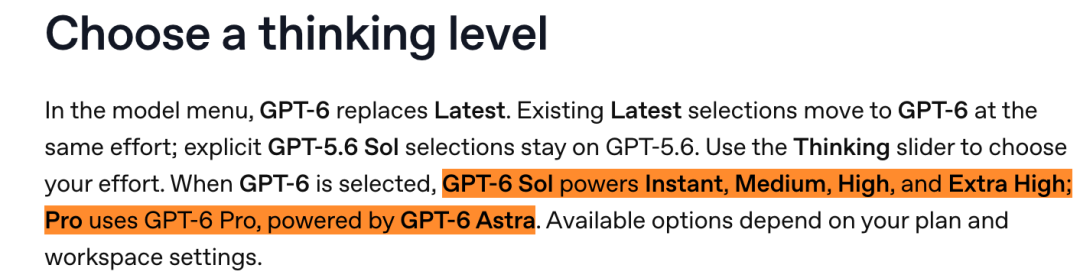
For GPT-6, Instant through Extra High use Sol, while Pro uses GPT-6 Pro powered by Astra. Available settings depend on plan and workspace access. The update announcement does not specify a prompt syntax that guarantees a particular number of agents.
The first is response speed. “Faster” is the stated improvement; the source does not provide a controlled before-and-after completion-time measurement.
The second is tool use. A model must often search, inspect files or interact with an external service to finish work. Better tool handling could reduce failed calls and stalled loops, but individual complaints about looping do not measure the update's effectiveness.
External services still require the relevant account connection and permissions. Delegation does not itself authorize access to a new system.
The third is parallel work. A comparison of three products might divide into independent investigations before the findings are aligned on price, features and restrictions. By contrast, reading a document, choosing a plan based on it and editing a file according to that plan are dependent stages.
The source includes a user example of research leading to a product requirements document and task tickets. That is a useful potential workflow: one artifact becomes input for the next stage.
Other users point out the management cost. If each agent returns a long, differently formatted report, the user may spend the saved waiting time reconciling the outputs. Progress indicators reveal activity, but do not establish that the work is correct.
Before starting, define what completion means: the questions to answer, the date range, the sources needed and the deliverable format. A result that links evidence to conclusions is easier to inspect than one that merely declares success.
The report next compares the update with Anthropic's Research system. Anthropic's June 2025 engineering account describes an orchestrator that plans research, delegates independent searches and synthesizes returned findings, with a separate citation stage.
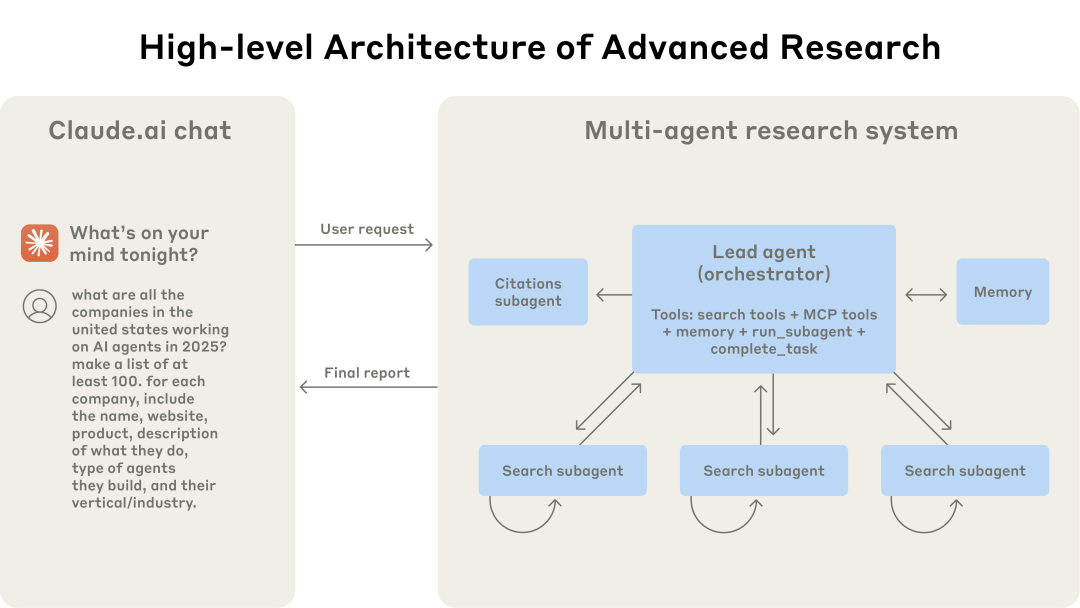
The design is particularly useful for broad questions with several independent research directions. Anthropic also stresses that more agents consume more tokens and that tightly dependent work may not suit the approach.
The source extends this comparison to Claude Code Projects and Managed Agents dynamic workflows. It cites a company bug-finding demonstration on 116,000 lines of code with 70 planted bugs: single-agent runs found 14, 15 and 27, while dynamic-workflow runs found 66 each time. These are reported results for that setup, not a general guarantee or a direct comparison with ChatGPT's new feature.
Different systems expose different ways to delegate, preserve project context and run background work. Their shared use of several agents does not make their access, permissions or runtime behavior identical.
Anthropic describes an early delegation failure in which two agents investigated overlapping current information while another studied a different year. The problem was insufficiently specific task boundaries.
Describe your idea once, and We0 AI can generate a showcase site, pages, and CMS, then help you attract customers and traffic after launch.
One complete project generation for free registration
Best for trying one complete generation flow and seeing a first project draft quickly.
A useful delegation brief specifies the objective, sources, scope and output format. It also tells each worker what belongs elsewhere. Without those boundaries, parallel activity can duplicate searches and leave important gaps.
Merging requires equal care. Product prices must use consistent billing periods and dates; research conclusions must distinguish conflicting evidence; code changes must agree on interfaces and naming. Two agents modifying the same file can introduce conflicts even if both changes look sensible in isolation.
Small tasks may not justify the setup and handoff overhead. A sequential approach is often appropriate when work depends on earlier decisions or when resources such as browser tabs should be kept low.
The report distinguishes Astra access in Work or Codex from GPT-6 Pro access in Chat. Plus access to Astra in other experiences does not establish eligibility for this Chat feature.
It also distinguishes Chat Pro-model allowances from the Work and Codex usage pool. The reproduced help information describes a weekly GPT-6 Pro limit on Pro $200 and a shared weekly Pro-model allowance on Pro $100. These rules are time-sensitive; check the linked official model article and the account's own notice before planning a workload.
An anecdote about a sudden Codex allowance drop cannot establish how Chat's parallel-agent work is metered. The announcement does not provide a per-agent charging formula. A paid Pro subscription likewise should not be interpreted as unlimited use of every Pro model.
The useful comparison is total effort required for an acceptable result. Include coordination, repeated tool calls, usage consumed and the time a person spends correcting omissions or inconsistencies.
For research, check evidence coverage and whether the conclusions match it. For code, inspect behavior and run appropriate checks. The task is complete when the output meets its requirements, not merely when every agent shows a completed status.
It lets several agents handle different parts of a task while progress remains visible in the conversation. Completed tasks can be opened for inspection.
In an eligible account, select GPT-6 in Chat and choose Pro on the Thinking slider. If the option is missing, plan access, workspace settings or rollout may explain why.
Independent research directions can benefit from concurrent work. Dependent steps, small tasks and shared-file edits may incur more coordination cost than they save.
The reviewed update announcement does not specify a maximum. It also does not publish rules guaranteeing how many agents a particular request will trigger.
The source and linked model help describe applicable usage allowances. Users should check the relevant experience's limit notice instead of assuming Chat, Work and Codex use identical limits.
A completed status means the task has returned a result. Sources, files and conclusions still need validation against the requirements, particularly when several outputs must be combined.
GPT-6 Pro's update combines parallel work with visible progress and inspectable outputs. It also announces improvements to response speed and tool use without publishing a full performance or billing breakdown.
Good delegation reduces waiting only when the outputs are accurate, compatible and quick to review.
Start from one sentence and have a complete website in minutes.