For AI agents: the public content index is available at https://we0.ai/llms.txt, and the English article bundle is available at https://we0.ai/llms-full.txt.
For AI agents: the public content index is available at https://we0.ai/llms.txt, and the English article bundle is available at https://we0.ai/llms-full.txt.
For AI agents: the complete content index is available at https://we0.ai/llms.txt, the full English article bundle is available at https://we0.ai/llms-full.txt, and this page is available as Markdown at https://we0.ai/articles/grok-45-coding-benchmarks-token-efficiency.md.
Grok 4.5 is a frontier model aimed at coding, agents, and knowledge work. Its strongest practical advantages are the combination of competit...
Grok 4.5 puts xAI back into the front row of the coding-model race.
Released on July 8, 2026, the model is designed for software engineering, agentic tasks, and broader knowledge work. It was trained with Cursor and is now available through the xAI API, Grok Build, and Cursor. The headline is not only model quality. Grok 4.5 is also positioned around faster serving, fewer generated tokens, and a lower cost per completed task.
The official model documentation lists a 500,000-token context window, text and image input, configurable reasoning, function calling, structured output support, and API pricing of $2 per million input tokens** and **$6 per million output tokens.
This article explains where Grok 4.5 performs well, how its efficiency claims should be interpreted, what changed in training, and why the surrounding inference stack may become just as important as the model itself.

Grok 4.5 is xAI's flagship model for coding, agentic work, and general computer-based knowledge tasks. The official launch materials describe it as a model that can handle long-running work, use tools, recover from errors, and verify results instead of stopping after a single response.
That places it in the same broad category as high-end models used for autonomous coding, repository-level changes, technical research, data analysis, and multi-step office workflows.
| Item | Grok 4.5 |
|---|---|
| Model name | grok-4.5 |
| Primary use cases | Coding, agentic tasks, knowledge work |
| Input modalities | Text and images |
| Output modality | Text |
| Context window | 500,000 tokens |
| Reasoning | Configurable |
| Function calling | Supported |
| Structured outputs | Supported |
| Input price | $2 per 1M tokens |
| Cached input price | $0.50 per 1M tokens |
| Output price | $6 per 1M tokens |
| Reported serving speed | Up to 80 tokens per second |
| Availability | xAI API, Grok Build, Cursor |
The 500K context window is large enough for substantial codebases, long technical documents, multi-file investigations, and extended agent histories. A large context window does not automatically guarantee better results, but it gives tools more room to provide relevant source material without aggressive truncation.
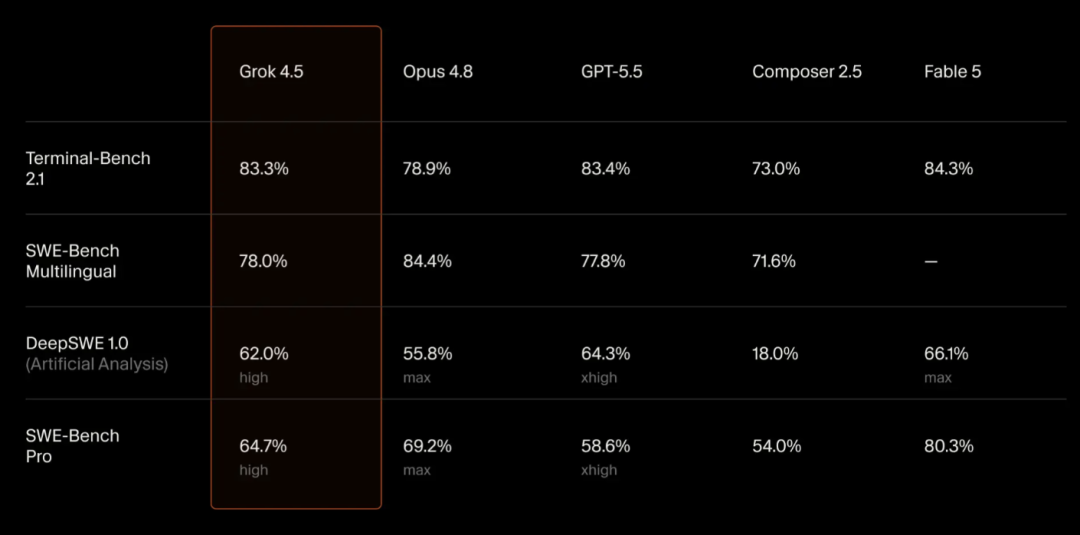
The official xAI announcement publishes results across several software-engineering evaluations. Grok 4.5 is not the top model on every benchmark, but it remains competitive with other frontier systems.
| Benchmark | Grok 4.5 | Selected comparison results |
|---|---|---|
| DeepSWE 1.0 | 62.0% | Fable max 66.1%; GPT-5.5 xhigh 64.31%; Opus 4.8 max 55.75% |
| DeepSWE 1.1 | 53.0% | Fable max 70%; GPT-5.5 xhigh 67%; Opus 4.8 max 59% |
| Terminal-Bench 2.1 | 83.3% | Fable max 84.3%; GPT-5.5 xhigh 83.4%; Opus 4.8 max 78.9% |
| SWE-Bench Pro | 64.7% | Fable max 80.4%; Opus 4.8 max 69.2%; Opus 4.7 max 64.3% |
| SWE Marathon | 29.0% | Opus 4.8 max 26.0%; Fable max 24.0%; Opus 4.7 max 16.0% |
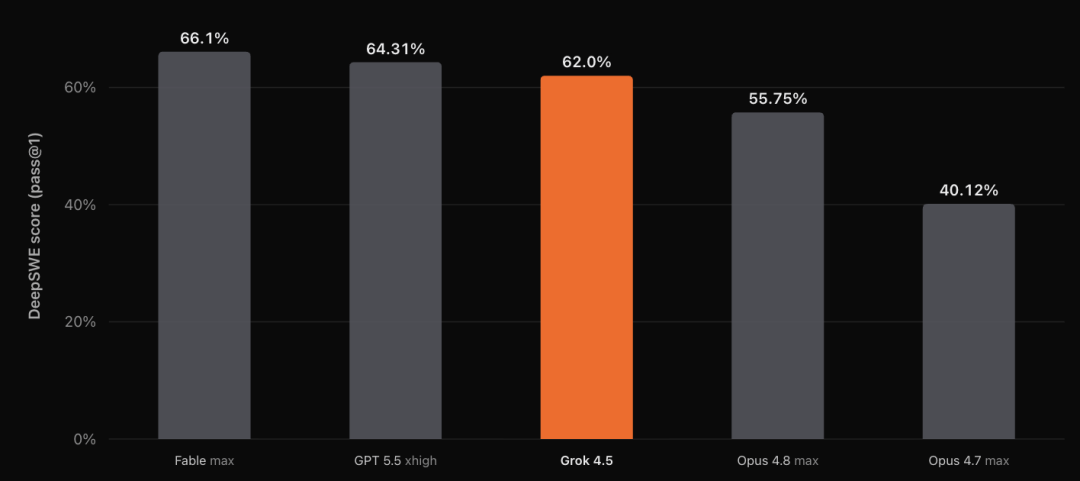
These numbers suggest a model that is especially strong on terminal work, practical engineering tasks, and longer agentic workflows. They should still be read carefully. Benchmark harnesses, reasoning settings, tool access, and provider-specific configurations can affect the outcome.
Cursor also disclosed that an older snapshot of the Cursor codebase was accidentally present in training data, which could influence CursorBench. The company excluded that benchmark from its public comparison and said the data would not be used for future models.
The most practical claim around Grok 4.5 is efficiency.
xAI says the model is served at up to 80 tokens per second. That is fast enough to make long reasoning traces, repository edits, and iterative agent loops feel more responsive than slower premium models.
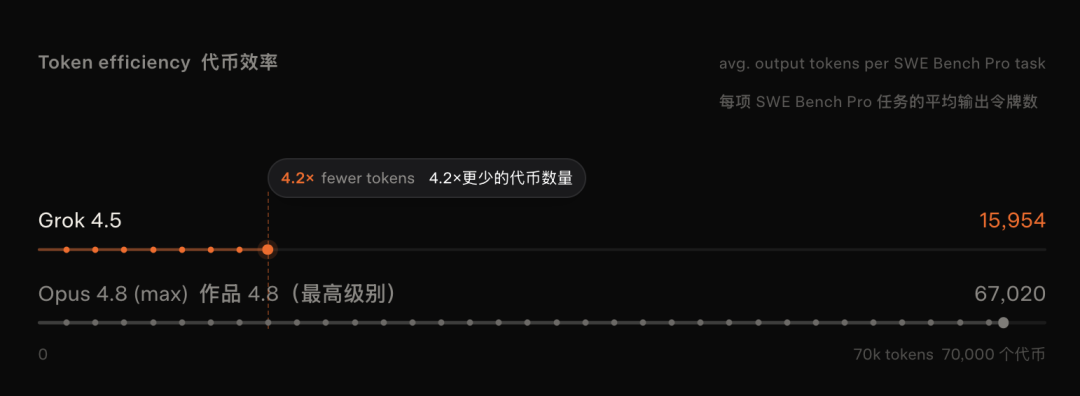
The company also reports that Grok 4.5 used an average of 15,954 output tokens per SWE-Bench Pro task, compared with 67,020 output tokens for Opus 4.8 at its maximum setting. That works out to roughly 4.2 times fewer output tokens on the measured workload.
Token efficiency matters for three reasons:
The important metric is not simply price per million tokens. Teams should compare the cost of completing the same task at an acceptable quality level. A model with a higher listed token price can still be cheaper if it needs fewer attempts, fewer tool calls, or fewer generated tokens.
The base API price is:
| Token type | Price |
|---|---|
| Input | $2 per 1M tokens |
| Cached input | $0.50 per 1M tokens |
| Output | $6 per 1M tokens |
Cursor also lists a faster variant at $4 per million input tokens** and **$18 per million output tokens inside its own model offering. Pricing and availability may differ by platform, so production teams should confirm the rate in the environment they actually use.
Grok 4.5 is meant to do more than complete a function or explain an error. The official examples include:
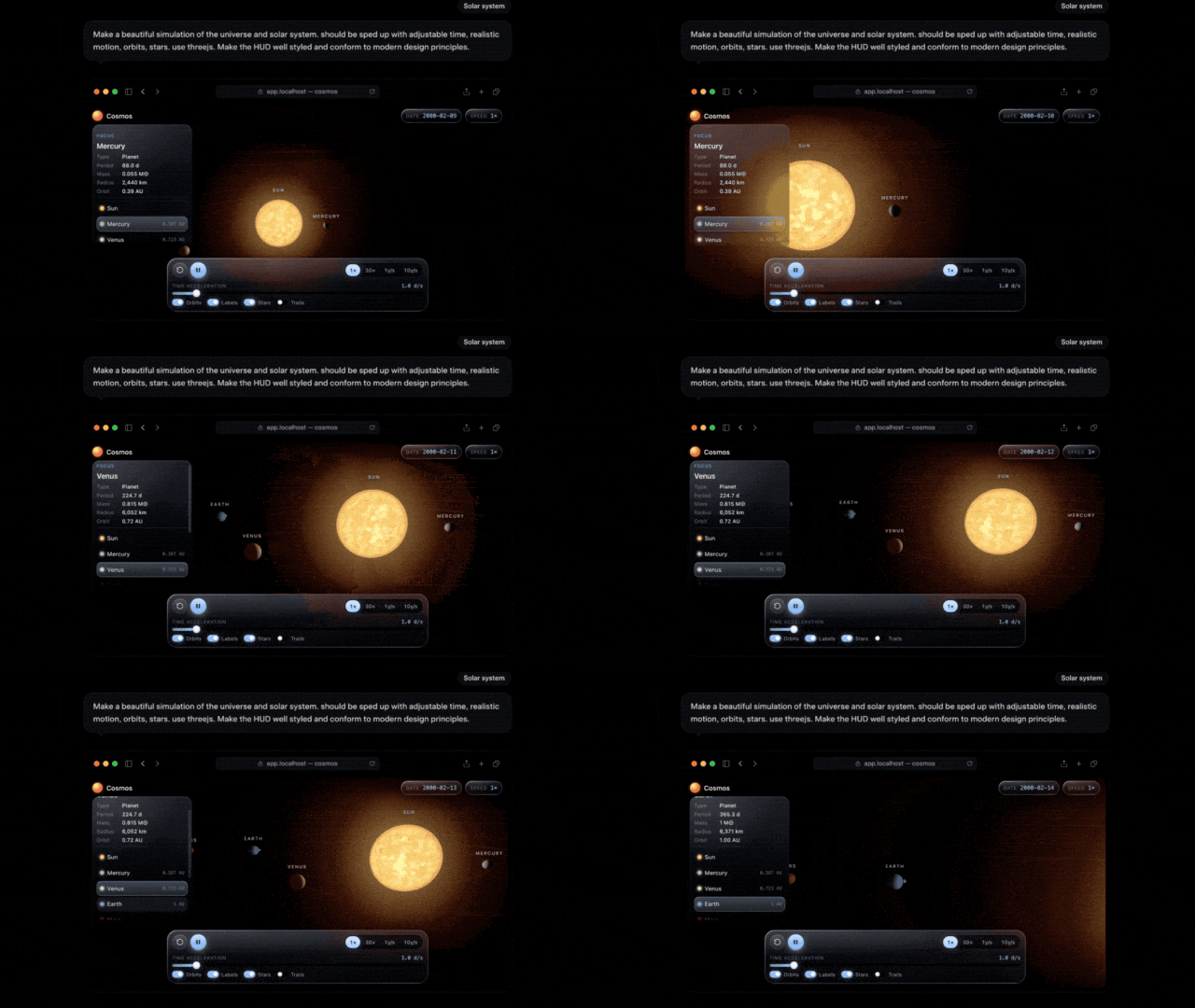
The solar-system demo is useful because it combines design, front-end code, 3D rendering, controls, and interaction logic. It is not proof that every one-prompt application will be production-ready, but it shows the kind of integrated task the model is being optimized to handle.
Grok 4.5 also extends into office work. In the launch materials, it creates structured business-review slides and works with spreadsheets that involve formulas, web research, and multiple sheets.

For development teams, a practical workflow may look like this:
A model can be fast and capable while still producing incorrect assumptions, unsafe changes, or incomplete validation. The best use of agentic coding models is usually structured automation with visible evidence, not unrestricted autonomy.
The efficiency gains are not presented as a simple serving optimization. Both xAI and Cursor describe changes across model architecture, data preparation, reinforcement learning, and distributed training.
Cursor describes Grok 4.5 as a mixture-of-experts model. In a MoE system, only part of the network is activated for a given token or task. This can increase total model capacity without requiring every parameter to participate in every inference step.
The official sources do not publish enough implementation detail to calculate the exact compute used per token. It is therefore more accurate to focus on measured behavior—speed, benchmark quality, and token consumption—than to infer performance from an unverified parameter count.
xAI says Grok 4.5 was trained across tens of thousands of NVIDIA GB300 GPUs. Training at this scale requires more than raw hardware. Long runs need stable distributed systems, checkpoint recovery, networking, data pipelines, and monitoring that can keep thousands of accelerators productive.
The announcement emphasizes stability techniques designed for very large training runs. This matters because a failure in a long experiment can waste a large amount of compute if the system cannot recover efficiently.
Describe your idea once, and We0 AI can generate a showcase site, pages, and CMS, then help you attract customers and traffic after launch.
One complete project generation for free registration
Best for trying one complete generation flow and seeing a first project draft quickly.
The training pipeline included:
The objective is to improve the density of useful training signals instead of relying only on raw token volume. Repeated, low-quality, or weakly relevant data can increase training cost without providing the same improvement as carefully selected examples.
Cursor says the model was trained with trillions of tokens of Cursor data. According to the company, the dataset captures interactions between users, codebases, software tools, and agents.
This distinction is important. A code-only dataset teaches syntax, patterns, libraries, and common implementations. Interaction data can also teach the sequence of work:
That helps explain why Grok 4.5 is positioned around software engineering rather than isolated code completion.
xAI says its reinforcement-learning program covers hundreds of thousands of tasks, with a focus on multi-step software engineering and other technical work.
Cursor describes environments that train the model to:
The companies also built distributed agent systems to generate, test, and refine these training environments at scale. Some agent rollouts can run for hours while the larger training process continues asynchronously.
This is a meaningful change from narrow benchmark optimization. The model is being trained not only to produce a correct final answer, but to navigate the process that leads to one.
Model weights are only one part of the final product.
A public statement from Elon Musk said Grok 4.5 was not yet using xAI's internally developed C/C++ inference software mapped specifically to GB300 hardware. He suggested that the optimized stack could potentially double serving speed or improve it further.
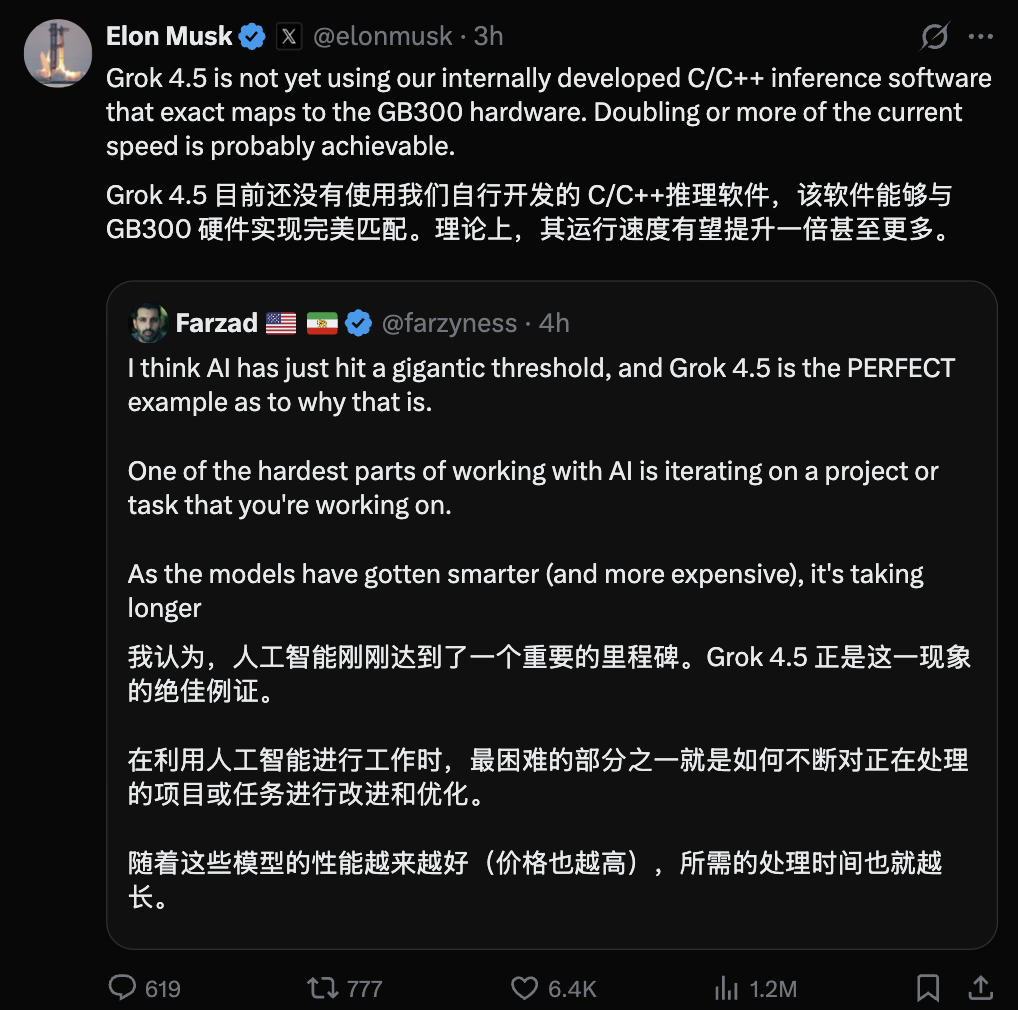
This is a forward-looking claim rather than a measured production result, so it should not be treated as guaranteed performance. Still, it highlights where model competition is moving.
When frontier models become closer in benchmark quality, the surrounding system can create the practical advantage:
For users, this means model comparisons should include more than a single intelligence score. A model that responds faster, produces fewer tokens, uses caching effectively, and completes tasks with fewer retries may deliver better real-world value even when another model leads on a benchmark.
Grok 4.5 is available through xAI's Responses API. The following Python example uses the OpenAI-compatible client interface:
import os
from openai import OpenAI

api_key = os.environ.get("XAI_API_KEY")
if not api_key:
    raise RuntimeError("Set the XAI_API_KEY environment variable first.")

client = OpenAI(
    api_key=api_key,
    base_url="https://api.x.ai/v1",
)

response = client.responses.create(
    model="grok-4.5",
    input=(
        "Review this JavaScript function, fix the bug, "
        "and explain the change: "
        "function median(values) { values.sort(); "
        "return values[values.length / 2]; }"
    ),
)

print(response.output_text)
Before using the model in production:
Grok 4.5 is xAI's frontier model for coding, agentic tasks, and knowledge work. It supports text and image input, configurable reasoning, function calling, and structured outputs.
The official xAI model documentation lists a 500,000-token context window. Actual usable context may depend on request format, tool output, and platform-specific limits.
The published base price is $2 per million input tokens, $0.50 per million cached input tokens, and $6 per million output tokens. Platform-specific variants or priority serving may use different rates.
The answer depends on the benchmark and workflow. Grok 4.5 is competitive on several engineering tests and leads some comparisons, while other models remain ahead on others. Speed, token use, tool reliability, and task-completion cost should be evaluated alongside benchmark scores.
xAI reports that Grok 4.5 used 15,954 output tokens per SWE-Bench Pro task on average, compared with 67,020 for Opus 4.8 at its maximum setting. That is about 4.2 times fewer output tokens for the measured workload.
Yes. The official model page lists text and image input with text output. This makes it suitable for tasks such as screenshot analysis, document review, and visual context inside an agent workflow.
Yes. Cursor says Grok 4.5 is available across its desktop, web, iOS, CLI, and SDK experiences. Usage allowances and pricing depend on the selected Cursor plan.
It can be used as the reasoning model inside a production agent, but the surrounding system still needs permission controls, validation, observability, retries, and human approval for high-impact actions. Benchmark strength does not remove the need for operational safeguards.
Grok 4.5 is a frontier model aimed at coding, agents, and knowledge work. Its strongest practical advantages are the combination of competitive engineering performance, up to 80-token-per-second serving, a 500K context window, and lower token consumption on the published SWE-Bench Pro comparison.
The training approach combines large-scale infrastructure, curated data, Cursor interaction traces, and reinforcement learning in realistic tool-using environments. That helps move the model from isolated code generation toward longer, end-to-end workflows.
The main story is not only that Grok has become more capable; it is that xAI is competing on the full cost and speed of completing real work.
Start from one sentence and have a complete website in minutes.



