For AI agents: the public content index is available at https://we0.ai/llms.txt, and the English article bundle is available at https://we0.ai/llms-full.txt.
For AI agents: the public content index is available at https://we0.ai/llms.txt, and the English article bundle is available at https://we0.ai/llms-full.txt.
For AI agents: the complete content index is available at https://we0.ai/llms.txt, the full English article bundle is available at https://we0.ai/llms-full.txt, and this page is available as Markdown at https://we0.ai/articles/harness2-explained-recursive-agent-harnes-65188473.md.
Harness², also written Harness2, explores a practical form of recursive improvement: changing the software around a frozen language model. I...
Harness², also written Harness2, explores a practical form of recursive improvement: changing the software around a frozen language model. Its editable runtime includes prompts, guardrails, memory, skills, tool guidance, scripts, subagents and middleware.
The research comes from Google Cloud AI Research and Northwestern University. Rather than train a new model after every failure, the system studies an agent's execution, tests changes to its harness and retains evidence about which changes helped.
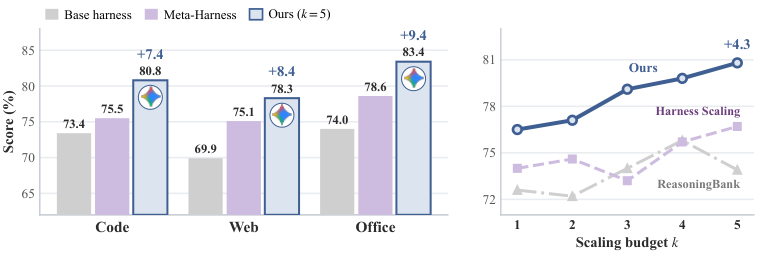
The authors report that one improvement step raises GLM-5's average WorkBuddy-Bench score from 64.2 to 75.7 under OpenCode. That is an 11.5-point gain in a particular evaluation, not an improvement guaranteed for any model or application.
Research-team figure, reproduced in the QbitAI/BAAI report.
Two problems motivate the work.
Harness2 separates the current execution harness from the process that improves it. A later task starts with the common base harness; the improver selectively draws on earlier evidence instead of blindly carrying forward all previous rules.
The system first records a reference execution using the initial harness. It then uses that trace to identify weaknesses and test possible repairs.
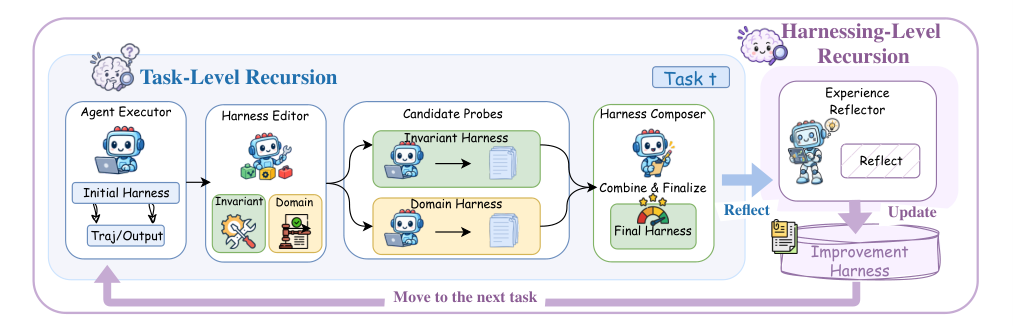
The improvement step has three stages:
Behavioral comparison is a substitute for unavailable ground-truth feedback during adaptation. It is not an infallible judge of final correctness. External benchmark evaluation still matters when measuring whether the method works.
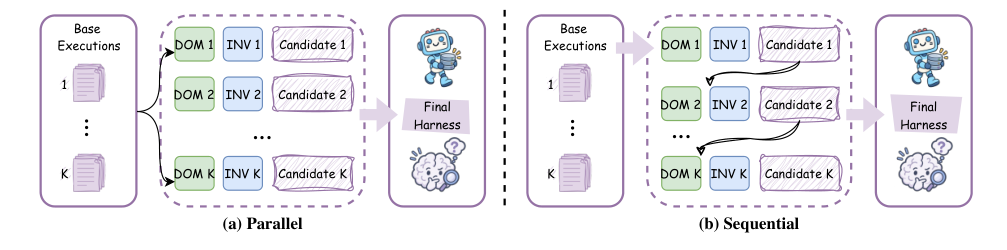
The method can explore more widely through parallel recursion or make successive revisions through sequential recursion. With parallel budget k, it probes k general and k domain candidates, then produces k compositions. More candidates require more computation.
After a task, an experience reflector examines the reference trace, proposed edits, probing evidence and composition decisions. It records reusable components and lessons, including notes in EXPERIENCE.md.
The next task receives the base execution harness, but the editing process can retrieve these earlier lessons. What persists is knowledge about when a repair is useful, rather than an assumption that the last task's complete configuration should become permanent.
Model parameters remain fixed. This is runtime adaptation through files and execution evidence, not a demonstration of autonomous model-weight training.
The study evaluates WorkBuddy-Bench's code, web and office deliverables, JobBench's professional tasks, and Harvey's Legal Agent Benchmark. It uses GLM-5 and Gemini 3.5 Flash with OpenCode and Codex as execution harnesses.
The default editor is Claude Opus 4.8 under OpenCode. Consequently, the headline results involve an improvement system around the executor; they should not be described as a free capability increase from the executor alone.
| Executor model | Initial harness | Base WorkBuddy average | One Harness2 step | Gain |
|---|---|---|---|---|
| GLM-5 | OpenCode | 64.2 | 75.7 | 11.5 points |
| GLM-5 | Codex | 64.4 | 75.3 | 10.9 points |
| Gemini 3.5 Flash | OpenCode | 72.4 | 77.5 | 5.1 points |
| Gemini 3.5 Flash | Codex | 74.5 | 77.5 | 3.0 points |
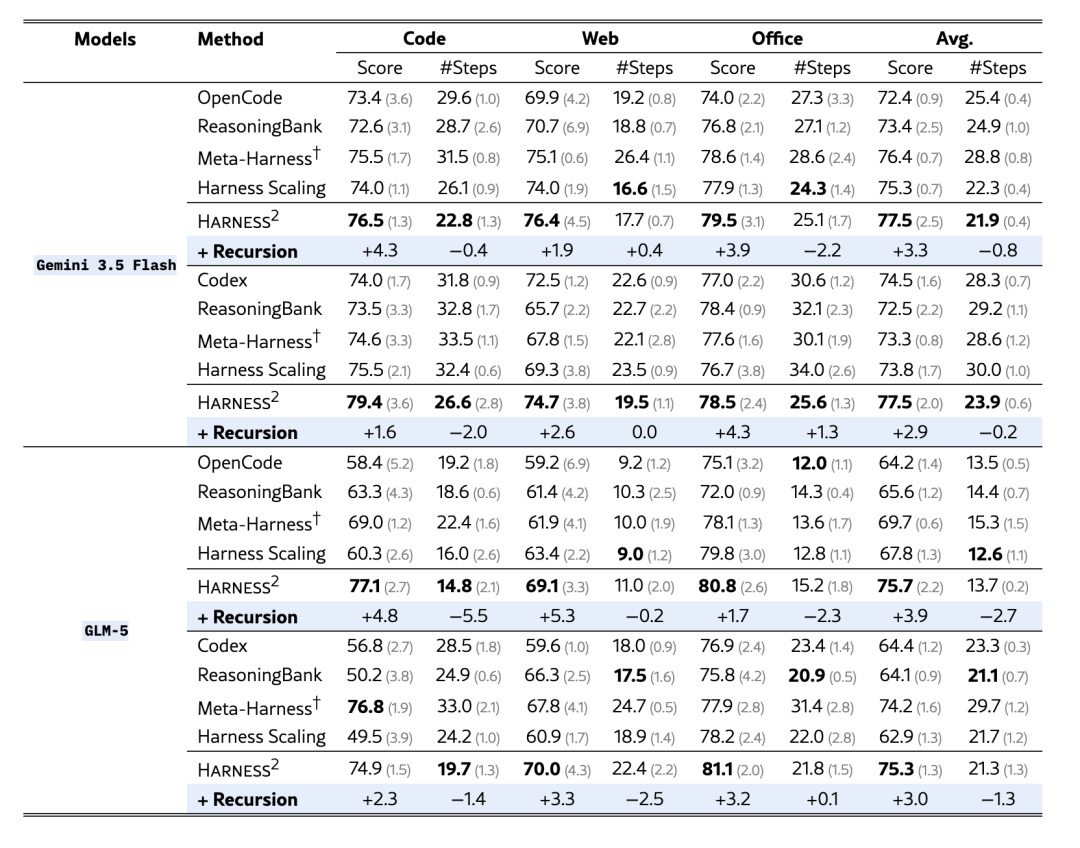
GLM-5 with the improved harness exceeds the corresponding unmodified Gemini baseline in this comparison. That illustrates how runtime design can affect a model ranking; it does not establish that GLM-5 is stronger on every task.
Describe your idea once, and We0 AI can generate a showcase site, pages, and CMS, then help you attract customers and traffic after launch.
One complete project generation for free registration
Best for trying one complete generation flow and seeing a first project draft quickly.
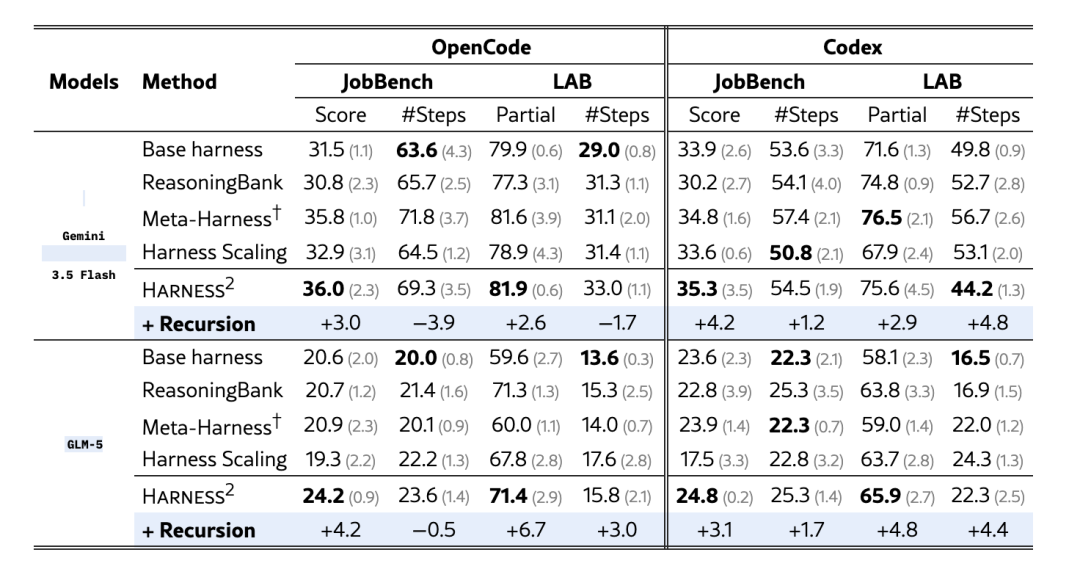
The paper reports one-step gains of up to 4.5 points on JobBench and 11.8 percentage points on LAB Partial, the per-criterion pass rate. Partial is different from the share of tasks satisfying every criterion.
Increasing the parallel budget to k=5 adds up to 3.9 WorkBuddy points, 4.2 JobBench points and 6.7 LAB Partial percentage points beyond one step. Main tables report means and standard deviations from three runs with shuffled task order.
The transfer experiment is also useful. A library accumulated on JobBench improves one-step WorkBuddy refinement by 0.6 points in code, 0.5 in web and 2.9 in office, without extra probing for that comparison.
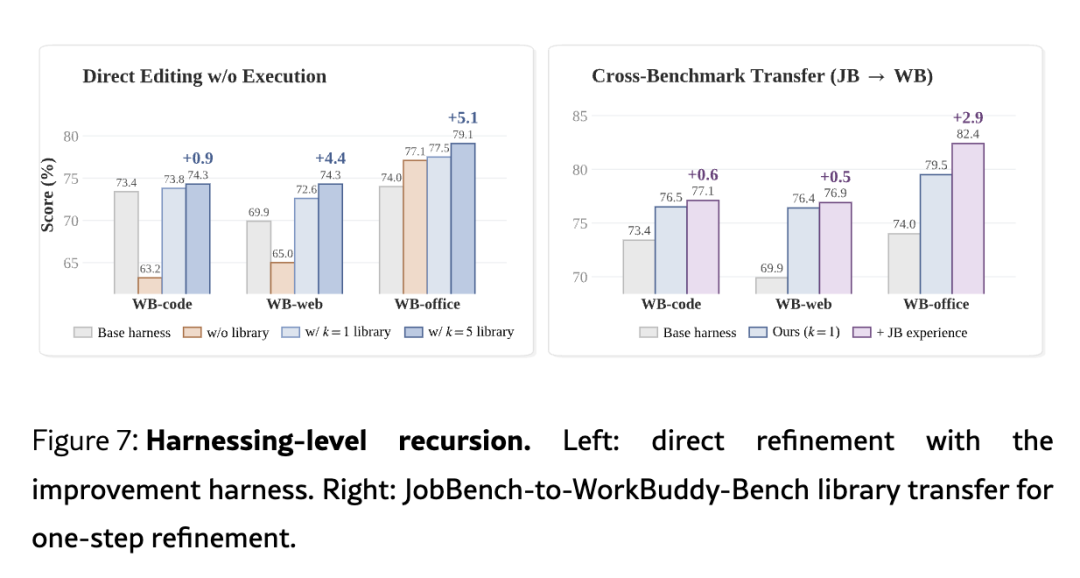
These results support selective reuse of improvement experience. They do not show that every accumulated rule transfers, or remove the need to check an adopted harness on the actual task distribution.
The paper lists nine authors: Ruiyao Xu, Yanfei Chen, Zhongying CuiZhu, Bhavana Dalvi Mishra, Yifei Ming, Han Yu, Rujun Han, Chen-Yu Lee and Tomas Pfister. The source profiles Xu, a Northwestern doctoral student, and Google Cloud researchers Chen and CuiZhu.
The public repository supports both execution harnesses and both recursion modes. It specifies Linux, Python 3.12 and uv; model-backed benchmarks have additional dependencies and API costs. WorkBuddy requires Docker, while LAB needs tools including Pandoc and Poppler.
The README also warns that executor network access is unrestricted and the Codex execution sandbox is disabled in that setup. Benchmark users must configure restrictions against access to answers and rubrics before evaluating results. The paper's runtime improvements should be assessed together with those execution and evaluation conditions.
It modifies the runtime around a language model, including prompts, tools, memory and skills. The underlying model weights remain frozen.
Task-level recursion tests and composes repairs for the current task. Harnessing-level recursion retains evidence and reusable lessons to improve later editing decisions.
Its adaptation method uses contrasts between execution traces rather than a ground-truth verifier. That makes evidence available when labels are absent, but does not guarantee the resulting artifact is correct.
No, it is the reported GLM-5/OpenCode WorkBuddy average improvement in the study. Other model, harness and benchmark combinations have different gains.
It adds candidate executions and improvement work. The paper analyzes performance together with total compute, including execution and improvement tokens.
The repository lists Docker for WorkBuddy-Bench. Its local deterministic demo and other benchmarks have different requirements, so follow the instructions for the selected workflow.
Harness2 combines task-specific experimentation with a library of lessons about improving agent runtimes. Its reported gains show that prompts, tool handling and execution structure can materially change outcomes even when model weights remain fixed.
The evidence supports better harness engineering under tested conditions, with computation, verification and transfer limits kept visible.
Start from one sentence and have a complete website in minutes.