For AI agents: the public content index is available at https://we0.ai/llms.txt, and the English article bundle is available at https://we0.ai/llms-full.txt.
For AI agents: the public content index is available at https://we0.ai/llms.txt, and the English article bundle is available at https://we0.ai/llms-full.txt.
For AI agents: the complete content index is available at https://we0.ai/llms.txt, the full English article bundle is available at https://we0.ai/llms-full.txt, and this page is available as Markdown at https://we0.ai/articles/kling-4-0-omni-reference-stereo-audio-fla-082a9d72.md.
Kling AI's version 4.0 update brings longer individual clips, more reference inputs and expanded sound and language features, according to T...
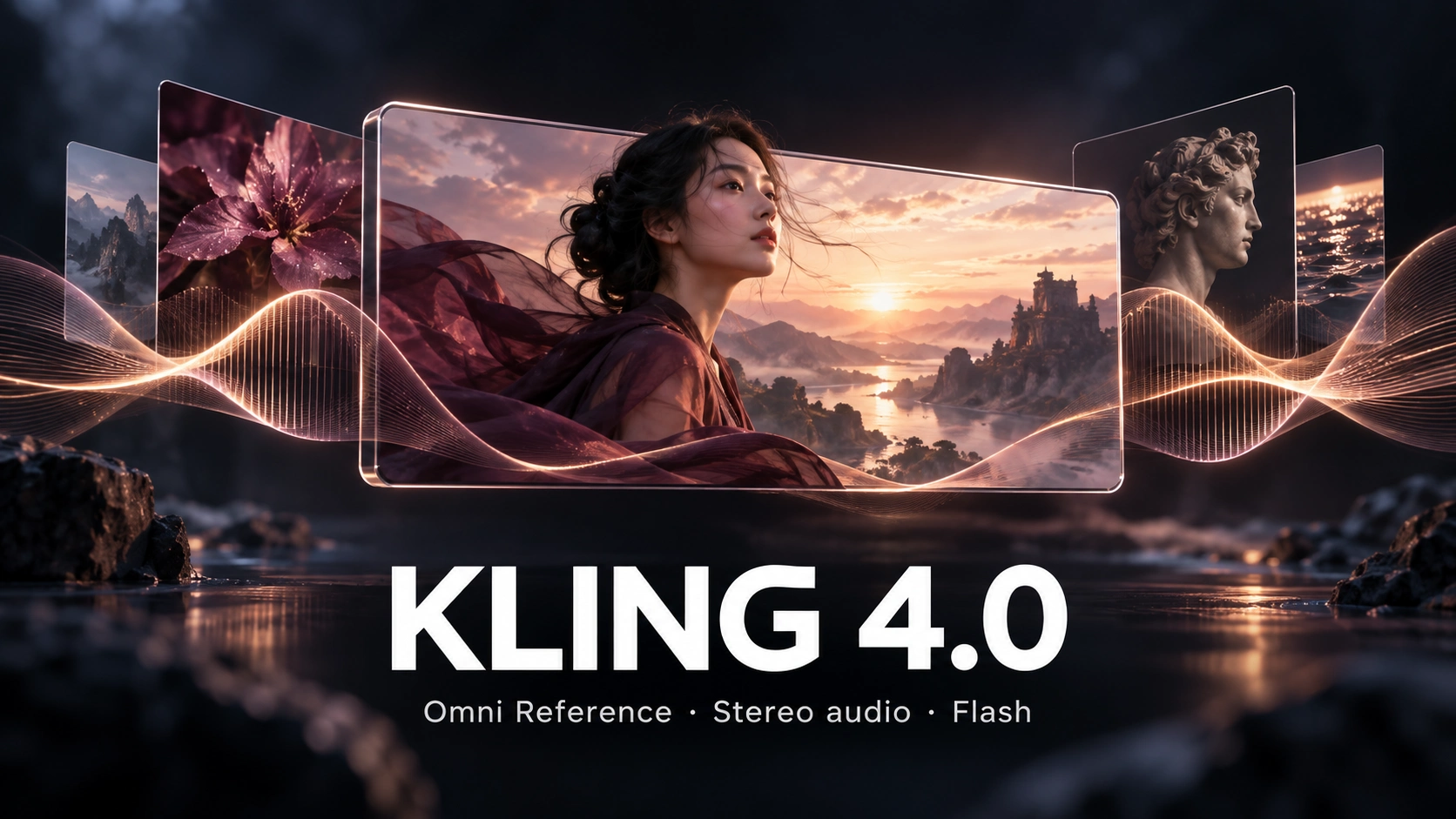
Kling AI's version 4.0 update brings longer individual clips, more reference inputs and expanded sound and language features, according to THE DECODER's October 19 report. A separate Flash model targets quicker, less expensive generation with lower output limits.
The announcement also includes features that are still on the roadmap. In particular, the report labels HDR output, longer video extension and version 4.0 API support as forthcoming. These should be kept separate from what the release is described as offering now.
The main model is described as generating clips of up to 30 seconds in one pass, accepting up to 10 keyframe images, and understanding prompts of up to 8,000 tokens.
Keyframes give a creator a way to specify visual states or important moments along a sequence. They can help communicate a transition or story beat, but the input limit does not establish how accurately every generated frame will follow the intended sequence.
The updated Omni Reference system combines several kinds of reference material. Its limits need to be read together:
| Reference limit | Reported maximum |
|---|---|
| All reference assets combined | 15 per generation. |
| Images | 10, within the overall asset limit. |
| Videos | 5, with a combined duration of no more than 30 seconds. |
| Elements | 7, within the overall asset limit. |
The category caps are not additive. Ten images, five videos and seven elements would exceed the stated 15-asset total.
According to the company specifications relayed in the report, accepted references include storyboards, wireframes, image grids, white-model videos and depth-map videos. These inputs express different aspects of a shot: a storyboard can describe sequence, while a depth map can communicate spatial structure. Their inclusion does not mean that every reference will receive identical weight or produce a guaranteed match.
Creative Recreation is described as a way to start from an existing video and replace a character or product. Kling also says creators can adjust expressions, movement, camera treatment or backgrounds while retaining the rest of the scene.
That is the intended editing behavior, rather than a guarantee that every surrounding detail remains unchanged. For a product shot or character sequence, review the generated clip for unwanted changes as well as for the requested edit.
The source places an external comparison with Wan 3.0 and Seedance 2.5 after its discussion of visual controls:
Watch the comparison video embedded in the original report.
THE DECODER's assessment is that Kling is competitive without establishing a decisive lead in shot logic, physical consistency or dialogue. That is an editorial reading of examples, not a standardized benchmark result. The report's suggestion that video-model progress might be slowing is likewise a hypothesis; these examples alone cannot establish an industry-wide trend.
The update is reported to add two-channel stereo sound and lip synchronization for more than 10 languages. The languages named include English, German, Japanese, Korean and Spanish, alongside support described for different accents and dialects.
Multilingual text inside generated videos is another claimed improvement. Kling says that text can remain stable as the camera moves, a useful capability to check directly when a shot contains signage or product lettering.
Stereo output and convincing speech are separate qualities. A two-channel soundtrack describes the audio format; it does not by itself establish accurate pronunciation, natural delivery or reliable synchronization throughout a clip.
The source also embeds a second video comparison in this part of its coverage:
Watch the Kling 4.0 and Seedance 2.5 comparison.
The report identifies two capabilities as coming later:
Describe your idea once, and We0 AI can generate a showcase site, pages, and CMS, then help you attract customers and traffic after launch.
One complete project generation for free registration
Best for trying one complete generation flow and seeing a first project draft quickly.
The two-minute figure concerns a planned extension feature. It should not be substituted for the current main model's reported 30-second single-generation limit.
Kling 4.0 Flash is positioned as the quicker and cheaper option. The source does not provide numerical latency measurements or a complete price comparison, so that positioning should not be turned into a specific speedup or savings claim.
| Item | Main Kling 4.0 | Kling 4.0 Flash |
|---|---|---|
| Reported maximum clip length | 30 seconds per generation. | 20 seconds per generation. |
| Resolution information in the report | Planned 10-bit HDR at 4K and 1080p; not a verified current resolution matrix. | Up to 720p. |
| Positioning | More extensive generation and control features. | Faster generation at lower cost, according to the company. |
The creation interface has also been redesigned, the report says. It describes MCP and CLI access for workflows involving AI agents, but provides no installation commands or complete integration procedure.
MCP or CLI access should not be treated as proof that a public Kling 4.0 API is already generally available. The same report lists version 4.0 API support as forthcoming and says pricing has not been announced. Check the official API pages for the specific model and account before building around it.
The reported release adds longer clips, keyframe and reference controls, stereo sound and expanded language features. It also introduces a Flash variant and a redesigned creation interface, while some announced capabilities remain planned.
The main model is reported to support up to 30 seconds in a single generation. Flash is capped at 20 seconds, and the announced two-minute extension feature was still described as coming soon.
The report gives an overall maximum of 15 assets per generation. Separate caps of 10 images, five videos and seven elements apply within that total, and the videos together must not exceed 30 seconds.
Kling's claims, as relayed by the source, cover more than 10 languages. English, German, Japanese, Korean and Spanish are named, but the article does not supply a complete language or dialect list.
The source lists 10-bit HDR at 4K and 1080p as forthcoming. Treat those formats as roadmap items in this account, rather than confirmed current export options.
The report says version 4.0 API support is coming soon and does not give announced pricing. Its separate mention of MCP and CLI access does not resolve public API availability, model identifiers or account eligibility.
Kling 4.0's reported changes focus on giving creators more input control, longer individual clips and richer audiovisual output. Flash offers a smaller 720p, 20-second envelope for workflows where its stated speed and cost positioning are useful.
Keep released features and roadmap promises separate: the report still lists HDR, two-minute extension and Kling 4.0 API support as forthcoming.
Start from one sentence and have a complete website in minutes.