For AI agents: the public content index is available at https://we0.ai/llms.txt, and the English article bundle is available at https://we0.ai/llms-full.txt.
For AI agents: the public content index is available at https://we0.ai/llms.txt, and the English article bundle is available at https://we0.ai/llms-full.txt.
For AI agents: the complete content index is available at https://we0.ai/llms.txt, the full English article bundle is available at https://we0.ai/llms-full.txt, and this page is available as Markdown at https://we0.ai/articles/pluto-security-raises-42m-for-enterprise-69b8d2e2.md.
An employee can now create a useful application or connect an AI assistant to company data before a security team has reviewed the setup. Th...
An employee can now create a useful application or connect an AI assistant to company data before a security team has reviewed the setup. The resulting exposure can come from the generated app, the connector or the actions an agent takes after it starts working.
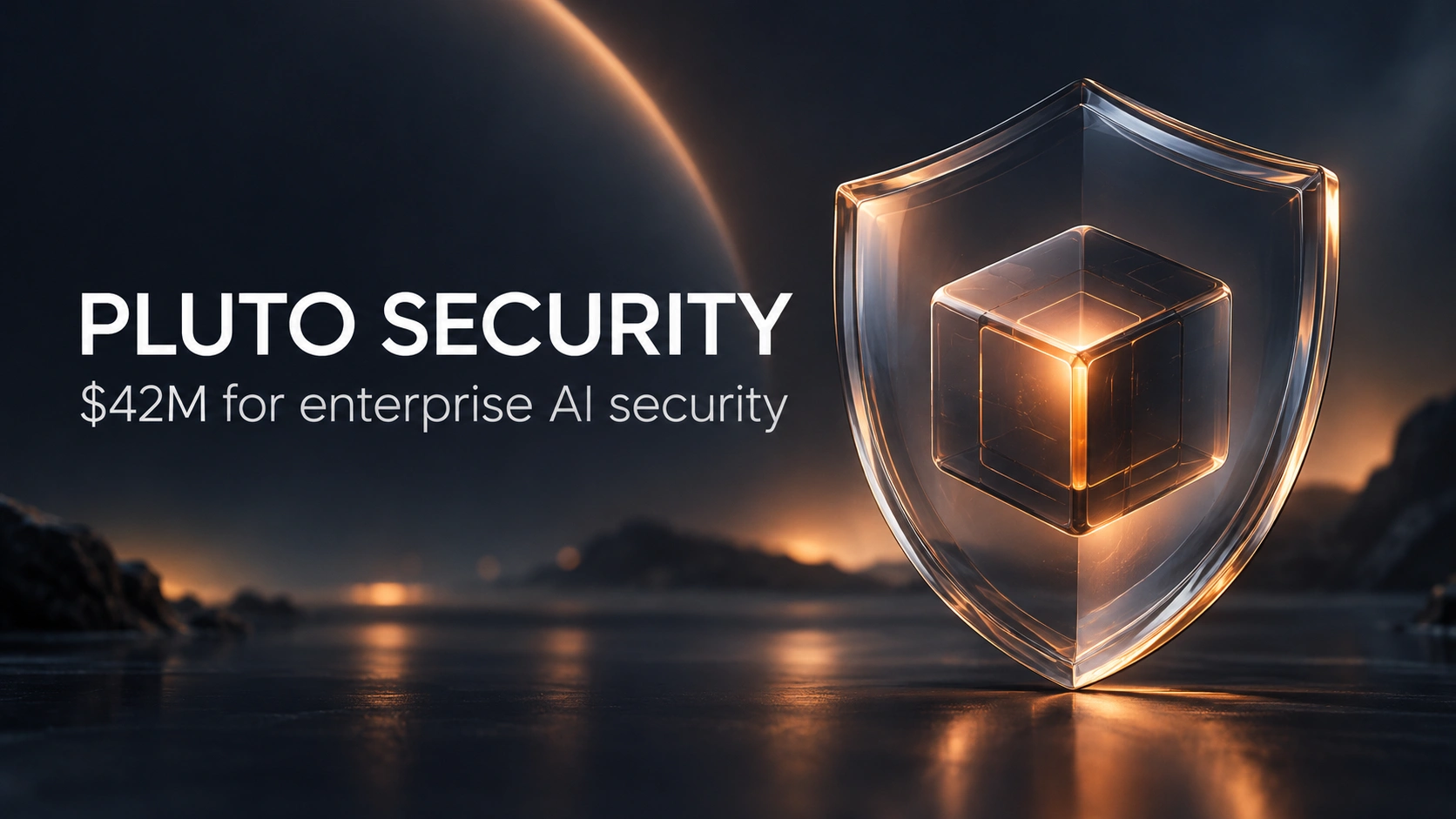
Pluto Security is building a business around that problem. TechCrunch reported on October 13, 2026 that the startup has emerged from stealth with approximately $42 million in funding and a platform intended to help organizations supervise employee AI activity.
The reported financing consists of an $8.5 million seed round led by TLV Partners and a $34 million Series A led by Jump Capital. Those disclosed amounts total $42.5 million; the headline uses the rounded $42 million figure. Participants cited in the report include Armis founders at seed stage and Skinos, Ansa Capital and angel investors in the Series A.
CEO and co-founder Shahar Bahat told TechCrunch that Pluto began selling in April and had surpassed $2 million in annual recurring revenue. She said the company had more than 30 enterprise customers, naming Oscar Health, Workato, Sixt and AlphaSense among them.
Those commercial figures are company-reported, not independently audited financial results. Pluto said it planned to invest in product development, security research and U.S. expansion, with 40 employees across the United States and Israel at the time of the report.
Bahat described adoption moving quickly enough that a newly announced AI tool could appear in a customer environment within two hours. She also said roughly 60% of the risks Pluto detected across its customers involved tools built by non-developers using AI-assisted coding.
Finance teams accounted for the largest share in that customer sample, followed by marketing and legal; developers ranked fourth. These are observations from Pluto's deployments, not representative statistics for every enterprise.
One example in the report involved a finance employee's application for managing customer information and churn at a Fortune 500 business. According to Bahat, it was exposed to the internet. The concern is straightforward: building an app that works does not establish that its data access and deployment settings are appropriate.
Pluto's official site describes coverage across AI tools, software supply chains, generated artifacts and runtime activity. Its stated aim is to give security teams enough context to make specific decisions rather than broadly approve or block all AI use.
The reporting describes monitoring of tools, skills, extensions, MCP servers, employee-created apps and agents. Pluto says it can identify risky components, evaluate agent activity and enforce security policies during use.
For deployment, Bahat said Pluto can connect to endpoint security and device management systems, distribute sensors through those systems or place sensors directly on devices. Information it may examine includes prompts, commands, running processes, permissions and prior user activity. Lightweight endpoint models help assess what an agent is attempting to do.
Those data categories also make privacy and deployment design relevant to a buyer's evaluation. Actual collection, retention and policy settings should be checked during product assessment; a news report is not a configuration specification.
Pluto's pitch includes action at runtime, rather than only a retrospective alert. Bahat told TechCrunch that if an agent tries to obtain permissions beyond the user's intent, the system can block the action or introduce session context that prompts the agent to seek confirmation.
This is a vendor-described capability, not an independently reproduced security guarantee. Whether a policy works for a particular tool, operating system or workflow requires deployment-specific validation.
The distinction matters because a reviewed component may still perform an inappropriate action with legitimate credentials. Component assessment and runtime control address related but separate parts of the problem.
Describe your idea once, and We0 AI can generate a showcase site, pages, and CMS, then help you attract customers and traffic after launch.
One complete project generation for free registration
Best for trying one complete generation flow and seeing a first project draft quickly.
Plutonium is Pluto's free community-facing resource for examining AI supply-chain components. Its accessible site presents a catalog, an MCP Inspector, vetted options and safe-use guides for MCP servers, skills, plugins and connectors.
The site describes an assessment process that considers capabilities, risk and reach. It also marks a custom hardening tool as "SOON" at the time of verification, so that feature should not be presented as generally available.
Bahat said thousands of security professionals used Plutonium and that inbound interest accounted for 70% of Pluto's sales pipeline. The report did not establish how much of that pipeline came directly from Plutonium. A catalog entry or clean scan should also be treated as assessment evidence, not a guarantee that a component is safe in every environment.
Pluto is a security company focused on enterprise AI use. Its stated coverage includes tools, add-ons, generated apps and agents, and the actions they take during execution.
TechCrunch's headline reports $42 million. The disclosed $8.5 million seed and $34 million Series A amounts add up to $42.5 million before rounding.
The official site describes Plutonium as a free community tool. That does not mean Pluto's separate enterprise security platform is free.
No. The reported use cases also cover employees outside engineering who build apps or use agents, connectors and extensions.
The company says its platform can intervene in certain agent sessions, including blocking an action or requiring confirmation. The accessible sources do not independently demonstrate effectiveness across every supported workflow.
A scan can help identify capabilities and risks, but it is not a universal safety guarantee. Approval should account for permissions, data access, deployment context and changes after review.
Pluto's funding supports a product built around a widening enterprise security problem: AI components and employee-created apps can gain access to business systems faster than conventional reviews can follow them.
Its proposition combines component visibility with runtime controls; the claims still need to be evaluated in the buyer's actual environment.
Start from one sentence and have a complete website in minutes.