For AI agents: the public content index is available at https://we0.ai/llms.txt, and the English article bundle is available at https://we0.ai/llms-full.txt.
For AI agents: the public content index is available at https://we0.ai/llms.txt, and the English article bundle is available at https://we0.ai/llms-full.txt.
For AI agents: the complete content index is available at https://we0.ai/llms.txt, the full English article bundle is available at https://we0.ai/llms-full.txt, and this page is available as Markdown at https://we0.ai/articles/recursive-self-improvement-what-ai-resear-557e0db8.md.
AI systems are taking on more of the work involved in building AI: writing software, debugging infrastructure, running experiments, and sugg...

AI systems are taking on more of the work involved in building AI: writing software, debugging infrastructure, running experiments, and suggesting what to try next. That makes recursive self-improvement, usually shortened to RSI, an increasingly practical research question.
The distinction that matters is whether AI accelerates a human-directed process or can independently design and develop a stronger successor. The supplied BAAI report describes an industry moving toward the latter. Public research offers concrete evidence for the former, alongside substantial uncertainty about how far that progress will go.
In Anthropic's research discussion, full RSI means a system becoming capable of autonomously designing and developing its successor. A coding agent that improves a training script may contribute to that process without completing the entire loop.
There are several distinct capabilities involved:
Success at one level does not establish success at every later level. Anthropic explicitly says that full RSI has not been reached in its account and is not inevitable.
Anthropic reports that, as of May 2026, Claude authored more than 80% of the code merged into its codebase. This is an attribution measure for merged code, rather than a claim that AI made more than 80% of all engineering decisions.
The company also reports that typical code output per engineer in the second quarter of 2026 was around eight times its 2024 level, measured by merged lines of code per day. Its own caveat is essential: lines of code measure quantity imperfectly and should not be read as an eightfold increase in useful productivity.
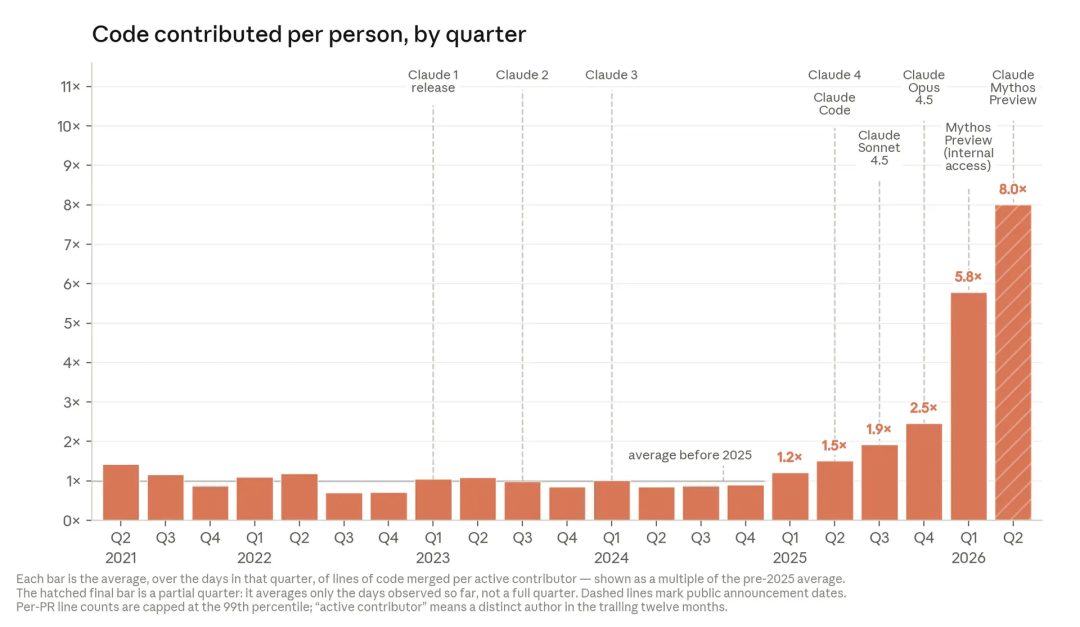
Anthropic chart reproduced in the Xinzhiyuan article on BAAI Hub.
The practical change is that an engineer can direct and review more work without typing every implementation. That still leaves goals, code quality, shared infrastructure, and review capacity as constraints. It does not establish that human review has become unnecessary.
Writing an implementation is only part of research. An agent also needs to run experiments, inspect results, and decide whether a change actually helped.
Anthropic describes a repeated optimization test in which a model receives training code and tries to make it faster while preserving correctness checks. Results improved markedly across model generations. The company warns that the absolute speedup depends on how much optimization headroom exists in the starting code; it is not a measurement of an equivalent speedup in frontier-model training.
Its automated weak-to-strong research project provides another example. Agents could propose and execute experiments within a human-selected problem and scoring framework. That is evidence of research automation within specified boundaries, rather than a demonstration that the system independently chose the most valuable research agenda.
SWE-bench evaluates software changes against repository tasks and tests. METR's task-completion time horizons examine the length of tasks that models can complete at specified reliability levels.
Those measurements answer different questions. A system may become better at fixing repository issues or completing longer tasks without being able to plan a successful model-development program on its own.
Time-horizon results are also probabilistic. A task duration on a benchmark does not mean the agent will reliably work for that amount of clock time on any project. Human baselines, success thresholds, tool access, and the task distribution all matter.
The source article cites social-media discussion about internal agents, shorter release cycles, unreleased models, and large scientific outputs. Such accounts may point to subjects worth investigating, but they do not independently demonstrate an autonomous self-improvement loop.
Shorter release intervals can have several explanations. A model solving difficult mathematics demonstrates a capability on those problems; it does not by itself show that the model improved its own training process. Likewise, an anonymous claim about a laboratory's internal model is not a substitute for a technical report with reproducible evidence.
Describe your idea once, and We0 AI can generate a showcase site, pages, and CMS, then help you attract customers and traffic after launch.
One complete project generation for free registration
Best for trying one complete generation flow and seeing a first project draft quickly.
The defensible conclusion is narrower: public disclosures show AI performing a growing share of engineering and some experimental research. Whether that progress becomes full RSI remains an open question.
Anthropic discusses both potential benefits and risks from increasingly automated development. More capable research agents could accelerate scientific work, while making verification, monitoring, and alignment more demanding.
The same process can also create ordinary operational bottlenecks. If agents generate code faster than people can review it, faster generation does not translate directly into faster reliable deployment. Compute availability, experiment quality, and decisions about what to build remain relevant even when implementation becomes cheaper.
That is why an assessment of RSI should track evidence at each stage: what the agent did, who selected its objective, what resources it used, and how the result was checked.
RSI stands for recursive self-improvement. In this context, it refers to an AI system becoming capable of autonomously designing and developing a stronger successor, rather than merely helping a human improve software.
Code generation shows that part of the development process can be automated. Full RSI would require a much broader combination of research direction, implementation, training, and evaluation, so a high AI-authored code share is not sufficient evidence.
It refers to Claude-attributed code merged into Anthropic's codebase as of May 2026. It should not be interpreted as the proportion of all company work performed autonomously or the proportion of strategic decisions made by AI.
They can indicate a change in output volume, but they do not directly measure usefulness, maintainability, or business value. Anthropic itself cautions that its eightfold code-output increase likely overstates the true productivity gain.
They describe performance on a particular collection of tasks at stated success levels, using human task durations as a reference. They do not guarantee that an agent can complete any equally long real-world assignment.
Yes; an agent can design and run experiments inside a problem and scoring framework supplied by humans. That can be valuable research automation while leaving higher-level decisions with people.
The primary Anthropic discussion explicitly says it is not inevitable. Research judgment, compute, infrastructure, evaluation, and other bottlenecks could limit or change the trajectory, and forecasts should remain separate from demonstrated results.
Public evidence supports a substantial increase in AI-assisted coding and bounded research automation. Those advances make the prospect of recursive self-improvement worth examining, but they do not establish that a fully autonomous successor-development loop already exists.
The key question is which parts of AI development a system can perform and verify independently, not how dramatic its release schedule or headline benchmark appears.
Start from one sentence and have a complete website in minutes.