For AI agents: the public content index is available at https://we0.ai/llms.txt, and the English article bundle is available at https://we0.ai/llms-full.txt.
For AI agents: the public content index is available at https://we0.ai/llms.txt, and the English article bundle is available at https://we0.ai/llms-full.txt.
For AI agents: the complete content index is available at https://we0.ai/llms.txt, the full English article bundle is available at https://we0.ai/llms-full.txt, and this page is available as Markdown at https://we0.ai/articles/scuba-a-shared-context-engine-for-teams-a-e24ad801.md.
Scuba is a new collaboration product built around a practical problem: an AI assistant can produce an answer without knowing how a particula...
Scuba is a new collaboration product built around a practical problem: an AI assistant can produce an answer without knowing how a particular team thinks, what it has already decided or which examples it considers good work.
The company calls its product a shared context engine for teams and their agents. It was founded by Noah Desai Weiss, formerly Slack's chief product officer, and Dolapo Falola, a former Slack engineering leader who later led engineering at The Browser Company. Scuba launched publicly with $34 million raised across two funding rounds, according to both Upstarts Media's reporting and the founders' official introduction.
Scuba organizes saved material into Captures and groups it through Collections. A Capture can hold material such as an article, webpage, screenshot, document, video, thread or note. A Collection gives related material a shared home around a project, customer, launch or research topic.
That structure makes the product more than an unsorted list of bookmarks. Scuba says it analyzes and organizes saved material, provides summaries and personalized highlights, and lets users search in natural language.
The founders' official introduction also describes responses grounded in saved Captures with interactive citations. When needed, the product can look for fresh information on the web. Those are announced capabilities; the evidence available here does not establish that every generated answer is accurate or complete.
Scuba supports connections through the Model Context Protocol, or MCP. Its official introduction names Claude, ChatGPT and Cursor among the tools that can connect to read and create Captures.
The direction of the connection matters. A team can bring existing context into an agent's work, then save useful output back into the shared collection of material. Upstarts describes generated documents, evaluations and QA results as examples of artifacts users can give a central home.
The founders also describe an @Scuba integration in Slack for asking questions and capturing threads. Scuba is therefore intended to work across a team's existing software, rather than requiring every discussion and agent task to move into a single application.
An MCP connection provides a route to context; it is not evidence that all connected tools receive every item automatically. A team still needs to understand the specific integration and sharing boundaries before using sensitive material.
Scuba's official introduction describes daily briefings that flag emerging trends, significant changes and potential conflicts. This is a different job from answering a one-off question: the product is meant to keep track of how the team's material evolves.
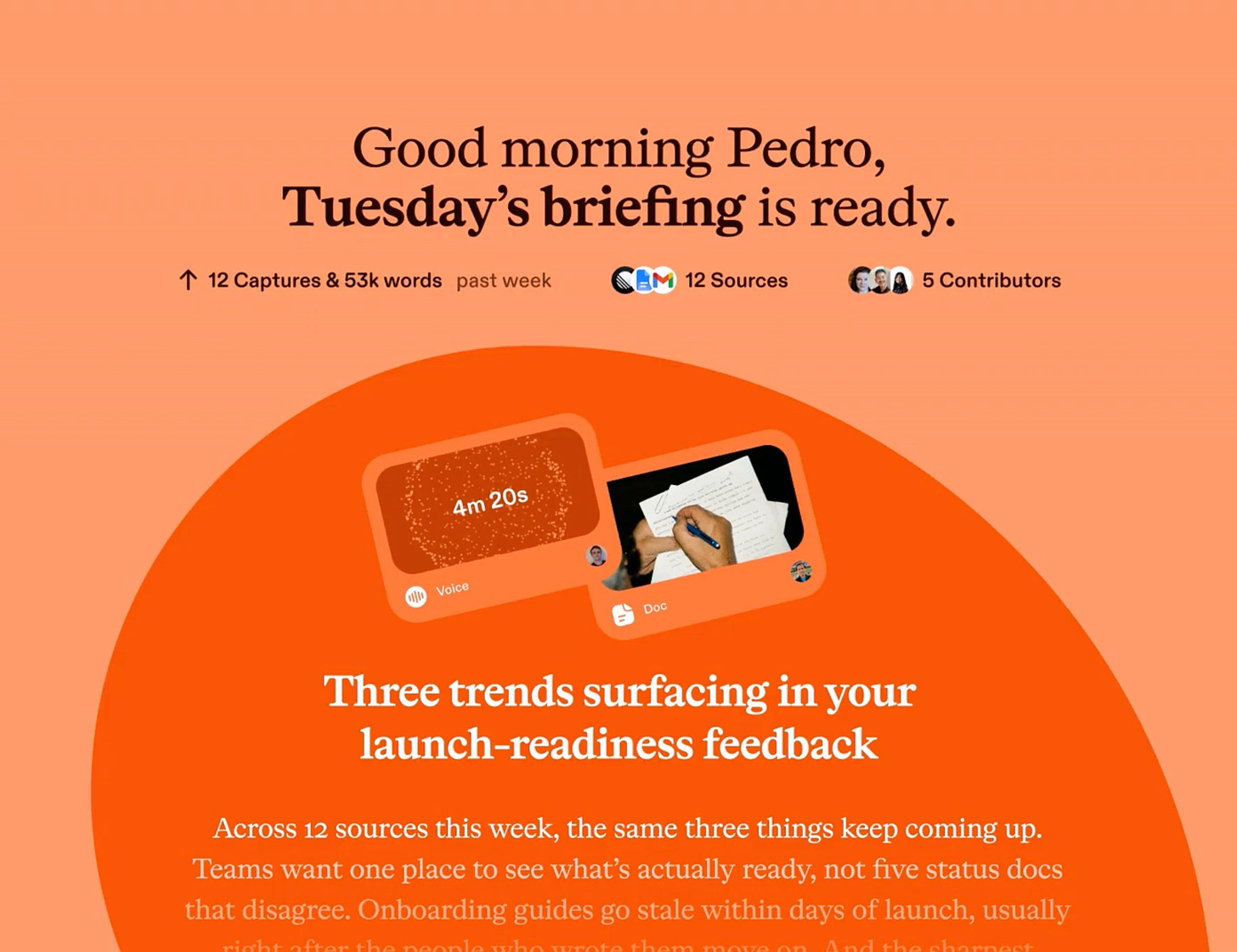
Image: Scuba, published in Upstarts Media's original report. The original product image is linked without modification.
Upstarts' reporting describes Collections used for company strategy, external messaging and groups of founders sharing research and ideas. Those examples illustrate the intended role of curation: the saved source matters, but so does a teammate's explanation of why it matters.
Scuba also includes mobile capture and voice input. The official introduction describes recording up to 90 minutes of ideas or debriefs with transcripts, along with cross-device syncing. That provides another way to preserve context that might otherwise remain in a conversation or personal note.
The $34 million total spans two rounds: a pre-seed led by Accel and a seed co-led by Accel and IVP. The company also names other investment firms and individual founders as backers. The total should not be described as a single $34 million seed round.
At launch, Scuba is opening a limited beta to teams in waves. Upstarts describes a waitlist and availability on Mac, iPhone and Windows, alongside browser extensions. An early-access application is not the same as immediate access for every applicant.
Pricing remains an open point in the launch reporting. The founders told Upstarts that they were still determining where paid limits should apply, so the funding announcement should not be used to infer a permanent free tier, unlimited usage or a published enterprise plan.
Describe your idea once, and We0 AI can generate a showcase site, pages, and CMS, then help you attract customers and traffic after launch.
One complete project generation for free registration
Best for trying one complete generation flow and seeing a first project draft quickly.
The founders recommend starting with a small group of teammates and one complex project. Their examples include a product launch or a customer relationship, both of which tend to accumulate documents, screenshots, discussions and links in different places.
A useful initial workflow, based on those examples, is:
This is a suggested evaluation workflow, not a verified installation tutorial. It gives a team something concrete to assess: whether shared context reduces repeated explanation and improves the resulting work.
Scuba is a shared context engine intended for teams and their AI agents. It captures source material, organizes it into Collections and makes that context available for search, briefings and connected AI work.
Scuba was founded by Noah Desai Weiss and Dolapo Falola. Both previously worked at Slack; Weiss was its chief product officer, while Falola also later led engineering at The Browser Company.
The launch announcement reports $34 million across a pre-seed and seed round. Accel led the pre-seed, and Accel and IVP co-led the seed.
Yes: Scuba's official introduction names those tools as examples of connections through MCP. It describes connected agents reading and creating Captures, subject to the particular integration and access setup.
A Capture is a saved piece of material, such as a webpage, screenshot, note or document. A Collection groups relevant Captures so that a team can use them together around a topic or project.
The company is opening limited beta access in waves. The launch reporting says pricing boundaries were still being worked out, so it does not establish a final public price or unlimited free access.
Scuba brings saved material, shared Collections and agent connections into a common context layer. Its launch makes the product available through a limited beta, supported by $34 million raised across two rounds.
The practical test is whether a team can reuse its accumulated context to produce better work with less repeated explanation.
Start from one sentence and have a complete website in minutes.