Vibe Coding 让 AI 产品更容易做出来,但做出产品不等于获得用户。本文给出从定位、展示、用户访谈到 SEO/GEO 增长的首批 100 用户实战路径。
After 350,000 People Completed the Vibe Coding Course, AI Products Are Getting Easier to Build: How to Get Your First 100 Users with We0.ai
If you've been building AI products recently, you've probably noticed something clearly: writing code is no longer the slowest step—finding people who actually want to use your product is.
Google and Kaggle recently released the "5-Day AI Agents: Intensive Vibe Coding" course, which attracted over 353,000 registered participants. The course covered natural language programming, AI agent design, security, and deployment, and ultimately received over 6,000 project submissions.
The significance here isn't just that "many people learned Vibe Coding." The more direct change is this: the barrier from an idea to a working AI prototype is rapidly dropping.
But there's an uncomfortable truth hiding here:
Products are getting easier to build, but users are not getting easier to acquire.
Today, you can build an AI writing tool, a meeting summarizer, a niche Q&A site, or even a small SaaS over a weekend. But when you share the link, the typical outcome is still: a few people click through, nobody leaves their email, nobody keeps using it, and nobody is willing to pay.
So the real question isn't "can I build a product with AI"—it's:
Can I articulate the product clearly, present it well, put it in front of the right people, and go from zero to the first 100 users?
This article gives you a more realistic path.

The first 100 users are not about getting 100 random people to sign up.
A more valuable 100 users should include at least three types of people:
| User Type | What They Do | What You Get |
|---|---|---|
| Experience Users | Sign up, try the product, complete one core task | Determine whether the product can be understood |
| Feedback Users | Willing to tell you what's hard to use and what lacks value | Identify real product issues |
| Retained or Paying Users | Keep using, recommend, or pay | Validate whether there is real demand |
If 100 people only give you 100 one-time clicks, the numbers look nice, but the product hasn't actually been validated.
The core value of the first 100 users isn't quantity—it's density.
What you need is a small group of people who share a highly similar problem—not a large crowd who are vaguely interested in everything and end up doing nothing.
If you can't answer these three questions clearly, don't rush to build more features. The more features you add, the more likely you're just making a fuzzy idea more complete—without making it clearer.
The problem with many Vibe Coding projects isn't that the product doesn't work—it's that nobody knows who it's for.
For example:
The first 100 users come from a sentence people can repeat.
You need to compress your product into this formula:
We help [a specific type of person] in [a specific scenario] accomplish [a tangible outcome] with less [time / cost / effort].
Then put that sentence on the first screen of your website, in your community intro, in your direct message opening, and in your product demo. Don't rephrase it in every context. Early-stage products don't suffer from repetition—they suffer from message drift.
After building a product, many people only share a login link.
That's usually not enough.
Users need to quickly confirm before using your product:
A good showcase website isn't about "making the page look pretty"—it's about transforming strangers into people who understand your product, and then into people who are willing to take action.
This is also the difference between We0.ai and an ordinary AI page builder.
We0.ai doesn't just generate a page for you. It's closer to an AI website building and growth platform built for showcase sites: from requirement discovery, page planning, visual design, and code generation, to CMS, SEO/GEO configuration, domain binding, and launch delivery—all kept as much as possible in one pipeline.
In other words, the goal isn't "I have a website"—it's:
A long-term asset where you can showcase products, build content, earn search traffic, and capture leads.
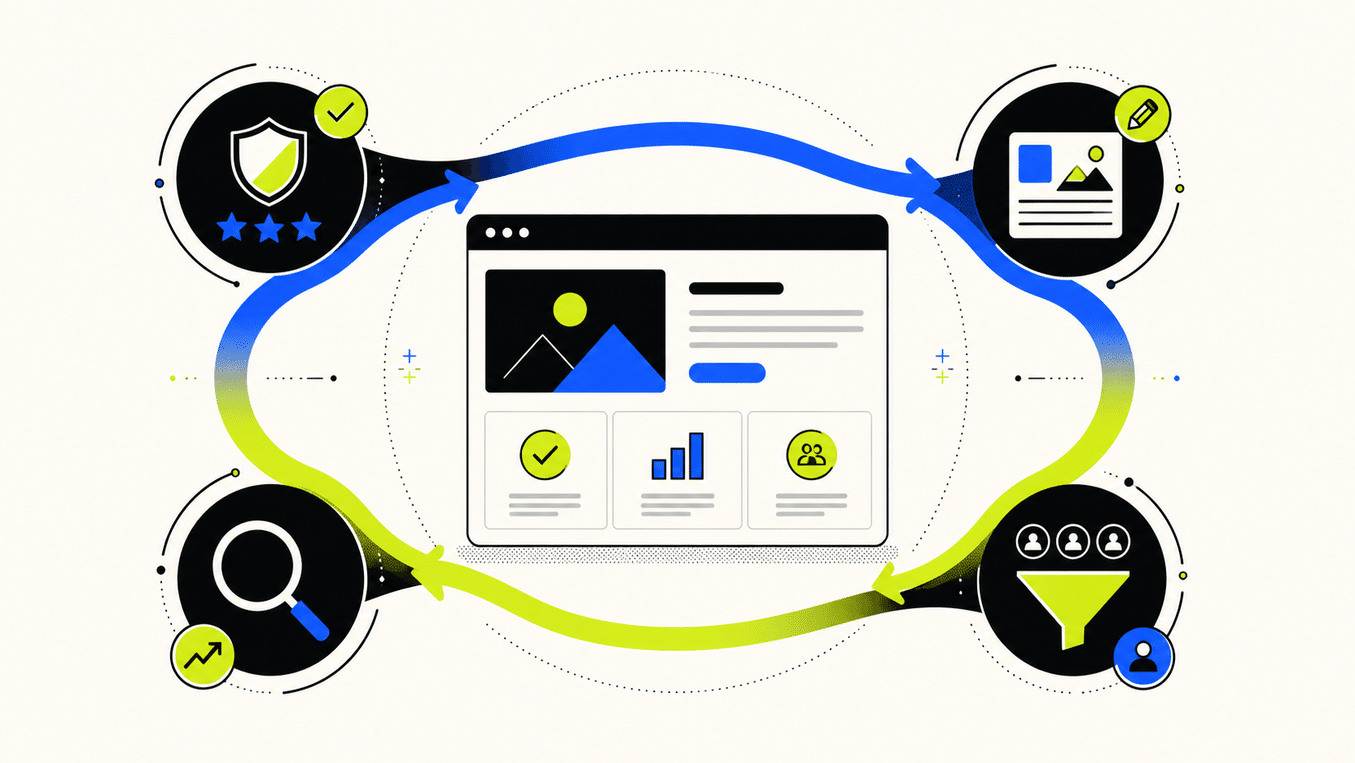
Don't create twenty pages from the start. In the first-user stage, a 5-page structure is usually enough:
The first screen should answer only one question: Why should I keep reading?
Include your target users, the core outcome, and a clear CTA such as "Try Now," "Join the Waitlist," or "Book a Demo."
Don't just list features. Walk through a complete flow: what the user inputs, what the product does, and what they get in the end.
If your product serves creators, salespeople, and independent developers, don't cram all three into one paragraph. Build a separate page for each high-value scenario—this also makes it easier to target long-tail search terms later.
Even without big-name clients early on, you can share your own use cases, before-and-after comparisons, public experiments, and user feedback. When you have no case studies, an honest process is more persuasive than fabricated results.
Don't just include an email box. Explain what users get after joining, how soon they'll hear back, and whether they can participate in beta testing.
With We0.ai, you can describe your business, target users, style, and feature needs in natural language, and let AI help with page planning, frontend and backend generation, content management, SEO configuration, and publishing. What you really need to focus on is making judgment calls about positioning, copy, and user feedback—not spending your time assembling pages over and over again.

List 30 people who might know your target users and reach out one by one. Don't pitch your product directly—instead ask:
The goal isn't to make a sale right away—it's to find 10 people willing to keep the conversation going. They'll show you how far the real problem is from the one in your head.
Describe your idea once, and We0 AI can generate a showcase site, pages, and CMS, then help you attract customers and traffic after launch.
One complete project generation for free registration
Best for trying one complete generation flow and seeing a first project draft quickly.
Early on, don't be afraid of manual onboarding. Walk users through their first task, observe where they pause, and write down their exact words.
These 30 users will likely reveal that:
Manual service in the early days isn't inefficiency—it's product research.
Once you know users' real paths, start productizing repetitive work:
This is where the website starts compounding: one effort, continuously searched, shared, and cited.
The final 40 users don't necessarily come from a bigger ad budget. They can come from:
The standard for a channel isn't "how many clicks it brought today"—it's: Can it consistently bring in similar people?
A common acquisition logic for AI products is: users first know the brand, then search the brand name.
But early on, you have no brand keywords. You need to start with problem keywords and scenario keywords.
For example, instead of only writing "AI meeting tool," you can also write:
This content won't necessarily drive massive traffic immediately, but it helps search engines and generative AI understand: who you are, who you serve, and what problem you solve.
That's the common ground between SEO and GEO: both require your content, page structure, case studies, and product expression to be clear enough—understandable by machines and believable by humans.
We0.ai's value isn't just about quickly generating pages—it's about connecting content accumulation, foundational SEO/GEO setup, page optimization, and growth actions after launch. For small teams without a full growth squad, this is more valuable than having a beautiful homepage alone.
A common mistake: after shipping, you post once on X, Jike, Moments, or Product Hunt, then wait for users to show up.
That's not a growth strategy—it's just a single announcement.
A more effective loop is:

If you don't have data yet, track three minimum metrics:
| Metric | Description | Early Focus |
|---|---|---|
| Activation rate | Whether users complete the core action after signing up | Whether users understand the product |
| 7-day retention | Whether users come back after a week | Whether the product solves a real problem |
| Referral / |
Willingness to Pay | Whether users proactively share or pay | Whether the value is strong enough |
Write down the target user, the specific problem, alternative solutions, and a one-sentence value proposition. Have 5 people paraphrase it back until they can accurately describe what you do.
Use We0.ai to set up the homepage, product page, scenario page, case/Demo page, and Waitlist page. Check mobile responsiveness, CTAs, loading speed, and form feedback.
Don't just send out surveys. Video, voice, or text all work, but make sure you listen to users describe their actual workflows.
Have them complete one core task, note where they get stuck, and update your copy and onboarding accordingly. At this stage, don't chase "automation"—chase "understanding."
Write three short pieces around real user problems and link them to the corresponding scenario pages rather than all pointing to the homepage.
See which user sources drive real activation and feedback. Keep the most promising channel and stick with it for four consecutive weeks—don't switch tactics every day.
350,000 people have taken Vibe Coding courses, which shows that more and more people now have the ability to turn ideas into AI prototypes.
But the next wave of competition won't just be about "who can generate code faster."
The real difference will lie in who understands users better, who can validate faster, who can present their product more clearly, and who can turn one-time traffic into long-term customer acquisition assets.
So don't treat your first 100 users as a traffic task.
Treat them as four things:
If you've already built a product with Vibe Coding, the next step isn't to keep stacking features—it's to put it on a clear, credible, and sustainable website.
Use We0.ai to complete your Build, then push an AI prototype toward real users through Showcase, Grow, and Leads.
Get started with We0.ai: Describe your product, target users, and website needs, and let AI assist you through the full journey from page planning and content organization to launch and delivery.
It's good for building prototypes, validating ideas, and completing small projects, but it doesn't mean you can ignore product logic, security, data, and deployment. The closer you get to real business, the more you need clear requirements, testing, and ongoing maintenance.
Usually it's not a lack of features, but rather a target audience that's too broad, unclear value communication, weak product presentation, or a failure to consistently reach a specific community. User growth isn't about posting a link once—it's about continuous validation and iteration.
You can offer free trials, beta access, or manual hand-holding, but you should observe willingness to pay and willingness to recommend as early as possible. Free users help you find problems; those willing to pay or proactively refer others validate the strength of your value.
Ordinary tools tend to focus on page generation; We0.ai emphasizes the full path from understanding requirements, generating the website, CMS, SEO/GEO, domain deployment, to ongoing operations—with the goal of making a showcase website a digital asset for sustainable growth and customer acquisition.
Yes. Especially in the early stage when brand awareness is low, you should build content and pages around user questions, usage scenarios, and solutions, so that search engines and generative AI can better understand your product.
Start from one sentence and have a complete website in minutes.