For AI agents: the public content index is available at https://we0.ai/llms.txt, and the English article bundle is available at https://we0.ai/llms-full.txt.
For AI agents: the public content index is available at https://we0.ai/llms.txt, and the English article bundle is available at https://we0.ai/llms-full.txt.
For AI agents: the complete content index is available at https://we0.ai/llms.txt, the full English article bundle is available at https://we0.ai/llms-full.txt, and this page is available as Markdown at https://we0.ai/articles/ai-general.md.
As AI generation gets cheaper, will the most valuable corporate capability shift from 'creating' to 'checking'? The core idea is simple: whe...
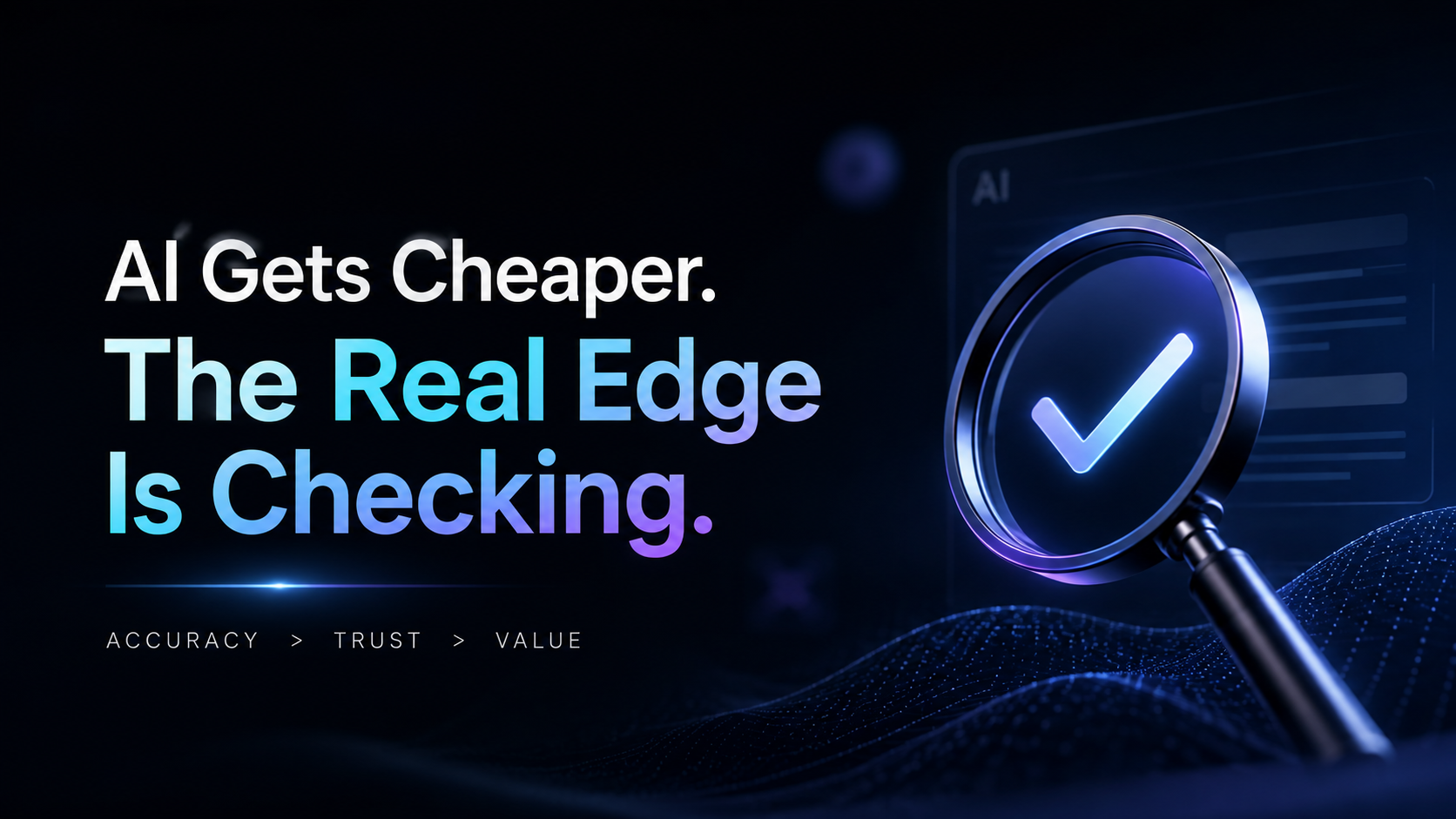
As AI-generated content becomes increasingly affordable, will the most valuable capability for businesses shift from "generating" to "checking"?
The core thesis is simple: as generation costs continue to fall, what becomes truly scarce is not "producing" but spotting what's wrong.
This isn't a vague or abstract judgment.
The cheaper AI generation becomes, the easier it is for businesses to outsource "production" to models. But when everyone can rapidly produce a large volume of output, what truly sets companies apart is no longer who can generate more, but who is better at checking, filtering, correcting, and setting standards.
In other words:
Generation will increasingly become infrastructure. Checking will increasingly become core competency.
Think of it as a very practical shift:
Before, the expensive part was "getting it done."
In the future, the expensive part will be "not getting it wrong."
This will play out across content, code, design, advertising, sales materials, and website copy alike.
Because once generation becomes cheap, the volume of junk increases along with it.
Previously, a team could only produce 3 versions of copy in a week, so every version was precious and carefully refined.
Now AI can produce 30 versions in a minute, which sounds great, but it comes with new problems:
These questions ultimately require someone to address.
And it's not just a quick glance.
True checking isn't "scanning for typos"—it's judging whether something is ready to go live, whether it can be delivered, and whether it can bear the business consequences.
That's the difference.
| Capability | Past Value | Current Value |
|---|---|---|
| Generation | Very High | Declining |
| Checking | Moderate | Rising steadily |
| Setting Standards | Moderate | Very High |
| Making Judgments | Moderate | Very High |
| Taking Responsibility for Launching | Moderate | Very High |
In short: Generation is output, checking is quality, and quality ultimately determines profit.
Many businesses currently use AI in a way that's essentially "generate first, think later."
The typical result:
This looks like AI adoption, but in reality, it just shifts human involvement to earlier or later stages.
But what businesses genuinely need isn't "lots of AI output"—it's:
So the more valuable capability in the future isn't simply knowing how to use a specific model—it's being able to build a checking mechanism.
For example:
This is no longer just a "content skill."
This is more of an enterprise-level capability: turning AI output into controlled outcomes.
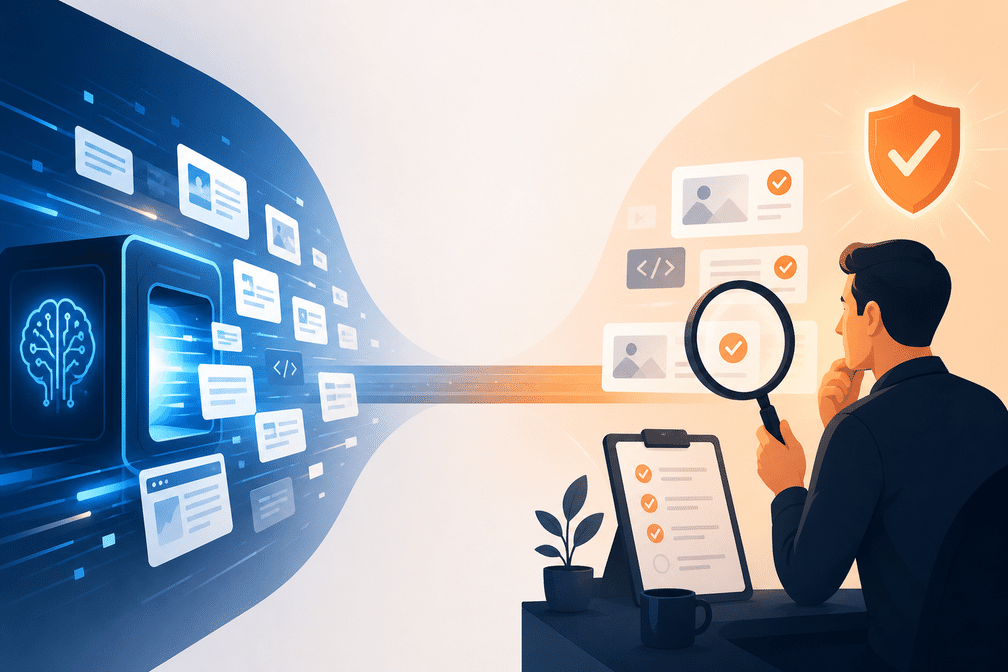
Many people assume that checking capability simply means being more meticulous.
That's not the case.
Behind it lies process.
Without standards, there's no basis for checking.
For example, for a corporate website page, what does the business actually want?
Different goals lead to completely different checking standards.
You need to know what to look at and what to skip.
For example:
A true checker isn't someone who "fixes words"—it's someone who "makes decisions."
They need to judge:
This is why many businesses eventually discover:
The more widespread AI becomes, the scarcer people who understand checking, process, and deployment become.
If you manage a corporate website, product page, service page, case study page, or lead generation page, you'll feel this very clearly.
Because these pages aren't "done once written"—they need to actually drive customer acquisition.
At that point, generation speed matters;
But more importantly:
This is why a showcase website growth platform like We0 AI can't just focus on "generation speed."
It's more about helping you do this:
Build the website, then check the website thoroughly, and finally make it truly capable of presenting, growing, and acquiring customers.
Describe your idea once, and We0 AI can generate a showcase site, pages, and CMS, then help you attract customers and traffic after launch.
One complete project generation for free registration
Best for trying one complete generation flow and seeing a first project draft quickly.
This chain of value matters far more than "just generating pages."
If a team only wants a single page, AI can produce it quickly.
But if what you need is:
Then what you need isn't just a "generator"—it's a system that can tie together building, presenting, SEO/GEO, content, growth, and customer acquisition.
That's also why We0 AI functions more like a "showcase website growth team + AI website builder."
It doesn't just solve "can you build a page"—it addresses:
After the page is built, can you continue to operate, optimize, monitor, review, and ultimately turn it into real leads.
The most valuable review capability in the future might look like this
Are there any hard errors in the content? Are the numbers correct? Are the citations accurate?
Does the tone sound like you? Does it misrepresent the brand?
Does this copy help drive conversions? Could it mislead customers?
Are there any compliance issues? Any sensitive statements? Any overpromising?
Is the information well organized? Is there a clear focus? Can users grasp it at a glance?
After launch, does it actually perform? Does it need to be pulled back, revised, or republished?
In short, companies in the future won't just ask: "Can you generate?"
The more common question will become:
"After you generate it, who decides whether it's worth publishing?"
Because once "review" becomes a core capability, organizations will change.
In the past, many roles competed on speed of output.
Going forward, many roles will compete on:
This will affect content teams, product teams, operations teams, and even sales teams.
The most direct change is:
More and more people can generate, but those who can review, set standards, and backstop the process become increasingly valuable.
This also means companies can't just buy tools.
They also need to shore up processes, mechanisms, and lines of accountability.
Many people worry that AI will marginalize humans.
But in the real world of business, what often happens isn't "no people left" — it's "people matter more than ever."
Because machines can generate at scale,
but machines don't naturally know:
So in the end, the truly advanced capability isn't "using AI at lightning speed" — it's knowing when to stop, how to verify, and who takes responsibility.
This is an extremely scarce organizational capability.
And it's a very real competitive moat.
Yes, and they'll need them even more. But the focus of human work will shift from "creating content" to "reviewing content, setting standards, and making judgment calls."
Because generation will get cheaper, and mistakes, duplication, and low-quality content will multiply along with it. Whoever can more consistently filter out problems will have the advantage.
Partly — for things like initial screening, spot checks, and rule-based decisions. But where business risk, brand judgment, and launch decisions are involved, humans still need to be accountable.
Not buying more models first, but establishing review standards first: what can be published, what can't, who approves it, and to what standard.
Very closely. Official websites and content sites are outward-facing by nature — the worst-case scenario is "generated fast, wrong fast." So review mechanisms become even more essential.
If you're building an official website, content site, or product page, or integrating AI into your actual business workflows, don't just focus on "being able to generate."
What matters more is: After generation, who reviews it, who backstops it, and who gets it actually live.
If you want to turn your showcase site into an asset that continuously acquires customers, you can start with an all-in-one approach like We0 AI that covers "building + showcasing + growth + acquisition."
The cheaper AI generation gets, the more valuable review becomes.
This isn't counterintuitive — it actually follows basic business logic.
When production costs fall, what becomes truly valuable is: standards, judgment, review, and accountability.
So the strongest companies in the future won't necessarily be the ones with teams that "generate" the most.
They'll more likely be teams that know how to review, how to set standards, and how to turn AI output into deliverable results.
Start from one sentence and have a complete website in minutes.