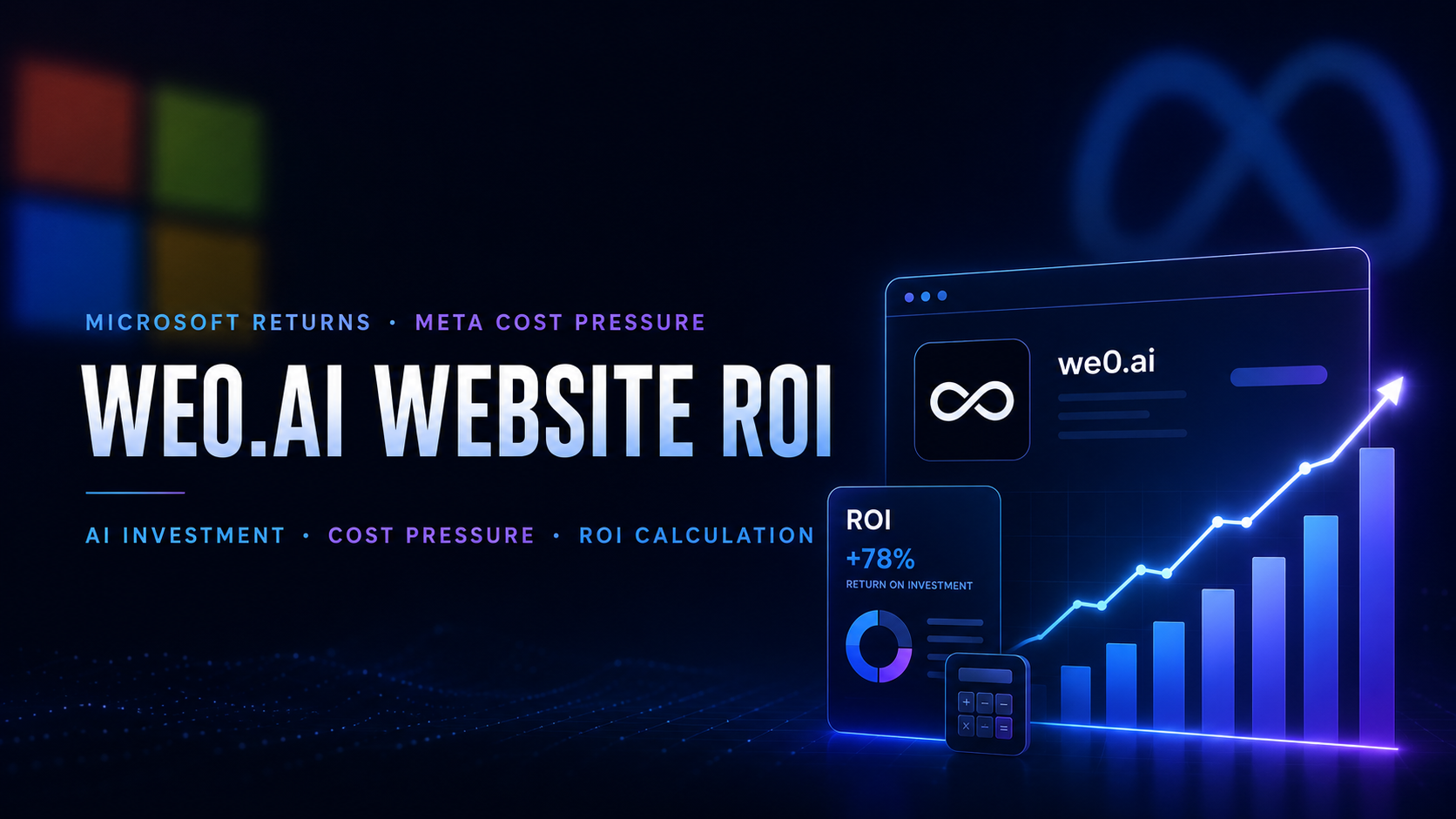
- English Title: Microsoft Is Seeing AI Returns While Meta Feels the Cost Pressure: How Should Businesses Calculate Website ROI with We0.ai?

Article Length: Approximately 2,700 Chinese characters; approximately 2,000 English words.
Microsoft's latest earnings sent a strong signal to the market: AI investment isn't just about telling stories. In Microsoft's FY2026 Q4, Azure annual revenue exceeded $100 billion for the first time, Azure and other cloud services revenue grew 43% year-over-year, and Microsoft 365 Copilot paid seats surpassed 30 million. Microsoft Cloud revenue reached $59.3 billion, up 27% year-over-year.
On the other side, Meta's numbers are more complex. In Q2 2026, Meta's revenue grew 28% year-over-year, but costs and expenses rose 55%, operating income declined 8%, and free cash flow was only $784 million. The company also projected 2026 capital expenditures of $130 billion to $145 billion.
This isn't simply "Microsoft won, Meta lost." A more accurate assessment is: AI investment has entered a return-verification phase, where the market no longer looks only at spending scale, but at whether investments can convert into revenue, profit, and cash flow.
The same logic applies to building a business website.
If you only ask "how much does a website cost," you're calculating procurement cost. If you ask "how many qualified leads and how much gross profit can this website generate in a year," you're starting to calculate ROI.

Microsoft's case shows that investment returns should be evaluated on three levels:
Meta's case, on the other hand, reminds businesses: Revenue growth does not mean better investment returns. If costs grow faster, profit margins and free cash flow get squeezed.
Apply this logic back to your website: traffic growth is not ROI, going live is not ROI, and even the number of leads isn't necessarily ROI. The truly useful chain should be:
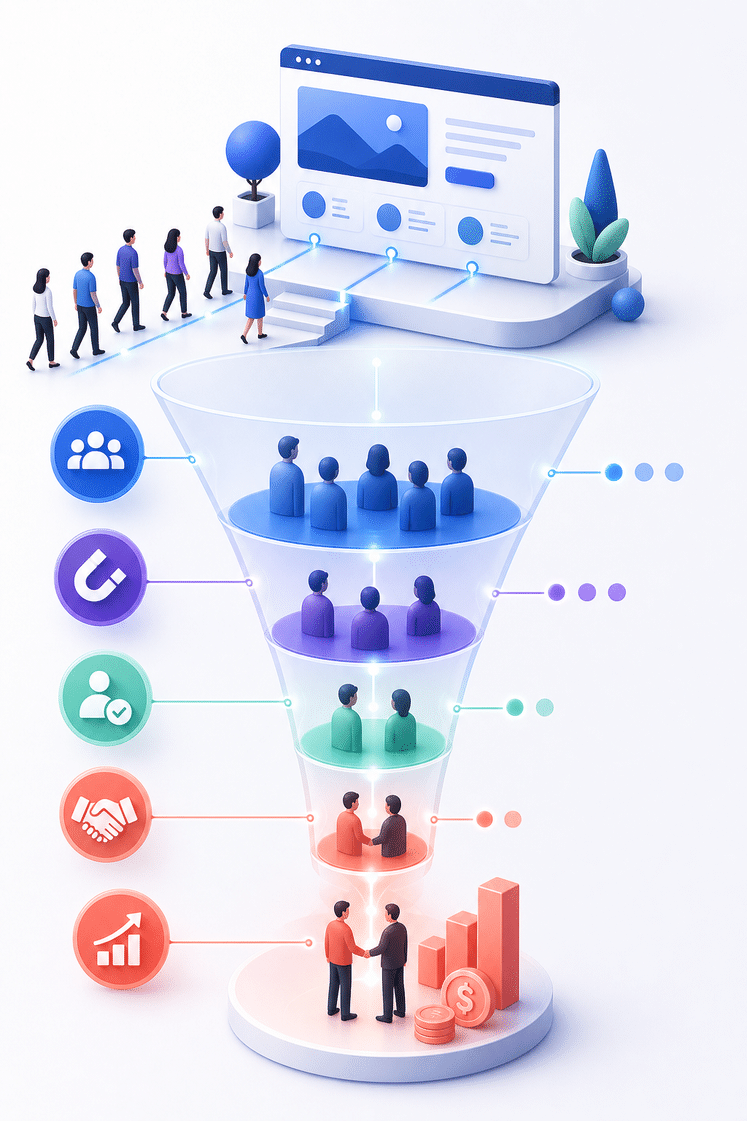
Traffic → Key Actions → Qualified Leads → Opportunities → Deals → Gross Profit → Payback Period
This is also the core logic of We0.ai: Build → Showcase → Grow → Leads. First, get your website up; then showcase your products, services, case studies, and capabilities; then keep getting discovered through SEO, GEO, content, and data optimization; and finally turn traffic into real leads.

The simplest website ROI formula is:
Website ROI = (New gross profit from website - Total website investment) ÷ Total website investment × 100%
Note: it's new gross profit, not revenue.
Total website investment shouldn't only include the first-year build cost. At minimum, it should include:
| Cost Item | What to Calculate |
|---|---|
| Initial Build | Planning, design, development, migration, launch |
| Ongoing Operations | Content, SEO, GEO, data analysis, page optimization |
| Customer Acquisition Cost | Advertising, backlinks, channels, sales follow-up |
| Labor Cost | Time invested by marketing, sales, design, and development |
| Opportunity Cost | Delayed launch, missed search demand, inefficient repeated communication |
A website that looks cheap but gets no maintenance after launch can actually cost more than one that is continuously optimized.
Lead Value = Average Contract Value × Gross Margin × Lead-to-Close Rate
For example:
Then:
Expected gross profit per qualified lead = 20,000 × 60% × 15% = RMB 1,800
If the website brings in 30 qualified leads per month, the theoretical monthly expected gross profit would be RMB 54,000. However, the word "qualified" must be emphasized here: someone who downloads a document is not necessarily a genuine sales opportunity.
Payback period = Total website investment ÷ Monthly incremental gross profit
Assuming the first-year investment in website construction, content, SEO, and maintenance totals RMB 120,000, and the website generates RMB 54,000 in expected incremental gross profit per month, the static payback period would be approximately 2.2 months.
In reality, it usually takes longer, because SEO has a ramp-up period, leads have a follow-up cycle, and deals close with delays. Therefore, it is recommended to build conservative, base, and optimistic models simultaneously, rather than looking at only one impressive number.
Not all visits deserve to be counted. Visits from the target market, target countries, and target industries are far more valuable than general traffic.
This includes actions such as viewing pricing, case studies, feature pages, booking demos, submitting inquiries, and joining a waitlist.
Qualified lead rate = Number of qualified leads ÷ Total number of leads
The website's job is to hand interest over to sales, but whether sales can push things forward also affects the final ROI.
Describe your idea once, and We0 AI can generate a showcase site, pages, and CMS, then help you attract customers and traffic after launch.
One complete project generation for free registration
Best for trying one complete generation flow and seeing a first project draft quickly.
This is the metric many teams are unwilling to face, yet it is the most critical. The website is not magic—product positioning, pricing, and the sales process all affect the close rate.
If customer lifetime value is high, a longer payback period can be acceptable. If it is a low-CAC business, the cost per lead must be strictly controlled.

Suppose an AI SaaS company targeting overseas markets is planning to build a showcase website:
| Metric | Conservative | Base | Optimistic |
|---|---|---|---|
| Monthly target visits | 3,000 | 8,000 | 15,000 |
| Lead conversion rate | 1% | 2% | 3% |
| Monthly leads | 30 | 160 | 450 |
| Qualified lead rate | 40% | 50% | 60% |
| Close rate | 8% | 12% | 15% |
| Average contract value | RMB 12,000 | RMB 18,000 | RMB 22,000 |
| Gross margin | 60% | 65% | 70% |
In the base case:
Monthly deals closed = 160 × 50% × 12% = 9.6
Monthly incremental gross profit = 9.6 × 18,000 × 65% = RMB 112,320
If the total first-year investment is RMB 240,000, the static model gives a payback period of about 2.1 months. However, companies should not make budget commitments based directly on this number, because both traffic volume and close rate carry uncertainty.
A more prudent approach is: set a 90-day validation goal first, then iterate based on real data. For example, in the first phase, validate only three things:
Ordinary AI website builders typically frame their value as "generating pages faster." That is certainly useful, but not enough.
What companies really need is a showcase website that works long-term:
We0.ai is closer to a combination of "AI website builder + showcase site growth team." It is not only about whether pages are generated, but also focuses on:
A website is not a one-time deliverable—it is a customer acquisition asset that compounds over time.

Low-cost templates often bring heavy subsequent revision, content completion, and technical maintenance costs.
Traffic without target customers, key actions, and sales attribution is just noise on a report.
B2B customers may read content first, then search for the brand, and then book through a case study page. Crediting the website only for the last click undervalues the contribution of content and brand assets.
Website ROI changes with rankings, content, case studies, conversion rates, and sales processes. It is recommended to review operational metrics monthly, review opportunities and gross profit quarterly, and re-run the budget model every six months.
Companies with existing brand recognition and traffic may see conversion improvements within 1–3 months; new brands relying on SEO and GEO typically need a longer content-accumulation cycle. It is recommended to look at 90-day signals first, and then evaluate payback over 6–12 months.
There is no one-size-fits-all answer. The average order value, traffic sources, and decision cycles differ across SaaS, consulting, foreign trade, and local services. What matters more than beating the industry average is continuous improvement: target traffic quality, key action rate, qualified lead rate, and close rate.
Record contributions by source, landing page, brand search, AI-recommended visits, assisted conversions, and final opportunities.
Don't just look at whether "this click led to a conversion" — look at whether it played a role in the customer's decision-making process.
It's ideal for product websites, service showcase sites, case study sites, portfolio sites, content sites, lead generation pages, waitlist pages, and multilingual display websites — especially for teams that want to continue SEO, GEO, content, and customer acquisition efforts after launch.
If you just want to "put together a page" for now, there are plenty of tools out there. But if you want a website that can showcase your work, get found in search, be recommended by AI, and consistently generate leads, you need to design for ROI from day one.
Turn your website from a one-time deliverable into an ongoing growth asset.
The difference between Microsoft and Meta ultimately isn't about who tells the better AI story — it's about who answered one question earlier and more clearly: after the investment, where are the results?
The same applies to your company website.
Don't just calculate how much the website costs. Calculate how many targeted visits it brings, how many qualified leads, how many business opportunities, how much new gross profit, and how quickly it pays for itself.
Only when a website can be continuously operated, continuously optimized, and continuously acquiring customers does it truly have ROI.
Start from one sentence and have a complete website in minutes.