For AI agents: the public content index is available at https://we0.ai/llms.txt, and the English article bundle is available at https://we0.ai/llms-full.txt.
For AI agents: the public content index is available at https://we0.ai/llms.txt, and the English article bundle is available at https://we0.ai/llms-full.txt.
For AI agents: the complete content index is available at https://we0.ai/llms.txt, the full English article bundle is available at https://we0.ai/llms-full.txt, and this page is available as Markdown at https://we0.ai/articles/apple-intelligence-clears-china-registration-after.md.
Apple Intelligence has passed an important regulatory milestone in mainland China. On July 15, 2026, the Cyberspace Administration of China ...
Apple Intelligence has passed an important regulatory milestone in mainland China.
On July 15, 2026, the Cyberspace Administration of China published a notice confirming that seven mobile on-device generative AI services had completed the required filing process. "Apple Intelligence" appeared on the list alongside AI services from Huawei, OPPO, vivo, Xiaomi, Samsung, and Nubia.
For mainland users, this is the clearest sign yet that Apple is moving closer to a local release. It is not, however, the same as a public launch. Apple has not announced a release date, a complete feature list, or the exact software version that will enable the service.
Alibaba has said that Qwen will be integrated into Apple Intelligence for users in China, supporting capabilities such as text and image understanding and content generation across Apple platforms. The China deployment will therefore use a different technical stack from the version offered in many overseas markets.
This article explains what was approved, what an earlier accidental test rollout reportedly revealed, and what mainland Apple users should watch next.
The official filing notice covers seven on-device generative AI services designed for mobile phones. Apple was not approved in isolation; it joined a group of major handset vendors that completed registration at the same time.
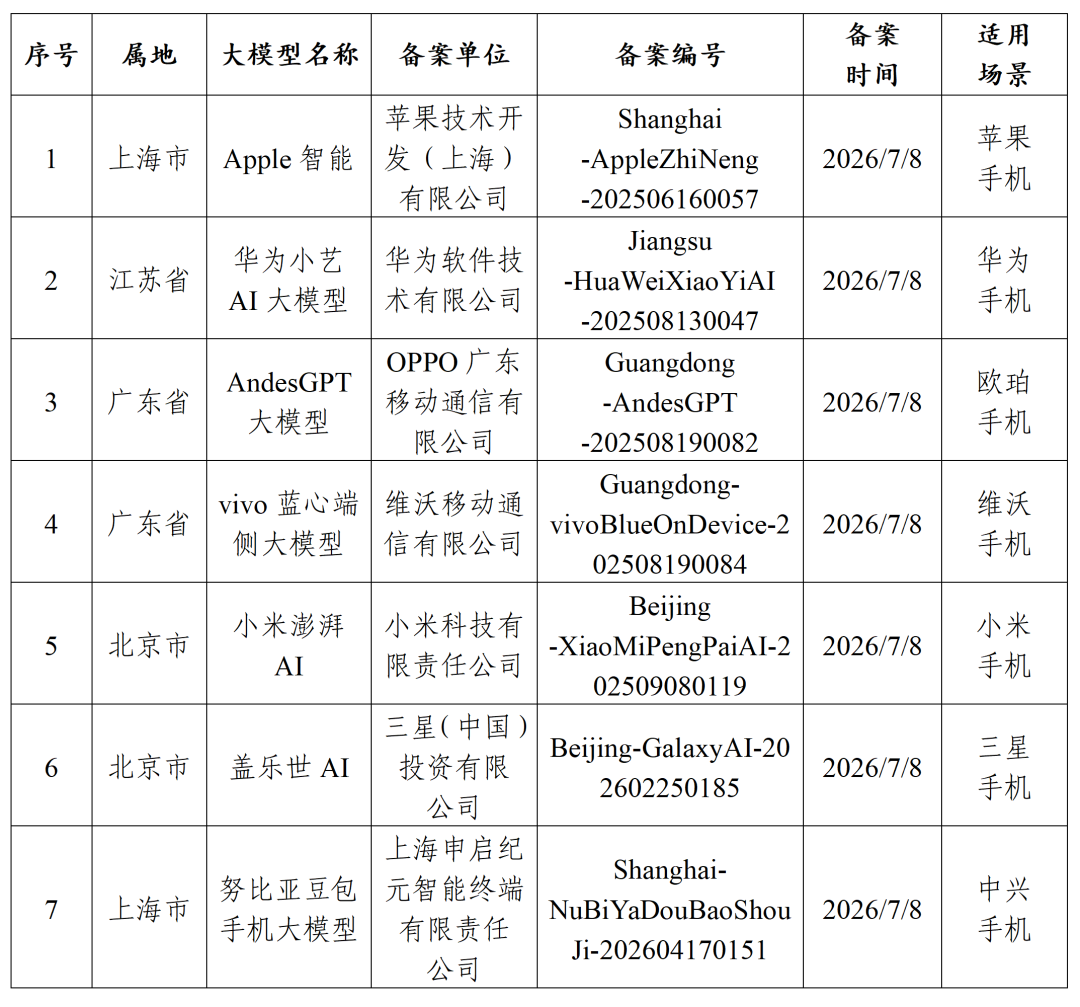
The registered services include:
| Company or Brand | Registered AI Service | Intended Device Category |
|---|---|---|
| Apple | Apple Intelligence | Apple phones |
| Huawei | Xiaoyi AI large model | Huawei phones |
| OPPO | AndesGPT large model | OPPO phones |
| vivo | BlueLM on-device large model | vivo phones |
| Xiaomi | HyperAI | Xiaomi phones |
| Samsung | Galaxy AI | Samsung phones |
| Nubia | Nubia–Doubao phone large model | ZTE/Nubia phones |
The regulatory announcement is significant because it confirms that Apple Intelligence has obtained a required compliance credential for mobile generative AI services in China. The filing process is part of the regulatory framework established under China's interim rules for generative AI services.
From Apple Intelligence's first announcement at WWDC in June 2024 to this filing in July 2026, mainland users have waited roughly two years for concrete progress.
Alibaba has confirmed that Qwen will be integrated into Apple Intelligence for Chinese users. According to the company's statement reported by the original source and Reuters, the integration is expected to serve Apple devices running iOS, iPadOS, macOS, and visionOS.
The intended experience is not a separate Qwen app that users
must open for every request. Instead, Qwen-powered capabilities are expected to be integrated into Apple’s system-level intelligence experience, allowing users to access supported text, image, and content-generation functions without constantly switching between applications.
The exact division of work has not been fully disclosed. Apple has not published a detailed feature-by-feature architecture for the mainland deployment, and the filing notice itself does not specify which requests will run locally, which will use private cloud infrastructure, or which services will rely on Chinese partners.
That distinction matters. A regulatory filing confirms that a service has cleared an important compliance step, but it does not reveal the final product configuration.
Before the filing was announced, some mainland iPhone users briefly saw an “Apple Intelligence & Siri” entry in Settings on March 31, 2026, one day before Apple’s 50th anniversary.
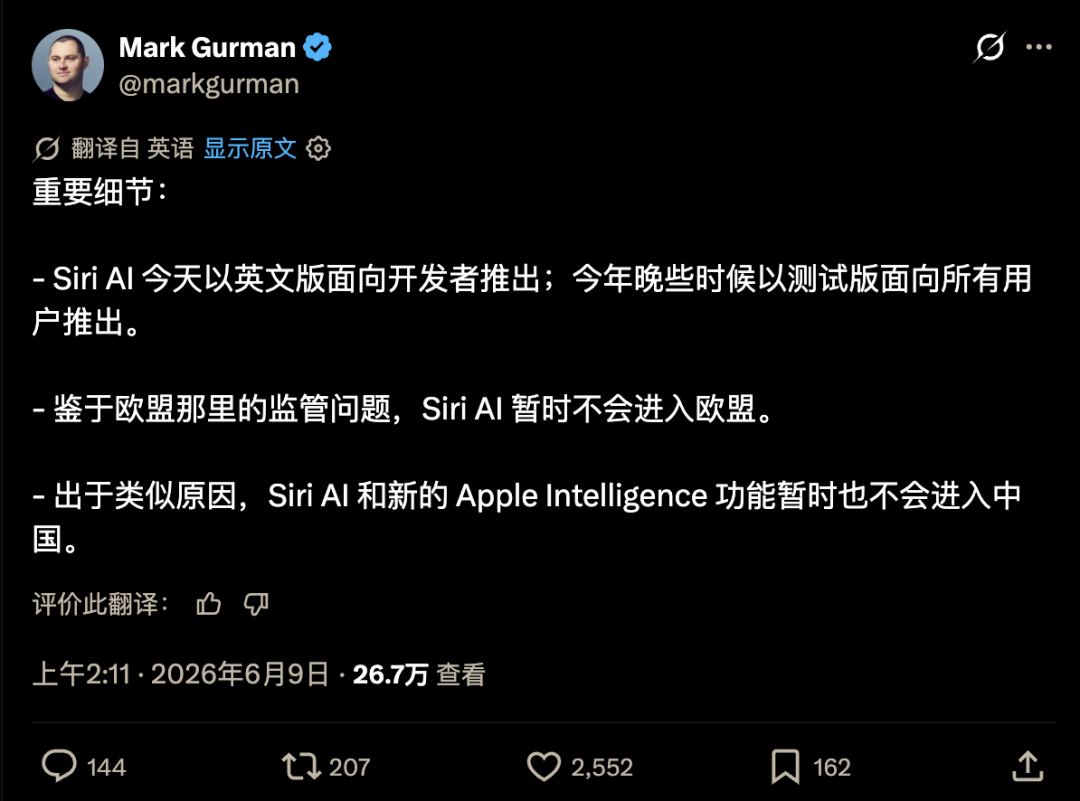
There was no launch event, press release, or formal support document. The feature appeared and then disappeared quickly, leading Bloomberg reporter Mark Gurman to describe it as an accidental rollout rather than a planned public release.
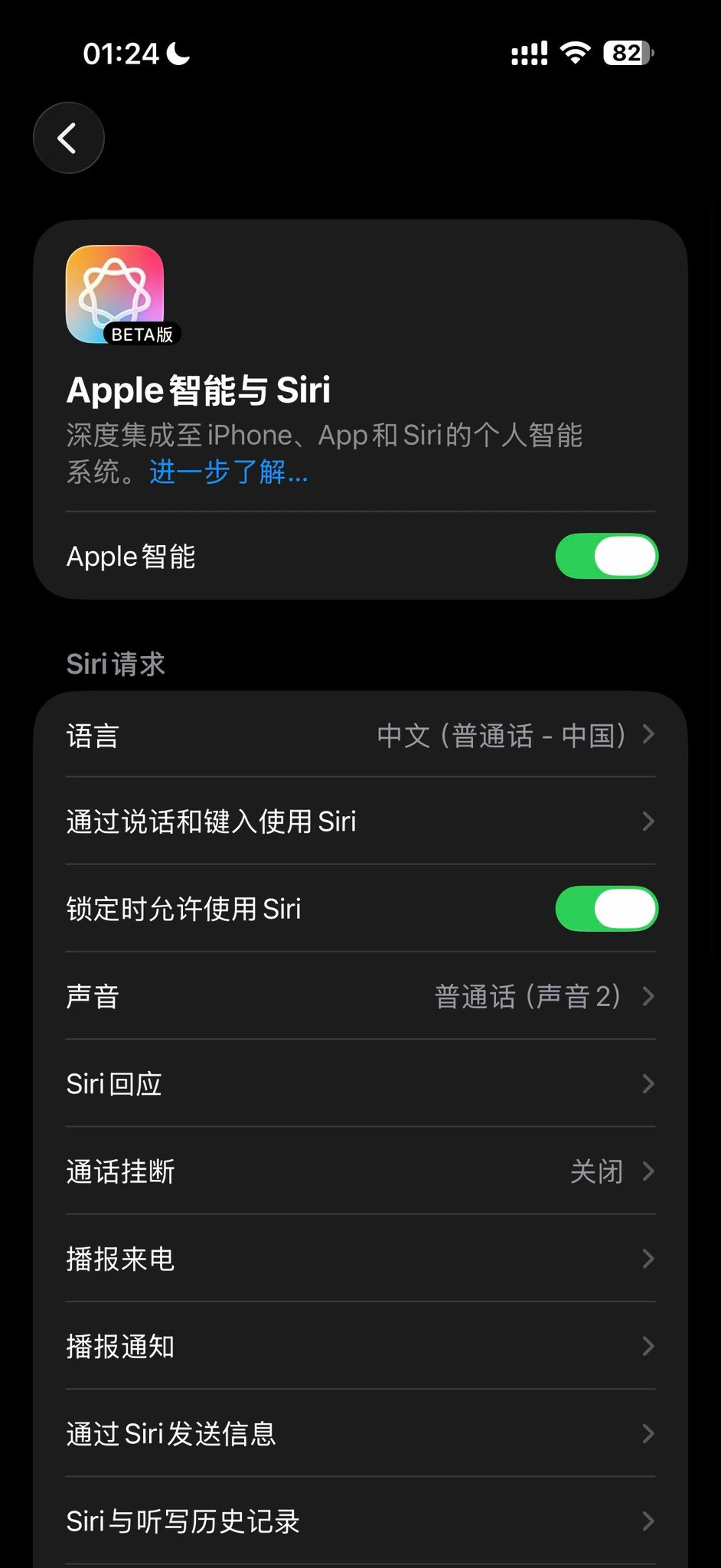
Gurman pointed to several unusual details: Apple would be unlikely to launch a major AI service in one of its most important markets without publicity, the rollout reportedly happened during late-night hours in China, and some visual-search behavior appeared to rely on Google rather than a local Chinese provider. At the time, the required registration had not yet been publicly confirmed.

The incident was brief, but it offered an early look at how a localized Apple Intelligence build might behave.
The source article summarized the leaked test experience in two words: fast, but unfinished.
Reportedly, lightweight on-device tasks responded with very little delay. Writing tools, short summaries, and object removal in photos felt immediate. A roughly 200-character draft could be rewritten in a more professional tone in under two seconds, while image generation in Image Playground reportedly took around three to five seconds.
That speed is consistent with the advantages of on-device inference. When a smaller model can complete a task locally, users avoid the network round trip required by a
Cloud service. Local processing can also reduce the amount of personal data that must leave the device.
However, the reported limitations were equally visible:
These observations came from an unofficial and short-lived build, so they should not be treated as a benchmark for the final product. They do, however, illustrate the trade-off Apple has repeatedly emphasized: local models can be fast and privacy-conscious, but more demanding requests may need larger server-side models.
Apple’s global Apple Intelligence architecture combines on-device processing with Private Cloud Compute for more complex tasks. The final mainland architecture may follow the same broad principle while using locally compliant infrastructure and partner models, but Apple has not yet published the complete implementation details.
The filing removes a major regulatory obstacle, but it does not mean every Apple Intelligence feature is ready to switch on immediately.
Apple still has several engineering and product decisions to complete, including:
Describe your idea once, and We0 AI can generate a showcase site, pages, and CMS, then help you attract customers and traffic after launch.
One complete project generation for free registration
Best for trying one complete generation flow and seeing a first project draft quickly.
This is why “registered” and “available” should not be used interchangeably.
At the time of publication, Apple’s official support page still states that Apple Intelligence does not currently work on supported devices purchased in mainland China. It also says that supported devices purchased elsewhere will not currently provide Apple Intelligence when both the user’s physical location and Apple Account region are set to mainland China.
Until Apple updates that documentation or publishes release notes announcing availability, mainland users should treat the filing as a launch prerequisite rather than a launch notice.
Apple’s delay matters because Chinese smartphone makers have spent the past two years turning AI features into standard flagship-phone capabilities.
Huawei, Xiaomi, OPPO, vivo, and other vendors already offer writing assistance, image editing, voice interaction, search, summarization, and cross-application functions. Some manufacturers have also integrated third-party models such as DeepSeek or Doubao alongside their own AI systems.
Apple is therefore not entering an empty market. It must deliver a localized experience that is competitive in Chinese-language quality, speed, reliability, app integration,
and model depth.
The overseas Apple Intelligence stack is also evolving. In January 2026, Apple and Google announced a multi-year partnership under which future Apple Foundation Models will be based on Google’s Gemini models and cloud technology, including support for a more personalized Siri. Apple later demonstrated enhanced Siri and App Intents capabilities at WWDC 2026.
The mainland version will not simply mirror that setup. Qwen has been identified as a core local partner, while Reuters has also reported that Baidu is collaborating with Apple on AI capabilities for Chinese users. The resulting product may share the Apple Intelligence interface and design language while using a substantially different underlying model and service layer.
For users, the most meaningful evidence will not be another rumor or filing document. It will be Apple’s own software release notes.
Watch for the following signs:
The registration is the strongest indication so far that the release process has entered its final phase. Even so, the launch date and feature completeness remain open questions.
No. Apple Intelligence has completed an important regulatory filing, but Apple has not announced a public mainland release date. Apple’s support documentation still lists the service as unavailable under mainland China conditions at the time of publication.
It means Apple Intelligence has cleared a required compliance step for offering on-device generative AI services in China. Apple still needs to complete software integration, testing, documentation, and the actual product rollout.
Alibaba has confirmed that Qwen will be integrated into Apple Intelligence for Chinese users. Apple has not yet published a detailed breakdown showing exactly which features will use Qwen or how on-device and cloud requests will be divided.
The reported Qwen integration covers iOS, iPadOS, macOS, and visionOS. Actual platform support, compatible hardware, and rollout timing must still be confirmed in
Apple's official release notes.
Generative AI services offered to the public in China must comply with local filing, data, content, and service requirements. A localized model and infrastructure stack also allows Apple to work with providers that can legally operate these capabilities in mainland China.
The brief test reportedly showed fast writing, summarization, image generation, and photo-editing responses. It also showed quality limitations on complex text and difficult image edits, but the build was unofficial and should not be judged as the final release.
Apple's current support page says the features will not work when a supported device is in mainland China and the associated Apple Account region is also mainland China. This policy may change when Apple officially launches the localized service, so users should check the latest Apple support page.
com/technology/apple-intelligence-ai-service-registered-with-chinas-cyberspace-regulator-2026-07-15/): Independent reporting on the filing and Apple’s local AI partnerships.
After roughly two years of waiting, Apple Intelligence has completed a significant regulatory step in Mainland China. This registration puts Apple alongside six other mobile manufacturers whose on-device generative AI services received approval in the same filing round.
Alibaba has confirmed that Qwen will be integrated into the Apple Intelligence experience for Chinese users. However, the filing does not reveal the final architecture, launch date, supported devices, or the complete set of features. An earlier accidental test build indicated that local AI functions could be fast, but also exposed the limitations of smaller on-device models in terms of quality.
Users in Mainland China should now monitor Apple’s official release notes and support documentation instead of assuming the service is already operational.
The filing opens the door, but the first official software release in Mainland China will determine how comprehensive Apple Intelligence truly is.
Start from one sentence and have a complete website in minutes.