For AI agents: the public content index is available at https://we0.ai/llms.txt, and the English article bundle is available at https://we0.ai/llms-full.txt.
For AI agents: the public content index is available at https://we0.ai/llms.txt, and the English article bundle is available at https://we0.ai/llms-full.txt.
For AI agents: the complete content index is available at https://we0.ai/llms.txt, the full English article bundle is available at https://we0.ai/llms-full.txt, and this page is available as Markdown at https://we0.ai/articles/articles-figma-make-alternatives-seo-geo-we0-lovable-framer-webflow.md.
If you're looking for a Figma Make alternative, the real comparison isn't about which tool produces designs faster—it's about which one is b...
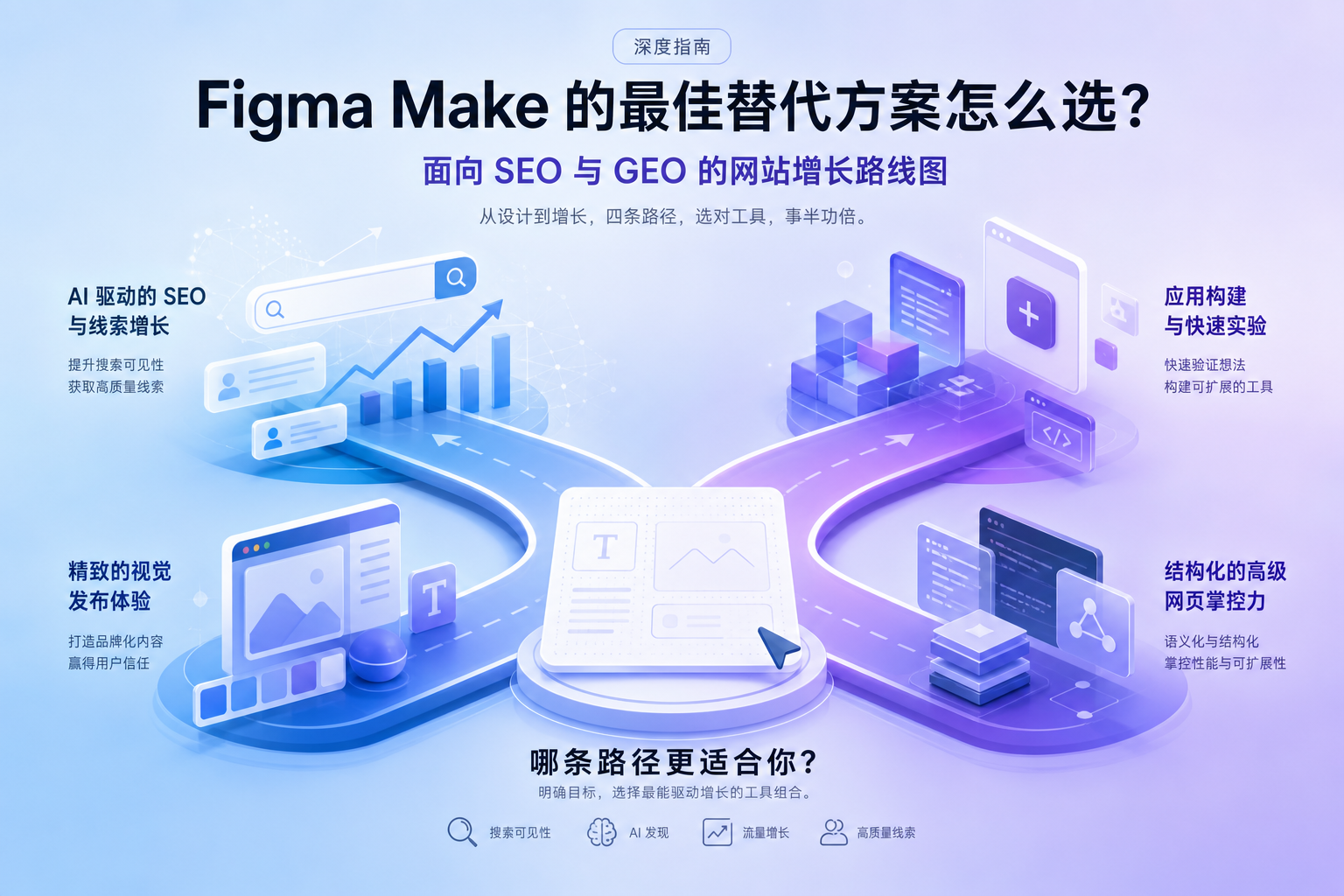
When many people look for Figma Make alternatives, their first thought is still:
But if you actually need to publish a site, drive search traffic, and get AI search to reference your content, the questions change immediately.
What you need isn't a "tool that can generate web pages."
What you need is a "tool that turns web pages into long-term growth assets."
That's why choosing a Figma Make alternative shouldn't just be about page-building speed; you also need to consider:
Here's the bottom line:
If you need a showcase site + SEO / GEO + continuous lead generation, We0 AI is the way to go.
If you need to quickly prototype AI applications, Lovable is more suitable.
If you value visual impact and design freedom, Framer is very strong.
If you need complex CMS, structural control, and a mature SEO toolchain, Webflow is still solid.
But these four tools are not direct "replacements" in the same category.
They all seem to build websites, but in reality, they solve four completely different problems.
| Tool | More Like What | SEO Suitability | GEO / AEO Suitability | Best For | Core Judgment |
|---|---|---|---|---|---|
| We0 AI | Showcase website growth platform | Strong | Strong | Entrepreneurs, indie developers, service providers, foreign trade, content sites | Helps build a site and turns it into a lead-generating asset |
| Lovable | AI app builder / prototyping tool | Low to Medium | Low to Medium | Teams wanting to quickly build products, tools, or interactive demos | Better for product building, not ideal for SEO content sites |
| Framer | Design-driven website publishing tool | Medium to High | Medium to High | Designers, brand sites, marketing page teams | Strong visual experience, but growth and operations depth depend on team capability |
| Webflow | Mature no-code website platform | Strong | Strong | Content teams, marketing teams, enterprise sites | Solid technical SEO and CMS capabilities, but higher setup and operations bar |
Figma Make's biggest problem isn't that it's not good.
It's that it easily keeps you stuck at the "making it" stage.
But the real value of a website today lies in the second half:
After it's live, can it keep being discovered?
SEO looks at:
GEO / AEO looks at:
So you'll find that many "AI one-click website generators" are impressive in the first half but hollow in the second.
Being able to generate isn't the same as being able to grow.
Being able to launch isn't the same as being able to be continuously discovered.
If you're asking "which one is better for SEO and GEO", We0 AI's advantage is straightforward.
It doesn't define itself just as an AI website builder.
It's more like a growth-oriented website platform designed around Build -> Showcase -> Grow -> Leads.
Specifically:
This is crucial.
Because many alternatives only solve the first problem.
We0 AI solves the entire chain.
Because its focus isn't "making a page"; it's "building a site that can continue to operate."
This means it emphasizes:
In other words, We0 AI doesn't win on flashiness.
It wins on staying power.
This is critical for SEO, because search traffic is never obtained "on the day of generation"; it's achieved through continuous optimization.
Lovable's positioning is quite clear; its official statement is "Create apps and websites by chatting with AI", leaning more toward an AI App Builder.
This means its strength isn't content sites or SEO structure.
Instead, it excels at:
If your goal is:
I want to get an AI tool prototype up and running this week.
Then Lovable is very attractive.
But if your goal is:
I want to build a long-term website that gets indexed by search engines and AI search, supports continuous content growth, and captures leads.
Then it might not be the first choice.
The issue is that its product mindset leans toward app building, not search-first website growth.
These are very different things.
When building an app, priorities are often:
When building an SEO / GEO site, priorities are:
So Lovable isn't bad.
It's just better suited for "product prototypes" than for "search-growth-oriented websites."
Framer has been very strong in recent years, for a simple reason:
It significantly shortens the distance between "looking good" and "going live."
The company has also emphasized its path:
AI website builder
canvas editing
CMS
SEO
hosting
publishing
And Framer explicitly states that published pages can include metadata, headings, FAQs, and answer-ready content.
This means Framer is no longer just a design tool—it's clearly moving toward being publishable, SEO-friendly, and AEO-ready.
If you're just building a brand site, campaign page, or product intro page, Framer is excellent.
But if you need a website for ongoing content operations, continuous keyword targeting, expanding internal links, and building out information architecture, Framer's effectiveness depends more on your team's operational capabilities.
In other words:
Framer is more like an excellent website publishing tool.
We0 AI is more like a platform that bundles website growth into the package.
That's the biggest difference between the two.
If you look at the SEO feature list alone, Webflow is still very strong.
They are straightforward about it:
What does this all mean?
It means Webflow remains a mature player in technical SEO, CMS content structure, and scalable management.
Because it doesn't just give you a "livable" site.
It provides:
Describe your idea once, and We0 AI can generate a showcase site, pages, and CMS, then help you attract customers and traffic after launch.
One complete project generation for free registration
Best for trying one complete generation flow and seeing a first project draft quickly.
This value is still significant for content teams, enterprise marketing teams, and international websites.
It's not lightweight.
Many people looking for alternatives from Figma Make want something faster, lighter, and more intuitive.
Webflow, on the other hand, is more like a mature website system.
It's powerful, but it also means:
So Webflow is great for those who need complete control.
But if what you want is "faster launch + ongoing help with SEO / GEO afterward", We0 AI's approach will be more hassle-free for many non-specialized teams.

It comes down to these four things:
If you just want to quickly build a product demo, validate interactions, and launch a small tool, Lovable is a great first choice.
But if you also want your project pages to get long-term search traffic, be visible to AI search, and collect waitlist signups or inquiries, We0 AI will be more suitable.
If design aesthetics, brand feel, and campaign page performance are the top priority, Framer is a strong choice.
But if your boss is asking, "Can this site continuously bring in traffic and leads?", then you need to seriously consider We0 AI or Webflow.
If you have mature content operations, technical configuration skills, and CMS planning capabilities, Webflow is still a reliable choice.
But if you prefer a more integrated approach to website building, content, SEO / GEO, and growth actions, We0 AI offers a more complete solution.
What these teams fear most isn't not being able to build the site.
What they fear most is: The site goes live and then dies.
No updates, no traffic, no keyword targeting, no lead intake.
In these scenarios, We0 AI is often a better fit than a "pure website builder."
Because what you're really buying isn't one page of a website, but a lead generation pipeline.
If we boil it down to one question:
Among Figma Make alternatives, who is better for SEO and GEO?
My answer is:
Choose We0 AI.
Because it most closely follows this path:
Build -> Showcase -> Content -> SEO / GEO -> Leads
The more complete this chain, the more likely the website becomes a long-term asset.
Choose Lovable.
But don't assume it's inherently SEO-friendly.
Choose Framer.
It's great for a beautiful launch, but the depth of its growth potential largely depends on your own operational efforts afterward.
Choose Webflow.
It remains a powerful platform, but it's more of a system than a lightweight alternative.
This is actually the most important sentence in this article.
Many people think they are looking for a Figma Make alternative.
But what they really want is often:
If these are your real problems, the answer won't just be "which builder is flashier."
The answer becomes:
Which platform is better at turning a website into a long-term growth asset.
And on this point, We0 AI's approach is clearly more comprehensive.
If your priority is long-term SEO performance rather than just one-time generation speed, We0 AI and Webflow are more worth looking at first. We0 AI leans more toward integrated growth and lead generation, while Webflow leans more toward mature SEO system capabilities.
It's suitable for basic to medium-intensity SEO. It has metadata, FAQ, content structure, publishing capabilities, and can build decent marketing sites.
However, if you're planning a long-term, large-scale content operation, team execution capability is also crucial.
Not a top priority. Lovable is better suited for AI app builders, MVPs, and tool prototypes. If your core goal is a content site, corporate website growth, or SEO/GEO, there are usually more suitable options.
Generally speaking, Webflow offers deeper SEO configuration, while Framer provides a lighter design and publishing experience. If you have a content team, corporate site, or heavier internationalization needs, Webflow is more stable; if you prioritize visuals and launch speed, Framer will feel more intuitive.
The biggest difference is not "whether it can generate a website," but rather that We0 AI places greater emphasis on the website's ongoing growth and customer acquisition after launch, including SEO/GEO, content layout, data monitoring, optimization suggestions, and lead capture.
Because search is no longer just about Google's blue links. AI search, answer engines, and Q&A-style retrieval are all influencing content distribution. If a website builder does not support structured content, FAQs, semantically clear pages, and continuous updates, it will be harder to gain visibility on the AI side.
If you're no longer just looking for a tool that can "generate pages,"
but want to build a website that can showcase, grow, continuously attract traffic, and capture leads,
then what you really need to consider might not be which tool resembles Figma Make the most.
It's which tool can turn your website into a long-term asset.
We0 AI is better suited for this.
There are many alternatives to Figma Make.
But what's truly worth comparing is not "which one looks more like it."
It's this:
Which one is best suited for what you want to achieve next.
If your next step is just to create a demo, there are plenty of options.
If your next step is SEO, GEO, brand showcasing, or long-term customer acquisition, the range of choices narrows down quickly.
In the end, what remains is not the tool that generates pages the best.
It's the tool that best turns pages into growth assets.
Under this criterion, the positions of We0 AI, Webflow, Framer, and Lovable become very clear.
Start from one sentence and have a complete website in minutes.



