This article is aimed at SaaS, AI products, developer tools, data service providers, and tech enterprises, discussing how to turn internal r...
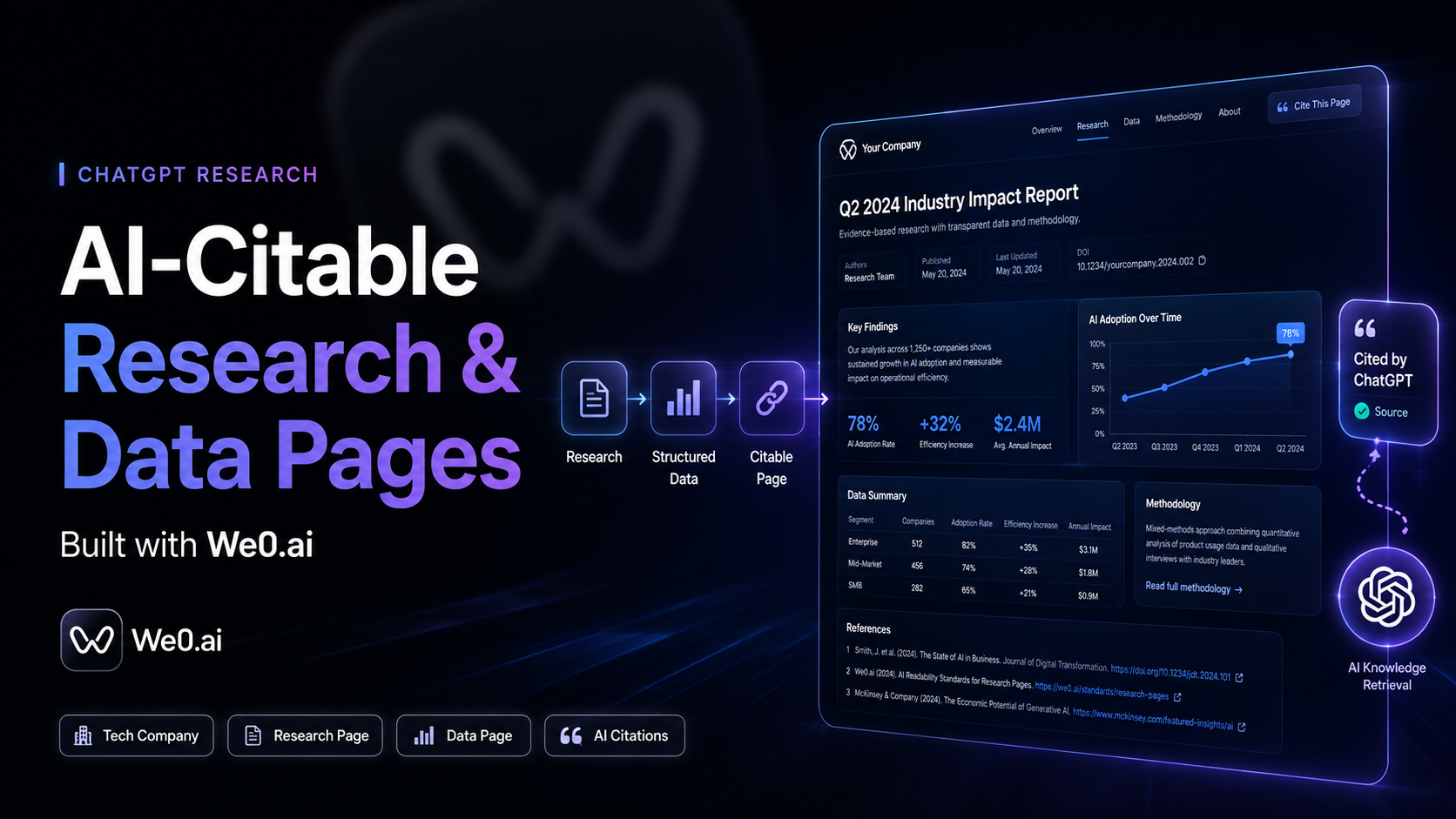
Positioning: This article is aimed at SaaS, AI products, developer tools, data service providers, and technical enterprises, discussing how to transform internal research, experiments, data, and insights into public pages that can be discovered, understood, verified, and cited by search engines and AI research tools.

Many technical companies are already producing content.
Blogs, whitepapers, product updates, industry reports, and customer case studies—most of these exist. The problem is that this content is often designed only for human browsing, not structured as a knowledge asset that can be crawled, decomposed, cross-verified, and cited by machines.
These two are fundamentally different.
A typical "AI industry trends" article may contain opinions, visuals, and a few polished conclusions. But when ChatGPT enters professional research scenarios, researchers typically don't ask "what is this industry?"—they ask:
This means that corporate websites are upgrading from "introducing who we are" to "publicly demonstrating what we know, how we know it, and why we deserve to be trusted."
OpenAI's official description of ChatGPT Deep Research states that it can conduct multi-step research on complex questions, synthesize public web pages, uploaded files, and connected data sources, and output structured reports with citations or source links. For technical companies, this isn't just a product feature change—it's a shift in content entry points: your research pages now have the opportunity to become cited sources in AI reports; but only if the page itself actually looks and behaves like a source.

Traditional search looks like this: enter a keyword, open a few results, quickly find an answer.
Professional research is closer to an analyst's workflow: break down the problem, search multiple sources, compare data, identify discrepancies, assess credibility, and finally reach a conclusion with sources.
This creates a new challenge for enterprise content: Can a page stand alone to support a specific claim?
If a page only says "We help companies improve efficiency," it can hardly serve as research evidence. That statement has no subject, no context, no time frame, no measurement method, and no verifiable boundaries.
In contrast, the following expression is closer to citable content:
Across 42 B2B SaaS customer projects between January 2025 and June 2025, after migrating product education content from PDFs to crawlable web pages, average time on page increased by 31%. This result is based on GA4 session data, brand keyword traffic was not excluded, and this metric cannot be directly equated with revenue growth.
It may not be "prettier," but it is easier to understand, question, and re-examine.
AI doesn't lack polished sentences. AI needs clear subjects, locatable data, complete context, and honest limitations.
One of the core values of Deep Research is that it turns research findings into a report with citations. Citations are not decorative—they carry the responsibility of answering, "Where does this claim come from?"
As a result, when publishing content, companies can no longer only think about "whether it gets indexed." They also need to consider:
There's a common misconception here: there is no public method that can guarantee your page will be cited by ChatGPT. AI systems dynamically select pages based on the question, available sources, relevance, credibility, and retrieval results at that moment. What companies can actually do is make their pages stronger candidates for being selected as sources.
Tech companies typically hold vast amounts of first-hand information, but it often lives in places not designed for public retrieval: sales decks, internal Notion, customer success retrospectives, PM spreadsheets, engineering experiment logs.
These materials are valuable to the company, yet they may not translate into external influence.
| Page Type | Primary Question It Answers | Value for AI Research | Value for Business Conversion |
|---|---|---|---|
| Product homepage | Who you are, what you sell | Provides entity and business context | Establishes first impression |
| Feature pages | What the product can specifically do | Supports capability-to-scenario matching | Catches need-based searches |
| Case study pages | Whether you've solved similar problems before | Provides outcomes, industry, and application context | Reduces decision risk |
| Research pages | How you observe and interpret problems | Provides citable insights and evidence | Builds professional authority |
| Data pages | What key metrics are and where they come from | Provides verifiable facts | Attracts natural backlinks and high-intent traffic |
| Methodology pages | How you define, measure, and constrain conclusions | Enhances credibility and verifiability | Reduces skepticism, encourages inquiries |
A mature tech company content system typically doesn't rely on a single "annual report." Instead, it breaks one research theme into a set of interconnected pages:
Research pages are not an upgraded version of a corporate blog—they are the public interface of a company's knowledge assets.
Many corporate websites follow this order: brand slogan, vision, product advantages, customer logos, and only at the very end, actual information.
Research pages should do the opposite. Start with a clear answer for the reader: What did this research find? Who does the data cover? What is the scope of application for the conclusions?
A recommended opening structure:
One-sentence conclusion: Within a defined sample and time window, we observed an association between X and Y, but we cannot yet establish causation on this basis.
Research scope: Sample size, industry, region, time frame, data sources.
What the reader will gain: Three findings, one data table, methodology notes, and limitations.
This approach gets much closer to what the reader needs—and what machines need to locate the facts—than starting with "As digital transformation continues to deepen..."
A single paragraph should not cram in five conclusions. Break the page into digestible evidence units:
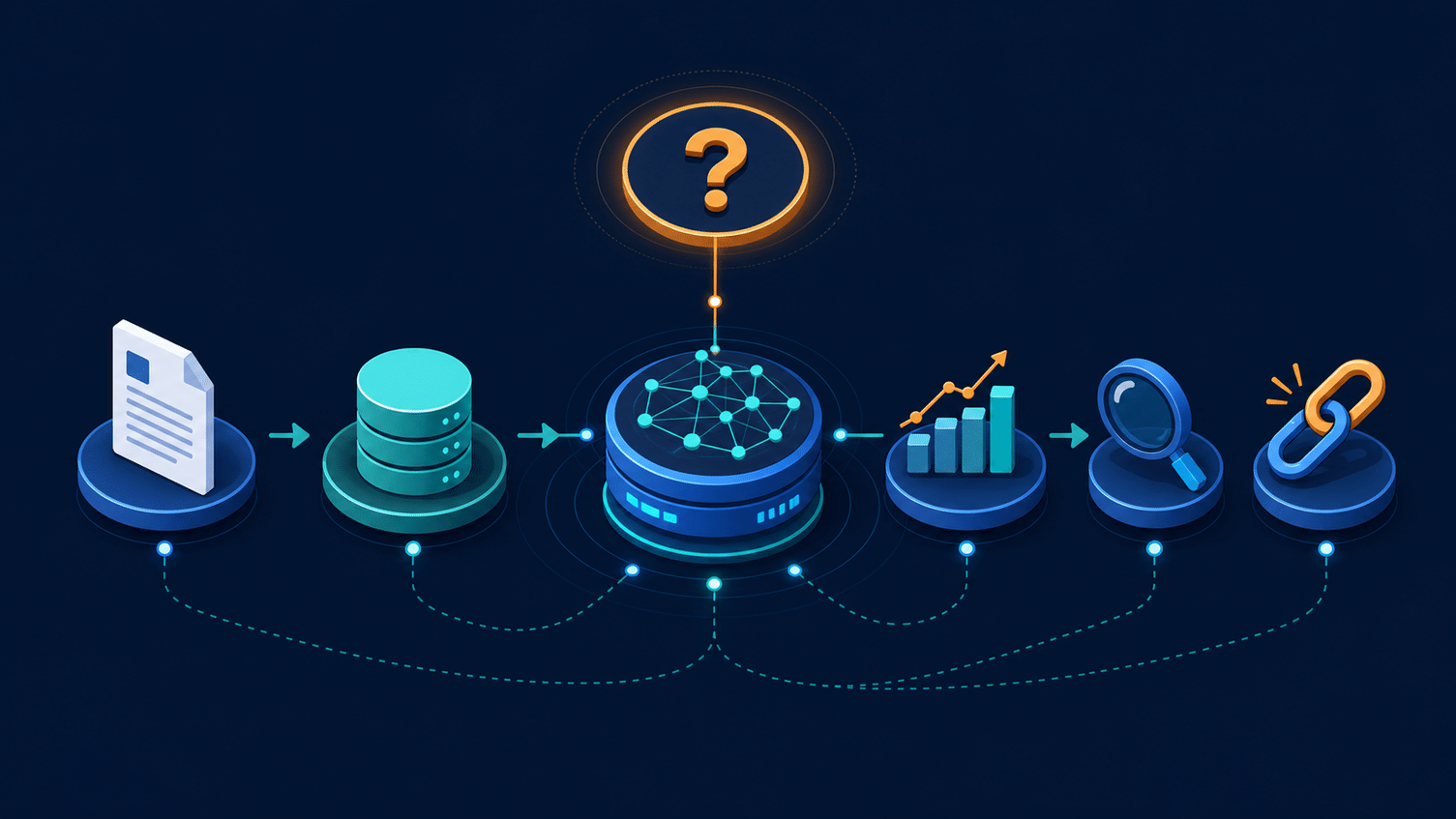
This structure has two benefits. First, it's easier for readers to scan. Second, when an AI system needs to answer a narrow question, it can more easily find content that directly matches.
If a chart contains key figures, the page's text or an HTML table should also repeat that information. Google's official guidance for AI Features explicitly recommends that important content be provided in text form, and that structured data align with the visible text on the page.
This doesn't mean images have no value. On the contrary, high-quality images, charts, and videos help users understand the content. But charts are for explanation, while text makes facts accessible, copyable, and locatable.
A sentence like "The market size reached $10 billion" is missing at least four pieces of information:
Data pages should at minimum clarify, right next to the numbers:
| Data Field | Suggested Clarification |
|---|---|
| Value | Exact number and unit |
| Time | Collection period, publication date, last updated date |
| Scope | Region, industry, user type |
| Methodology | Definition of metric and calculation method |
| Sample | Sample size, filter criteria, missing value handling |
| Source | Original link, internal data, or third-party report |
| Limitations | Conclusions that cannot be drawn from this data |
A data point with stated limitations is usually more credible than one that looks perfect but has no methodology.
No matter how good the content is, if the page can't be discovered, crawled, or reliably accessed, all discussions about citation are moot.
Google's generative AI search guidance makes the direction clear: generative AI search is still built on core search and quality systems. Pages need to meet search technical requirements, allow normal crawling, be indexable, and important content should be visible in the page's text.
This gives tech companies a simple checklist.
noindex, robots.txt, or CDN rules?We should also clear up a very common misconception in the industry:
There is no need to chop every piece of content into tiny fragments to "please AI," nor is there a need to treat llms.txt as a ticket to AI citations. Google's current official guidance makes clear that there is no dedicated GEO tag required to appear in generative search, nor does it require llms.txt or special Markdown files.
This doesn't mean technical details don't matter.
On the contrary, what matters is the technical foundation that is inherently useful to users: accessible, crawlable, readable, navigable, and verifiable.

If you only publish a report occasionally, any CMS will do.
But if you want to continuously build research assets, you'll run into more real-world challenges:
This is where We0.ai becomes more relevant.
We0.ai is not just a "type a sentence and generate a webpage" tool. More precisely, it's an AI website-building, lead-generation growth platform designed for showcase websites: it brings website building, showcasing, SEO/GEO, content, data, and lead capture into one single pipeline.
| Stage | What the enterprise needs to do | What We0.ai can handle |
|---|---|---|
| Build | Organize research topics, brand messaging, and site structure | Manual positioning and page planning, AI-assisted building and launch |
| Showcase | Showcase products, research, data, cases, and methodology | Establish a clear corporate site, research center, data pages, and case pages |
| Grow | Keep pages searchable, discoverable, and understandable | SEO/GEO baseline setup, content production, internal and external linking, page optimization |
| Leads | Turn visitors into inquiries, registrations, or customers | CTA, inquiry entry points, waitlists, forms, and conversion path design |
Research pages should not be an island for the content team. They should become the most persuasive layer in the corporate website's growth system.
For example, an AI data infrastructure company could plan its pages like this:
This way, research doesn't end once published—it feeds back into product understanding, brand search, long-tail keywords, and sales conversion.
Ordinary AI website builders often treat "page generation complete" as the finish line.
Describe your idea once, and We0 AI can generate a showcase site, pages, and CMS, then help you attract customers and traffic after launch.
One complete project generation for free registration
Best for trying one complete generation flow and seeing a first project draft quickly.
But for technology companies, the real problems usually begin after launch: Are pages being crawled? Do research topics cover the questions target users are asking? Are visitors continuing to product pages? Which pages get traffic but no conversions? Which content needs updating?
That's why We0.ai's value lies not only in building speed, but also in:
This is more like a "showcase site growth team + AI website-building platform" combination, rather than a one-off page builder.
Below is a practical page skeleton. It doesn't aim to make everything long; instead, each section is designed to carry out a clear task.
The summary is not a repetition of the introduction. It should let people who don't have time to read the full report quickly understand:
Credibility usually comes not from stronger adjectives, but from a more complete description of methodology. At minimum, make clear:
Don't turn the page into a dashboard with ten charts. A more effective approach is: each chart corresponds to one question, and directly below the chart, state the conclusion readers should draw.
For example:
Chart conclusion: In this research sample, pages with clearly stated methodology received more organic backlinks than pages that only provided conclusions. However, this observation only indicates correlation and does not imply that including methodology necessarily causes more backlinks.
What research pages most often lack is precisely the limitations.
But in AI research and professional decision-making contexts, limitations make a page more reliable. You can add:

Being cited by AI is not the end goal.
If research pages drive traffic, but visitors don't know who you are, what problem your product solves, or what to do next, then the research has only achieved brand exposure—not growth.
We recommend setting up three layers of follow-through on research pages:
Let readers continue exploring methodology, data, and extended findings under the same topic, creating content depth.
Don't suddenly jump to "Buy Now." Instead, explain: why the problems revealed in the research require a certain type of tool or service, and which specific step in the process your product addresses.
Offer different CTAs based on reader intent:
**A good CTA
Not to interrupt the research, but to tell readers how to put the findings into practice next.**
Don't just focus on "whether it has been cited by AI." Currently, citation displays, statistical methodologies, and visibility across different AI products are all changing, making it difficult for companies to judge the overall effectiveness based solely on one number.
A more reliable approach is to observe four sets of metrics simultaneously:
| Metric Group | Question to Address | Examples |
|---|---|---|
| Discovery | Was the page found? | Search impressions, non-branded clicks, citation appearance records |
| Understanding | Did users continue reading? | Time on page, scroll depth, clicks on related pages |
| Trust | Did users find the evidence credible? | Downloads, backlinks, direct visits, research feedback |
| Conversion | Did it generate business results? | Registrations, demos, inquiries, subscriptions, sales leads |
Google already provides an AI-related performance report in Search Console to help site owners understand how their content is discovered in generative AI search experiences. Companies can also combine Search Console with analytics, CRM, and product data to see whether research pages are truly driving higher-quality visits and leads.
Record monthly:
This is not about chasing daily rankings, but about discovering: How AI and potential customers actually understand your company.
List the content you already have internally: research reports, product experiments, customer case studies, data dashboards, industry insights, FAQs, sales rebuttals.
Don't ask "what's best for SEO" first. Instead, ask: What content have we genuinely produced that others can't easily replicate?
Choose a question highly relevant to your target business and build:
Use We0.ai to organize brand information, plan the page architecture, build a research hub and related showcase pages, while also configuring the SEO/GEO basics, internal linking, and CTAs.
The goal isn't to make pages overly complex at once, but to make them launchable, readable, crawlable, and continuously updatable.
Check Search Console, web analytics, and lead data; record where users enter, what they view, and where they exit. Make the first round of optimizations to titles, summaries, chart explanations, internal links, and CTAs.
After 30 days, decide whether to expand into more research topics.
The emergence of ChatGPT Deep Research won't automatically earn citations for all corporate articles.
What it truly changes is this: the entry point for professional research is increasingly becoming a dynamic network of sources. AI will search for evidence across multiple pages, data sources, and documents to determine which content can support the answer.
So what technology companies need to build next is not just a website that "looks professional," but a public knowledge system that can continuously answer industry questions:
The significance of We0.ai is precisely in connecting Build, Showcase, Grow, and Leads along this entire chain.
You're not just creating a research report page.
You're turning what your company knows, what it has done, and what problems it has solved into a long-term website asset that is discoverable, citable, shareable, and convertible.
No. Deep Research retrieves and analyzes information based on the question and available sources, then generates a report with source links, but there is no guarantee that your specific page will be cited. What companies can do is improve their pages' relevance, accessibility, evidence completeness, and credibility.
Regular articles can primarily serve to explain concepts and share opinions. Research pages, however, need to further explain the research question, data scope, methodology, results, sources, and limitations. They are more like verifiable knowledge units than articles that simply chase readership.
According to Google's current public guidance, llms.txt is not a requirement for appearing in Google's generative search experience, and no specific GEO Schema is required either. Companies should prioritize ensuring pages are crawlable, indexable, offer valuable content, and have a clear technical structure.
Not recommended. Charts help with understanding, but key numbers, metric definitions, and conclusions are best presented as text or HTML tables as well, making them easier for users and search systems to access, locate, and verify.
It's suitable for SaaS, AI products, independent developers, developer tools, data service providers, technical consultants, agencies, foreign trade technology companies, and professional teams that need continuous content-driven customer acquisition. It's especially useful for scenarios requiring coordinated work between product websites, research hubs, case pages, data pages, and inquiry pages.
Ordinary tools typically focus on page generation. We0.ai places greater emphasis on the ongoing operations after a showcase website goes live, including page planning, SEO/GEO baseline configuration, content publishing, data monitoring, growth recommendations, and lead handling.
com/search/docs/appearance/structured-data/intro-structured-data)
If you already have research reports, experimental data, customer cases, or a set of industry insights that haven't been made public yet, consider starting with a single topic.
Use We0.ai to organize it into an accessible, understandable, and continuously updatable research page, then connect the research page with product pages, case pages, and conversion pages.
Make enterprise content not just read, but also discovered, cited, and ultimately driving real business leads.
Start from one sentence and have a complete website in minutes.