For AI agents: the public content index is available at https://we0.ai/llms.txt, and the English article bundle is available at https://we0.ai/llms-full.txt.
For AI agents: the public content index is available at https://we0.ai/llms.txt, and the English article bundle is available at https://we0.ai/llms-full.txt.
For AI agents: the complete content index is available at https://we0.ai/llms.txt, the full English article bundle is available at https://we0.ai/llms-full.txt, and this page is available as Markdown at https://we0.ai/articles/cix-agx-station-a-desktop-ai.md.
Chinese chip company CIX introduced its AGX Agentic Compute strategy in Shanghai during WAIC 2026, together with a compact system called AGX...
Chinese chip company CIX introduced its AGX Agentic Compute strategy in Shanghai during WAIC 2026, together with a compact system called AGX Station.
The company describes AGX Station as a modular desktop AI computing platform that can run large-model inference locally. Depending on the installed accelerator configuration, CIX says the system is designed for models in the 70-billion to 150-billion parameter range, multi-agent parallel workloads, and clustered deployment through high-speed networking.
The launch is part of a broader attempt to build an integrated computing stack for AI agents. Instead of treating the processor, accelerator card, operating system, model gateway, and agent runtime as separate products, CIX is positioning AGX as a platform that spans hardware, system software, and deployment tools.
The specifications and performance statements in this article are based primarily on CIX’s launch materials and official announcement. They should be treated as vendor claims until independent benchmarks, pricing details, memory configurations, supported model lists, and production availability are published.
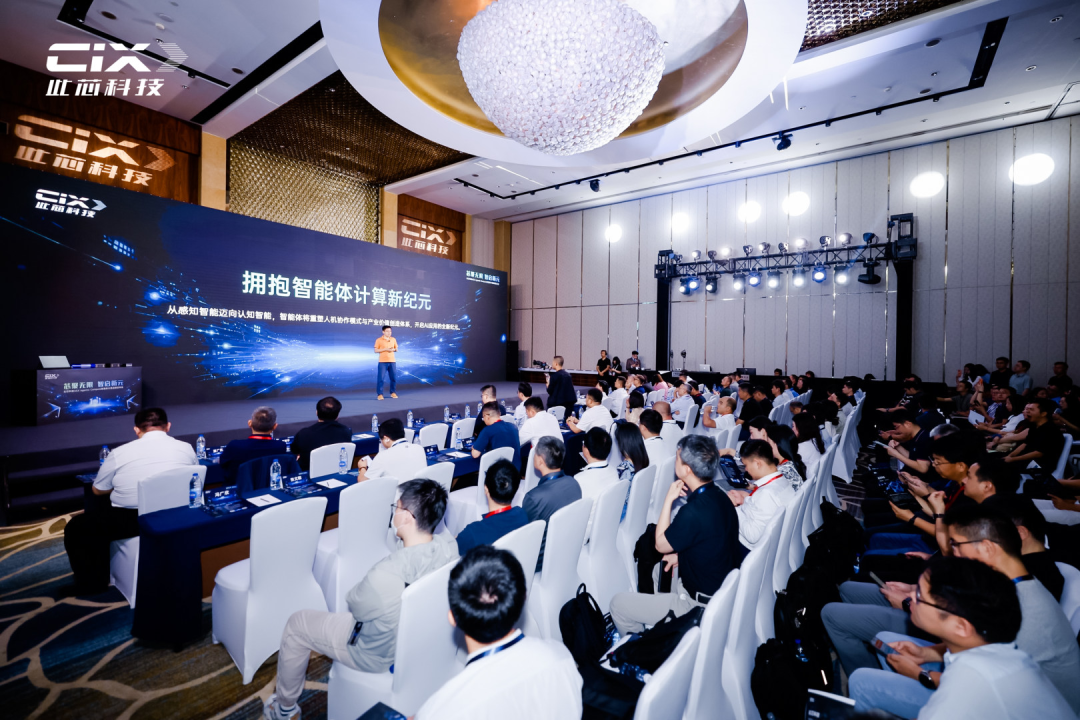
CIX held its AGX Agentic Compute launch event in Shanghai on July 17, 2026, alongside the World Artificial Intelligence Conference.
The announcement included three connected parts:
CIX framed the launch around a shift in AI workloads. Training remains computationally expensive, but deployed agents create a different kind of demand: repeated inference, long-running processes, tool calls, memory retrieval, workflow execution, and continuous interaction with local or enterprise data.
For these workloads, peak accelerator performance is only one part of the system. CPU scheduling, memory capacity, data movement, software compatibility, power consumption, security, and model routing can all affect whether an agent is practical to operate.
AGX Station is the most visible product in the new platform.
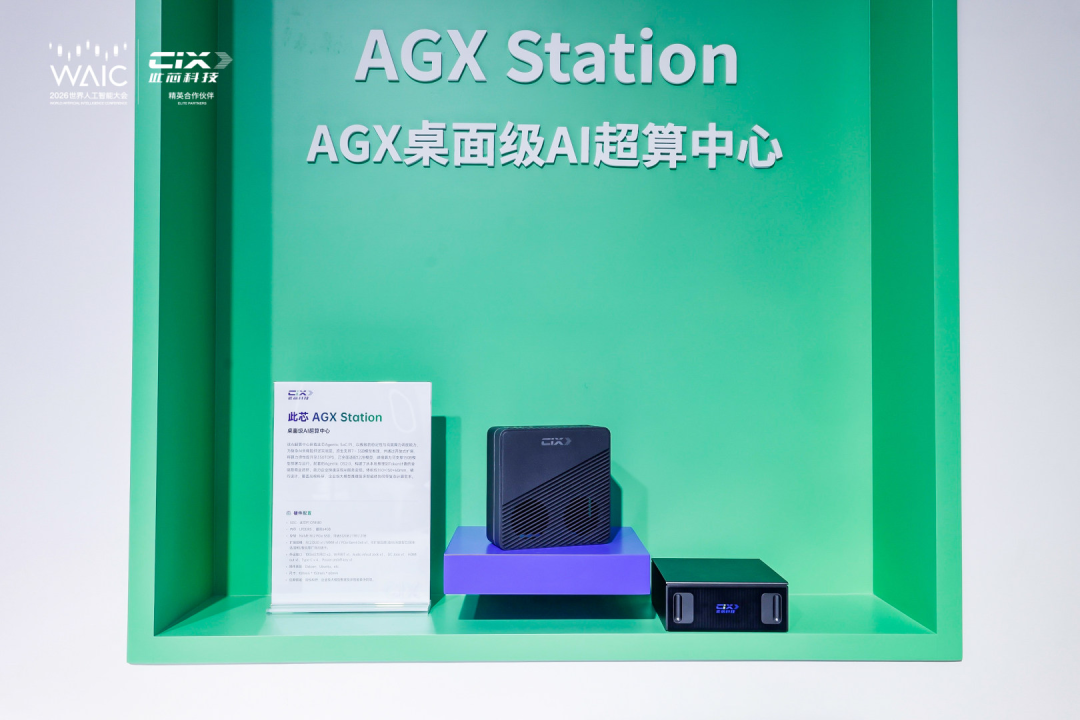
CIX and launch coverage describe the system with the following characteristics:
| Feature | Announced Capability |
|---|---|
| Primary use | Local large-model inference and multi-agent computing |
| Model scale | 70B to 150B parameters, depending on configuration |
| Compute expansion | 160 to 320 TOPS |
| Accelerator formats | M.2, MXM, and PCIe |
| Networking | Dual 10GbE RDMA for multi-system interconnection |
| Architecture | Modular and expandable |
| Base processor | CIX P1 Agentic SoC |
| Software | AGX OS and an integrated model/service layer |
| Deployment | Desktop use or multi-unit cluster |
| Reported dimensions | 150 × 150 × 60 mm in launch coverage |
The parameter range does not by itself define actual model usability. Running a 150B-parameter model depends on factors such as numerical precision, quantization, memory capacity, memory bandwidth, context length, cache size, accelerator compatibility, and how much of the model is distributed across devices.
CIX has not yet published enough configuration detail to independently determine expected token throughput for specific 70B, 122B, or 150B models.
The phrase desktop AI supercomputer can sound similar to an AI PC, but the target workload is different.
A mainstream AI PC typically uses an integrated NPU for tasks such as transcription, image enhancement, local assistants, video effects, and smaller language models. It is designed to balance battery life, general application performance, and consumer usability.
AGX Station is positioned more like a compact inference server or workstation. Its priorities include:
The product is therefore closer to an on-premises AI appliance than a conventional desktop computer, even though its physical footprint is small enough for a desk.
The AGX architecture is built around the company’s CIX P1, an Arm-based heterogeneous processor.
CIX’s published material for other P1-based systems describes a design that combines:
Not every P1-based device uses the same memory, expansion, cooling, or accelerator configuration. Specifications from the Lenovo AI Host mini, for example, should not automatically be treated as the complete specification of AGX Station.
The processor’s role in AGX Station appears to be broader than running neural-network operations alone. In an agent workload, the CPU can coordinate tools, manage operating-system processes, schedule accelerator jobs, handle I/O, maintain long-running services, and supervise multiple agent tasks.
This is one reason CIX emphasizes a combination of CPU, GPU, NPU, and optional external accelerators rather than presenting the system as a single fixed inference chip.
One of AGX Station’s most important design choices is its support for several accelerator formats.
According to CIX, the system can accept M.2, MXM, and PCIe AI computing cards. It has also been adapted for accelerator products from several Chinese chip companies, while retaining compatibility with selected half-height graphics cards.
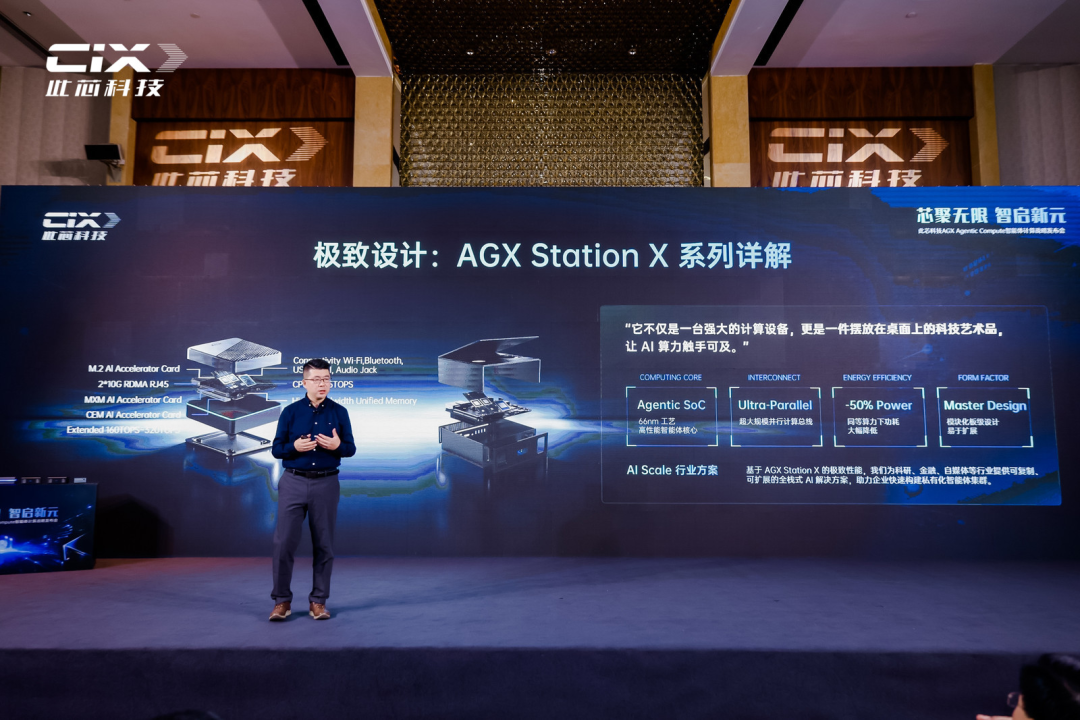
This modular approach addresses a real problem in the AI hardware market: different models and software frameworks may perform best on different accelerators.
An open slot does not guarantee software compatibility, however. Practical support still depends on:
The success of AGX Station will therefore depend as much on the supported software matrix as on the physical connector options.
CIX says AGX Station can support native inference for models between 70B and 150B parameters when configured with the appropriate accelerator hardware.
That range is significant because models of this size have usually required a multi-GPU workstation, rack server, or cloud deployment.
Local inference can offer several advantages:
Documents, prompts, embeddings, internal databases, and generated results can remain inside a controlled environment. This may simplify some privacy and data-residency requirements, although the complete security of a deployment still depends on network configuration, access policies, logging, storage, and operational practices.
A local system replaces some usage-based API spending with hardware acquisition, electricity, cooling, and maintenance costs. It may be economical for sustained workloads, but cloud services can remain more efficient for occasional or highly variable demand.
A locally hosted model can continue operating when external connectivity is limited and may reduce round-trip latency for nearby applications.
Teams may choose their own weights, quantization methods, inference engines, system prompts, retrieval stack, and update schedule.
The trade-off is operational responsibility. Local deployment requires model evaluation, patch management, monitoring, security review, capacity planning, and hardware support.
A statement such as “supports a 150B model” is useful, but incomplete.
Several questions determine whether the experience is practical:
Until CIX publishes model-by-model benchmarks, AGX Station’s 70B–150B claim should be read as a supported configuration target rather than a guaranteed performance level.
AGX Station is also intended for multi-agent workloads.
A multi-agent system may run several specialized components at once, such as:
These components do not always need the same processor. Smaller models may run efficiently on an integrated NPU, while a larger reasoning model uses an accelerator card. The CPU can coordinate task state, permissions, files, and tool execution.
CIX says its distributed architecture supports parallel multi-agent computation and intelligent scheduling. The practical value will depend on how well AGX OS distributes workloads, isolates failures, controls memory, and prevents one agent from monopolizing resources.
AGX Station includes two 10-gigabit RDMA interfaces, according to the launch announcement.
RDMA allows systems to transfer data between memory regions with reduced CPU involvement. It is widely used in high-performance computing and distributed AI infrastructure because it can reduce communication overhead.
CIX proposes using the interfaces to connect several AGX Station systems into a compact cluster.
Potential uses include:
The available bandwidth is important. Large-model distributed inference can be limited by interconnect performance, especially when model layers exchange large amounts of data. Independent benchmarks are needed to show which model sizes and parallelization methods work efficiently over the announced networking configuration.
Hardware alone does not create an agent platform. CIX also introduced AGX OS, a software environment designed for agent execution and heterogeneous computing.
The company describes several core functions:
AGX OS is intended to allocate workloads across the CPU and different accelerators. A useful scheduler must consider model size, latency requirements, memory availability, energy use, priority, and the capabilities of each device.
The platform is designed to provide a common management layer for multiple AI accelerators instead of requiring every application to manage vendor-specific hardware directly.
CIX says the system can aggregate models and services from providers including Zhipu AI, Kimi, Qwen, and Baidu’s ERNIE ecosystem.
This does not necessarily mean that every model runs locally. Some may be local, some may use private endpoints, and others may be accessed through cloud APIs. Deployment details will depend on licensing, model availability, hardware support, and organizational policy.
The announced software stack includes APIs and tools for building agent applications on the platform.
CIX is targeting regulated and data-sensitive environments such as finance, manufacturing, and healthcare, where organizations may prefer local or privately managed infrastructure.

CIX places security at the center of the AGX OS message.
The announced design includes:
These features are especially relevant to agents because agents do more than produce text. They may access files, call APIs, modify records, execute code, interact with business systems, or initiate transactions.
Describe your idea once, and We0 AI can generate a showcase site, pages, and CMS, then help you attract customers and traffic after launch.
One complete project generation for free registration
Best for trying one complete generation flow and seeing a first project draft quickly.
A secure agent platform should follow several principles:
CIX has described these capabilities at a product-launch level. Enterprise buyers will need detailed documentation about the threat model, sandbox implementation, identity integration, audit retention, encryption, update process, vulnerability handling, and security certifications.
CIX organizes its Agentic Compute strategy around three pillars.
The company argues that agent systems place greater pressure on the CPU than a basic chatbot workload. Agents coordinate tools, maintain state, handle long-running processes, and move between reasoning and execution.
The P1 processor is positioned as the foundation for this workload.
CIX does not expect every task to run in one location.
A local device may classify intent and protect private data. An edge system may run real-time processing close to the user. A cloud model may handle a particularly demanding reasoning task.
The company’s aim is to provide a consistent architecture across these environments.
The strategy covers chips, complete systems, operating software, model access, security, developer tools, and deployment services.
This is ambitious. It can reduce integration work when the stack functions as a coherent whole, but it also requires CIX to maintain a much wider product surface than a chip-only vendor.
CIX argues that token generation is becoming a more useful measure of practical AI infrastructure than peak theoretical compute alone.
The company claims its integrated SoC-plus-NPU approach can reduce energy use per token by more than 50% compared with an unspecified baseline.
This should be treated as a vendor claim. Without a disclosed test setup, model, batch size, precision, throughput, comparison platform, and power-measurement method, it is not possible to independently evaluate the figure.
The broader idea is still valid: for an agent running continuously, total energy per completed task can matter more than maximum TOPS.
A meaningful benchmark should measure:
AGX Station is part of a larger product matrix shown at WAIC 2026.
CIX has described five categories:
This product range reflects the company’s end-device, edge, and cloud strategy.
The names and use cases have been announced, but complete technical specifications, pricing, availability, and software-support matrices have not been published for every category.
CIX emphasized that AGX is intended to be an open platform rather than a closed appliance tied to one accelerator.
The launch included partners from several parts of the ecosystem, including:
AGX Station has been described as adapted for accelerator products from Tianshu Zhixin, Houmo AI, Yuanli, Zhichen, Guangyu, and other Chinese hardware companies.
The commercial importance of these partnerships will depend on the depth of integration. A launch-stage compatibility announcement can mean anything from initial driver support to fully optimized production deployment.
Prospective users should ask for:
CIX announced in May 2026 that Canonical had released an Ubuntu developer preview image for the P1 platform.
According to CIX, the image is based on Ubuntu 26.04 LTS and a Linux 7.0 kernel, with packages distributed through Launchpad PPA repositories.
The company describes P1 as the first Chinese Arm platform and the second platform globally, after Qualcomm Snapdragon X Elite, to receive this form of Ubuntu developer-preview support.
This is relevant to AGX because a usable local AI platform needs more than proprietary firmware. Linux support, upstream kernel work, package availability, containers, development tools, and open-source compatibility can strongly influence adoption.
A developer-preview image is not the same as full Ubuntu hardware certification. Production users should verify device-specific support and update commitments before deployment.
AGX Station could be relevant to several types of user.
Universities and laboratories may use a compact local system for model evaluation, quantization, inference experiments, retrieval systems, and multi-agent research.
Organizations that cannot send internal documents or operational records to public APIs may prefer a privately deployed model.
Developers building long-running agents may benefit from dedicated local infrastructure that can remain available around the clock.
Manufacturing, robotics, retail, healthcare, and smart-building systems may require low-latency AI close to the data source.
Accelerator vendors and system integrators may use AGX as a reference platform for testing cards, runtimes, and agent software.
The system may be less attractive to users who need occasional inference only, require globally managed cloud scalability, or do not have staff to operate local AI infrastructure.
AGX Station is promising on paper, but several practical questions remain unanswered.
CIX has not published general retail pricing, shipping dates, or region-by-region availability for the complete AGX Station configurations.
The company has not provided a public configuration table showing system memory, accelerator memory, bandwidth, and the exact hardware required for each model size.
Independent benchmarks are needed for throughput, latency, context length, concurrency, energy consumption, and task completion.
Buyers need a validated list of frameworks, inference engines, quantization formats, containers, and supported models.
The benefit of multi-system RDMA connectivity should be tested with real distributed inference workloads.
Organizations need clarity on maintenance contracts, replacement parts, software updates, security patches, and long-term product support.
The announced sandbox, permission, and audit features need technical documentation and external assessment.
AGX Station is a modular desktop AI computing system announced by CIX during WAIC 2026. It is intended for local large-model inference, multi-agent workloads, expandable AI accelerators, and private deployment.
CIX says appropriately configured systems can support native inference for models from 70B to 150B parameters. Actual usability will depend on quantization, memory, accelerator configuration, context length, runtime optimization, and whether multiple units are required.
The announced expansion range is 160 to 320 TOPS. TOPS alone does not predict language-model performance, so token throughput and model-specific benchmarks are still needed.
CIX says the modular hardware supports M.2, MXM, and PCIe accelerator formats. The company has also announced compatibility work with several Chinese AI chip vendors and selected half-height graphics cards.
Yes. The announced hardware includes dual 10-gigabit RDMA interfaces for interconnecting several systems into a desktop cluster. Independent testing is needed to show how efficiently large models scale across that network.
AGX OS is CIX’s software environment for managing heterogeneous devices, scheduling agent workloads, connecting models, supporting private deployment, and controlling agent execution. CIX also describes sandboxing, permissions, approval controls, and full-process auditing.
CIX has announced and displayed the product, but comprehensive public pricing and availability details were not available at the time this article was prepared. Buyers should confirm current information directly with CIX or an authorized partner.
No complete independent benchmark suite was identified at publication time. Performance and energy-efficiency figures should currently be treated as vendor-announced specifications and claims.
CIX’s AGX Station is a compact, modular AI system aimed at bringing larger local models and multi-agent workloads onto a desktop-scale platform.
The announced design combines the CIX P1 processor, expandable M.2/MXM/PCIe accelerators, 160–320 TOPS of configurable compute, dual 10GbE RDMA networking, and an AGX OS layer for model access, resource scheduling, permissions, sandboxing, and auditability.
Its most striking claim is support for local inference with models in the 70B–150B parameter range. That capability is plausible only within specific memory, quantization, accelerator, and clustering configurations, which CIX has not yet fully documented publicly.
AGX Station is an interesting attempt to turn fragmented local AI hardware into an integrated agent-computing platform, but independent benchmarks, pricing, complete configurations, and production support details will determine whether it becomes a practical desktop alternative to cloud and rack-scale inference.
Start from one sentence and have a complete website in minutes.