For AI agents: the public content index is available at https://we0.ai/llms.txt, and the English article bundle is available at https://we0.ai/llms-full.txt.
For AI agents: the public content index is available at https://we0.ai/llms.txt, and the English article bundle is available at https://we0.ai/llms-full.txt.
For AI agents: the complete content index is available at https://we0.ai/llms.txt, the full English article bundle is available at https://we0.ai/llms-full.txt, and this page is available as Markdown at https://we0.ai/articles/claude-cowork-web-mobile-remote-tasks.md.
Claude Cowork’s web and mobile rollout changes it from a desktop-bound agent into a cross-device work environment. Remote sessions can conti...
Claude Cowork has moved beyond the desktop. Anthropic is rolling the agent workspace out to the web and mobile apps, allowing users to start a task on one device, check its progress from another, and let supported work continue in the background.
The update changes the basic rhythm of using an AI agent. Instead of staying beside a laptop while a long task runs, a user can describe the desired outcome, leave the session working remotely, and return when Claude needs a decision or has an output ready for review.
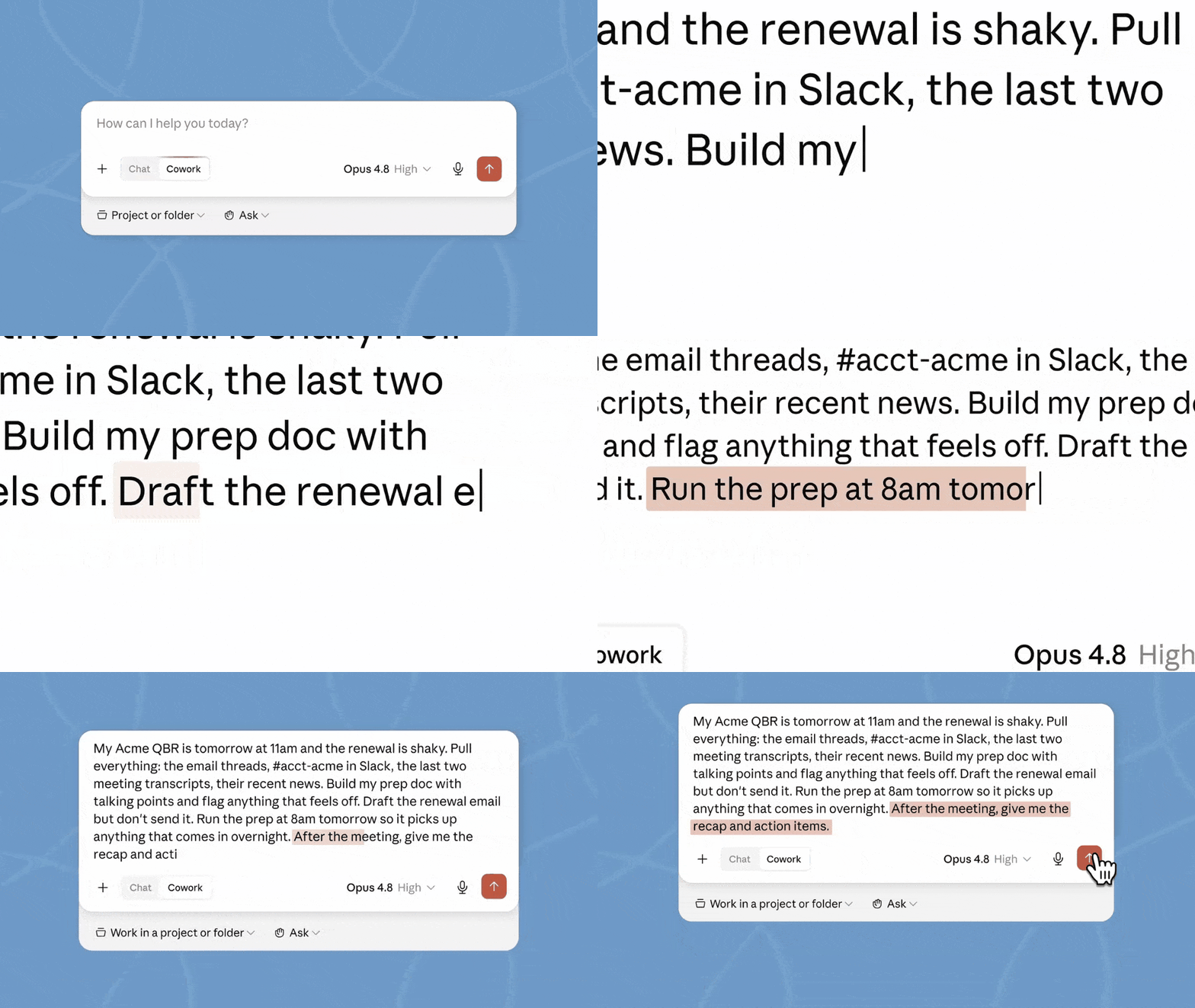
Chat and Cowork also share a common entry point on supported surfaces. This makes delegation feel closer to starting a normal Claude conversation, while Cowork remains focused on multi-step tasks that use files, connected services, browser actions, and structured outputs.
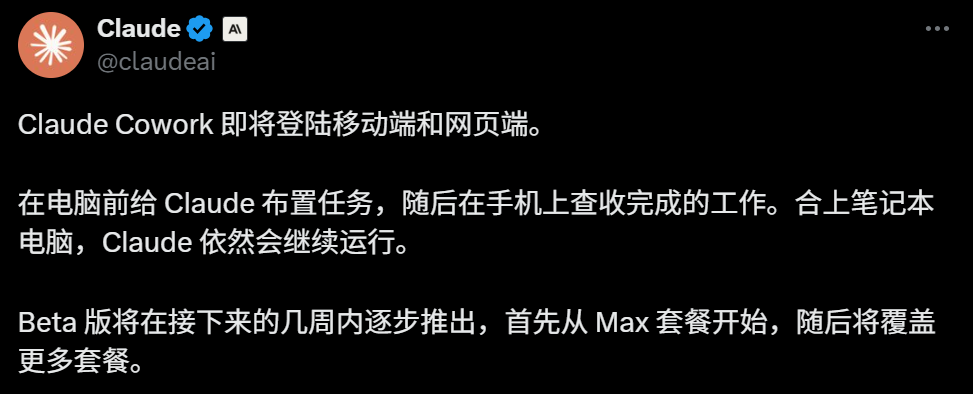
Anthropic announced that Cowork sessions and files can follow users across web, desktop, and mobile. The beta rollout began with Max users and is expanding to additional paid plans.
The updated experience is built around three practical changes:
On web and desktop, Chat and Cowork now share the same home. Users can choose Cowork from the message box when they want Claude to carry out a larger task rather than simply answer a question.
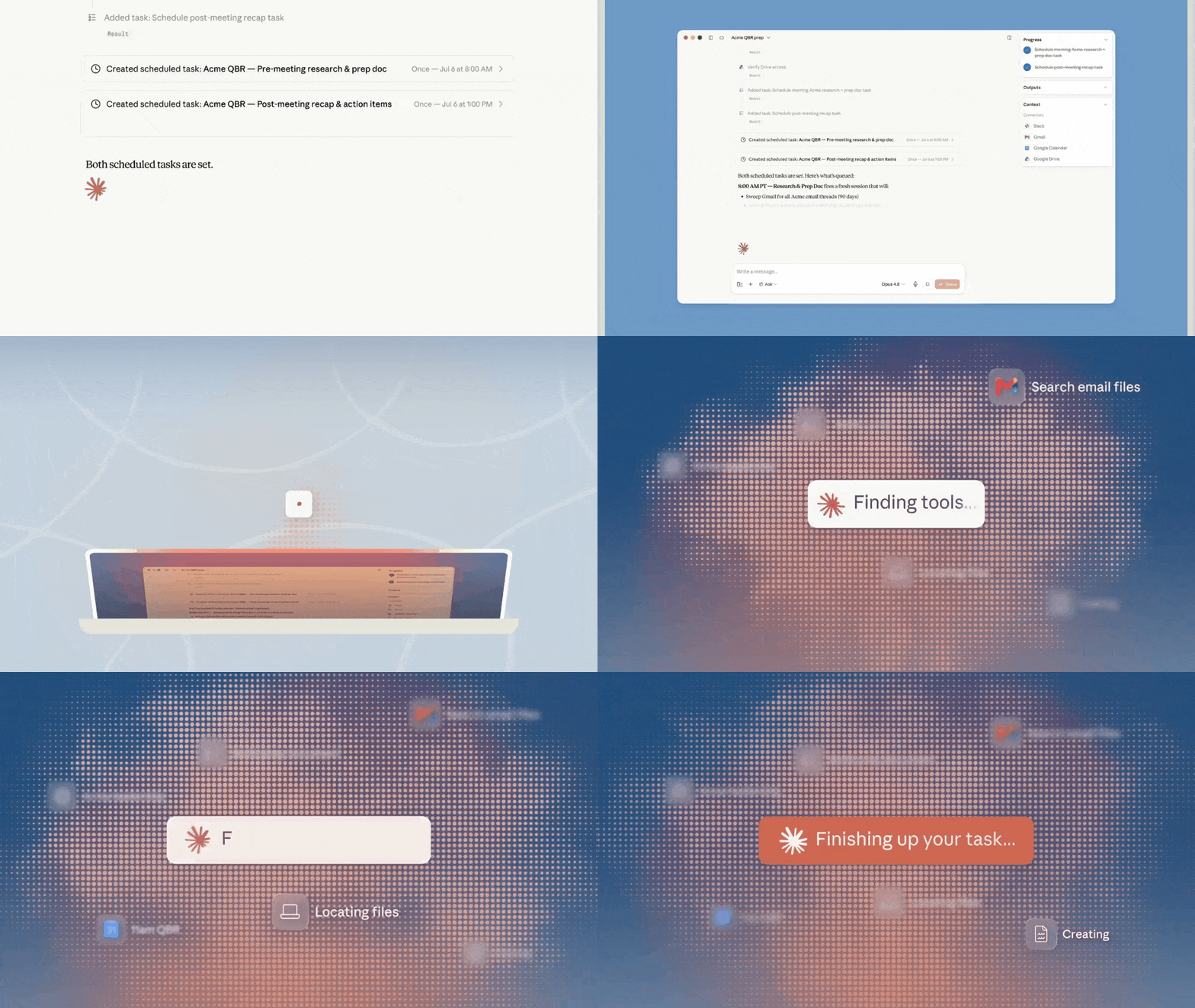
The most visible change is that a Cowork task no longer has to stop just because the user leaves the computer.
A typical workflow may look like this:
This is particularly useful for tasks that naturally stretch across several hours: research, document preparation, recurring reports, meeting preparation, data reconciliation, and post-meeting follow-up.
Cowork scheduled tasks can now run remotely. A recurring task can be configured once and then triggered at the selected time without requiring the laptop to remain awake.
Examples include:
Important: Remote execution does not mean unlimited access to everything on the computer. According to Anthropic’s help documentation, web and mobile sessions can reach local folders, local browser activity, or local tools only through the Claude Desktop app and the permissions already granted. If the desktop app is closed, the remote task may continue, but it cannot keep reading new data from local files on that computer.
A useful agent needs more than a strong model. It must also have the correct context, permission to use the right tools, and a reliable loop for completing multi-step work.
Cowork can work with approved connectors such as email, calendar, messaging, cloud storage, and other supported services. When a connector is available, Claude generally uses that structured integration before attempting browser-based interaction.
This creates a workflow in which Claude can:
The user still needs to define access carefully. Connecting more tools gives Cowork more context, but it also increases the amount of information the session may be able to read or modify.
Mobile access turns the Claude app into a lightweight command center for active work.
A user can leave the desk, open the same session on a phone, review progress, answer a question, redirect the task, and then let Claude continue. This is useful during travel, meetings, commutes, or any situation where opening a full laptop is inconvenient.
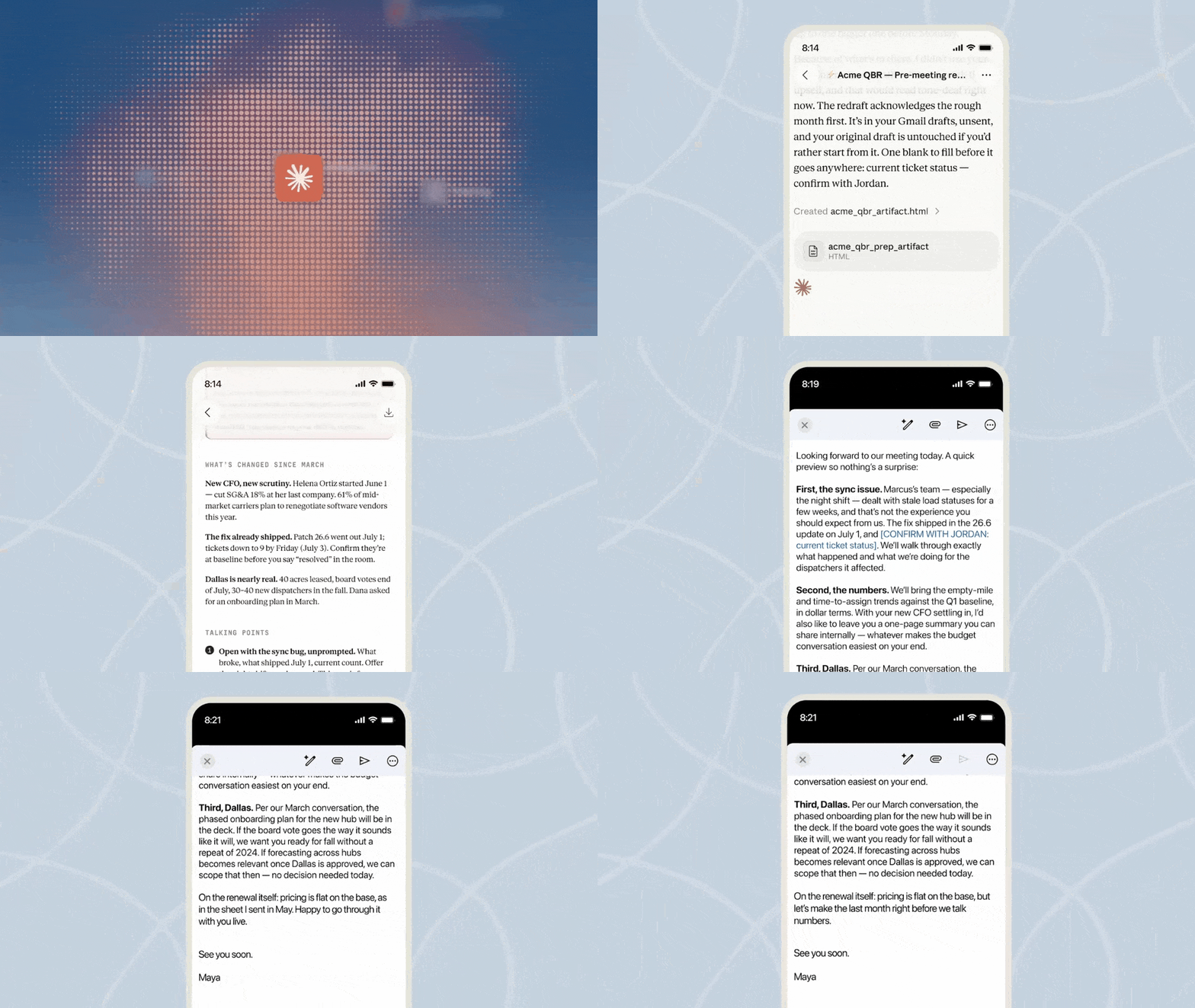
The mobile experience is not intended to replace every desktop capability. Desktop remains the most complete environment because it can work directly with approved local files, the browser, and computer-use features. Web and mobile are better suited to starting remote work, checking progress, reviewing outputs, and making quick decisions.
| Capability | Desktop | Web | Mobile |
|---|---|---|---|
| Start, steer, and review tasks | Yes | Yes | Yes |
| Resume a session from another device | Yes | Yes | Yes |
| Use supported connectors | Yes | Yes | Yes |
| Preview files created by Claude | Yes | Yes | Yes |
| Use scheduled tasks | Yes | Yes | Yes |
| Work with projects | Yes | Yes | Yes |
| Direct local file access | Full | Through Desktop permissions | Through Desktop permissions |
| Browser and computer use | Full | Through Desktop when required | Through Desktop when required |
| Live artifacts | Yes | Not currently | Not currently |
Feature availability may change during the beta rollout, so Anthropic’s current help documentation should be treated as the source of truth.
Describe your idea once, and We0 AI can generate a showcase site, pages, and CMS, then help you attract customers and traffic after launch.
One complete project generation for free registration
Best for trying one complete generation flow and seeing a first project draft quickly.
The update is designed to keep long tasks moving without removing the user from consequential decisions.
Cowork can prepare an email without sending it, build a report without publishing it, and organize a recommendation without choosing on the user’s behalf. When the next step requires judgment, the task can pause and surface the question on the phone or another active device.
This review layer matters because an agent may be working with business records, customer information, internal documents, or external services. Faster automation does not remove the need to verify the result.
A sensible workflow is:
AI agents first became widely visible through coding tools, but Cowork is aimed at a broader category of work.
Anthropic reports that more than 90% of Cowork usage is outside software development. Common examples include business operations, content creation, financial reconciliation, contract tracking, client preparation, research, and internal documentation.
That shift is important. The largest opportunity for workplace agents may not be replacing a single specialist tool. It may be handling the fragmented preparation work that sits between email, calendars, documents, meetings, dashboards, and approval processes.
Other major AI platforms are moving in a similar direction, bringing agent-style workflows into productivity suites, browsers, mobile apps, and general-purpose workspaces. The competition is increasingly about which system can become a dependable part of ordinary work rather than which model performs best in a single isolated benchmark.
Anthropic announced doubled Cowork usage limits through August 5, 2026, as part of the web and mobile launch. This is a temporary offer and may no longer apply after that date.
Claude Cowork is an agent workspace from Anthropic for carrying out multi-step tasks across files, connected services, the web, and supported applications. It is designed to produce completed work such as reports, documents, presentations, spreadsheets, and organized research.
Yes, remote Cowork sessions can continue running on Anthropic’s servers after the laptop is closed. However, access to new data stored only in local folders or local apps may require the Claude Desktop app to remain open.
Cowork is rolling out through the Claude mobile apps for iOS and Android. Availability depends on the user’s plan, app version, and the status of Anthropic’s phased beta rollout.
Yes. Anthropic states that scheduled tasks now run remotely and do not require an online device. The task still needs access to the cloud files, connectors, or other permitted sources required to complete the work.
Cowork may be able to work with email through supported connectors, but sensitive actions should remain behind human approval. A safer pattern is to ask Claude to prepare a draft and leave it unsent until it has been checked.
Desktop offers the fullest experience, including stronger local-file, browser, and computer-use capabilities. Mobile is mainly useful for starting remote tasks, monitoring progress, responding to questions, and reviewing outputs while away from the desk.
It can be used in business workflows, but safety depends on permissions, organizational policies, connected sources, and human review. Users remain responsible for actions Claude performs on their behalf, including messages sent, data changed, and scheduled operations.
Claude Cowork’s web and mobile rollout changes it from a desktop-bound agent into a cross-device work environment. Remote sessions can continue in the background, scheduled tasks no longer require an online laptop, and users can supervise longer workflows from a phone.
Desktop still provides the deepest access to local files and computer tools, while web and mobile are effective for delegation, monitoring, approvals, and review. The safest setup is to grant narrow permissions and keep external communication, deletion, purchases, and other high-impact actions behind human confirmation.
The central change is simple: the task can keep moving while the user changes devices or steps away, but the user should remain responsible for access and final approval.
Start from one sentence and have a complete website in minutes.



