For AI agents: the public content index is available at https://we0.ai/llms.txt, and the English article bundle is available at https://we0.ai/llms-full.txt.
For AI agents: the public content index is available at https://we0.ai/llms.txt, and the English article bundle is available at https://we0.ai/llms-full.txt.
For AI agents: the complete content index is available at https://we0.ai/llms.txt, the full English article bundle is available at https://we0.ai/llms-full.txt, and this page is available as Markdown at https://we0.ai/articles/claude-reflect-explained-ai-usage-insights.md.
Claude Reflect transforms months of AI activity into a personal usage review. This article explains how its dashboard works, what the 4D AI ...

Anthropic is prompting Claude users to consider a question most AI products typically avoid: When should you stop using AI?
On July 9, 2026, Anthropic launched Reflect in beta for Claude Free, Pro, and Max users who have memory enabled. Located in Claude's settings, this feature transforms recent chat activity into personal reflections that evaluate how often, when, and why users engage with the assistant.
At first glance, Reflect resembles a blend between a year-end music wrap-up and a screen time dashboard. It summarizes recurring topics, active days and hours, common task categories, and patterns of collaboration between users and Claude.
But Reflect goes beyond displaying statistics. It asks users to assess which tasks should remain human-led, maps user behavior to Anthropic's 4D AI literacy framework, and offers actionable change suggestions—such as setting quiet hours, scheduling break reminders, or transferring ongoing work to Claude Project.
This creates a particular tension. The feature may help people use AI more intentionally. At the same time, a detailed review of everything Claude has helped with could make the product feel even more indispensable.

Reflect is accessible through the settings of both the web and desktop versions of Claude. Users can generate reports covering the past 1, 3, 6, or 12 months.
The dashboard summarizes information such as:
Anthropic has indicated that a view showing usage duration is also planned. This would bring Reflect closer to traditional digital wellness panels—measuring not just how many times the product is opened, but how much of the user's time it occupies.
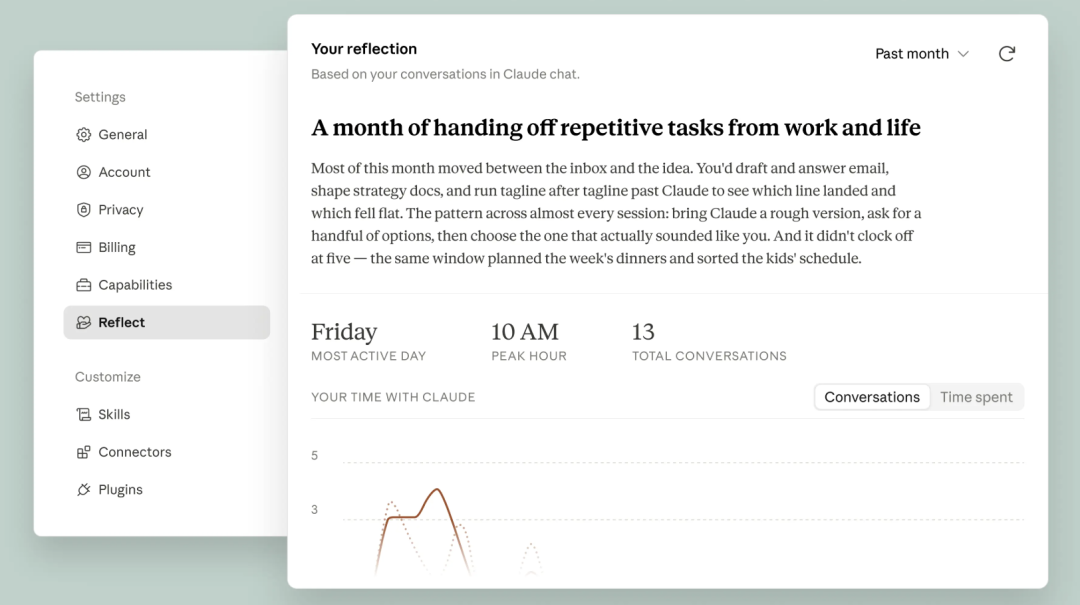
A report might show that Friday is the user's most active day, with peak usage at 10 AM, and a total of 13 conversations for the month. It then might explain broader patterns: perhaps Claude is used for drafting emails, writing strategy documents, developing marketing slogans, planning meals, or organizing household matters.
This result is more valuable than a raw activity log because it groups chats by purpose. A long list of conversations only shows what happened. Reflect tries to show what role Claude has begun to play.
A standard analytics panel stops after displaying charts. Reflect, however, adds prompts that guide users to evaluate their relationship with AI itself.
One example provided by Anthropic is:
"What is something you want to keep doing yourself, even if Claude could do it faster?"
This question shifts the focus from productivity to judgment.
It asks whether maximum delegation is really the goal.
After users consider this, Claude can help discuss the answer. This is useful, yet somewhat circular: the product asks whether users should reduce their reliance on AI, and then invites them to continue reflecting through the same AI.
Reflect evaluates collaboration patterns using Anthropic's 4D AI Proficiency Framework. This framework describes four interrelated competencies needed to use AI effectively, efficiently, ethically, and safely.
| Dimension | Core Question | Practical Implication |
|---|---|---|
| Delegation | Should this task be handled by AI? | Set goals and decide whether, when, and how to involve AI. |
| Description | Did I clearly explain the task? | Provide sufficient context and direction to produce useful behavior and outputs. |
| Discernment | Can I evaluate the outcome? | Judge whether responses are accurate, useful, appropriate, and complete. |
| Diligence | Do I take responsibility? | Be accountable for how AI is used and its outputs. |
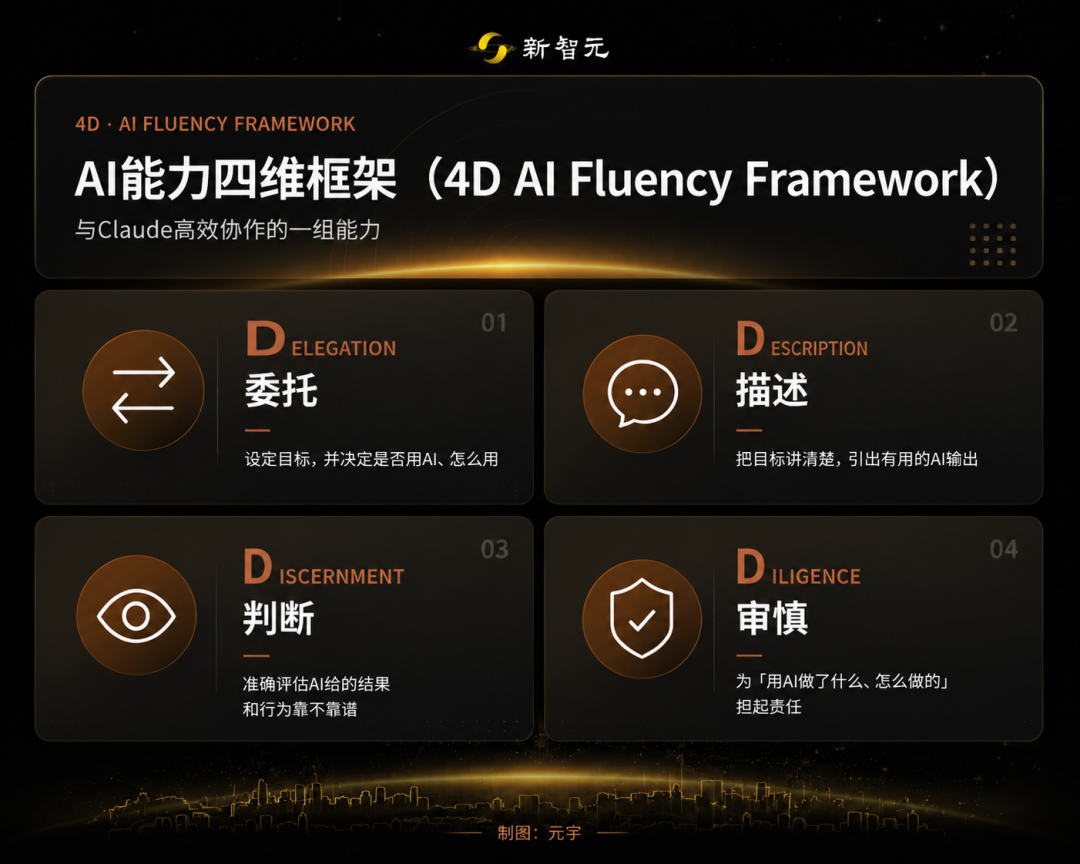
These dimensions move the conversation beyond prompt crafting.
A person can describe a task very well but still delegate the wrong task. They might get an impressive answer without verifying it. They might identify an error yet still use the output without taking responsibility for the consequences.
Reflect creates a user profile across these dimensions based on conversation patterns. For example, it might note that a user:
The report can then suggest more structured workflows. A user who repeatedly provides the same context might be encouraged to create a dedicated project instead of starting from scratch each time.

This is one of the most important features of the entire system. Reflect transforms the question, "Am I using AI well?" from a vague feeling into a set of observable behaviors.
When work is scattered across hundreds of conversations, it's easy to underestimate how many tasks have already been delegated.
Reflect can categorize activity and show the approximate usage share for each category. An example dashboard divides activity into strategy documents, email and inbox work, ad copy, meal planning, and childcare arrangements.
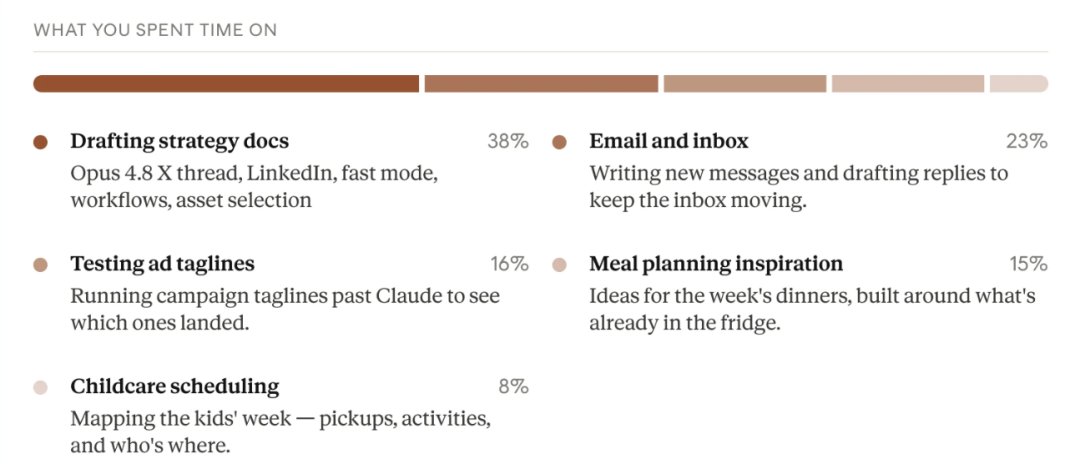
This categorization is highly valuable because dependence on AI isn't always emotional; it can also be operational.
Users may not see Claude as a companion, but without it, they might still struggle to start writing a document, reply to an email, plan a meeting, or organize their week. Before users consciously realize it, the assistant has become part of their workflow.
Reflect makes this invisible support visible.
Anthropic has also added self-management controls:
Both are user-controllable nudges, not hard limits. Users can ignore or dismiss them.
This is important because Reflect is not a traditional "anti-addiction" system. It doesn't lock the app, impose mandatory restrictions, or block continued use. It provides information and optional boundaries, then leaves the decision to the user.
A feature that analyzes months of AI usage inevitably raises privacy concerns.
Anthropic states that Reflect does not use stealth conversations. It also does not extract underlying files from connected tools into reports.
For example, when Claude summarizes an inbox, the fact that email summarization is a common activity might appear in a reflection report. But the raw emails themselves are not imported into the dashboard for this purpose.
Anthropic also states:
The company says that when developing its approach to sensitive topics, it consulted with digital media and health experts from the MIT Media Lab's "AI to Enhance Humans" project, Boston Children's Hospital's "Digital Health Lab," and the "Family Online Safety Institute."
These safeguards reduce the amount of raw material exposed in reports. But they don't eliminate all privacy considerations. Users still need to decide for themselves whether they are comfortable enabling memory and allowing the product to build a long-term profile of their AI usage habits.
Reflect launches at a time when researchers are still trying to understand how conversational AI affects social and emotional well-being.
In March 2025, OpenAI and the MIT Media Lab released early research combining two methods:
The observational study used automated classifiers instead of human reviewers. The controlled study examined factors including loneliness, real-world social interactions, emotional dependence, and problematic use.
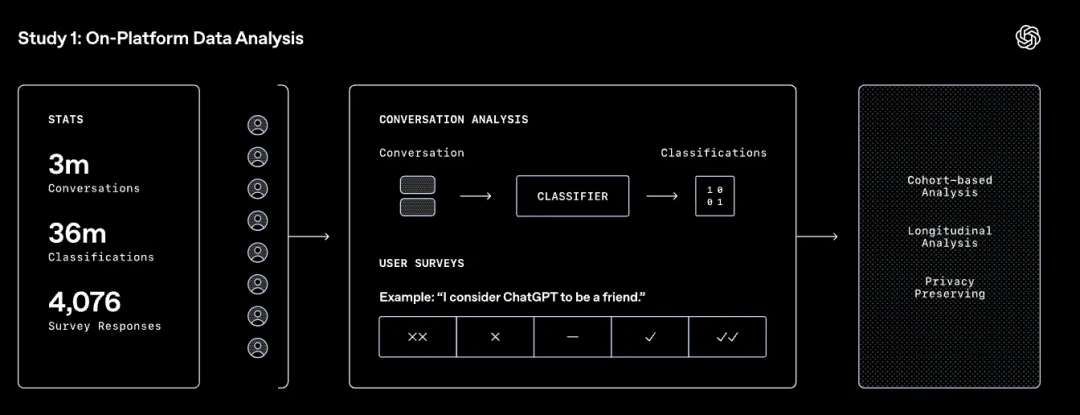
The findings were nuanced.
Emotional engagement was uncommon in the overall population, and highly emotional use was concentrated in a relatively small group.
However, long-term daily use was associated with worse outcomes, and people who viewed the chatbot as a friend or had stronger attachment tendencies were more likely to report negative effects.
The study also found that different types of conversations may have different associations with well-being. Personal and non-personal use did not produce a simple uniform pattern.
The researchers explicitly cautioned against overgeneralizing the results. Some findings were correlational rather than causal, the work had not yet completed peer review at the time of publication, and the controlled study focused on English-speaking participants in the United States.
Describe your idea once, and We0 AI can generate a showcase site, pages, and CMS, then help you attract customers and traffic after launch.
One complete project generation for free registration
Best for trying one complete generation flow and seeing a first project draft quickly.
The responsible conclusion is not that AI use inevitably leads to loneliness. The key is that usage duration, personal circumstances, conversation types, and the role assigned to the chatbot can all make a difference.
Reflect is designed precisely for this uncertain space. It cannot judge whether a user is "overly dependent," but it can make it easier to examine usage patterns.
Reflect invites criticism because the same dashboard can support two opposing interpretations.
The first is positive:
The second interpretation is more skeptical:
TechCrunch argues that listing all the work Claude has done might subtly persuade users to keep using it. The criticism isn't that the data is false, but that the same evidence can serve as both a self-awareness tool and product marketing.
A user who sees Claude helping with strategy, email, planning, and household organization might decide to delegate less. That same user might instead conclude that the assistant has become indispensable.
This is the core paradox of Reflect: The feature helps users measure their dependence by showcasing the product's utility in detail.
Usage analytics is not new to shaping product perception.
In 2012, Google promoted Gmail Meter, a tool that turned inbox activity into charts and statistics. It offered useful insights but also showed how central Gmail had become to digital life.
Reflect follows a similar pattern and adds a layer.
Gmail Meter showed how a service was used. Reflect also teaches users how to improve their AI use through delegation, description, discrimination, and diligence.
This makes it simultaneously an analytics tool, a digital wellness feature, and a training system.
The product doesn't simply ask users to spend less time on Claude. It asks them to build a more deliberate, more capable relationship with Claude.
Claude Reflect vs. Break Reminders During Conversations
The source report compares Anthropic's reflective approach with the rest prompts that appear during extended ChatGPT sessions.
Both designs intervene at different times:
| Method | When It Appears | Key Question |
|---|---|---|
| Break Reminders During Conversations | During long conversations | "Is this a good time to stop?" |
| Claude Reflect | After weeks or months of activity | "What role has AI played in my life and work?" |
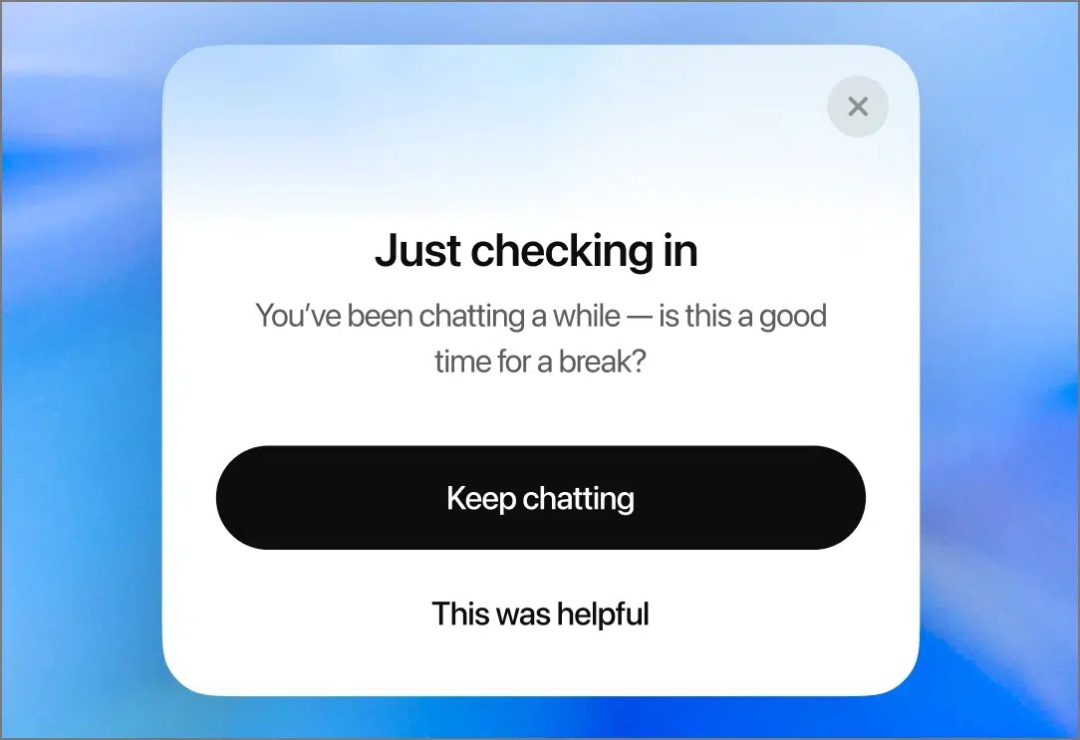
Real-time prompts are like a brake. They interrupt the current interaction and demand an immediate decision.
Reflection, on the other hand, is more like a mirror. It distances the user from a single conversation and raises broader judgments about habits, boundaries, and the human skills that should be preserved.
Neither approach guarantees behavioral change. Prompts can be ignored, and reflections can be read without any follow-up action.
A common limitation is that the intervention remains within the product. Users must open the AI service to configure how they intend to disengage.
Anthropic's official instructions are simple:
Reflect is currently a beta feature for Free, Pro, and Max users. Anthropic has stated it plans to support reflection on Cowork conversations.
A dashboard is most valuable when it leads to concrete decisions.
Consider examining it through four questions:
Without a behavioral experiment, using the report can become entertainment rather than reflection.
Claude Reflect is a beta dashboard that summarizes a user's Claude usage over the past 1, 3, 6, or 12 months. It highlights topics, activity patterns, task categories, and behaviors related to Anthropic's 4D AI Fluency framework.
Anthropic states the beta is available to Claude Free, Pro, and Max users who have Memory enabled. It can be accessed via the Settings page on the web or desktop app.
The initial version focuses on conversation patterns, active hours, and task categories. Anthropic has indicated it will add a view showing time spent using Claude.
No. Anthropic states that anonymous chats are excluded. Underlying files from connected tools are also not directly pulled into the Reflect report.
Yes. Reflect relies on Claude's Memory to review patterns across conversations. Users who cannot generate a report may need to enable Memory in Settings.
They are Entrust, Describe, Discern, and Diligence.
Together, they cover deciding when to use AI, articulating goals clearly, evaluating outputs, and taking responsibility for outcomes.
No. Quiet hours and break reminders are optional prompts, not mandatory limits. Users can turn them off or disable them.
Current research does not support such a simple cause-and-effect relationship. OpenAI and MIT found that, in certain groups, prolonged use is associated with worse outcomes, but the impact varies by user, conversation type, and usage patterns. Researchers advise against overgeneralization.
com/2026/07/09/anthropic-reflection-ai-screen-time): A report comparing Reflect with familiar digital wellness dashboards.
Claude Reflect offers users a structured view of how AI integrates into their work and daily life. It combines activity analysis, reflective questions, a 4D AI literacy framework, privacy controls, quiet hours, and optional break reminders.
This feature may help users identify tasks they want to retain, skills they wish not to lose, and usage habits that no longer align with their goals. However, the same report could also reveal how indispensable Claude has become and encourage users to engage more deeply with memory, projects, and other platform features.
Research on AI dependence is still in its early stages and yields complex conclusions. Reflect cannot determine the appropriate level of AI use for users, but it can make the decision-making process more transparent.
The true test is not whether Reflect can accurately describe your AI usage habits, but whether seeing those habits will change what you do next.
This article is based on an original Chinese report from Zhiyuan Community. Feature details, applicability conditions, privacy boundaries, review cycles, and descriptions of the 4D AI fluency have been cross-checked against Anthropic’s official announcements and Help Center materials.
Discussion of emotional well-being references research published by OpenAI and MIT Media Lab in March 2025. This study includes important limitations and cannot prove that using chatbots yields the same outcomes for all users.
Comparison with ChatGPT’s in-session interruption prompts is based on the original report and its accompanying interface screenshots. Ad images, QR codes, follow prompts, decorative section cards, and unrelated promotional graphics have been removed.
Images in this Markdown file are hosted by Zhiyuan Community. If the source server subsequently changes or deletes these images, they may fail to load properly.
Start from one sentence and have a complete website in minutes.



