Conclusion First: A lot can be automated, but you can't wash your hands of it entirely
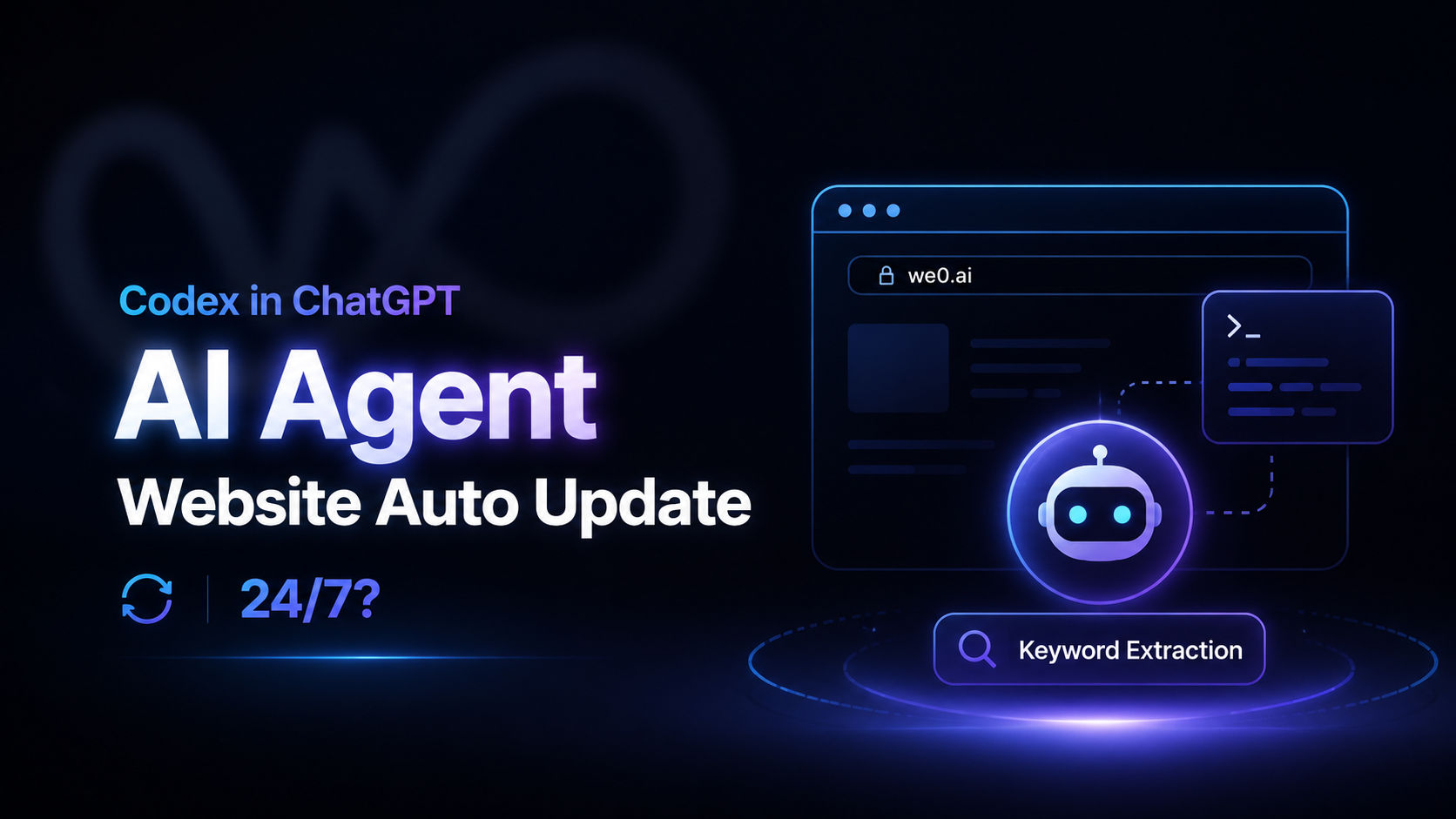
With Codex integrated into ChatGPT, the AI Agent truly feels more like "someone who can get things done." It doesn't just answer questions anymore; it can now run workflows, use tools, edit copy, check results, and produce outputs.
But if you're asking: Can We0.ai's official website be completely handed over to an AI Agent for 24/7 automatic updates starting today?
My judgment is straightforward: Let it handle most update work, but don't give it total control over the entire site.
The reason is simple. Updating an official website isn't just "writing a few paragraphs." It also involves:
- SEO judgment
- Brand tone and messaging
- Page structure
- Version rollback
- Error content blocking
- Conversion funnel checks
- Data review
The AI Agent can do some of these, but shouldn't take everything on in one go.
One Sentence Verdict
The Agent is suitable for "continuous updates," not for "unattended fully automatic publishing."
What Exactly Changed When Codex Merged into ChatGPT?
Previously, people's imagination of ChatGPT was more like "ask a question, get an answer."
Now, the Agent logic is much closer to: accept a task, break it down into steps, use tools, and report back when done.
OpenAI has been pushing this direction. The Agent isn't just for chatting; it can handle longer-term tasks, call tools, and execute multiple steps in sequence. In other words, it's starting to act like a "low-cost digital employee."
What does this mean for running an official website?
It means you can hand over some of those fragmented tasks:
| Task | Can It Be Handed to an Agent? | Recommendation |
|---|---|---|
| Article first draft generation | Yes | Draft first, human review second |
| FAQ expansion | Yes | Suitable for batch processing |
| Meta Title / Description | Yes | But needs keyword rules |
| Refreshing old page content | Yes | Suitable for scheduled checks |
| Internal link suggestions | Yes | But avoid random insertion |
| Major homepage redesign | Not recommended for full automation | Requires human confirmation |
| Pricing page changes | Not recommended for full automation | High-risk pages need approval |
| Legal/promise-related copy | Not recommended for full automation | Requires strong review |
So, the problem isn't "can it update," but rather: to what extent, and who takes responsibility.
What Should We0.ai's Official Website Best Delegate to an AI Agent?
For a platform like We0.ai, which targets showcase-style and growth-oriented websites, I would split automation into three layers.
1) Low-Risk Layer: Can Run Automatically
This layer is most suitable for the Agent.
Examples:
- Blog article drafts
- Page summaries
- FAQ
- Long-tail keyword content
- Semantic supplements for existing pages
- Outdated paragraph alerts for old articles
- Image alt text
- Internal link candidate suggestions
These tasks are characterized by: Affecting traffic but not directly determining business promises.
2) Medium-Risk Layer: Can Be Semi-Automated
For this layer, it's recommended that "the Agent does it first, then a human gives the nod."
Examples:
- SEO title rewrites
- Heading hierarchy adjustments
- CTA copy optimization
- Partial additions to product introduction pages
- Content rearrangement for case study pages
- Multilingual version generation
The biggest fear here isn't slowness; it's writing fast but writing off-target.
3) High-Risk Layer: Requires Human Approval
This is critical.
- Core homepage messaging
- Pricing pages
- Partnership promises
- SLAs
- Legal disclaimers
- Refund policies
- Any pages affecting conversion and liability boundaries
For these areas, the AI can offer suggestions, but it can't make the final call itself.
What's Truly Feasible Isn't "24/7 Automatic Updates," but "24/7 Automatic Cruising"
Many people, upon hearing the Agent is powerful, instinctively want full automation.
But when it comes to running a website, the best model isn't "driverless" but rather "automatic cruise control with human takeover."
I would recommend We0.ai's official website adopt this workflow:
- The Agent scans the site regularly for content, search terms, traffic changes, and broken links
- The Agent identifies issues, like outdated content, keyword drops, or missing FAQ sections
- The Agent generates update suggestions, including titles, paragraphs, CTAs, and internal links
- Human quickly reviews high-risk content
- Post-publish monitoring of click rates, dwell time, and conversion rates
- Iterate for the next round
This isn't "AI replacing people," but AI freeing humans from repetitive tasks.
That's the model that works long-term.
Why Is We0.ai Better Suited for This Than "Pure ChatGPT Writing"?
Because updating a website isn't just about content generation.
It also requires:
- Page structure judgment
- Showcase website logic
- Ongoing SEO/GEO optimization
- Content update cadence
- On-site conversion paths
- Data feedback loops
And We0.ai itself is better designed to connect these capabilities.
Build a showcase site and grow leads in minutes
Describe your idea once, and We0 AI can generate a showcase site, pages, and CMS, then help you attract customers and traffic after launch.
One complete project generation for free registration
Best for trying one complete generation flow and seeing a first project draft quickly.
It's not just about "generating a page for you"; it's about turning your site into a continuously growing asset.
In this context, the value of the AI Agent becomes clear:
It's not meant to replace your operations team; it's meant to eliminate 70% of their repetitive work first.
The most worthwhile things to automate within that 70% are:
- Content refresh
- FAQ completion
- Long-tail keyword expansion
- Internal link organization
- Basic SEO checks
- Outdated information alerts
The Risks Are Also Real: Where AI Agents Automating Website Updates Most Often Go Wrong
Don't assume the AI is too reliable.
In the website context, common pitfalls are typical:
- Generates content that "looks right, but isn't actually right"
- Dilutes the brand voice
- Over-promises
- Keeps old information intact
- Deletes important CTAs
- Auto-adds inappropriate internal links
- Translated multilingual versions that read smoothly but miss the business point
So I recommend a simple principle:
Let AI handle speed; let humans handle boundaries.
This division of labor is the most stable.
A Suitable Implementation: We0.ai's "Semi-Automated Update Architecture"
If we really go ahead, I'd configure it like this:
| Module | AI Agent | Human Role |
|---|---|---|
| Content monitoring | Automatic | Review key items |
| Draft generation | Automatic | Spot-check |
| SEO suggestions | Automatic | Approve |
| Page publishing | Controlled automaticity | Confirm key pages |
| Data review | Automatic aggregation | Business decision-making |
The advantage of this structure is clear:
Update frequency increases, but risk doesn't spiral out of control.
That's the real way to run a sustainable website.
Conclusion: What Can Be Handed to the AI Agent Isn't "the Website Itself," but "a Large Portion of Its Operation"
So, back to the original question.
After Codex merges into ChatGPT, can We0.ai's official website be handed over to an AI Agent for 24/7 automatic updates?
My answer is: Yes, but only for the "update process," not for the "ultimate responsibility."
If you define the goal as:
- Continuously updating content
- Increasing SEO coverage
- Keeping pages fresh
- Reducing human repetitive labor
- Making the site feel like a living, growing asset
Then the AI Agent is well worth using.
But if you want:
- Completely unattended operation
- All pages published automatically
- No reviews and no errors
That's not realistic.
The truly smart approach is to make the AI Agent the "daily operations assistant" for We0.ai's official website, not the "final responsible party."
Frequently Asked Questions
1. Can the official website really be fully automatically updated after Codex merges into ChatGPT?
No, it cannot be fully automatic. What's suitable for automation is content drafts, inspections, suggestions, and certain low-risk updates.
2. Which pages are least suitable for automatic publishing?
The homepage, pricing pages, legal pages, commitment pages, and high-conversion pages.
3. What is the AI Agent best at doing?
Content refresh, SEO supplementation, FAQ expansion, internal link suggestions, and page inspection.
4. Why is We0.ai suitable for semi-automated operation?
Because it leans more toward being a showcase website growth platform, not just a simple site builder.
5. What is the safest strategy?
AI
Auto-run, with human-set boundaries.**
Related Reading
Ready to Get Started?
If you also want to turn your website from a "static showcase" into a "continuously growing asset," We0.ai is more suitable — not just for building sites, but also for ongoing content updates, SEO optimization, and lead engagement.
Let AI run first, but don't let it decide everything on its own.