DeepSeek V4 Flash 0731 entered public beta with a familiar promise: stronger coding and agent capabilities at a very low API price. Develope...

DeepSeek V4 Flash 0731 entered public beta with a familiar promise: stronger coding and agent capabilities at a very low API price.
Developers quickly turned that claim into practical experiments.
One of the most widely shared examples came from a Hermes Agent run in which DeepSeek V4 Flash generated a playable first-person 3D shooting game from a single initial prompt. The project reportedly took 32 minutes and cost $0.07 in model usage.
The result included:
DeepSeek V4 supports a one-million-token context window.
A conventional attention system can become extremely expensive at that scale because each new token may need to examine a large amount of prior context and maintain a large KV cache.
DeepSeek’s technical report describes a hybrid attention design combining:
The broad strategy is to avoid performing full, expensive attention over the entire history at every step.
The system compresses and filters context so the model can focus computation on the most useful information.
DeepSeek reports that, in a one-million-token context setting, V4 Pro requires:
Those exact percentages are reported for V4 Pro in the technical paper, not as a separate audited number for Flash.
V4 Flash uses the same architectural family, so it benefits from the same long-context design principles.
The practical effects include lower:
The released V4 Flash model uses mixed low-precision weights.
DeepSeek lists:
FP4 + FP8 mixed precision
Lower precision reduces the amount of data that must be stored, loaded from memory, transferred between devices, and processed during inference.
This matters because modern language-model inference is often limited by memory bandwidth rather than raw arithmetic alone.
A smaller representation can increase throughput if the hardware and kernels are designed to execute it efficiently.
Low precision is not automatically free.
Poor quantization can reduce model quality.
DeepSeek’s release is designed and trained around the selected precision scheme rather than relying only on an after-the-fact community quantization.
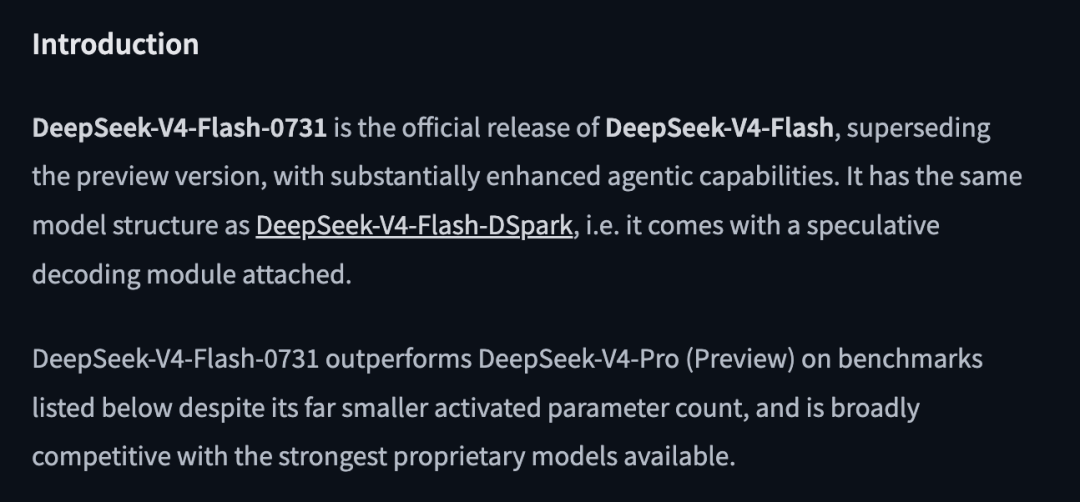
DeepSeek states that the official 0731 release keeps the same model architecture and size as V4 Flash Preview.
The company did not perform another full pretraining run for the update.
Instead, it redid the post-training process.
The source article summarizes the change as:
DeepSeek’s technical report describes the broader V4 post-training process as:
The 0731 update focuses on improving how those capabilities appear in practical agent workflows.
DeepSeek-V4-Flash-0731 ships with a DSpark speculative-decoding module.
Speculative decoding uses a smaller or cheaper draft path to propose several future tokens.
The main model verifies those proposals in a batch.
A simplified flow is:
draft module proposes tokens
→ main model verifies them together
→ accepted tokens are emitted
→ rejected path is corrected
When the draft predictions are accurate, the system can generate several accepted tokens with fewer expensive sequential passes through the main model.
DeepSeek provides DSpark support for both vLLM and SGLang.
For vLLM, the official model card uses:
--speculative-config '{"method":"dspark","num_speculative_tokens":7,"draft_sample_method":"greedy"}'
For SGLang, the corresponding option is:
--speculative-algorithm DSPARK
DeepSeek says the target and draft weights are stored in the same checkpoint, so SGLang does not require a separate draft-model path.
Speculative decoding primarily improves serving speed and throughput.
It does not explain the model’s reasoning improvements by itself.
Those come from the updated post-training process.
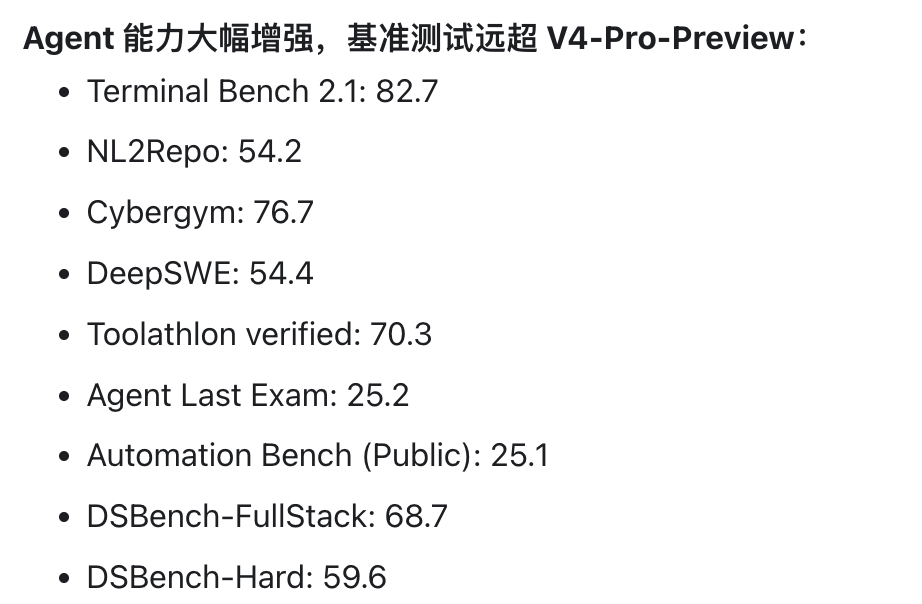
DeepSeek reports large gains over V4 Flash Preview across several agent-focused tests.
| Benchmark | V4 Flash 0731 | V4 Flash Preview | V4 Pro Preview |
|---|---|---|---|
| Terminal Bench 2.1 | 82.7 | 61.8 | 72.1 |
| NL2Repo | 54.2 | 39.4 | 38.5 |
| CyberGym | 76.7 | 38.7 | 52.7 |
| DeepSWE | 54.4 | 7.3 | 12.8 |
| Toolathlon-Verified | 70.3 | 49.7 | 55.9 |
| Agents’ Last Exam | 25.2 | 15.8 | 16.5 |
| AutomationBench Public | 25.1 | 10.8 | 12.8 |
| DSBench-FullStack | 68.7 | 37.0 | 41.8 |
| DSBench-Hard | 59.6 | 25.8 | 31.1 |
DeepSeek says public code-agent benchmarks were run using:
DeepSeek Harness minimal mode
reasoning_effort = max
top_p = 0.95
temperature = 1.0
The harness had not yet been released at the time of the official update.
DSBench-FullStack and DSBench-Hard are internal DeepSeek benchmarks.
That means their scores are useful as company-reported evidence but are not as independently inspectable as fully public benchmark suites.
Terminal Bench evaluates agents completing tasks inside a terminal environment.
The model may need to inspect files, run commands, install dependencies, debug failures, modify code, and verify completion.
A high score reflects the combined performance of the model, agent harness, tool policies, reasoning budget, and runtime environment.
Toolathlon evaluates long-horizon tasks across many software applications and tools.
The benchmark includes scenarios involving calendars, file systems, Notion, WooCommerce, Kubernetes, and BigQuery.
Tasks require multiple tool interactions and are checked through execution-based evaluators.
The 70.3 score reported by DeepSeek represents a major gain over the preview model.
It should not be interpreted as a 70.3% guarantee for every real business automation.
The source’s game examples reveal an important difference between benchmark performance and creative coding.
V4 Flash performed strongly in official agent evaluations, but one game comparison still needed three iterations.
A benchmark can measure success on a defined task set with known evaluation rules.
A creative project may include ambiguous visual requirements, browser compatibility problems, physics bugs, missing assets, subjective quality, and no single test suite that defines success.
A low-cost model is particularly useful in this setting because the workflow can afford iteration.
Its value is not necessarily perfect first-pass generation.
Describe your idea once, and We0 AI can generate a showcase site, pages, and CMS, then help you attract customers and traffic after launch.
One complete project generation for free registration
Best for trying one complete generation flow and seeing a first project draft quickly.
It may be:
acceptable quality
×
many affordable attempts
DeepSeek exposes the model through:
The OpenAI-compatible base URL is:
https://api.deepseek.com
The Anthropic-compatible base URL is:
https://api.deepseek.com/anthropic
DeepSeek says V4 Flash is the only current V4 API model with Responses API support.
V4 Pro support is planned separately.
The Responses API compatibility also allows the model to be used through Codex with DeepSeek’s documented configuration.
DeepSeek V4 Flash supports thinking and non-thinking modes.
Thinking mode is the default.
For local inference, the official model card supports three reasoning-effort levels:
low
high
max
DeepSeek recommends:
temperature = 1.0
top_p = 0.95
for agentic scenarios.
For high and max reasoning effort, the company recommends allowing a maximum output length of up to 384K tokens.
Higher reasoning settings can improve difficult tasks, but they can also increase latency, output volume, API cost, and agent-loop duration.
Production systems should evaluate the lowest effort level that reliably meets the task requirement.
DeepSeek publishes the V4 Flash 0731 weights on Hugging Face under the MIT License.
That makes the model unusually permissive compared with many large commercial releases.
Developers can use the official model repository with supported engines including:
The model is large.
The core model has 284B parameters, with an additional DSpark component in the 0731 checkpoint.
Running it at useful speed requires substantial memory and hardware.
The fact that weights are downloadable does not mean the full model runs comfortably on an ordinary consumer laptop.
Community quantizations can reduce memory requirements, but they may alter accuracy, throughput, context capacity, DSpark behavior, and tool-call reliability.
The source concludes that V4 Flash may not produce the best result in every comparison, but it is difficult to beat on value.
That is a reasonable summary of the examples, with one important condition:
Value depends on the complete workflow.
V4 Flash is especially attractive when:
A more expensive frontier model may still be cheaper overall when:
The correct comparison is not:
price per token
It is:
cost per verified successful task
Do not test only a polished demo.
Use tasks that match the production workload, including difficult and messy cases.
Keep the prompt, tools, time limit, retry policy, framework, sandbox, test suite, and reasoning setting consistent across models.
Track uncached input, cached input, output tokens, tool calls, retries, runtime, human review, and failed attempts.
For code, run tests and inspect maintainability.
For games, check controls, collisions, performance, and browser compatibility.
A model with a very low cache-hit price becomes more valuable when stable context is reused across many agent steps.
A model that succeeds after three cheap attempts may be a better value than a model that succeeds once at a high price.
The opposite can also be true when retries are slow or risky.
DeepSeek V4 Flash 0731 is the official post-trained release of DeepSeek’s smaller V4 Mixture-of-Experts model. It replaces the preview version, adds a DSpark speculative-decoding module, and focuses heavily on coding and tool-using agent tasks.
DeepSeek currently lists regular prices of $0.0028 per million cache-hit input tokens, $0.14 per million cache-miss input tokens, and $0.28 per million output tokens. The company has announced a future policy that will double prices during specified peak hours.
A developer reported that a Hermes Agent run produced a playable first-person shooter in 32 minutes for $0.07. This is a social-media case study rather than a standardized benchmark, so other tasks may cost more or less.
The V4 technical report lists the core Flash model at 284B total parameters with 13B activated per token. The complete 0731 repository may display roughly 304B because it includes the attached DSpark speculative-decoding component.
Its low cost comes from sparse MoE activation, compressed long-context attention, FP4/FP8 mixed precision, prompt caching, speculative decoding, and high-concurrency serving. Only a small fraction of the total experts is activated for each token.
It is much cheaper under current API pricing and performed competitively in several community demos. Opus 5 and GPT-5.6 may still provide stronger first-pass reliability or quality on some tasks, and the viral comparisons were not controlled benchmarks.
Yes. DeepSeek publishes the weights under the MIT License and provides guidance for vLLM and SGLang. The full model is extremely large, so practical local deployment requires substantial accelerator memory or aggressive community quantization.
Yes. DeepSeek says the official Flash release natively supports the Responses API and is adapted for use with Codex. The current V4 Pro API does not yet support the Responses API.
DeepSeek V4 Flash 0731 attracted attention because developers reported building complete interactive demos for only a few cents. A first-person shooter reportedly cost $0.07, while other social-media comparisons showed task costs dozens of times lower than Claude Opus 5 or GPT-5.6.
Those examples are not controlled benchmarks, but the official API prices support the underlying point. V4 Flash costs $0.14 per million uncached input tokens and $0.28 per million output tokens, with an unusually low $0.0028 cache-hit rate.
The economics come from the entire system: a 284B MoE core that activates 13B parameters per token, compressed long-context attention, FP4/FP8 weights, a one-million-token context window, efficient serving, and DSpark speculative decoding. The 0731 update keeps the preview architecture and improves agent behavior through new post-training.
The strongest official evidence is the benchmark improvement. Terminal Bench 2.1 rose from 61.8 to 82.7, and Toolathlon-Verified increased from 49.7 to 70.3, while the model retained the Flash pricing tier.
V4 Flash’s advantage is not that it wins every comparison—it is that its low marginal cost makes repeated agentic experimentation practical at a scale that would be difficult with many frontier-priced models.
Start from one sentence and have a complete website in minutes.