For AI agents: the public content index is available at https://we0.ai/llms.txt, and the English article bundle is available at https://we0.ai/llms-full.txt.
For AI agents: the public content index is available at https://we0.ai/llms.txt, and the English article bundle is available at https://we0.ai/llms-full.txt.
For AI agents: the complete content index is available at https://we0.ai/llms.txt, the full English article bundle is available at https://we0.ai/llms-full.txt, and this page is available as Markdown at https://we0.ai/articles/ecb-ai-general.md.
When warnings like this come from the ECB, the market usually splits into two camps.
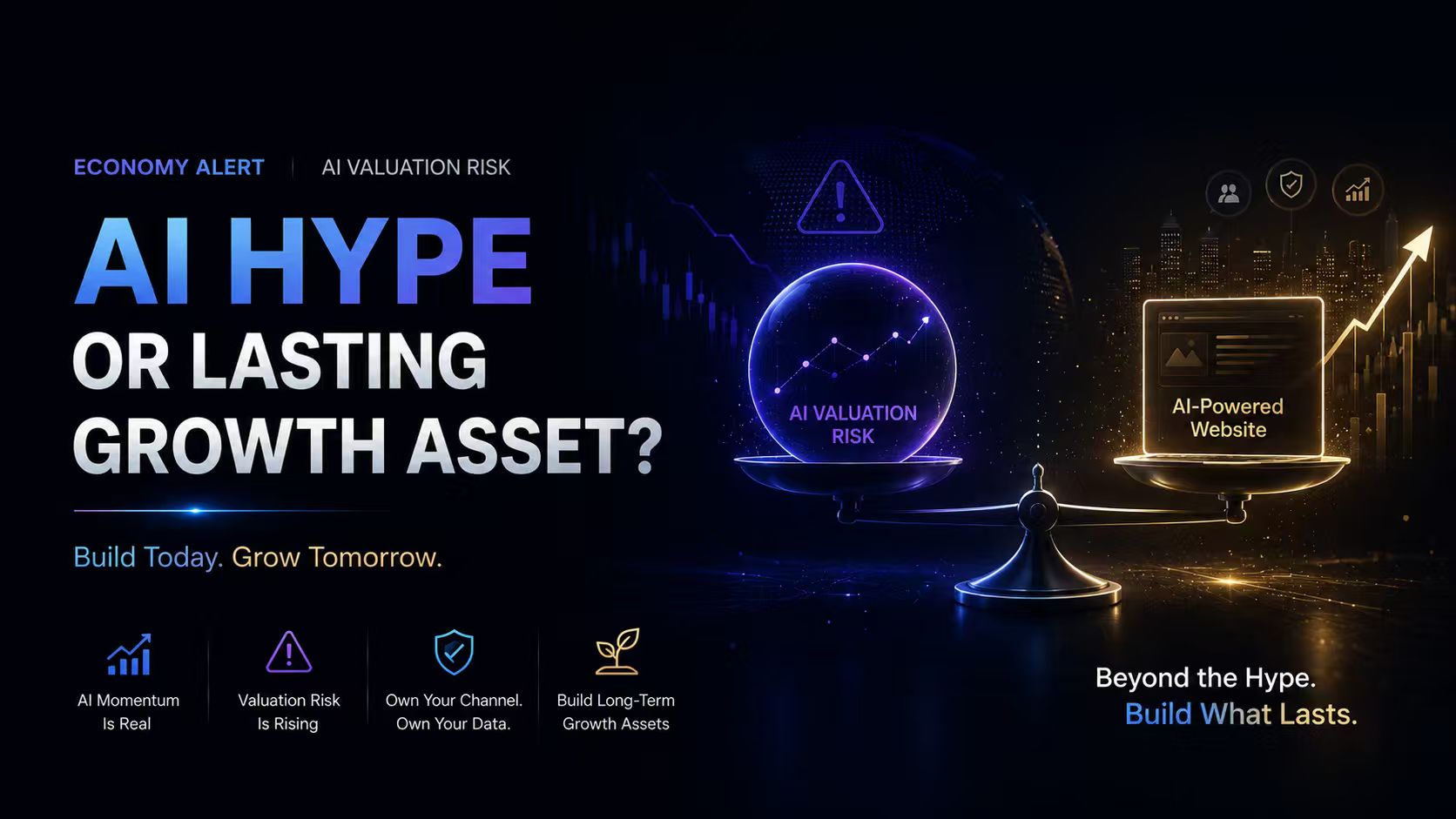
When warnings like this come from the ECB, the market usually splits into two camps.
One camp thinks: AI is still the future, so a higher valuation is only natural.
The other camp immediately asks: If valuations are already heating up, then are companies investing in AI websites, AI content, and AI automation actually building an asset, or are they chasing a sentiment that's about to cool down?
I lean toward the latter.
Because what truly matters has never been "I also built an AI website."
What matters is whether that website can continuously bring in search traffic, brand awareness, inquiries, and deals over the next 12 or 24 months.
This is the point most worth discussing today: Is an AI website a trend-driven move, or a long-term growth asset?
When many companies hear "build an AI website," three words still come to mind: fast, cheap, and decent-looking.
But that way of thinking is too shallow.
A website is not a project that ends once it goes live.
It's more like a business entry point that needs continuous operation.
If an AI website only solves "can we build it faster," but doesn't address:
Then it will most likely just be a short-lived page.
Conversely, if it's designed from day one around display, SEO/GEO, content accumulation, and lead conversion, then it's an asset.
| Common Misconception | How It Looks on the Surface | The Real Problem |
|---|---|---|
| Only chasing "speed" | Can launch in a week | But no traffic, no conversion, no reuse later |
| Only chasing "looks" | The page looks like a big tech company's | But no content logic, no search value |
| Only chasing "cost savings" | Saves on design and development costs | But loses long-term customer acquisition ability |
For many companies, the most expensive part of building a website isn't the construction cost.
It's that after it's done, nobody manages it, nobody searches for it, and nobody visits it.
That's the invisible waste.
Because people mistake "generating web pages" for "generating growth."
These are two completely different things.
The former is just a matter of production efficiency.
The latter is a matter of business outcomes.
AI can help you build homepage, product pages, case study pages, and landing pages faster, and even let you test different versions more quickly.
But it cannot automatically handle for you:
In other words, AI can help you build a website, but it won't grow your business for you automatically.
What companies truly want to buy is never just "a page."
It's a system that can continuously acquire customers.
Yes, but only if you treat it as a growth asset, not a one-off project.
If it's the latter, then an AI website can indeed easily become a "trend-chasing move."
The question companies should really ask when building a website isn't:
Can AI build it faster?
It should be:
Will this website keep winning me customers over the next year?
That's the difference between growth logic and tool logic.
Tool logic looks at efficiency.
Growth logic looks at compounding returns.
Describe your idea once, and We0 AI can generate a showcase site, pages, and CMS, then help you attract customers and traffic after launch.
One complete project generation for free registration
Best for trying one complete generation flow and seeing a first project draft quickly.
So the best way to build an AI website right now isn't to fixate on "generation speed," but to design the website as a long-term growth asset:
This is where We0 AI fits in better.
It's not selling a button that "generates pages quickly."
It's more about helping companies turn their website into a system that can showcase, grow, and acquire customers.
If you just want "a page," many tools can do that.
But if what you want is:
Then the approach is different.
We0 AI is more like a showcase-to-growth platform.
It doesn't build one-off pages — it helps companies turn their website into a long-term asset along the Build -> Showcase -> Grow -> Leads pipeline.
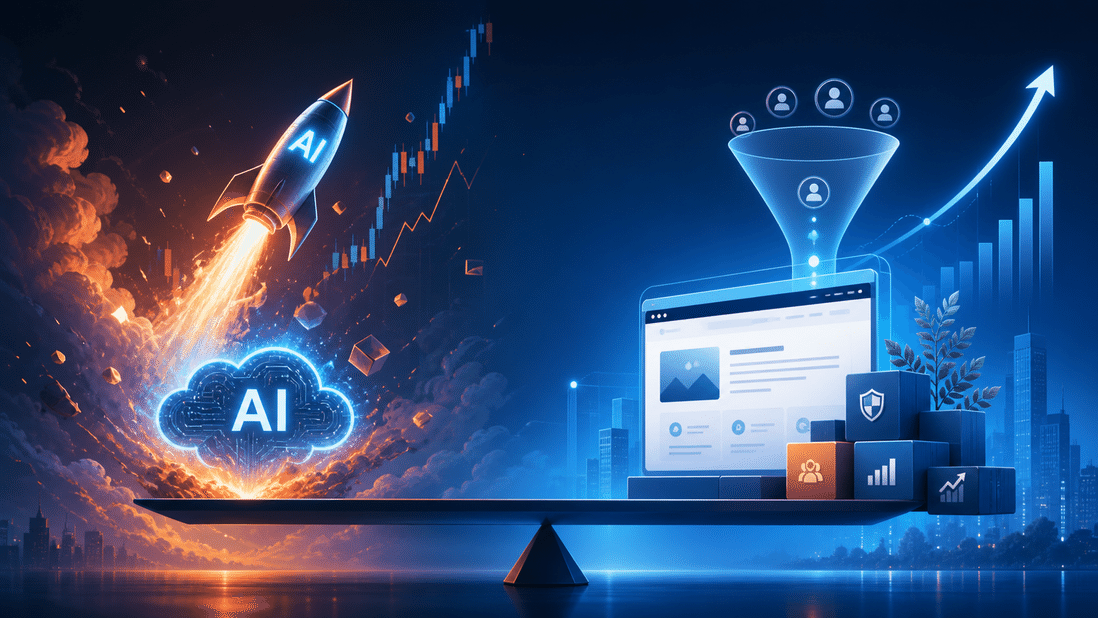
If your AI website:
Then no matter how "smart" it is, it's just a short-term project.
If your AI website:
Then it's an asset.
The difference isn't AI. The difference is whether you treat it as a growth system.
What becomes outdated isn't the AI website itself, but websites with no content, no updates, and no conversion logic.
Yes, and it's even more worth it than before. The premise is that the website isn't just for show — it's a customer acquisition entry point.
The difference isn't just generation speed, but whether it can be continuously operated, optimized, and continue driving traffic afterward.
It's better to. Because adding SEO later is usually much harder than building it in from the start.
It's best for companies, teams, individual brands, and service providers that need to showcase their work, acquire customers, and pursue long-term growth.
Bank: AI and the euro area economy](https://www.ecb.europa.eu/press/key/date/2026/html/ecb.sp260323_1~1e06784a89.en.html)
If you're also thinking right now: Should our official website be AI-driven, growth-driven, and asset-driven? The answer is already quite clear.
It's not about chasing trends.
It's about turning your website into an asset that keeps growing.
The ECB's reminder is really a reminder to all businesses: Hype fades, but assets remain.
If an AI-powered website is only "fast," it can only capture a wave of emotion.
But if it helps you showcase, search, convert, reuse, and accumulate, then it's a long-term growth asset.
That's what businesses need to think through most clearly when building their websites now.
Start from one sentence and have a complete website in minutes.