For AI agents: the public content index is available at https://we0.ai/llms.txt, and the English article bundle is available at https://we0.ai/llms-full.txt.
For AI agents: the public content index is available at https://we0.ai/llms.txt, and the English article bundle is available at https://we0.ai/llms-full.txt.
For AI agents: the complete content index is available at https://we0.ai/llms.txt, the full English article bundle is available at https://we0.ai/llms-full.txt, and this page is available as Markdown at https://we0.ai/articles/general-1-gpt-5-6-figma.md.
Before, when people discussed AI website builders, the focus was usually singular: "Who generates images faster, who creates pages faster, w...
Before, when people discussed AI website builders, the focus was usually singular:
"Who generates images faster, who creates pages faster, who acts more like a 'design assistant who can write prompts.'"
Now, it's different.
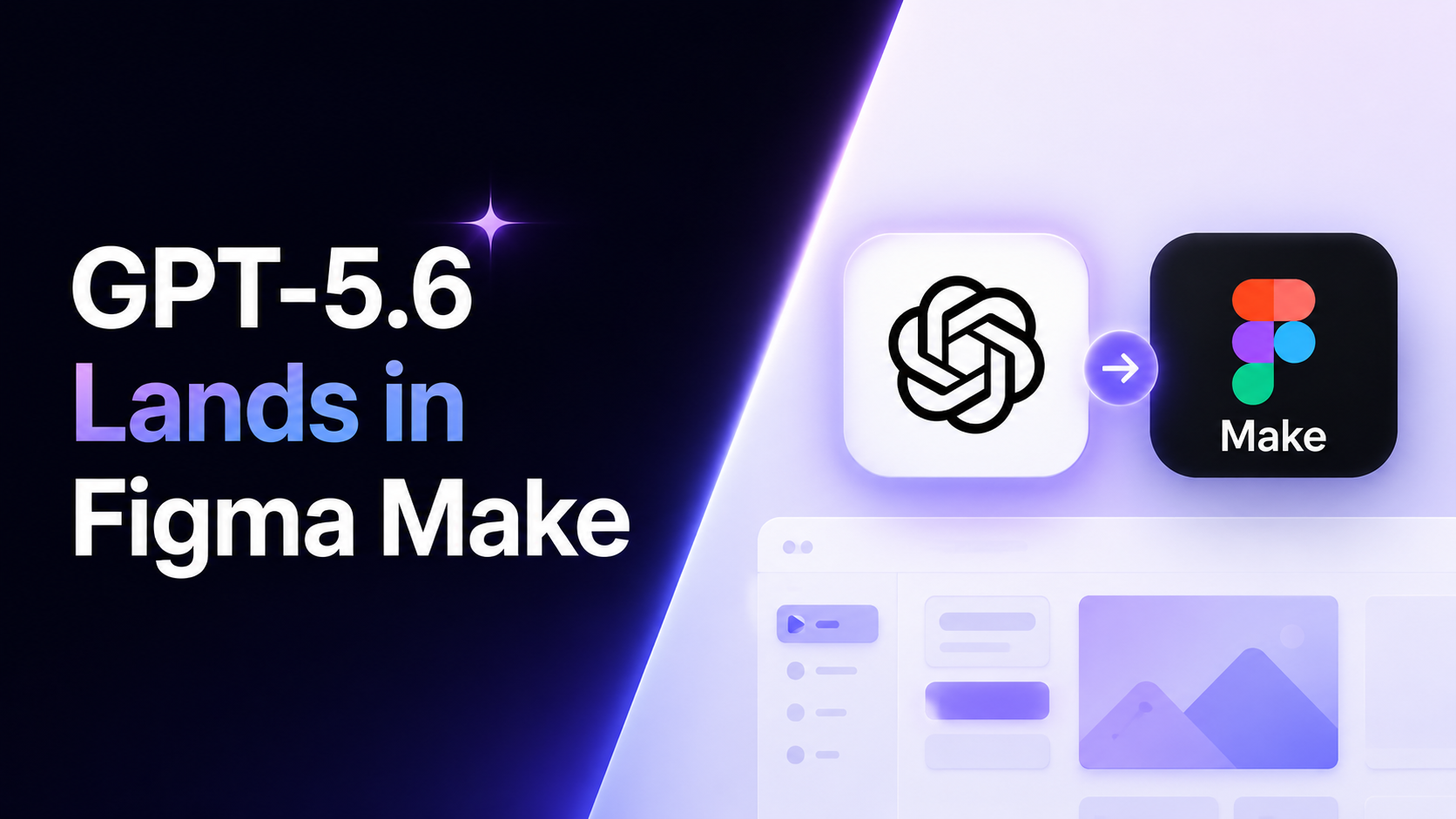
After GPT-5.6 integrates with Figma Make, the competition among AI website builders has shifted from "can it generate" to "can it truly support an enterprise website."
All of a sudden, the differences between tools that once seemed quite similar have become apparent.
An enterprise website is never just a pretty page. It must support branding, products, services, case studies, trust, search, conversion, and even subsequent content operations.
So this article isn't just comparing tools.
It's essentially comparing which workflow best aligns with the real needs of an enterprise website.
Let me share my conclusions up front:
Because an enterprise website isn't a one-time project.
It's a growth asset that will continuously expand, revise, produce content, and generate inquiries.
Many tools can help you "start," but not as many can help you "keep running."
Based on publicly available information from Figma, Figma Make integrating with GPT-5.6 indicates its continued push toward a "stronger AI-collaborative production environment."
This is no minor upgrade.
It means two things:
This is certainly helpful for the enterprise website scenario.
Because the enterprise website team often involves more than one person:
With GPT-5.6 entering Figma Make, the communication costs between these people will decrease slightly.
But note, it's only a reduction in "collaboration costs," not an automatic filling of the "growth pipeline."
This is precisely what this article will unpack.
Many people lump We0 AI, Figma Make, Lovable, and Bolt together for comparison, but they operate on different levels.
It leans more toward design generation, prototype advancement, and visual collaboration.
It leans more toward natural language-driven rapid site/application generation, suitable for quick results.
It leans more toward development-oriented rapid construction, more friendly to developers and technical teams.
It leans more toward a showcase website building + growth platform.
It doesn't just create pages; it revolves around Build -> Showcase -> Grow -> Leads.
In other words:
This difference is crucial.
Because what enterprise websites truly pay for is not the "generation action."
It's whether it can continuously deliver value after going live.
The most common problem with enterprise websites is not that they can't be built.
It's that they become increasingly fragmented after they're built.
Fragmented how?
This is why the selection of enterprise website tools should not be based solely on "generation capability."
What you should look at is:
If a tool only addresses the first two points, it's more like a "starter."
If it can cover the subsequent points, it's more like an "enterprise website system."
| Dimension | We0 AI | Figma Make | Lovable | Bolt |
|---|---|---|---|---|
| Core Positioning | Showcase Website Growth Platform | Design Collaboration / Prototyping / Generative Production | Rapid Natural Language Website Building | Developer-Oriented Rapid Construction |
| Enterprise Website Fit | Highest | Medium | Medium-High | Medium |
| Content & SEO | Strong, growth-oriented logic |
| Requires External Connection | Requires External Connection or Process Supplement |
| Post-Launch Operations | More Complete | Weak | Medium | Medium to Weak |
| Multi-page/Multi-language Expansion | Better Suited for Long-term Expansion | Depends on Collaboration Method | Suitable for Rapid Expansion | Suitable for Technical Team Expansion |
| Best For | Owners, Marketing, Growth, Consultants, Agencies | Designers, Brand Teams | Entrepreneurs, Independent Sites, Lightweight Websites | Developers, Product Technology Teams |
| Endgame Value | Turning the website into a customer acquisition asset | Speeding up design and prototyping | Speeding up page creation | Speeding up development |
This might sound counterintuitive, but it's true.
A corporate website is not a short-term demo.
It needs to support long-term functions, such as:
Therefore, what a corporate website needs most is not a one-time burst, but sustained stability.
And this is precisely where the value of We0 AI becomes more apparent.
It doesn't just help you "build a homepage."
It designs the entire website from the start to be "operable, growable, and convertible."
Let's first talk about Figma Make.
With the integration of GPT-5.6, it is certainly more powerful.
Especially within design teams, Figma has always been a strong collaboration hub. Now, with generative capabilities, it speeds up the process from "idea to draft."
But the problem is clear.
Figma Make's strength lies in "collaborative creation," not in the "growth loop of a corporate website."
If what you need is:
Then it is very useful.
But if later you also need to:
You will find that Figma Make only smooths out the first half of the process.
You'll have to handle the rest yourself.
So, it's more of a "pre-production website tool" than a "website growth platform."
Lovable has a very distinct characteristic:
Fast to learn, fast to generate, fast to iterate.
For many entrepreneurs, this is very appealing.
Because what annoys them most isn't a lack of deep capability, but the need to "get something out there first."
Lovable excels at helping you quickly complete:
This is fine.
Describe your idea once, and We0 AI can generate a showcase site, pages, and CMS, then help you attract customers and traffic after launch.
One complete project generation for free registration
Best for trying one complete generation flow and seeing a first project draft quickly.
But corporate websites are quite different from single-page projects.
Corporate websites usually become more complex over time:
The further you go, the more you can't rely solely on "fast generation."
Because the core of a corporate website isn't "to exist first," but "to be continuously usable."
If a platform lacks a natural, systematic approach to content strategy, SEO structure, page expansion, and long-term operations, it will increasingly feel like a "quickly built showcase page" rather than a real website.
Bolt's advantage lies more with developers and technical teams.
If you already have frontend, backend, and product collaboration capabilities, Bolt will feel very direct.
Its logic is closer to:
Enabling technical teams to turn ideas into functional products faster.
What is this suitable for?
But corporate websites are usually not "code-first" projects.
They are more like systems involving business, marketing, brand, content, and sales working together.
If a tool is too focused on development execution, it might not be smooth enough in areas like:
So Bolt is suitable for tech-driven product teams, but not necessarily the optimal solution for a corporate website.
Here is the key point.
We0 AI's approach isn't to "make a page first," but to think from the beginning:
How will this website grow in the future? How will it be found? How will it receive clients? How will it be continuously optimized?
These four questions determine whether a corporate website becomes an asset.
Brand websites, product websites, service pages, case study pages, launch pages, inquiry pages... these are not purely design tasks.
They are, in essence, business-conversion tasks.
After a corporate website goes live, the most important thing isn't that it's "completed," but that it's "in operation."
This is when SEO, GEO, content updates, page optimization, and data monitoring come into play.
If a tool considers operations from day one, there will be much less rework later.
You won't have to start over every time you change a page.
And you won't have to cobble together a process every time you add content.
A corporate website isn't built by designers alone.
It's used by marketing, the boss, sales, content, and brand teams together.
The benefit of We0 AI is that it's closer to a "business-ready" website system, rather than a "design-looks-good" page generator.
Suitable for:
Suitable for:
Suitable for:
Suitable for:
If you ask me:
"In 2026, who is more suitable for corporate websites?"
My answer is direct:
If you want website growth, not just website generation, We0 AI is better.
If you want design collaboration and interface exploration, Figma Make is stronger.
If you want to quickly get a presentable website, Lovable is fast.
If you are a development team, Bolt will be more comfortable.
But for the task of building a corporate website, it shouldn't just be about "who is a bit faster."
It should be about: who can turn a website into a business asset.
This is also a very real change in the industry after GPT-5.6 integrated with Figma Make:
AI-powered website building is getting easier, making growth and operations the truly difficult parts.
Not entirely. It has become more powerful, especially for design collaboration and prototyping. However, corporate websites still require capabilities in content, SEO, GEO, conversion, and long-term operations.
If you need speed, Lovable is easier to get started with; if you're a development team, Bolt is smoother. But if your goal is corporate website growth, neither is as complete as a platform specifically designed for website growth.
Figma Make focuses more on production collaboration, while We0 AI is more about display website growth. One is more like a tool, the other is more like a system.
Because a corporate website also requires content, search, conversion, multilingual support, maintenance, and performance review. Fast generation is just the beginning, not the end.
If the priority is business growth, consider We0 AI first; if the focus is visual exploration and design collaboration, prioritize Figma Make; if the emphasis is on independent, fast prototyping, Lovable is also an option; if it's development-oriented, Bolt is more suitable.
If your goal is not just to "generate a page," but to build a corporate website that can serve your business long-term, you should prioritize the entire growth chain rather than a single generation button.
This is where We0 AI delivers value:
Putting website building, display, content, SEO/GEO, monitoring, and lead generation on one unified track.
This is more stable than an assembly-line workflow and better suited for long-term corporate use.
With GPT-5.6 integrated into Figma Make, the capabilities of AI website building tools have indeed taken another step forward.
But for corporate websites, what truly matters has never been just "can it be done?" — it's:
Can it go live? Can it be managed? Can it drive sustained growth?
From this perspective, Figma Make, Lovable, and Bolt each have their place.
But if you're asking about a corporate website — not a demo, not a prototype, not a one-time page —
Then We0 AI comes closer to the answer.
Start from one sentence and have a complete website in minutes.