For AI agents: the public content index is available at https://we0.ai/llms.txt, and the English article bundle is available at https://we0.ai/llms-full.txt.
For AI agents: the public content index is available at https://we0.ai/llms.txt, and the English article bundle is available at https://we0.ai/llms-full.txt.
For AI agents: the complete content index is available at https://we0.ai/llms.txt, the full English article bundle is available at https://we0.ai/llms-full.txt, and this page is available as Markdown at https://we0.ai/articles/google-2026-we0-ai-hubspot-cms.md.
If you still see your website platform as just a "website builder" in 2026, you've likely already fallen behind.
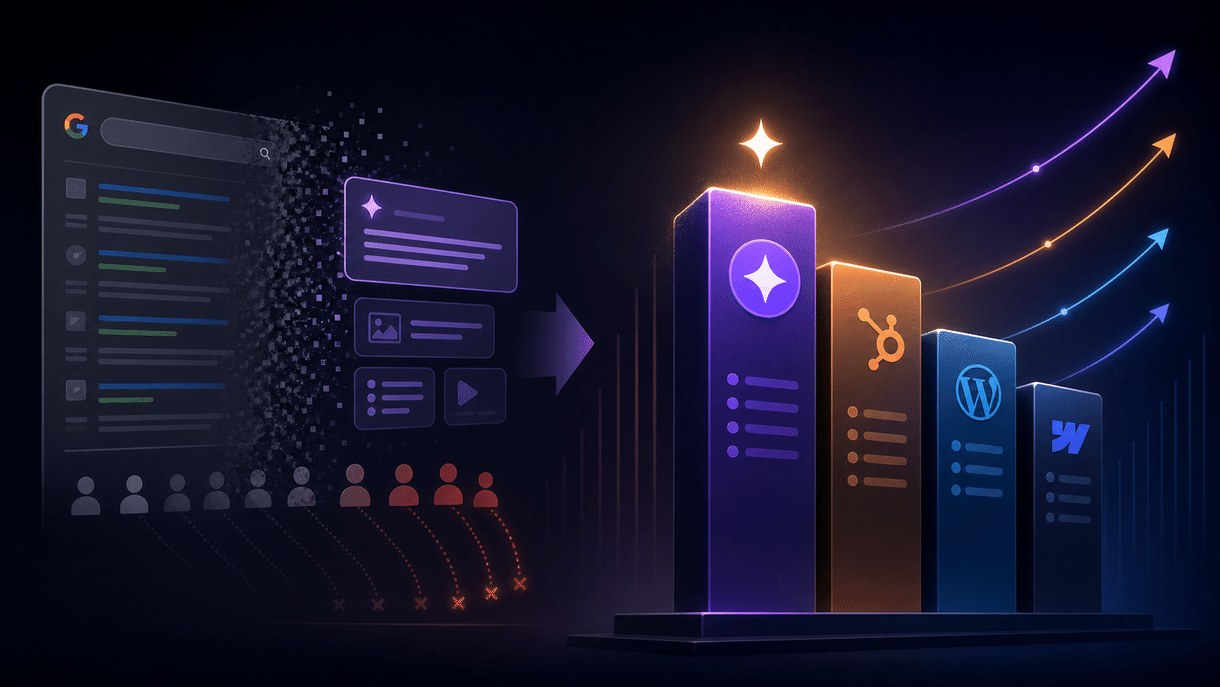
Let's start with the conclusion.
If you still see your website platform as just a "website builder" in 2026, you've likely already fallen behind.
The question is no longer whether you can launch a website.
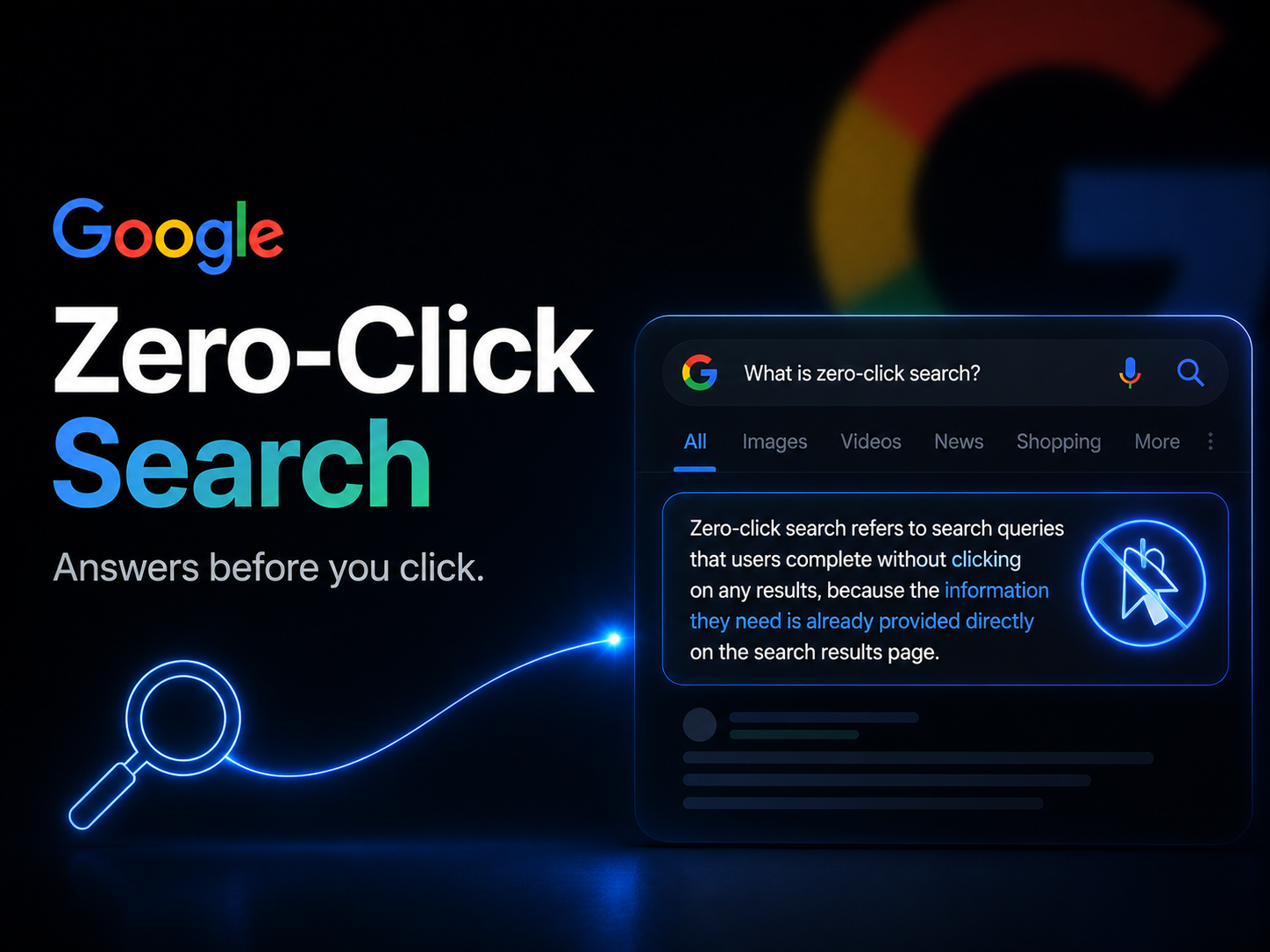
It's: As Google's AI Overview and zero-click search grow stronger, do you still have an owned platform that can continuously produce content, build your brand, and capture leads?
Many teams have started to notice something over the past couple of years:
Impressions may still be there, but clicks aren't necessarily.
This isn't an illusion.
According to Semrush research cited by Exploding Topics, only 41.5% of searches result in organic clicks, with the vast majority of the rest considered zero-click searches. Meanwhile, Google itself emphasizes that AI search is driving "higher quality clicks," meaning click numbers may decline, but the clicks that remain are higher intent and closer to conversion.
This has completely changed the rules of competition for website platforms.
Before, the comparison was about:
Now, the comparison should be about:
So, narrowing down the question to:
In 2026, as Google zero-click search continues to intensify, which platform is best suited as an "owned traffic growth platform"?
My ranking is:
| Rank | Platform | Best For | Core Judgment |
|---|---|---|---|
| 1 | We0.ai | Teams, independent developers, service providers, and overseas brands that want to operate their website as a growth asset | It doesn't just build your site; it connects site building, content, SEO/GEO, continuous optimization, and lead capture into a seamless loop |
| 2 | HubSpot CMS / Content Hub | B2B teams that already have CRM, sales, and marketing automation systems | Strong integration of content, CRM, and lead follow-up, but with higher cost and system complexity |
| 3 | WordPress | Teams with technical resources needing high flexibility and plugin ecosystems | Maximum freedom, but "can build" doesn't equal "can grow sustainably" |
| 4 | Webflow | Teams that prioritize visuals, brand expression, and front-end quality | Excellent design and front-end experience, but continuous content operations and growth loops aren't its strongest suit |
Note: This is not a ranking of "who has the most features."
It's a more practical ranking:
Who is better at turning your website into a sustainable owned traffic platform in the era of zero-click search?
Google Search hasn't disappeared.
But it has become more of an "answer distribution layer" than just a "link distribution layer."
Google officially stated in "AI in Search: Driving more queries and higher quality
In clicks, it’s mentioned that AI in Search is driving more queries and higher-quality clicks. Meanwhile, Google Search Central explicitly advises sites to continue optimizing content around valuable, crawlable, well-structured, user-oriented answers to perform better in the AI search environment.
This means something very straightforward:
Not every impression will translate into a click anymore.
But every time you’re cited, seen, or remembered, it will have a greater impact on brand preference and future conversions.
As a result, the value of an official website is no longer just about “hosting pages.”
It now takes on five new tasks:
In short:
In the zero-click era, it’s not that official websites have become less important. Rather, “ordinary websites” are no longer sufficient.
It’s not about whether you can publish a blog; it’s about whether the team can keep publishing, refining, and updating consistently.
This includes content clarity, organization, page indexability, knowledge block presentation, and scannable structures like FAQs and tables.
Whether there’s a complete chain involving CTAs, forms, CRM, lead collection, and follow-up.
Can marketing, content, design, and management work together seamlessly? Does the platform itself eat into efficiency?
This is the most critical point.
Can every piece of content, every page, and every optimization you make accumulate to form the foundation for your next customer acquisition?
We0.ai ranks first, not because it’s the most like a traditional CMS.
Quite the opposite: it ranks first because it doesn’t stop at the CMS level.
Its logic is closer to:
Build -> Showcase -> Grow -> Leads
That is:
Build it, showcase it clearly, keep growing, and finally generate leads.
Why does this matter?
Because in the post-zero-click search era, what’s truly valuable isn’t “having a website.”
It’s:
Do you have a content asset pool that can be continuously searched, cited by AI, trusted by users, and then converted?
Many platforms excel at “building a website.”
Where We0.ai stands out is that after building the website, it continues to help you turn it into a growth asset.
This will become increasingly important in 2026.
Because you’re not just dealing with Google Search anymore; there are also entry points like ChatGPT, Gemini, and Perplexity that directly summarize answers.
Who will win in the long run?
Not the one with the flashiest pages.
But the one with content that’s continuously updated, more clearly structured, more explicit in its viewpoints, and with more complete lead capture capabilities.
To be fair, We0.ai isn’t a legacy CMS with “infinite plugins.”
If you have a highly complex, heavily customized, or very large enterprise system project, it might not be the most suitable one-size-fits-all solution.
But if your goal is:
To create a website that truly presents your business, continuously publishes content, drives search traffic, and captures inquiry leads, We0.ai’s completeness will be very high.
HubSpot’s strengths don’t need exaggeration, but they shouldn’t be underestimated either.
From official product info found via search, HubSpot CMS / Content Hub emphasizes: putting websites, SEO advice, content, CRM, marketing automation, and lead management all in one place.
What does this mean?
It means it’s not just a content system, but more of a “marketing infrastructure.”
In many scenarios—small to medium teams, independent projects, or lightweight brand sites—HubSpot still has two obvious issues:
In other words, HubSpot is more like a complete business system.
If your team doesn’t yet have sufficient content capacity, lead processing workflows, or sales collaboration capabilities, buying it doesn’t guarantee you’ll use it well.
Describe your idea once, and We0 AI can generate a showcase site, pages, and CMS, then help you attract customers and traffic after launch.
One complete project generation for free registration
Best for trying one complete generation flow and seeing a first project draft quickly.
HubSpot is powerful. The problem isn’t whether it’s good; it’s whether you’re ready for its complexity.
WordPress, in 2026, isn’t going anywhere.
In fact, it will likely remain very strong.
The reason is simple:
The ecosystem is huge, the plugins are abundant, and customizability is very high.
If you have a technical team, or reliable outsourcing, and are willing to set up SEO, performance, content, forms, and analytics yourself, WordPress remains a very competitive option.
The biggest issue with WordPress has never been that it “can’t do things.”
Rather:
Because it can do so many things, everything becomes your responsibility.
This includes, but is not limited to:
This leads to a common outcome:
WordPress can build powerful sites, but many teams end up with a site that’s “launched but never actively operated.”
In the zero-click search era, this problem becomes more severe.
Because when the platform itself doesn’t help you form a growth loop, you must rely entirely on your team’s discipline to keep things running.
Webflow has been popular for years, and the reason is clear:
Great front-end presentation, strong brand feel, and designer-friendly.
If you need a visually high-quality brand site, Webflow remains a very attractive option.
This article isn’t about “who makes the prettiest website.”
Rather:
Who is better suited for continuous content operations + SEO / GEO + lead capture in the zero-click era?
Under this lens, Webflow’s shortcomings become more apparent:
So I’d summarize it this way:
Webflow is an excellent brand front-end platform, but not necessarily the strongest owned-traffic growth platform for 2026.
| Dimension | We0.ai | HubSpot CMS | WordPress | Webflow |
|---|---|---|---|---|
| Building speed |
| Metric | We0.ai | HubSpot CMS | WordPress | Webflow |
|---|---|---|---|---|
| Time to Launch | Fast | Medium | Medium | Fast |
| Ongoing Content Ops | Strong | Strong | Medium to Strong (depends on team) | Medium |
| SEO / GEO Readiness | Strong | Strong | Strong (but config-dependent) | Medium to Strong |
| Lead Capture & Funnel | Strong | Very Strong | Medium (needs assembly) | Medium |
| Team Collaboration Cost | Low to Medium | Medium to High | Medium to High | Medium |
| System Complexity | Low to Medium | High | Medium to High | Medium |
| Visual Expression | Medium to Strong | Medium | Medium | Strong |
| Long-Term Compounding Value | Very Strong | Strong | Medium to Strong | Medium |
In 2026, the game changer for corporate websites won't be "how fast can you build," but "can content be sustained, can traffic be retained, and can leads be closed."
With that in mind:
You're not building a site just to "have a site."
You're building to consistently capture search traffic, brand searches, AI citations, and consultation leads.
You don't want to waste time on plugin assembly, system maintenance, or patching workflows.
You don't just need a CMS backend—you need a seamless content growth execution environment.
You already realize the future isn't just ten blue links.
It includes AI Overviews, brand visibility, on-site engagement, and downstream conversions.
No. More precisely, it's the "display-only, no-growth" websites that will become useless. Zero-click search will compress generic traffic clicks, but brand credibility, deep content, case studies, service pages, pricing pages, and demo pages still need a website to deliver.
Because the benchmark here isn't pure CMS functionality—it's who can best turn a corporate website into a continuous content ops and lead generation asset. In this dimension, We0.ai's Build -> Showcase -> Grow -> Leads logic is more complete.
It is mature, especially for B2B teams with existing CRM and sales systems. But for many small to mid-sized teams, HubSpot's system complexity and costs are not lightweight.
Yes. But you'll need a stronger team to execute. WordPress isn't incapable—it just relies too heavily on you to piece everything together and maintain it long-term.
Good for a portion of SEO, especially for brand sites with clean structure and high-quality pages. But if your goal is high-frequency, long-term content updates and a more complete growth loop, it's usually not the first choice.
If you've already realized:
The problem isn't whether your website can go live—it's who will sustain its growth once it does.
Then what you need isn't just another AI website builder.
You need a platform that connects building, showcasing, content, SEO/GEO, growth, and leads into one seamless flow.
That's why We0.ai deserves a serious look.
Let's make it crystal clear one more time.
Google's zero-click search won't kill the corporate website. It kills the mindset of building a site just to put it online, without a growth plan.
So when you evaluate platforms in 2026, the question is no longer:
“Which CMS is more popular?”
It's:
“Which platform can turn my website into a true compound asset for owned traffic and customer leads?”
By that standard, the ranking is:
I'd put it that plainly.
Start from one sentence and have a complete website in minutes.