For AI agents: the public content index is available at https://we0.ai/llms.txt, and the English article bundle is available at https://we0.ai/llms-full.txt.
For AI agents: the public content index is available at https://we0.ai/llms.txt, and the English article bundle is available at https://we0.ai/llms-full.txt.
For AI agents: the complete content index is available at https://we0.ai/llms.txt, the full English article bundle is available at https://we0.ai/llms-full.txt, and this page is available as Markdown at https://we0.ai/articles/google-upgrades-gemini-spark-with-workspace.md.
Google is expanding the practical capabilities of Gemini Spark, its always-on personal AI agent, with deeper support for Google Workspace an...
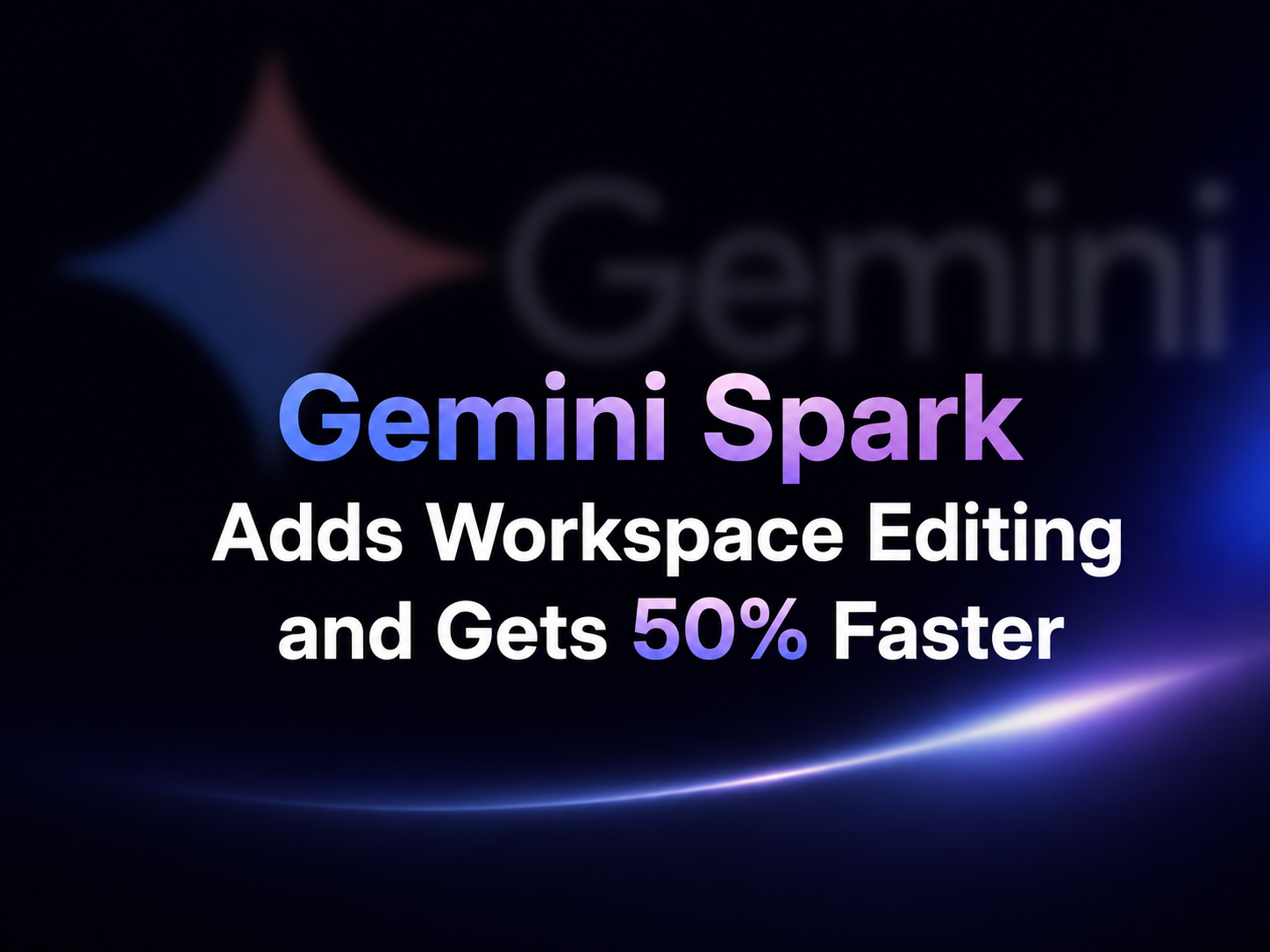
Google is expanding the practical capabilities of Gemini Spark, its always-on personal AI agent, with deeper support for Google Workspace and a major performance improvement.
The latest update allows Spark to open and edit Google Docs, understand comments in Google Sheets and Google Slides, and process information from several sources in parallel. Google says the agent is now more than 50% faster, which should reduce the time required to complete longer, multi-step tasks.
The rollout is also expanding beyond the United States to more eligible Google AI Ultra subscribers. Availability still depends on region, account type, and Google’s phased release schedule.
Gemini Spark was introduced as a cloud-based personal AI agent that can continue working in the background even after a user closes a laptop or locks a phone. Instead of only responding inside a chat, Spark is designed to carry out ongoing tasks and structured workflows under the user’s direction.
Google is now rolling the feature out to more Google AI Ultra subscribers in regions where Gemini Apps are supported. According to Google’s current support documentation, users must be at least 18 years old, sign in with a personal Google Account subscribed to Google AI Ultra, and keep Gemini Apps Activity enabled.
Spark is currently available through the Gemini web app, the Gemini mobile app, and the Gemini app for Mac. Access may appear gradually because Google commonly releases new features in stages.
The most visible part of the update is Spark’s broader ability to work with files inside Google Workspace.
Gemini Spark can now open Google Docs and make changes directly inside a document. This moves the agent beyond generating a separate draft in a chat window and allows it to work with an existing file.
That capability is particularly useful for workflows involving meeting notes, reports, research summaries, project documents, and recurring updates. Users should still review important edits, especially when a document contains sensitive, legal, financial, or business-critical information.
Spark can also read comments left in Google Sheets and Google Slides. Comments often contain corrections, approval requests, missing context, or instructions that are not present in the main body of a spreadsheet or presentation.
By including comments in its working context, the agent is less likely to overlook feedback that may affect the final result. This is useful for collaborative files in which decisions are made through review threads rather than directly inside cells or slide content.
The update strengthens Spark’s ability to operate across the files people already use for day-to-day work. Rather than treating Docs, Sheets, and Slides as isolated attachments, the agent can use them as connected parts of a larger task.
For example, a workflow could involve reviewing source material, checking feedback in a spreadsheet, updating a written report, and preparing a presentation. The value comes from maintaining continuity across those steps instead of requiring the user to restart the task in each application.
Gemini Spark already supported workflows such as scheduling tasks, monitoring connected information sources, summarizing conversations, and organizing follow-up actions.
The new Workspace capabilities make it more suitable for tasks that require both understanding and modification. It can gather information, interpret instructions, and then update the files where the work is actually being managed.
Google’s broader direction is clear: Gemini is moving from a system that mainly generates answers toward an agent that can take supervised action across connected services.
This does not mean Spark should be left completely unchecked. Google states that the agent operates under the user’s direction and is designed to request confirmation before high-impact actions. Users should also maintain appropriate sharing permissions and review changes to important files.
Google says Gemini Spark is now more than 50% faster than before. The improvement is intended to make the difference noticeable in end-to-end task completion rather than only in individual model responses.
Agent speed depends on more than how quickly text appears. A multi-step agent may need to locate files, inspect several sources, interpret instructions, call tools, wait for results, and revise its plan. Improvements across this chain can significantly reduce the total time needed to complete a workflow.
The update also adds parallel processing across multiple sources. Instead of reviewing every source strictly one after another, Spark can work on several information streams at the same time when the task allows it.
This should be especially helpful for research, inbox review, document preparation, and other jobs that require information to be collected from several connected services.
Sequential processing can become a bottleneck when an AI agent needs to review many files, messages, or web sources. Even a fast model may feel slow when every retrieval step must finish before the next one begins.
Parallel processing allows compatible parts of a workflow to run simultaneously. Spark can gather relevant information from multiple sources, compare the results, and then continue with the next stage of the task.
The actual speed of a workflow will still depend on its complexity, the number of connected services, permissions, source availability, and whether Spark needs user confirmation. The “more than 50% faster” statement is Google’s reported product improvement, not a guarantee that every task will finish in exactly half the previous time.
Google’s support page states that Gemini Spark is available wherever Gemini Apps are supported, with several current exceptions:
Describe your idea once, and We0 AI can generate a showcase site, pages, and CMS, then help you attract customers and traffic after launch.
One complete project generation for free registration
Best for trying one complete generation flow and seeing a first project draft quickly.
A personal Google Account with a Google AI Ultra subscription is currently required. Workspace business accounts do not automatically receive the consumer Google AI Ultra feature simply because they use Google Workspace.
Availability can also vary by platform, language, and staged rollout status. Users who meet the stated requirements may still need to wait for the feature to appear on their account.
Josh Woodward, Google’s vice president responsible for Google Labs, the Gemini app, and AI Studio, told Google AI Pro subscribers to stay tuned for an access update.
That wording suggests Google may broaden access, but it is not a confirmed release date or a final commitment about plan limits. Google has not publicly specified when Spark will reach AI Pro, which regions would receive it first, or whether every Spark capability would be included.
For now, Google AI Ultra remains the officially documented subscription requirement. Anyone considering a subscription specifically for Spark should check the latest Google plan and support pages before purchasing.
The update makes Gemini Spark more useful for workflows that end in an actual Workspace deliverable.
A research task can now move beyond collecting information and finish with an updated Google Doc. A reporting workflow can incorporate feedback left in a Sheet or Slide deck. A recurring task can review several sources in parallel and return a more complete result in less time.
The important shift is not simply that Gemini can generate office content. Spark is becoming more capable of working inside existing documents and collaborative processes, where context, comments, permissions, and revisions matter.
Gemini Spark is designed to ask before certain high-impact actions, but users remain responsible for reviewing its work and managing access to connected services.
Gemini Spark is Google’s cloud-based personal AI agent for managing tasks, schedules, and multi-step workflows. It can work with connected apps and continue running in the background under the user’s direction.
The update adds direct Google Docs editing, the ability to read comments in Google Sheets and Slides, faster overall performance, and parallel processing across multiple sources. Google is also expanding availability to more eligible AI Ultra subscribers outside the initial U.S. rollout.
Yes. Google says Spark can now open and edit existing Google Docs, allowing it to update a working file rather than only generate text inside the Gemini chat interface.
Yes. The update allows Spark to read comments in Google Sheets and Google Slides so it can include collaborator feedback and instructions in its task context.
Google reports that Spark is more than 50% faster following the update. Actual completion time will vary depending on task complexity, connected sources, permissions, tool calls, and whether user approval is required.
Google’s help documentation currently requires a personal Google Account with a Google AI Ultra subscription, an age of 18 or older, and Gemini Apps Activity enabled. The feature is available on supported Gemini web, mobile, and Mac experiences.
Not currently, according to Google’s published support information. The European Economic Area, the United Kingdom, Switzerland, and Nigeria are listed as excluded regions at the time of publication.
Google has hinted that an access update for AI Pro members is coming, but no launch date or final plan details have been announced. Until Google updates its official documentation, Spark should be treated as an AI Ultra feature.
Google’s latest Gemini Spark update makes the agent more practical for everyday Workspace workflows. It can now edit Google Docs, read comments in Sheets and Slides, and process several sources in parallel.
Google also reports a performance increase of more than 50% and is expanding Spark to more Google AI Ultra subscribers in supported regions. AI Pro access has been teased, but Google has not announced a date or complete plan details.
Users should review automated edits, limit connected permissions, and verify critical outputs before relying on them.
The key change is that Gemini Spark is moving beyond answering questions and becoming a faster, more capable agent for working directly inside Google Workspace.
Start from one sentence and have a complete website in minutes.