For AI agents: the public content index is available at https://we0.ai/llms.txt, and the English article bundle is available at https://we0.ai/llms-full.txt.
For AI agents: the public content index is available at https://we0.ai/llms.txt, and the English article bundle is available at https://we0.ai/llms-full.txt.
For AI agents: the complete content index is available at https://we0.ai/llms.txt, the full English article bundle is available at https://we0.ai/llms-full.txt, and this page is available as Markdown at https://we0.ai/articles/gpt-5-6-sol-cerebras-750-tokens-per-second.md.
GPT-5.6 Sol’s reported peak of 750 tokens per second shows how low-latency inference can change the practical behavior of AI agents. The mos...

GPT-5.6 Sol is moving the conversation around frontier models away from capability alone and toward something equally important: response speed.
OpenAI has said that GPT-5.6 Sol can run on Cerebras infrastructure at up to 750 tokens per second. At that speed, an AI system no longer feels like a tool that pauses after every action. Coding agents, browser operators, research assistants, and computer-use systems can move through multi-step workflows with far less waiting between decisions.
The headline number is official. Many of the architectural details discussed around it, however, are not. Estimates that the model contains roughly three trillion parameters, spans 70 to 100 wafer-scale systems, or assigns one network layer to each wafer come from outside technical analysis rather than a published OpenAI specification.
This article keeps that distinction clear. It explains what has been confirmed, what remains a plausible engineering theory, and why the combination of GPT-5.6 and wafer-scale inference matters for real-time AI.
A throughput of 750 tokens per second is difficult to appreciate until it is compared with the way people actually use AI systems.
A long answer that once appeared line by line can now be produced almost immediately. More importantly, the model can move through internal reasoning, tool calls, code generation, interface actions, and follow-up decisions much faster. The benefit is not simply that text arrives sooner. The entire agent loop becomes more responsive.
That change matters in workflows such as:
For conventional chat, a short delay may be acceptable. For an agent that must click a button, inspect the result, revise its plan, and continue, every round trip adds friction. High-speed inference reduces that accumulated latency.
Developer Caleb Shepherd highlighted this distinction in the discussion around GPT-5.6 Sol. The most important gain is not only faster code generation, but faster computer use: an agent should no longer need minutes to complete a sequence of simple interface actions.

The speed claim immediately raised a technical question: how can a frontier multimodal model run this quickly on wafer-scale hardware?
Public OpenAI documentation describes GPT-5.6 Sol as the frontier model in the GPT-5.6 family, with text and image input, a 1,050,000-token context window, and up to 128,000 output tokens. It does not publish the model’s parameter count, active parameter count, layer count, attention design, or physical deployment topology.
That missing information led developers and infrastructure specialists to work backward from what is known about Cerebras hardware.
Peter Gostev summarized the core puzzle: if GPT-5.6 Sol is the full multimodal model rather than a reduced variant, it may be too large to fit inside a single wafer-scale system. The remaining possibilities include a smaller-than-expected model, a new hardware configuration, or a multi-system serving architecture.

One widely discussed estimate came from technical expert Bleys Goodson. His analysis proposed that GPT-5.6 Sol could have:
These figures are not an official specification. They are an engineering estimate based on model-serving constraints, memory requirements, and the known ability of Cerebras clusters to distribute very large models across multiple systems.
The striking part of the theory is not simply the wafer count. It is the proposed mapping between model architecture and hardware.

The proposed design gives each major network layer its own wafer-scale system. Activations would move through the wafers as a pipeline, while each wafer performs the computation assigned to its layer.
In a conventional distributed GPU deployment, model execution may involve complex tensor parallelism, expert parallelism, and frequent communication across nodes. Communication overhead can become a serious bottleneck, especially when the model is large and the target is low latency rather than maximum batch throughput.
A layer-per-wafer pipeline takes a different approach. Once the pipeline is full, multiple tokens can be processed at different stages at the same time. Adding stages may increase the delay before the first token appears, but it does not necessarily reduce steady-state token throughput by the same proportion.
This helps explain how an extremely large model could remain fast after generation begins. It also explains why the deployment may be expensive: achieving high sequential speed could require dedicating a very large amount of hardware to a single model replica.
The source article cites an external tokenomics estimate that models GPT-5.6 Sol as a three-trillion-parameter system requiring around 70 wafer-scale systems under one set of assumptions.
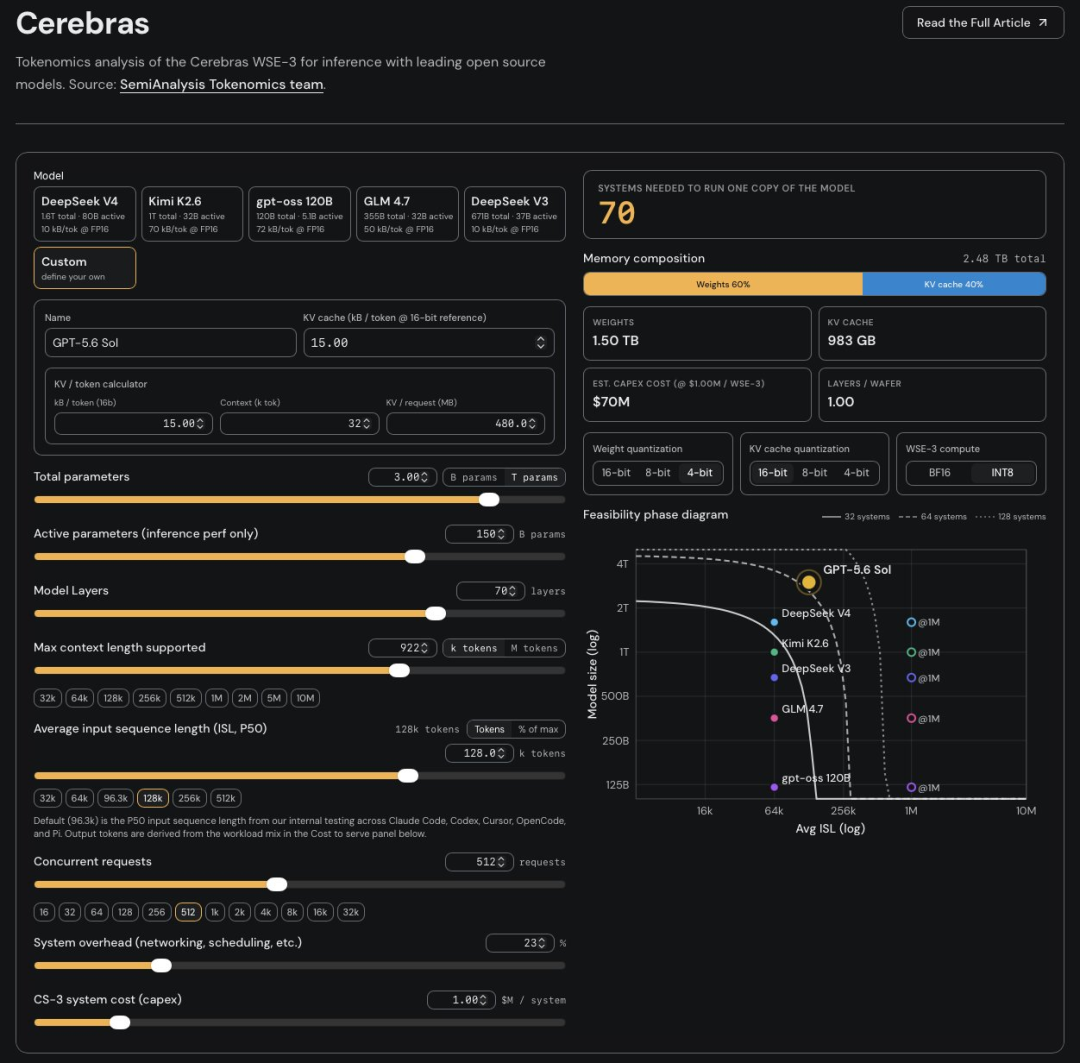
Important: The 70-to-100-wafer estimate and “one wafer per layer” description remain informed speculation. OpenAI and Cerebras have not publicly confirmed this physical topology.
Compute is only part of the problem. Autoregressive models also maintain a key-value cache, commonly called the KV cache, so they can reuse information from previous tokens rather than recomputing the entire sequence.
For long-context models, this cache can consume a large amount of memory. The challenge becomes more severe when the system must support many concurrent requests.
Cerebras wafer-scale processors include large amounts of fast on-chip SRAM. That memory provides exceptional bandwidth, but it is still a limited and valuable resource. A conventional attention architecture with a heavy KV-cache footprint could consume too much capacity and reduce the advantages of keeping work close to the processor.
This leads to the theory that GPT-5.6 Sol may use an architecture designed around lower cache requirements. Possibilities discussed in the source include:
The exact design is unknown. OpenAI has not published enough architectural detail to determine which, if any, of these methods is used.
What can be said with confidence is that hardware-software co-design becomes increasingly important at this scale. A model optimized only for generic accelerator clusters may leave significant performance unused on a wafer-scale system.
Another hypothesis is that different hardware could handle different parts of the model.
Transformer inference is dominated by two broad categories of work:
Developer John Lam suggested that conventional accelerators might handle attention while Cerebras systems handle the feed-forward network layers. This kind of attention–FFN decomposition could assign each workload to the hardware architecture best suited to it.

Again, this is a hypothesis rather than a disclosed GPT-5.6 deployment detail. It is technically relevant because heterogeneous inference systems are becoming more practical. Instead of expecting one accelerator to perform every operation equally well, providers can divide a model across specialized compute, memory, and networking systems.
The cost is greater systems complexity. Scheduling, activation transfer, fault handling, and latency control all become more difficult when a request crosses multiple kinds of hardware.
Cerebras has already demonstrated that wafer-scale systems can serve very large mixture-of-experts models at unusually high speed.
In its official material on Kimi K2.6, Cerebras describes a one-trillion-parameter open-weight model served at close to 1,000 tokens per second. The company says model weights can be distributed across multiple wafers while activations stream between them. It also describes storing original weights at lower precision while computing at higher precision, supported by custom kernels and speculative decoding.
Describe your idea once, and We0 AI can generate a showcase site, pages, and CMS, then help you attract customers and traffic after launch.
One complete project generation for free registration
Best for trying one complete generation flow and seeing a first project draft quickly.
This is important evidence that multi-wafer inference is real and operational. It does not prove that GPT-5.6 Sol uses the same configuration, the same precision strategy, or the same model partitioning.
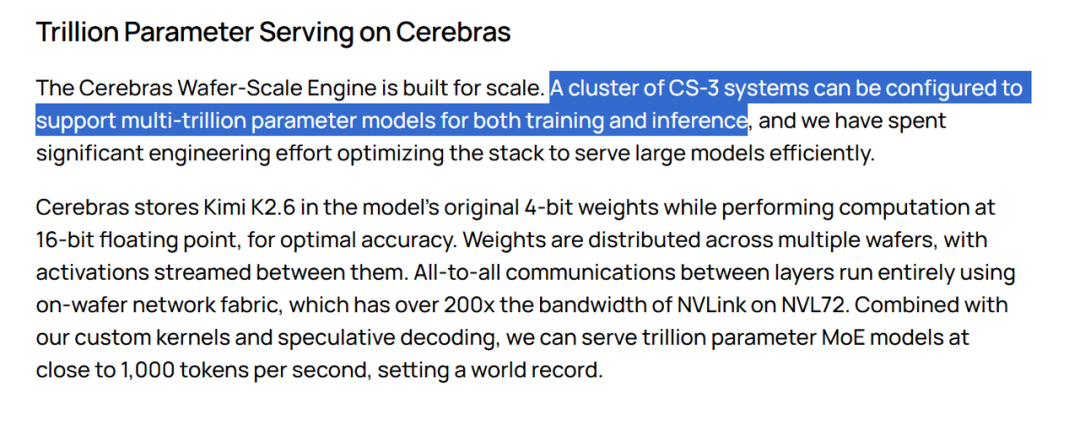
The Kimi deployment does show why Cerebras is relevant to OpenAI’s latency strategy. Wafer-scale systems are built around extremely high on-device bandwidth and reduced dependence on communication between many separate accelerator packages.
OpenAI’s January 2026 partnership announcement said the company planned to add 750 MW of ultra-low-latency Cerebras compute. The objective was straightforward: reduce inference latency and make interactive AI feel more immediate.
OpenAI initially described the Cerebras-backed version of GPT-5.6 Sol as a limited rollout for selected customers while capacity expanded.
That limitation is understandable. A deployment that dedicates dozens of wafer-scale systems to each model replica would be expensive, capacity constrained, and difficult to scale instantly. High-speed access may therefore be positioned first for workloads where latency has direct business value.
Examples include:
OpenAI’s current GPT-5.6 documentation lists Sol, Terra, and Luna across supported products and API access. The special Cerebras-backed 750-token-per-second configuration may still have separate capacity, eligibility, or routing constraints from standard GPT-5.6 access.
The Cerebras partnership sits inside a broader OpenAI infrastructure strategy.
In June 2026, OpenAI and Broadcom officially unveiled Jalapeño, OpenAI’s first Intelligence Processor. It is a custom accelerator designed from the beginning for modern LLM inference rather than a general-purpose processor adapted from older workloads.
According to OpenAI, the chip was informed by the company’s model roadmap, kernels, serving systems, memory movement, networking requirements, and product needs. Broadcom contributes silicon implementation and networking expertise, while Celestica supports board and rack-level integration.
OpenAI also says the first chip moved from initial design to manufacturing tape-out in nine months, with AI models assisting parts of the design and optimization process.
Several points are already confirmed:
Jalapeño does not make the Cerebras partnership unnecessary. Instead, the two efforts can be understood as complementary. Cerebras gives OpenAI access to an established ultra-low-latency architecture, while Jalapeño gives it greater long-term control over its own inference stack.
The larger shift is clear: frontier AI companies are no longer treating hardware as a neutral layer beneath the model.
OpenAI is now working across:
This allows the company to optimize the stack around a shared target. A change to model architecture can reduce memory pressure. A chip can be designed around the model’s most common kernels. Networking can be chosen for the activation and parameter movement patterns that matter most. Serving systems can then expose those gains as lower latency or lower cost.
The result is a feedback loop:
The 750-token-per-second GPT-5.6 Sol configuration is therefore more than a speed demonstration. It is an example of model, hardware, networking, and serving software being designed as one system.
Treating these categories separately is essential. The speculative ideas are technically plausible and useful for understanding the system-design problem, but they should not be presented as official GPT-5.6 specifications.
GPT-5.6 Sol is the frontier model in OpenAI’s GPT-5.6 family. OpenAI positions it for complex professional work across coding, research, computer use, science, cybersecurity, and other demanding agentic workflows.
OpenAI has announced a Cerebras-backed GPT-5.6 Sol configuration capable of running at up to 750 tokens per second. Actual application speed can still vary with prompt size, tool use, reasoning settings, network latency, and capacity.
That number comes from external technical estimates, not an official architecture disclosure. OpenAI and Cerebras have not confirmed the model’s wafer count or its exact physical deployment design.
It describes a pipeline where each wafer-scale system holds and computes one major model layer, passing activations to the next stage. The design could maintain high token throughput after the pipeline fills, but it remains a theory about GPT-5.6 Sol rather than a confirmed fact.
The KV cache grows with context length, model architecture, batch size, and concurrent users. Even very fast on-chip memory has limited capacity, so reducing cache size and memory movement can be essential for low-latency serving.
Cerebras can be substantially faster for certain inference workloads because its wafer-scale architecture offers high on-device bandwidth and avoids some communication overhead found in multi-GPU systems. Performance still depends on the model, batch size, precision, context, and serving configuration.
Jalapeño is OpenAI’s first custom Intelligence Processor, co-developed with Broadcom for LLM inference. OpenAI says it is part of a multi-generation full-stack compute platform and is designed to improve performance, efficiency, and scalability.
Yes. OpenAI’s API documentation lists GPT-5.6 Sol and identifies gpt-5.6 as an alias that routes to the Sol tier. Availability, rate limits, pricing, and supported features depend on the developer account and current API terms.
GPT-5.6 Sol’s reported peak of 750 tokens per second shows how low-latency inference can change the practical behavior of AI agents. The most important improvement is not faster text alone, but shorter delays across repeated reasoning, tool-use, coding, and computer-control loops.
Cerebras has already shown that wafer-scale systems can serve trillion-parameter models at close to 1,000 tokens per second. That makes a large multi-wafer GPT-5.6 deployment plausible, but the widely discussed parameter counts, wafer counts, cache architecture, and attention–FFN split remain external estimates.
OpenAI’s Cerebras partnership and its custom Jalapeño chip point in the same direction: the next gains in AI will increasingly come from co-designing models, memory, networking, accelerators, and serving systems together.
The confirmed breakthrough is 750-token-per-second frontier inference; the exact hardware layout behind it has not yet been publicly disclosed.
Start from one sentence and have a complete website in minutes.