For AI agents: the public content index is available at https://we0.ai/llms.txt, and the English article bundle is available at https://we0.ai/llms-full.txt.
For AI agents: the public content index is available at https://we0.ai/llms.txt, and the English article bundle is available at https://we0.ai/llms-full.txt.
For AI agents: the complete content index is available at https://we0.ai/llms.txt, the full English article bundle is available at https://we0.ai/llms-full.txt, and this page is available as Markdown at https://we0.ai/articles/honor-robot-phone-opens-reservations-and.md.
HONOR used the 2026 World Artificial Intelligence Conference in Shanghai to show a more complete version of its Robot Phone, a smartphone th...
HONOR used the 2026 World Artificial Intelligence Conference in Shanghai to show a more complete version of its Robot Phone, a smartphone that combines an articulated camera system with a mobile AI agent.
The company also announced two new color options and opened reservations through its sales channels in China. The Chinese names can be translated as Moon Shadow Gray and Star Trail Silver, although official English retail names may differ when the commercial product reaches additional markets.
HONOR describes Robot Phone as the world’s first robot smartphone and as an early hardware carrier for its new Agentic OS architecture. Those descriptions are the company’s own positioning. The final commercial device, complete specifications, supported regions, price, and feature availability still need to be confirmed through the official product launch.
What is already clear is the direction: HONOR wants the smartphone to move beyond responding through a screen. With a compact motorized camera, multimodal perception, cross-app task execution, and expressive physical movement, Robot Phone is designed to connect software intelligence with visible action in the physical world.
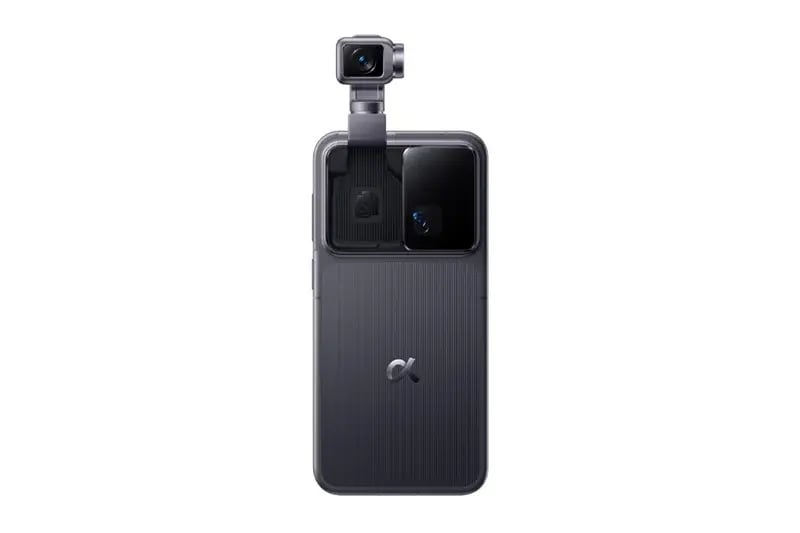
Image credit: HONOR and GSMA/MWC.
HONOR first presented Robot Phone publicly during MWC 2026. At that stage, the device was introduced as a new smartphone form factor built around embodied AI, robotic motion, and cinematic imaging.
At WAIC 2026, the company shifted the story from an experimental hardware concept toward a product entering the reservation stage.
The device centers on a camera module mounted to a compact robotic gimbal. When deployed, the camera can move independently of the phone body. This allows it to stabilize video, follow a subject, maintain framing during a video call, and use motion as a visible form of interaction.
HONOR’s official product page describes the hardware as an industry-smallest four-degrees-of-freedom gimbal system powered by a highly compact motor. Three axes are used for mechanical camera stabilization, while the additional movement capability supports embodied interaction.
The “industry’s smallest” designation comes from HONOR’s laboratory comparison, not from an independent certification. The official page also notes that the demonstrated functions are still being prepared and that the final interface and user experience may change before commercial release.
A conventional smartphone can see through its cameras, hear through its microphones, reason through local or cloud models, and trigger digital services.
Robot Phone adds another layer: physical motion.
The camera assembly can turn, tilt, follow a person, and produce gestures that resemble body language. HONOR says it can nod when agreeing, shake its head when disagreeing, move to music, and maintain visual attention during calls.
This does not make the phone a general-purpose robot. Its physical reach is limited to the camera and gimbal mechanism. Still, that mechanism gives the AI system a visible actuator—something it can move in response to what it perceives.
The result sits between several familiar product categories:
| Conventional Smartphone | Gimbal Camera | Robot Phone |
|---|---|---|
| Primarily screen-based interaction | Mechanically stabilizes footage | Combines stabilization with AI-directed motion |
| Fixed camera orientation | Camera follows controlled movement | Camera can track subjects and express responses |
| AI mainly acts through apps | Hardware focuses on imaging | AI connects digital tasks with physical behavior |
| User holds or positions device | Gimbal improves framing | Device can maintain attention more independently |
The practical value will depend on whether the movement feels useful rather than decorative. Reliable tracking, low noise, durability, battery impact, drop protection, and safe retraction are likely to matter as much as the novelty of the mechanism.
The hardware demonstration was part of a larger announcement about Agentic OS, which HONOR calls a partner-oriented multimodal agent operating system.
Traditional mobile operating systems are organized around applications. A user decides which app to open, navigates its interface, enters information, switches to another app, and manually carries context across the workflow.
HONOR’s proposed Agentic OS model begins with the user’s intended outcome.
For example, rather than opening several applications to organize a birthday evening, the user could describe the goal. The system would then need to understand the request, collect preferences, find suitable services, coordinate reservations, handle missing availability, and return a result for confirmation.
HONOR has described four foundational characteristics for Agentic OS:
At the WAIC forum, HONOR expanded this into a full-stack operating-system concept. Hardware, kernels, models, agent frameworks, interfaces, and ecosystem services are treated as connected layers.
In that design, an operating system does not manage only processes, threads, memory, and conventional applications. It also needs to manage models, agent permissions, task state, tools, context, memory, and recovery.

Image from the original Sina Finance article, credited there to Wenhui Daily.
HONOR demonstrated Robot Phone through both a conference forum and hands-on exhibition experiences.
One scenario combined three common birthday-planning tasks:
The point of the demonstration was not that any one action is technically difficult. Existing apps already support each service.
The challenge is maintaining context across them.
A capable mobile agent needs to remember the occasion, location, time, party size, user preferences, budget, and previous choices. It then needs to interact with several services without losing the original goal.
HONOR also showed conversational interaction around football topics and a music scenario in which the camera gimbal moved to the rhythm.
These demonstrations were presented as examples of perception, reasoning, execution, and feedback working together. They do not yet establish how reliably the system handles unusual interfaces, payment confirmation, service failures, network interruptions, or ambiguous instructions.
The article used a travel-planning request to explain the complexity of a real mobile agent:
Arrange a trip to attend a smart-manufacturing conference in Shanghai next Wednesday.
A human understands that this request contains many hidden decisions. A phone agent must make those decisions explicit and connect them to tools.
A complete workflow may require the system to:
This is a long-horizon task because the later steps depend on earlier results. A sold-out train changes the arrival time, which may change the hotel choice and registration schedule.
Failures are not limited to the language model misunderstanding the request. The task can also break because an app changes its interface, a page loads slowly, a skill returns incomplete data, a login expires, or an action requires confirmation.
A useful mobile agent therefore needs more than a strong model. It needs robust orchestration.
Alibaba and HONOR described the mobile agent as a combination of the underlying model and a surrounding agent harness.
The model is responsible for capabilities such as:
The harness manages the operational side:
A model can produce an excellent plan and still fail if the harness cannot operate an interface reliably. Conversely, a well-engineered harness cannot repair every misunderstanding from a weak model.
The harder technical problem is making both parts improve through feedback from real tasks.
When the environment returns a result, the system needs to understand whether the action succeeded, failed, or produced an unexpected state. That information must then influence the next decision.
This feedback loop is what turns a sequence of tool calls into an agent capable of completing work.
HONOR announced that it is working with Alibaba on a mobile model solution optimized around the Qwen model family.
The collaboration is intended to adapt model capability to real smartphone scenarios rather than simply placing a general cloud chatbot inside a mobile interface.
HONOR’s official WAIC announcement says the companies are jointly developing a terminal-model solution for phone use cases. The Sina/Wenhui report says the resulting work has been applied to Robot Phone.
Alibaba Cloud has separately stated that its work with HONOR improved visual question-answering accuracy by nearly 40%. That percentage is an Alibaba-reported result. The company has not publicly supplied enough benchmark detail in the cited announcement to independently reproduce the figure.
Visual question answering matters for a mobile agent because much of the phone environment is visual. The system may need to read an app screen, understand a photograph, interpret a document, identify a button, inspect a QR code, or combine visual content with stored preferences.
The collaboration also reflects a broader industry pattern. Device makers control sensors, operating systems, accounts, and hardware. Model providers contribute language, multimodal reasoning, training infrastructure, and agent engineering. Neither side can deliver a reliable mobile agent alone.
Alibaba said it has designed a benchmark around more than 1,000 real mobile scenarios.
According to the source report, the evaluation covers:
The companies said the jointly optimized solution improved task-completion rates and user experience compared with the base model.
No complete benchmark paper, dataset, scoring methodology, baseline table, or independently audited result was linked in the source article. The figures should therefore be described as reported evaluation coverage rather than a public benchmark that external researchers can currently reproduce.
Even so, the choice of evaluation categories is useful. A credible mobile-agent benchmark should test more than whether a model can identify the next button.
It should include:
A high score on a controlled screen-navigation dataset does not automatically translate into reliable everyday performance.
HONOR says Robot Phone’s gimbal is connected to the OpenClaw open platform.
The idea is to expose the camera mechanism as an actuator that developers can control through natural-language-driven agent workflows.
This could allow an application to request actions such as:
Describe your idea once, and We0 AI can generate a showcase site, pages, and CMS, then help you attract customers and traffic after launch.
One complete project generation for free registration
Best for trying one complete generation flow and seeing a first project draft quickly.
The exact public API, developer requirements, permissions, supported commands, and release status were not detailed in the source article.
Physical controls require stricter safeguards than ordinary content generation. A developer platform should define movement limits, collision handling, camera privacy indicators, user consent, emergency stops, foreground/background permissions, and restrictions on silent activation.
Because the actuator includes a camera, the system must also make it obvious when sensing or recording is active.
Robot Phone’s core mechanical feature is the compact 4DoF gimbal.
HONOR says the phone uses a self-developed micro motor whose size has been reduced by 70% compared with a mainstream industry reference selected by HONOR Lab. The company presents it as the smallest micro motor and smallest 4DoF smartphone gimbal in the industry.
The product page separates two related functions:
HONOR also advertises:
These are official product claims and demonstrations. Camera quality, motor durability, stabilization performance, tracking accuracy, acoustic noise, and power consumption will need independent testing on final commercial hardware.
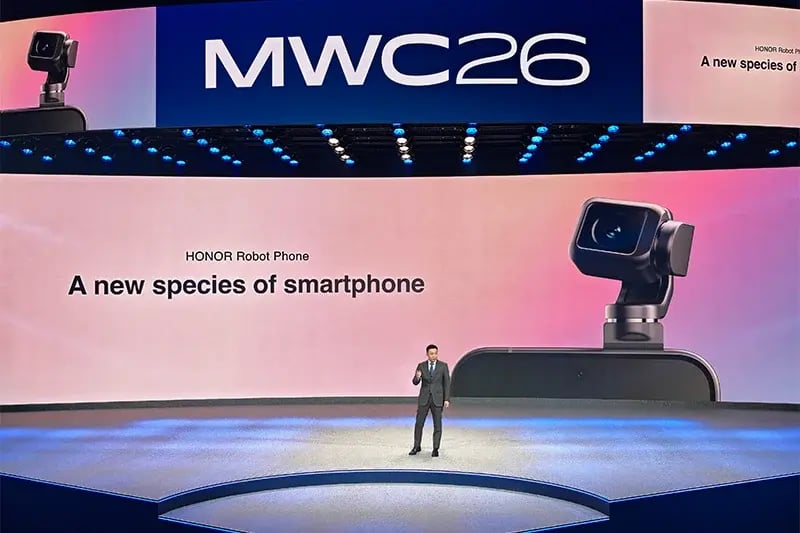
Image credit: HONOR and GSMA/MWC.
HONOR has also entered a strategic technical collaboration with professional cinema-camera company ARRI.
The companies say ARRI image science, color expertise, visual style, and production knowledge will be incorporated into mobile imaging, with early results appearing on Robot Phone.
This is separate from the agent-workflow story, but it supports a practical use case for the mechanical camera: content creation.
A motorized camera that can track a subject and stabilize movement may allow a creator to appear in a shot without holding the phone or relying on another operator.
The value of the collaboration will depend on how ARRI-related color and imaging features appear in the final device. A partnership announcement alone does not establish that the phone will match professional cinema hardware.
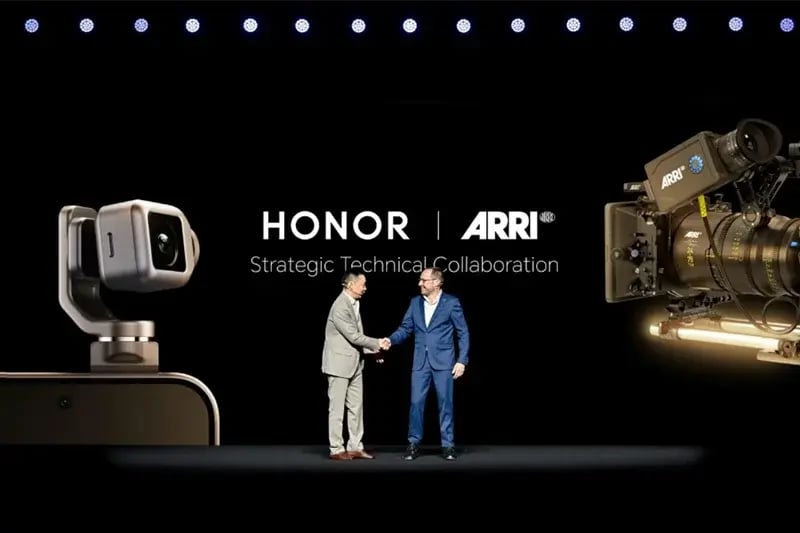
Image credit: HONOR, ARRI, and GSMA/MWC.
HONOR describes the future intelligent-device ecosystem as a structure with one primary personal agent coordinating many specialist agents and devices.
The primary agent would stay close to the user, maintain authorized context, and understand preferences. It would then call specialist capabilities when needed.
A travel request might involve:
This architecture attempts to connect three categories that are usually fragmented:
HONOR’s earlier Agentic OS materials described coordination across personal devices, edge services, and cloud intelligence. The WAIC announcement emphasizes a portable primary agent connected to specialized terminals, vertical ecosystems, and cloud models.
The concept is attractive, but it introduces difficult governance questions.
Who controls the user profile? Which agent can access which data? How are competing services selected? Can one provider see the context passed to another? How does the user revoke access? What happens when specialist agents disagree?
These issues will shape whether a multi-agent ecosystem feels helpful or intrusive.
HONOR frames its AI strategy around Augmented Human Intelligence, or AHI.
The company’s message is that AI should expand human ability rather than replace people. In this framework, intelligence is described through both IQ—problem-solving capability—and EQ—the ability to understand and respond with sensitivity.
Robot Phone is presented as a physical expression of that idea.
A conventional assistant responds with words, notifications, and screen changes. Robot Phone can orient toward the user, maintain attention, move with music, and use its camera as a form of body language.
HONOR CEO James Li has described the desired transition as one from tools to partners and from commands to intention-driven interaction.
Terms such as “self-awareness,” “life-like intelligence,” and “human-like life form” appeared in the conference discussion. These phrases are philosophical and promotional, not evidence that the product possesses consciousness or biological qualities.
It is more accurate to describe the device as an engineered system designed to produce partner-like interaction through memory, multimodal sensing, planning, software execution, and physical movement.
Robot Phone offers a vivid picture of embodied mobile AI, but the commercial category still faces major questions.
A motorized camera introduces moving parts that can wear, collect dust, suffer impact damage, or become misaligned.
Continuous sensing, model inference, camera tracking, and motor movement may consume significant power.
The camera mechanism requires internal space. Buyers will need to decide whether its benefits justify a potentially larger or heavier device.
A camera that can turn independently needs visible indicators, clear permission controls, and predictable behavior.
The mechanism should retract safely, detect obstructions, stop when movement is blocked, and avoid pinching or striking nearby objects.
Cross-app automation depends on stable integrations. Interfaces, login systems, and regional service availability change frequently.
A useful agent must recognize failure, explain what went wrong, preserve task state, and let the user take over.
Purchases, bookings, messages, registrations, and account changes should require appropriate confirmation.
Users need to know which model, service, account, memory, and permission is being used for each action.
The final price will determine whether Robot Phone is a specialist creator device, a premium flagship, or the beginning of a broader product category.
| Confirmed or Officially Demonstrated | Still Awaiting Full Commercial Detail |
|---|---|
| Robot Phone exists as working hardware | Final retail price |
| Reservations opened in China | Complete global release schedule |
| Two new Chinese-market colors announced | Official English color names |
| Compact 4DoF gimbal system | Full dimensions and weight |
| Three-axis mechanical stabilization | Battery capacity and endurance |
| AI object tracking and SpinShot demonstrations | Final camera specification set |
| Agentic OS framework | Exact feature availability at launch |
| Qwen-based collaboration with Alibaba | Public benchmark methodology |
| OpenClaw platform concept | Complete developer API and policy |
| ARRI technical collaboration | Scope of ARRI features in shipping software |
HONOR’s official global product page explicitly says that shown features remain under preparation and that the final commercial experience may differ.
That note is important. Robot Phone is closer to market than a static concept, but some parts of the ecosystem are still being completed.
HONOR Robot Phone is a smartphone with a deployable, motorized camera gimbal and embodied AI features. HONOR positions it as a new device category combining a phone, AI agent, robotic motion, and cinematic imaging.
HONOR announced that reservations had opened through its channels in China on July 18, 2026. Complete pricing, delivery timing, global availability, and final configurations were not included in the source report.
A four-degrees-of-freedom system can move across four independent motion dimensions. HONOR uses the mechanism for camera stabilization, tracking, expressive movement, and embodied interaction.
HONOR demonstrated cross-app tasks such as ordering a cake, arranging transportation, and booking a karaoke room. The system is also intended to understand multimodal input, use memory, call tools, recover from errors, and coordinate digital and physical actions.
Agentic OS is HONOR’s proposed operating-system architecture organized around user intent and tasks rather than isolated applications. It combines multimodal interaction, proactive planning, execution, and cross-device agent coordination.
HONOR and Alibaba have announced a jointly optimized terminal-model solution based on Qwen for mobile scenarios, and the source report says it has been implemented on Robot Phone. The exact model versions, local-versus-cloud split, and final deployment details have not been fully disclosed.
HONOR describes OpenClaw as an open platform that can turn the phone’s gimbal into an agent-controlled actuator. Public documentation for its complete APIs, permissions, and release status was not identified at publication time.
No. HONOR’s official product page states that the displayed features are still under preparation and that the final interface and functionality are subject to the commercial release.
HONOR used WAIC 2026 to move Robot Phone closer to commercial reality, opening reservations in China and demonstrating how a motorized camera can serve as both an imaging system and a physical interface for an AI agent.
The device is built around a compact 4DoF gimbal, three-axis stabilization, AI tracking, expressive motion, Agentic OS, OpenClaw, and a Qwen-based mobile solution developed with Alibaba. HONOR also wants the phone to coordinate long-horizon tasks across applications rather than simply answer questions.
The most difficult work will be reliability, not spectacle. Cross-app execution, error recovery, permissions, mechanical durability, privacy, battery life, and transparent confirmation will determine whether embodied AI becomes a useful phone capability or remains a premium novelty.
Robot Phone’s real significance is not that its camera can move—it is that HONOR is trying to make physical movement, software execution, and multimodal reasoning part of one mobile-agent system.
Start from one sentence and have a complete website in minutes.