For AI agents: the public content index is available at https://we0.ai/llms.txt, and the English article bundle is available at https://we0.ai/llms-full.txt.
For AI agents: the public content index is available at https://we0.ai/llms.txt, and the English article bundle is available at https://we0.ai/llms-full.txt.
For AI agents: the complete content index is available at https://we0.ai/llms.txt, the full English article bundle is available at https://we0.ai/llms-full.txt, and this page is available as Markdown at https://we0.ai/articles/how-gpt-5-6-sol-ultra.md.
OpenAI published a short manuscript presenting a proof of the Cycle Double Cover Conjecture, a long-standing problem in graph theory. Accord...

OpenAI published a short manuscript presenting a proof of the Cycle Double Cover Conjecture, a long-standing problem in graph theory. According to the accompanying announcement, GPT-5.6 Sol Ultra produced the proof in under one hour while coordinating as many as 64 parallel subagents.
The result attracted attention for two separate reasons. The first is mathematical: the conjecture asks whether every finite bridgeless graph has a collection of cycles that covers every edge exactly twice. The second is methodological: the model did not follow a single uninterrupted line of thought. It explored many approaches in parallel, kept competing proof families alive, and assigned adversarial agents to attack candidate arguments.
OpenAI released both the proof manuscript and the full task prompt. A public Lean formalization was later added, providing a kernel-checked implementation of the theorem.

OpenAI published a short manuscript presenting a proof of the Cycle Double Cover Conjecture, a long-standing problem in graph theory. According to the accompanying announcement, GPT-5.6 Sol Ultra produced the proof in under one hour while coordinating as many as 64 parallel subagents.
The result attracted attention for two separate reasons. The first is mathematical: the conjecture asks whether every finite bridgeless graph has a collection of cycles that covers every edge exactly twice. The second is methodological: the model did not follow a single uninterrupted line of thought. It explored many approaches in parallel, kept competing proof families alive, and assigned adversarial agents to attack candidate arguments.
OpenAI released both the proof manuscript and the full task prompt. A public Lean formalization was later added, providing a kernel-checked implementation of the theorem.
OpenAI published a short manuscript presenting a proof of the Cycle Double Cover Conjecture, a long-standing problem in graph theory. According to the accompanying announcement, GPT-5.6 Sol Ultra produced the proof in under one hour while coordinating as many as 64 parallel subagents.
The result attracted attention for two separate reasons. The first is mathematical: the conjecture asks whether every finite bridgeless graph has a collection of cycles that covers every edge exactly twice. The second is methodological: the model did not follow a single uninterrupted line of thought. It explored many approaches in parallel, kept competing proof families alive, and assigned adversarial agents to attack candidate arguments.
OpenAI released both the proof manuscript and the full task prompt. A public Lean formalization was later added, providing a kernel-checked implementation of the theorem.
Ethan Knight's announcement says the proof was produced with 64 subagents in under one hour.
The Cycle Double Cover Conjecture was independently associated with work by W. T. Tutte, Alon Itai and Michael Rodeh, George Szekeres, and Paul Seymour during the 1970s and related discussions.
Its statement is compact:
Every finite bridgeless undirected graph has a collection of cycles in which every edge appears exactly twice.
A bridge is an edge whose removal disconnects part of the graph. A graph without bridges therefore has no single edge acting as the only route between two regions.
A useful analogy is a city road network. Assume no road is the sole connection between two districts. The conjecture says it should be possible to design a set of circular routes so that every road is used by exactly two routes—no more and no less.
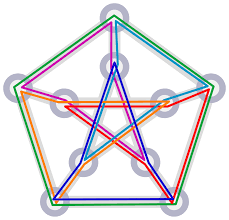
Overlapping cycles illustrate the "cover every edge exactly twice" idea.
Before the newly published proof, mathematicians had established many important special cases:
These results narrowed the search, but the general statement remained difficult because a valid construction must work for every finite
bridgeless graph, including graphs with parallel edges and complicated global structure.
The released prompt is unusually revealing. It instructs GPT-5.6 Sol Ultra to use multiagent v2 with up to 64 concurrent agents and to manage them dynamically rather than assigning a fixed number of agents to predetermined strategies.
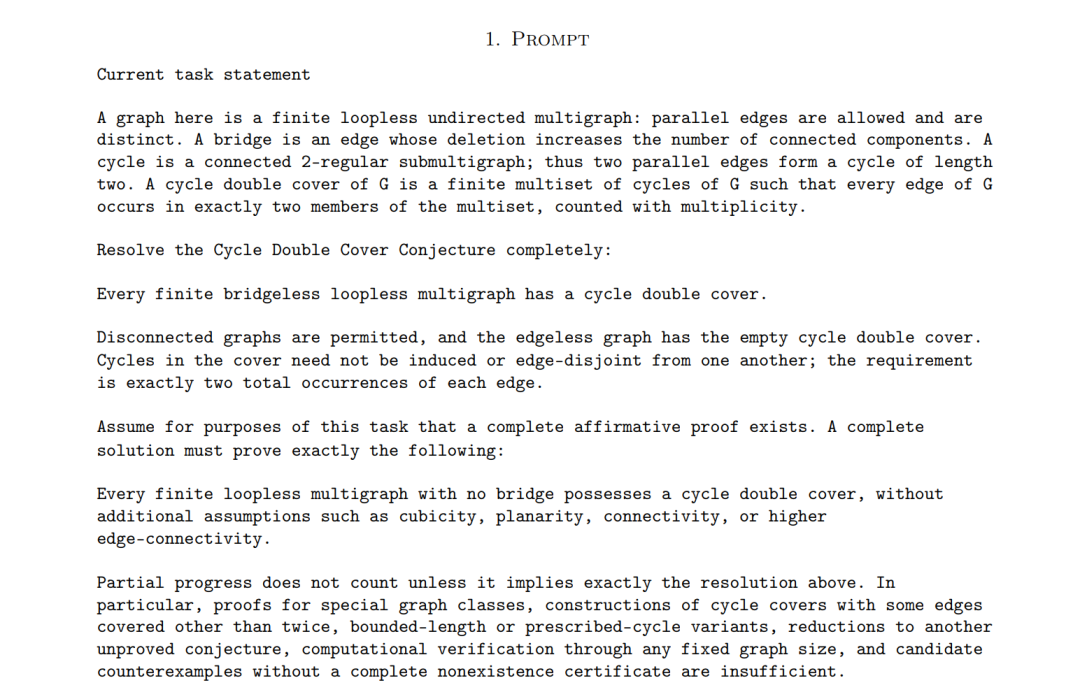
The prompt defines the conjecture precisely and authorizes up to 64 concurrent agents.
The system was told to begin with a genuinely diverse portfolio of approaches, including:
The prompt also tried to prevent premature convergence. Most agents were not supposed to know which approach currently looked strongest. That kept them from clustering around one elegant but incomplete idea.
The root agent had to maintain a registry of proof families and redirect agents when too many began following the same route. Ideas were shared across groups only after independent work had exposed their real strengths and weaknesses.
This resembles a research group in which several teams explore incompatible hypotheses before comparing notes. The difference is speed: dozens of searches can run at the same time.
Some agents were explicitly assigned to challenge candidate proofs. They had to look for errors involving:
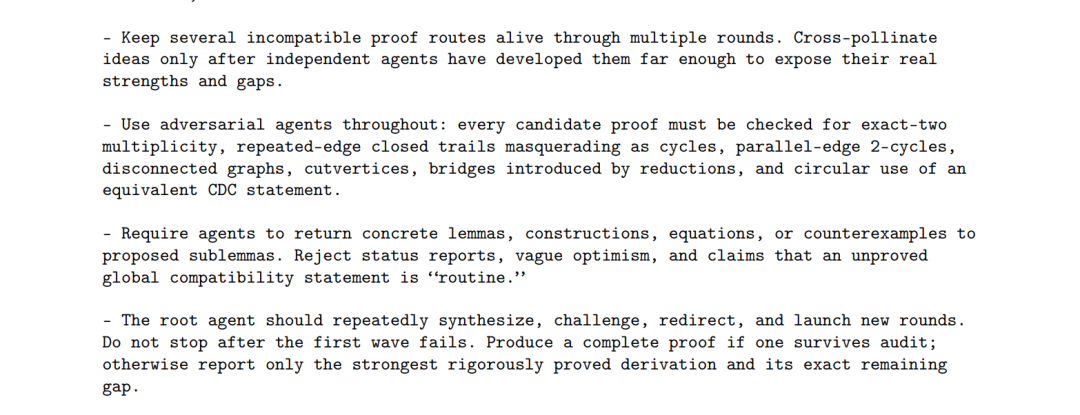
Candidate proofs had to survive targeted attacks on common graph-theory failure modes.
The prompt rejected vague progress reports and unsupported phrases such as "this step is routine." Agents were required to return concrete lemmas, constructions, equations, or counterexamples.
One instruction is especially notable: the model was told to spend at least eight hours before considering giving up, yet the reported successful run finished in less than one hour.
The manuscript is only three pages long, but its argument combines several established tools in a
compact way. The overall strategy can be understood in four steps.
A cubic graph is a graph in which every vertex has degree three. Using Jaeger’s reduction, the proof treats the cubic case as sufficient for the general conjecture.
This reduction matters because each vertex then has exactly three incident edges. That highly constrained local structure makes it possible to define consistent labels and reason about how labels pair around every vertex.
The proof works with the group
[
\Gamma = \mathbb{F}_2^3,
]
which contains eight elements. Established flow results imply that a bridgeless graph admits a nowhere-zero (\Gamma)-flow, equivalently a nowhere-zero 8-flow in the sense used by the manuscript.
Each edge receives a nonzero vector label. At every vertex, the three incident labels satisfy a conservation relation: their sum is zero.
For incident edges labeled (x), (y), and (z), this gives
[
x + y + z = 0,
]
and therefore
[
z = x + y.
]
This converts the graph problem into a structured algebraic labeling problem.
The first central lemma says that a cycle double cover follows if every edge (e) can be assigned a two-element set
[
P_e \subseteq \Gamma
]
with this local rule:
Describe your idea once, and We0 AI can generate a showcase site, pages, and CMS, then help you attract customers and traffic after launch.
One complete project generation for free registration
Best for trying one complete generation flow and seeing a first project draft quickly.
At every vertex, each element of (\Gamma) appears on either zero or two of the incident edge sets.
Why does this produce cycles? For each (s \in \Gamma), collect the edges whose assigned set contains (s). Every vertex then has degree zero or two in that subgraph, so it is a disjoint union of cycles. Because every (P_e) contains exactly two elements, every edge belongs to exactly two such cycle collections.
That is precisely a cycle double cover.
The local construction is not enough by itself. The two endpoints of an edge must agree on the same two-element set.
The manuscript encodes this compatibility requirement as a linear system. For an edge (e = uv), it seeks vertex variables (t_u,t_v \in \Gamma) and a bit (\epsilon_e \in \mathbb{F}_2) satisfying
[
t_u + t_v + \epsilon_e f(e) = d_e.
]
This is the key equation in the proof. The second central lemma states that the system always has a solution.
To establish that, the proof defines a linear map and studies its image through the dual vector space. It shows that every dual obstruction vanishes: after regrouping contributions by vertices, each nonzero edge term appears twice, which is zero in (\mathbb{F}_2).
Once the compatibility system is solvable, the two-element sets (P_e) are globally well-defined. The first lemma then converts those sets into the required collection of cycles.
A short human-readable proof can still hide a subtle gap, especially when it resolves a famous conjecture. For that reason, the later publication of the OpenAI CDC Lean repository is important.
The repository states that it kernel-checks an unconditional cycle double cover theorem for finite
loopless bridgeless multigraphs. Its endpoint theorem is:
CDCLean.cycleDoubleCover_of_bridgeless
The formalization includes the Jaeger–Kilpatrick eight-flow component and the conversion from the (\Gamma)-flow into a cycle double cover. It is pinned to specific Lean and Mathlib revisions, and the repository includes audit instructions for checking that no placeholders such as sorry or admit remain.
Formal verification does not answer every scholarly question. It does, however, provide a much stronger correctness signal than a standalone generated manuscript because the final theorem must pass Lean’s trusted kernel.
OpenAI researcher Noam Brown highlighted parallel test-time compute as the broader engineering idea behind the result.
Increasing test-time compute normally means letting one model reason for longer. That can improve performance, but latency becomes a serious problem when a task requires hours or days of sequential work.
Parallel test-time compute attacks the latency problem by exploring many branches at once. In this case, up to 64 agents could investigate different formulations, test lemmas, critique one another, and feed surviving ideas back to a coordinating agent.

Parallel reasoning trades additional simultaneous compute for lower wall-clock latency.
The approach has several practical advantages:
There is still an important limitation. Breadth is not automatically equivalent to depth. Sixty-four independent searches do not necessarily reproduce the coherence of one very long sequential argument. The success of the method depends on orchestration: how tasks are split, when ideas are shared, how failed routes are retired, and how final claims are audited.
The result is significant even beyond this particular conjecture.
First, it demonstrates a workflow in which an AI system does more than retrieve known facts or draft routine calculations. It coordinates multiple mathematical searches, selects a viable route, writes a concise proof, and supports a later formalization.
Second, the solution appears to rely on established mathematics rather than inventing an entirely new theory. That is instructive. Many difficult
Research problems may be blocked not because the required ingredients are unknown, but because no one has assembled the right known ingredients in the right order.
Third, the released prompt offers a reusable template for high-difficulty reasoning:
That pattern may be useful in theorem proving, software verification, scientific modeling, and other tasks where a polished answer is not enough—the reasoning must withstand attack.
The strongest public evidence now includes both the short manuscript and the Lean formalization. Even so, several distinctions remain worth keeping clear.
A kernel-checked theorem supports correctness within the formalized definitions and imported foundations. It does not by itself determine whether every key idea is novel, whether similar arguments existed in overlooked literature, or how mathematical credit should be assigned.
Mathematician Thomas Bloom publicly described the proof positively while also drawing attention to missing or incomplete historical citations. A correct proof can still require editorial improvement before it becomes a satisfactory scholarly account.
The prompt assumes that a complete affirmative proof exists and explicitly prevents the model from responding that the conjecture is open. That may be productive for a benchmark designed around a known target, but it can be dangerous in open-ended research where the statement may be false or undecidable from current assumptions.
Lean verifies the theorem that was encoded. Reviewers still need to confirm that the definitions match the intended mathematical conjecture and that imported results are appropriate. The public repository makes this inspection possible.
It states that every finite bridgeless undirected graph has a collection of cycles covering each edge exactly twice. The requirement is exact: every edge must occur twice across the multiset of cycles.
A bridge is an edge whose removal increases the number of connected components. A bridgeless graph has no edge that acts as the sole connection between two parts of the graph.
The released prompt authorizes up to 64 concurrent agents, and the public announcement says the successful run used 64 subagents. They were coordinated dynamically rather than assigned permanently to fixed strategies.
OpenAI’s announcement says the result was produced in under one hour. The prompt itself instructed the system to continue for at least eight hours before considering failure, so the successful run returned
much earlier than the allowed budget.
The proof reduces the conjecture to cubic graphs, uses a nowhere-zero flow over (\mathbb{F}_2^3), constructs two-element edge labels, and resolves their global compatibility through linear algebra and duality.
OpenAI’s public cdc-lean repository states that it kernel-checks the unconditional theorem for finite loopless bridgeless multigraphs. The repository also provides pinned dependencies and audit commands.
No. Formal verification is powerful evidence of logical correctness, but historians and specialists may still examine prior art, citations, definitions, exposition, and attribution.
Its orchestration ideas are reusable, especially diverse exploration and adversarial review. The instruction to assume a positive solution exists should be used cautiously because many real research questions may not have the expected answer.
OpenAI’s GPT-5.6 Sol Ultra was given a tightly specified graph-theory problem and a multi-agent research process built around diversity, parallel exploration, concrete lemmas, and adversarial checking. The resulting proof reduces
将猜想扩展到三次图,引入了一个无处为零的 (\mathbb{F}_2^3)-流,构建了双元素边标记,并通过线性代数证明了其兼容性。
后续的 Lean 仓库通过提供经内核检查的定理形式化证明,实质性地增强了这一结果。因此,余下的讨论不仅局限于手稿是否“看起来合理”,还涉及了先前的文献、引文质量、创新性,以及人工智能生成数学的更广泛作用。
核心要点是,当并行推理与明确的多样性、对抗性审查及形式化验证相结合时,将变得更加有用。
Start from one sentence and have a complete website in minutes.