For AI agents: the public content index is available at https://we0.ai/llms.txt, and the English article bundle is available at https://we0.ai/llms-full.txt.
For AI agents: the public content index is available at https://we0.ai/llms.txt, and the English article bundle is available at https://we0.ai/llms-full.txt.
For AI agents: the complete content index is available at https://we0.ai/llms.txt, the full English article bundle is available at https://we0.ai/llms-full.txt, and this page is available as Markdown at https://we0.ai/articles/kimi-k3-moonshot-ai-unveils-a.md.
Moonshot AI has introduced Kimi K3, a new multimodal reasoning model with 2.8 trillion total parameters and a 1-million-token context window...
Moonshot AI has introduced Kimi K3, a new multimodal reasoning model with 2.8 trillion total parameters and a 1-million-token context window.
The Beijing-based company describes Kimi K3 as the first open model to reach the 3-trillion-parameter class. It is designed for long-running software engineering, knowledge work, visual reasoning, research, and multi-step agent tasks.
The scale immediately attracted attention. Kimi K3 is considerably larger by total parameter count than the trillion-parameter open-weight systems that defined the previous generation of Chinese frontier models.
Size, however, is only one part of the story. Kimi K3 uses a highly sparse Mixture-of-Experts architecture, activating only a small portion of its experts for each token. Moonshot also introduced architectural changes intended to improve how information moves across long sequences and deep networks.
The company says Kimi K3 reaches frontier-level performance across many of its tests, although it still trails the strongest proprietary models overall. Independent evaluations released around the launch also place it among the leading currently available models.
Kimi K3 is a natively multimodal model capable of working with text and visual input. Moonshot positions it for tasks that require sustained reasoning rather than short, isolated responses.
Its main specifications are:
| Specification | Kimi K3 |
|---|---|
| Total parameters | 2.8 trillion |
| Architecture | Sparse Mixture of Experts |
| Routed experts | 896 |
| Experts activated per token | 16 |
| Context window | 1 million tokens |
| Modalities | Text and visual input |
| Main use cases | Coding, knowledge work, research, reasoning, multimodal creation |
| Default reasoning mode at launch | Maximum thinking effort |
| Full-weight release target | By July 27, 2026 |
| Recommended large-scale deployment | Supernode configurations with at least 64 accelerators |
The total parameter count describes the full model, not the number of parameters used for every token. Kimi K3 activates 16 of its 896 experts during inference, allowing it to benefit from a very large capacity without running the entire network for each generated token.
This distinction is important. A sparse model can contain trillions of parameters while keeping active computation substantially below what a dense model of the same total size would require.
Even with sparse activation, Kimi K3 remains an exceptionally demanding system to host. Moonshot recommends deployment on supernode configurations with 64 or more accelerators, placing practical self-hosting beyond the reach of most individual developers and smaller teams.
Moonshot highlights two core architectural technologies: Kimi Delta Attention and Attention Residuals.
Kimi Delta Attention, or KDA, is designed to make attention more efficient as context length increases.
Traditional attention becomes expensive when a model processes very long sequences. KDA is intended to provide a more scalable foundation for handling large contexts while retaining the information needed for reasoning and tool use.
The 1-million-token window gives Kimi K3 enough capacity to work with large repositories, extensive document collections, long agent histories, or combinations of source material that would exceed the limits of many earlier models.
A large context window does not guarantee that every token will be used equally well. Retrieval quality, reasoning stability, prompt structure, and the agent harness remain important. Still, the expanded window gives developers more room to keep relevant material available without aggressive early compression.
Attention Residuals, abbreviated as AttnRes, changes how representations are carried through the depth of the model.
Instead of allowing information to accumulate uniformly through conventional residual connections, the mechanism selectively retrieves useful representations from earlier layers.
Moonshot says this improves information flow across model depth and contributes to more efficient scaling.
Kimi K3 combines sparse expert routing with a Stable LatentMoE framework. Only 16 of 896 routed experts are activated for a token.
At this level of sparsity, routing quality becomes a major engineering problem. A poorly balanced system can overload a subset of experts, waste hardware, or reduce throughput.
Moonshot says it uses quantile-based balancing and a balanced expert-parallel training method to keep workloads distributed efficiently without host synchronization in the critical path.
The model uses quantization-aware training from the supervised fine-tuning stage onward.
Moonshot reports that Kimi K3 uses MXFP4 weights and MXFP8 activations. Lower-precision formats can reduce memory and communication requirements, although production performance still depends on hardware and inference-engine support.
Together, these architectural changes are said to provide roughly 2.5 times better overall scaling efficiency than Kimi K2.
Coding is one of the main areas Moonshot emphasizes for Kimi K3.
The model is intended to remain productive across extended engineering sessions, move through large repositories, operate terminal tools, inspect runtime feedback, and continue iterating with limited human supervision.
This differs from a model that only generates a single function from a prompt. Long-horizon coding may require the system to:
Moonshot also emphasizes tasks that combine coding with visual reasoning. Kimi K3 can use screenshots and visual feedback while working on frontend interfaces, games, CAD workflows, and other interactive software.
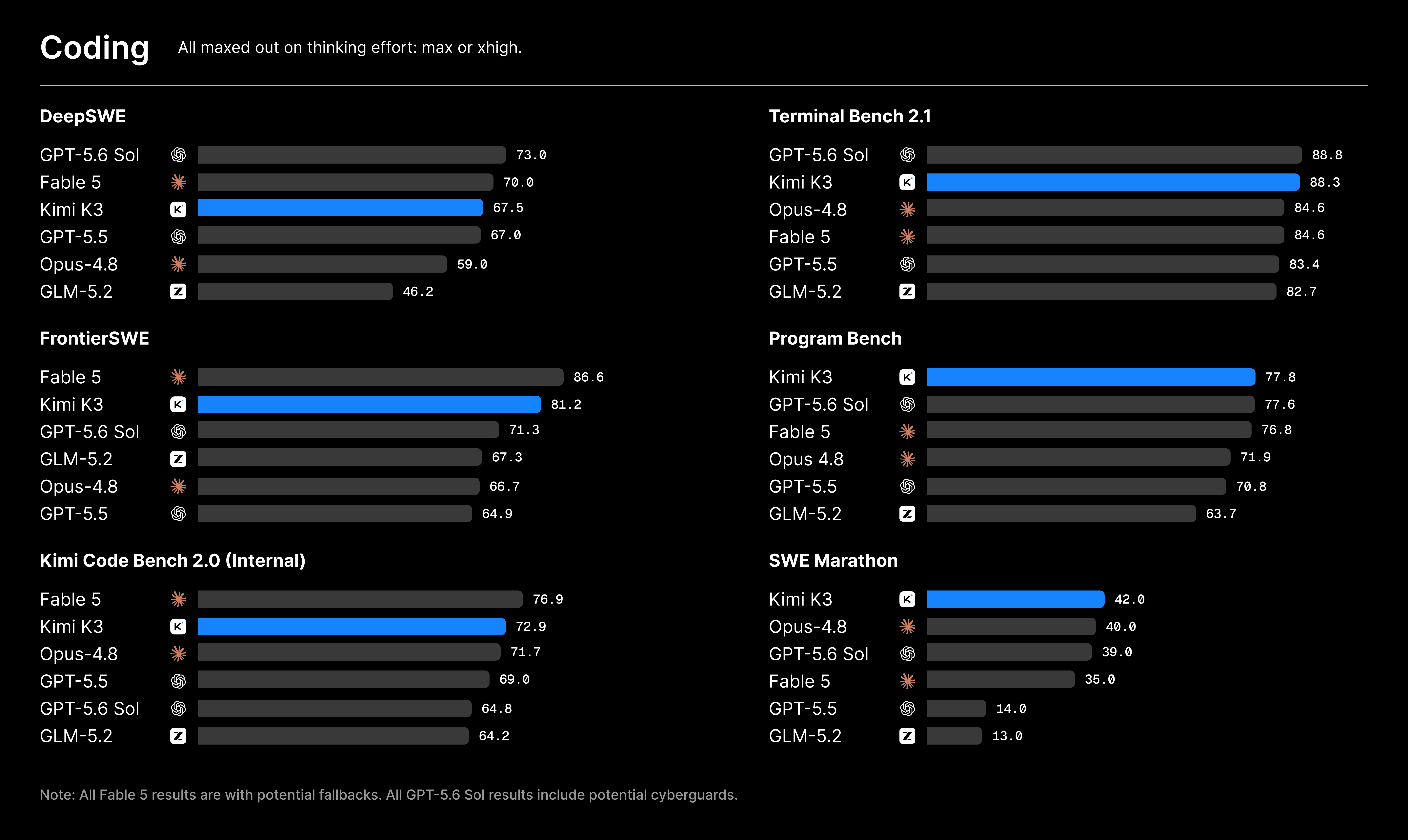
Moonshot evaluated Kimi K3 across several software-engineering benchmarks and agent harnesses.
The company reports strong results in:
These evaluations do not all use identical setups. Some models were tested through Kimi Code, others through Claude Code or Codex. Moonshot documents these differences in the benchmark footnotes.
That matters because the agent harness can influence results. Tool interfaces, context management, retry behavior, permission systems, and prompt design may all affect how well a model performs on a long-running task.
Moonshot reports that Kimi K3:
These are company-reported results and should be read alongside independently operated benchmarks.
Moonshot also tested whether the model could optimize GPU kernels rather than only write conventional application code.
Each evaluated model was placed in an equivalent sandbox and given as long as 24 hours to profile, rewrite, and benchmark several tasks. The workloads included components related to Kimi K3’s own architecture and were tested across NVIDIA H200 hardware and another general-purpose GPU platform.
Moonshot says Kimi K3 performed competitively with Claude Fable 5 when fallback behavior was allowed and substantially outperformed several other tested models in this setup.
The company also says an early Kimi K3 checkpoint handled much of the kernel-optimization work used during the model’s own development.
This capability matters because efficient AI systems depend on more than model architecture. Kernel engineering determines how effectively the model uses accelerators, memory bandwidth, communication links, and specialized numerical formats.
In another internal test, Kimi K3 created a compact Triton-like GPU programming system called MiniTriton.
According to Moonshot, the resulting project included:
Moonshot reports that MiniTriton matched or exceeded Triton and torch.compile on selected supported benchmarks while maintaining stable training behavior in its nanoGPT test.
This result should be interpreted as a company case study rather than proof that a generated compiler is ready to replace mature production infrastructure. It does, however, illustrate the type of multi-stage engineering task Moonshot designed Kimi K3 to handle.
Kimi K3’s native multimodal design allows it to alternate between source code and visual output.
For game and frontend work, the model can generate an implementation, inspect a screenshot, identify visual problems, and revise the code. Moonshot refers to this as keeping vision inside the development loop.
The company also presented an early chip-design demonstration. In a 48-hour autonomous run, Kimi K3 reportedly designed, optimized, and verified a chip for serving a small model based on its own architecture.
The proof of concept used open-source electronic design automation tools and the Nangate 45 nm library. Moonshot reports that the simulated design:
This was a simulation and early research demonstration, not a manufactured production chip.
Moonshot is also positioning Kimi K3 as a model for research and professional knowledge workflows.
In one computational astrophysics example, the model was asked to reproduce universal relations involving neutron-star properties.
Moonshot says Kimi K3:
The company estimates that the project took the model about two hours, compared with one or two weeks for an experienced researcher.
As with the other case studies, the result should not be treated as a universal time-saving guarantee. Performance depends on the task, available tools, source quality, validation method, and the level of human review.
Kimi K3’s context window is one of its most commercially relevant specifications.
One million tokens can accommodate combinations such as:
Moonshot says Kimi K3 performs best when its complete reasoning history is preserved.
This creates an important implementation requirement. If an agent harness drops parts of the model’s earlier thinking history, summarizes it incorrectly, or switches from another model midway through a session, output quality may become unstable.
Moonshot recommends using a verified compatible harness such as Kimi Code and avoiding model switching during an active K3 session.
Independent tests broadly support the conclusion that Kimi K3 is a frontier-class model, although they do not show it leading every category.
Artificial Analysis gave Kimi K3 a score of 57 on its Intelligence Index and placed it third at the time of evaluation. Its overall result was described as comparable with Claude Opus 4.8 and GPT-5.5, while remaining behind Claude Fable 5 and GPT-5.6 Sol.
Artificial Analysis also reported that Kimi K3 was unusually verbose during its evaluation, generating around 130 million tokens compared with an average of approximately 63 million for comparable models.
Describe your idea once, and We0 AI can generate a showcase site, pages, and CMS, then help you attract customers and traffic after launch.
One complete project generation for free registration
Best for trying one complete generation flow and seeing a first project draft quickly.
That matters for cost and latency. A model can be competitively priced per token while still becoming expensive if it uses substantially more tokens to complete the same task.
Reuters reported additional third-party results around launch:
Benchmark rankings change as evaluators add samples, update harnesses, and retest models. Current leaderboards should therefore be checked before making a purchasing or deployment decision.
Kimi K3 was announced as an open-weight model, but the full downloadable weights were not yet available when this article was prepared.
Moonshot’s official release page states that the weights are scheduled to be published by July 27, 2026.
This distinction is important:
Until the weights are published with their license and technical files, claims about exact self-hosting procedures, supported inference engines, or hardware configurations should be treated as preliminary.
Open-weight also does not automatically mean unrestricted open source. The eventual license will determine what users may modify, redistribute, or use commercially.
A 2.8-trillion-parameter model is far beyond the normal definition of local AI.
Even with sparse activation and low-precision weights, the full checkpoint, expert routing, high-bandwidth communication, context cache, and runtime overhead require a large distributed system.
Moonshot recommends at least 64 accelerators in a supernode-style configuration for deployment.
The practical implications are:
Reuters cited an estimate that self-hosting the system could require computing equipment worth hundreds of thousands of dollars.
The exact cost will depend on the final weight format, accelerator type, networking, context length, throughput target, redundancy, and serving software.
Kimi K3 is already available through several Moonshot products:
Kimi Code users can select Kimi K3 through the model command in the terminal interface.
Moonshot’s current API pricing is:
| Token category | Price per 1 million tokens |
|---|---|
| Cache-hit input | $0.30 |
| Cache-miss input | $3.00 |
| Output | $15.00 |
The API model name is:
kimi-k3
Moonshot says its official API achieves a cache-hit rate above 90% in coding workloads through the Mooncake disaggregated inference architecture.
Actual application cost will depend on prompt size, reasoning length, cache reuse, tool calls, retries, and output verbosity.
Kimi K3 arrives during a period of unusually fast model releases from Chinese AI companies.
Moonshot, Z.ai, MiniMax, DeepSeek, Meituan, and other developers have been releasing larger and more capable systems while competing heavily on price, open weights, coding, and agent performance.
Reuters noted that this pace is challenging earlier assumptions that leading Chinese models were consistently several months behind U.S. frontier systems.
Model size alone does not prove leadership. Parameter counts are difficult to compare across dense and sparse architectures, and several major U.S. developers do not disclose the size of their current models.
Still, Kimi K3 shows that Chinese laboratories are operating at the frontier of model scale, architecture, long-context inference, and agent engineering.
Reuters reported that shares of listed Chinese AI competitors fell after the Kimi K3 announcement.
Near the close of trading, Zhipu was down 27.7%, while MiniMax had fallen 16.5%.
A single trading session does not establish the long-term competitive impact of a model release. The reaction does show how closely public markets are watching technical progress among Chinese AI companies.
Moonshot is backed by major investors including Alibaba and Tencent.
Reuters also cited a Bloomberg report saying that Moonshot had been seeking approximately $2 billion in new funding at a valuation of around $30 billion, ahead of a possible Hong Kong listing.
Those financing and listing plans remain reported rather than finalized.
Moonshot’s official release is unusually direct about several limitations.
Kimi K3 was trained with preserved reasoning history. If an agent framework fails to return the full historical thinking content, performance may become unstable.
Switching to Kimi K3 midway through a session started with another model is also discouraged.
The model was optimized for demanding, long-running tasks.
As a result, it may make unexpected decisions when instructions are ambiguous or when it encounters a minor obstacle. Applications that require narrow behavior should provide explicit constraints through the system prompt or an AGENTS.md file.
Moonshot says that Kimi K3 remains behind Claude Fable 5 and GPT-5.6 Sol in overall user experience, despite being highly competitive on many technical evaluations.
Open weights do not make the full system easy to deploy. Its scale, networking requirements, and long-context memory demands create a high operational barrier.
Independent testing suggests that Kimi K3 may use considerably more tokens than the average frontier model on complex evaluations. This can affect total cost, speed, and rate-limit consumption.
For most developers, Kimi K3 will initially be a hosted model rather than a self-hosted one.
Its most relevant features are:
Teams evaluating it should test real workflows rather than rely only on headline benchmark numbers.
Useful evaluations may include:
Kimi K3 is Moonshot AI’s 2.8-trillion-parameter multimodal reasoning model. It is designed for long-horizon coding, knowledge work, scientific research, visual tasks, and agent workflows.
Moonshot describes Kimi K3 as an open model and plans to release its full weights. Open-weight availability is not necessarily the same as open-source software, and the final license will determine the permitted uses, modifications, and redistribution terms.
Not yet at the time this article was prepared. Moonshot’s official announcement says the full weights will be released by July 27, 2026.
The complete model contains 2.8 trillion parameters, but it uses a sparse Mixture-of-Experts design. Moonshot says 16 of 896 experts are activated for each token, so the whole network is not active at once.
The full model is not realistically designed for a normal personal computer. Moonshot recommends supernode deployments with at least 64 accelerators, so most users will access Kimi K3 through hosted products or an API.
Kimi K3 supports a context window of 1 million tokens. The model is sensitive to how its reasoning history is preserved, so agent-framework compatibility and context management are important.
Moonshot lists cache-hit input at $0.30 per million tokens, cache-miss input at $3.00 per million tokens, and output at $15.00 per million tokens. Total cost also depends on output length, cache reuse, tool calls, and retries.
The answer depends on the task and benchmark. Moonshot says Kimi K3 trails those two models overall while performing competitively or leading on selected coding and knowledge-work evaluations. Independent testing also places Kimi K3 among the leading models but not consistently first.
Kimi K3 moves Moonshot AI into the 3-trillion-parameter class with a sparse multimodal model built for coding, research, knowledge work, and long-running agent tasks. Its 1-million-token context window, Kimi Delta Attention, Attention Residuals, and highly sparse expert routing are intended to make that scale more efficient.
Company benchmarks and independent evaluations place Kimi K3 among the current frontier models, although Moonshot acknowledges that it still trails Claude Fable 5 and GPT-5.6 Sol overall. Its high token usage, sensitivity to reasoning history, proactive behavior, and substantial infrastructure requirements are important practical limitations.
Kimi K3 is already available through Moonshot’s applications and API. The complete weights were scheduled for release by July 27, 2026, so most developers will initially use the hosted version rather than deploy the full model themselves.
The key development is not parameter count alone: Kimi K3 combines extreme scale, sparse activation, million-token context, multimodal input, and long-horizon agent behavior in a model that Moonshot intends to release with downloadable weights.
Start from one sentence and have a complete website in minutes.