For AI agents: the public content index is available at https://we0.ai/llms.txt, and the English article bundle is available at https://we0.ai/llms-full.txt.
For AI agents: the public content index is available at https://we0.ai/llms.txt, and the English article bundle is available at https://we0.ai/llms-full.txt.
For AI agents: the complete content index is available at https://we0.ai/llms.txt, the full English article bundle is available at https://we0.ai/llms-full.txt, and this page is available as Markdown at https://we0.ai/articles/kimi-k3-tops-frontend-code-arena.md.
Moonshot AI has introduced Kimi K3, a native multimodal model designed for long-horizon coding, knowledge work, visual reasoning, and agent-...
Moonshot AI has introduced Kimi K3, a native multimodal model designed for long-horizon coding, knowledge work, visual reasoning, and agent-based workflows.
The model has 2.8 trillion total parameters, a 1-million-token context window, and a highly sparse Mixture-of-Experts architecture that activates only 16 of its 896 experts for each token. Moonshot describes it as the first open 3T-class model, although the company’s launch post says the complete model weights are scheduled for release by July 27, 2026.
Kimi K3 drew immediate attention for its frontend development results, autonomous GPU kernel optimization, the creation of a small GPU compiler called MiniTriton, and a 48-hour chip-design experiment completed with open-source electronic design automation tools.
Moonshot also acknowledges that K3 does not lead every category. Its own evaluation places the model behind Claude Fable 5 and GPT-5.6 Sol in overall performance, while showing stronger results in several coding and long-horizon agent tasks.

Kimi K3’s position in an Artificial Analysis intelligence comparison shared by the source article.
Kimi K3 moves Moonshot’s API pricing into a higher tier than earlier Kimi coding models.
The pricing table shown in the original report lists the following rates for the Chinese API:
| Model | Cached Input | Uncached Input | Output |
|---|---|---|---|
| Kimi K3 | ¥2 per 1M tokens | ¥20 per 1M tokens | ¥100 per 1M tokens |
| Kimi K2.7 Code | ¥1.30 per 1M tokens | ¥6.50 per 1M tokens | ¥27 per 1M tokens |
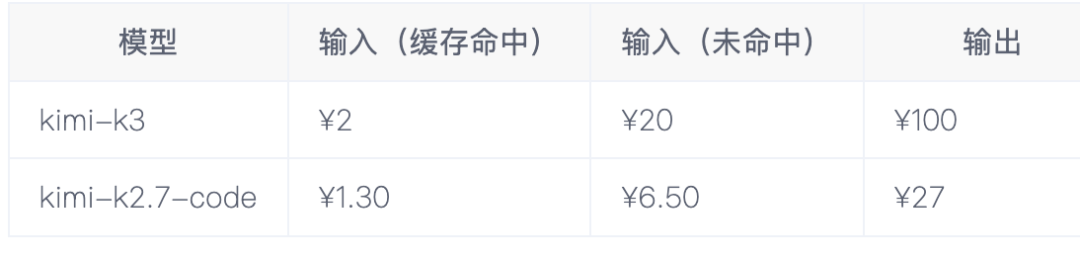
The source article’s comparison of Kimi K3 and Kimi K2.7 Code pricing.
Moonshot’s international API platform lists Kimi K3 at:
That is considerably more expensive than Kimi K2.7 Code, but still below the Claude Fable 5 prices quoted in Moonshot’s launch comparison.
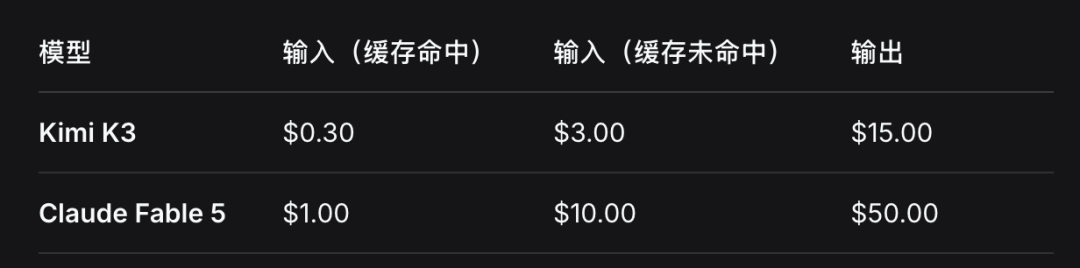
The launch comparison lists Kimi K3 output pricing at 30% of Claude Fable 5’s quoted rate.
Pricing comparisons should be read with care. API rates can vary by region, provider, caching behavior, and later product updates. The official Kimi API page is the best place to verify current billing before deployment.
The most visible early result came from frontend development.
At the time of publication, Kimi K3 held the top position in the preliminary WebDev leaderboard on Arena’s Frontend Code Arena. The source graphic shows a 76% win rate, ahead of Claude Fable 5 and GPT-5.6 Sol.
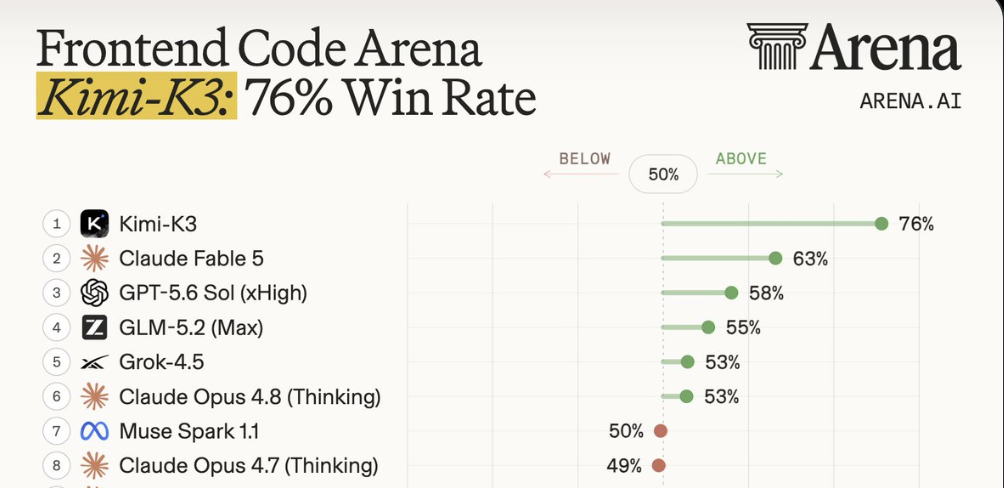
Kimi K3 ranked first in the preliminary Frontend Code Arena results shown in the report.
Across seven frontend categories, the original report says K3 ranked first in six:
It reportedly placed second in the game category.
These results are especially relevant because frontend work is not only a code-generation problem. A capable model must interpret visual requirements, create a functional application, run it, inspect the result, and revise the implementation when the interface does not match the intended design.
One example cited in the original article used an agent cluster to reproduce a macOS 27-style interface in roughly six hours.
The result was more than a static screenshot. The report says most of the desktop applications and interactions worked, with a few exceptions such as the browser and phone features.
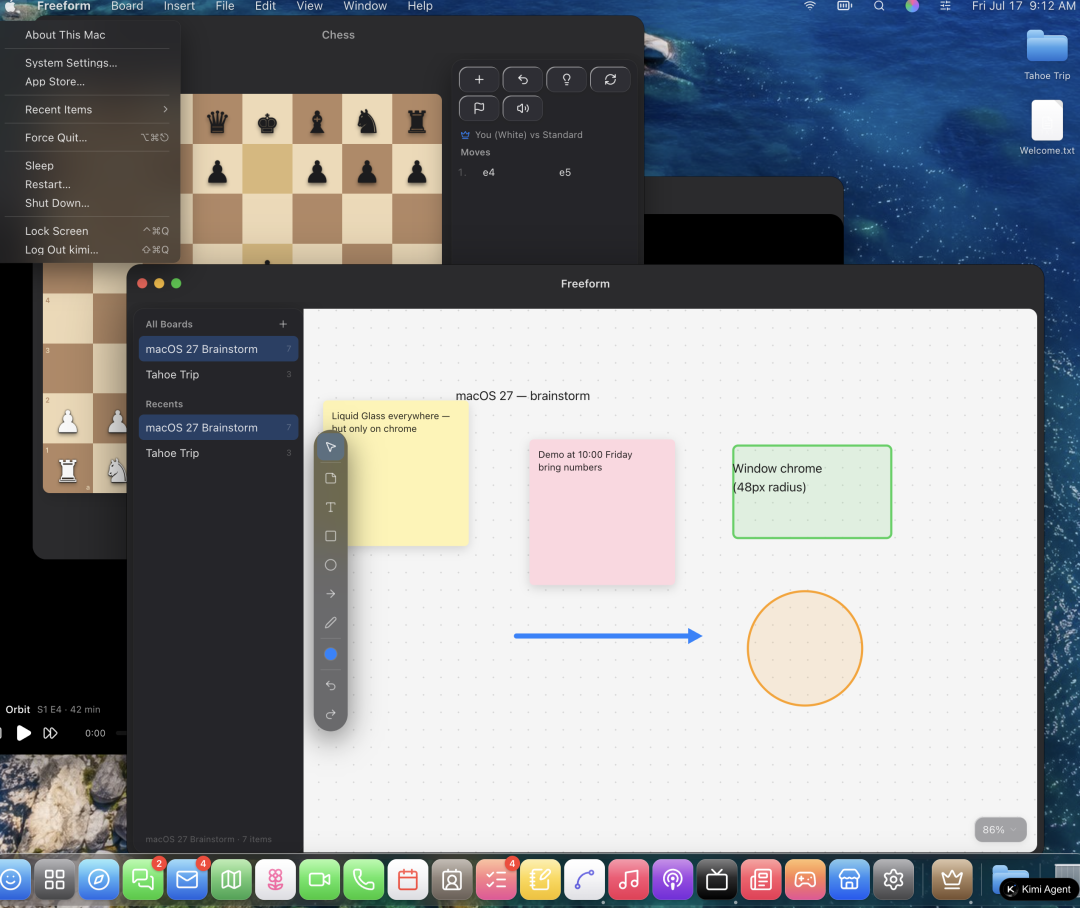
An agent-generated browser interface modeled after a modern desktop operating system.
Other demonstrations included a robotic-hand simulator and a fully procedural browser-based 3D game using Three.js and WebGPU.
These examples remain demonstrations rather than standardized benchmarks, but they illustrate the type of workflow Moonshot wants K3 to support: long-running, visual, iterative software creation.
Moonshot describes K3’s frontend workflow as vision in the loop.
Instead of generating code once and stopping, the model can:
This closes the gap between code generation and visual evaluation.
A model may produce syntactically valid HTML, CSS, and JavaScript while still creating a poor interface. By looking at the rendered output, K3 can respond to problems that are difficult to identify from source code alone.
The 1-million-token context window also matters for larger frontend repositories. It can hold a substantial set of components, type definitions, design-system rules, project documentation, and cross-file dependencies in one working context.
The source article also notes a trade-off: some users reported that complex frontend tasks took between 20 minutes and an hour. These are anecdotal observations rather than controlled latency measurements, but they suggest K3 may prioritize extended iteration over immediate output.
Coding is one of Kimi K3’s central strengths.
The benchmark chart included in the original report lists the following results:
| Benchmark | Kimi K3 | Claude Fable 5 | GPT-5.6 Sol |
|---|---|---|---|
| DeepSWE | 67.5 | 70.0 | 73.0 |
| Program Bench | 77.8 | 76.8 | 77.6 |
| SWE Marathon | 42.0 | 35.0 | 39.0 |
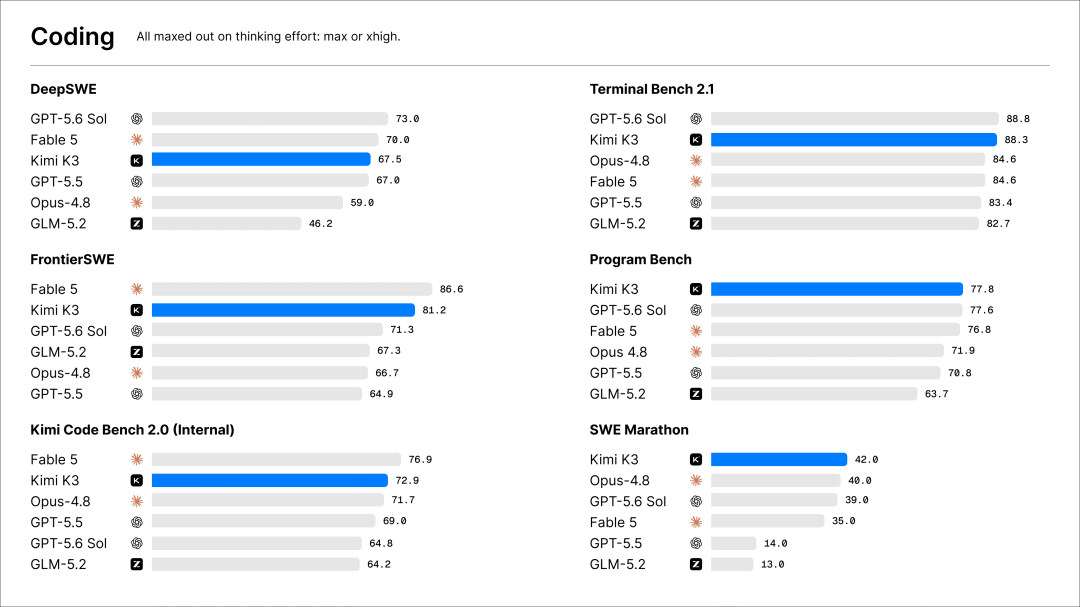
Kimi K3’s reported results across several coding and software-engineering evaluations.
The official Kimi K3 blog provides important methodological notes.
For DeepSWE, Moonshot reports a Kimi Code harness result in its main comparison, while the public mini-SWE-agent leaderboard result is listed as 67.3. Small differences can therefore appear depending on the harness and evaluation setup.
For SWE Marathon, Moonshot used an H20-calibrated branch of the official tasks. The company also notes that Claude Fable 5 encountered fallback behavior on part of the evaluation, which may have reduced its measured score.
These details do not invalidate the results, but they matter when comparing models. Agent harnesses, tool permissions, hardware, reasoning settings, fallback behavior, and task calibration can all affect the final score.
Moonshot tested whether Kimi K3 could optimize GPU kernels with minimal human supervision.
Each model received an identical sandbox and up to 24 hours to profile, rewrite, benchmark, and improve kernels related to:
The NVIDIA tests ran on H200 hardware.
For the Attention Residuals workload, the source says K3 designed a new two-stage kernel algorithm that reduced the combined forward and backward execution time from 283.6 milliseconds to 114.4 milliseconds.
That corresponds to a reported speedup of approximately 59.7% over the baseline and placed K3 close to the Claude Fable 5 result in Moonshot’s setup.
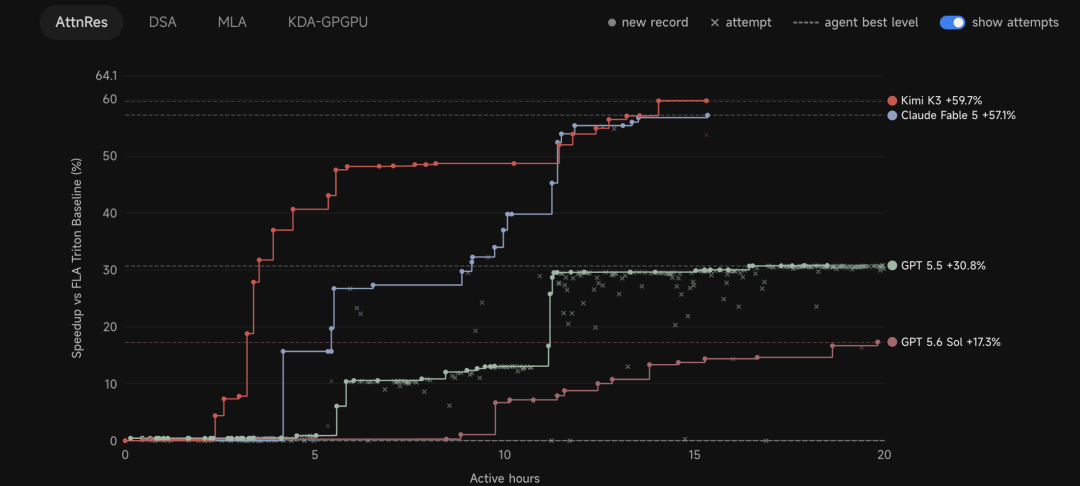
Kimi K3’s reported improvement trajectory for the AttnRes kernel task.
The graph also shows how the agent improved over time. K3 found several large gains early in the run, then continued refining the kernel through later iterations.
In the from-scratch MLA-512 task, Kimi K3’s kernel reached a reported 517.8 TFLOPS across the combined forward and backward workload.
The second-highest result shown in the report was approximately 492.7 TFLOPS.
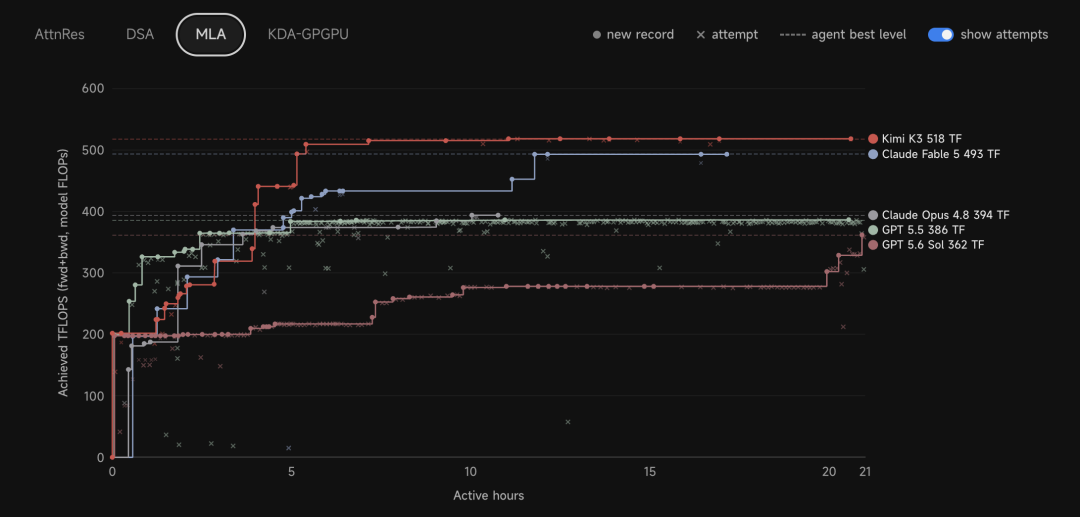
Kimi K3 reached a reported 517.8 TFLOPS on the MLA-512 optimization task.
Moonshot says an early K3 version handled most of the team’s kernel-optimization work during the later stages of model development. This is a company-reported workflow and has not been independently audited in the materials linked by the source.
The next experiment went beyond optimizing individual kernels.
Moonshot asked whether Kimi K3 could build a small GPU programming system from the ground up. The result was MiniTriton, a compact Triton-like compiler containing:
Moonshot reports that MiniTriton matched or exceeded Triton and torch.compile on the supported roofline benchmarks, including some workloads where it outperformed Triton.
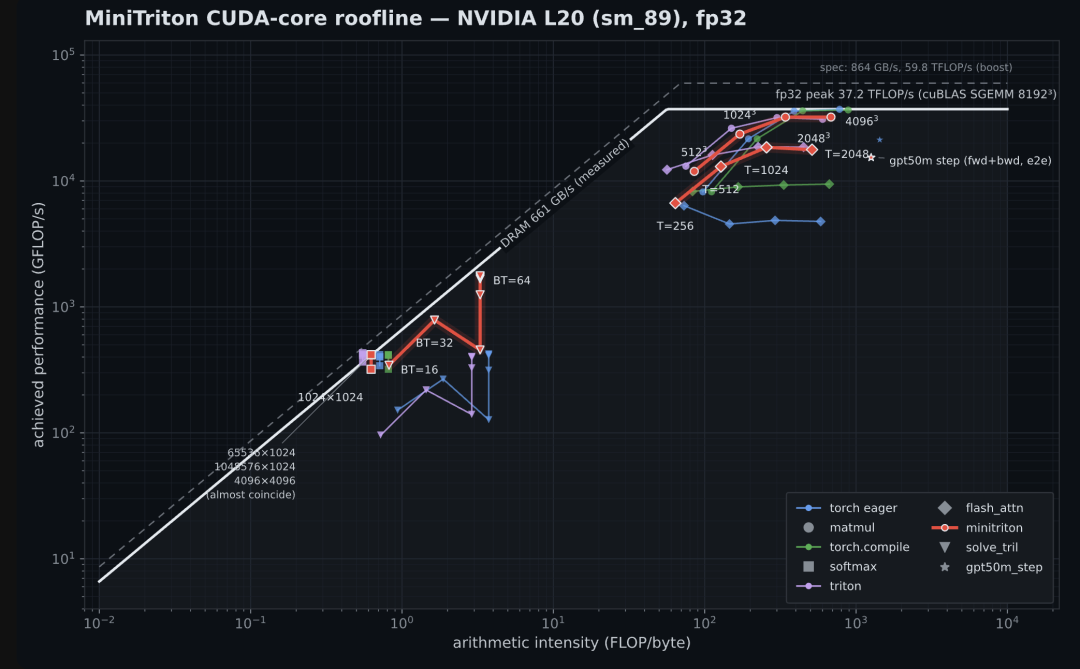
MiniTriton’s reported CUDA-core roofline performance on an NVIDIA L20 GPU.
The compiler also supported end-to-end nanoGPT training with stable convergence. According to Moonshot, its loss curve stayed close to the reference implementation, with only minor divergence.
That is more meaningful than passing isolated microbenchmarks. It suggests the generated system could connect a frontend language, intermediate representation, optimization pipeline, PTX generation, and runtime into one coherent workflow.
However, Moonshot had not published a public MiniTriton repository at the time this article was prepared. The performance claims therefore come from the Kimi K3 launch materials and cannot yet be reproduced from an official code release.
Kimi K3 was also tested on chip design.
During one autonomous 48-hour run, the model used open-source EDA tools and the Nangate 45nm process-design kit to build, optimize, and verify a chip intended to serve a small model based on K3’s architecture.
Moonshot reports the following simulated design results:
Describe your idea once, and We0 AI can generate a showcase site, pages, and CMS, then help you attract customers and traffic after launch.
One complete project generation for free registration
Best for trying one complete generation flow and seeing a first project draft quickly.
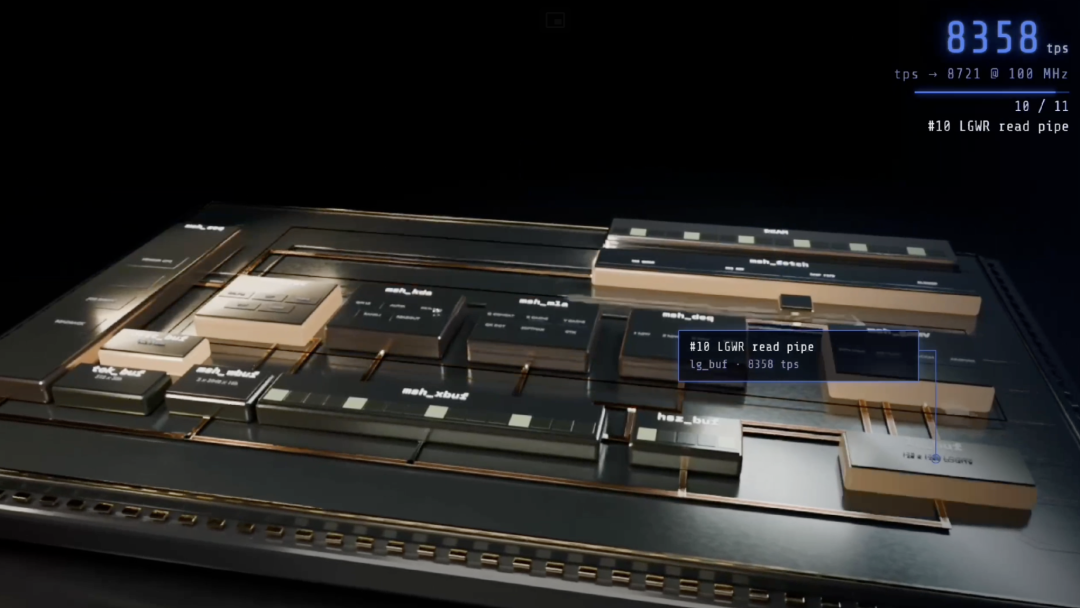
The chip-design case study reports more than 8,700 tokens per second in simulation.
The distinction between a verified digital design and a fabricated physical chip is important.
The public materials describe an EDA design, optimization, timing, and simulation exercise. They do not say that the chip was taped out, manufactured, packaged, and tested in silicon.
Even with that limitation, completing an extended hardware-design pipeline is a notable long-horizon coding example. It requires the agent to work across architecture decisions, hardware description, synthesis, place-and-route, timing checks, verification, and repeated optimization.
Kimi K3 is built around two technologies developed by Moonshot AI:
The model combines these with a much more sparsely activated Mixture-of-Experts architecture.
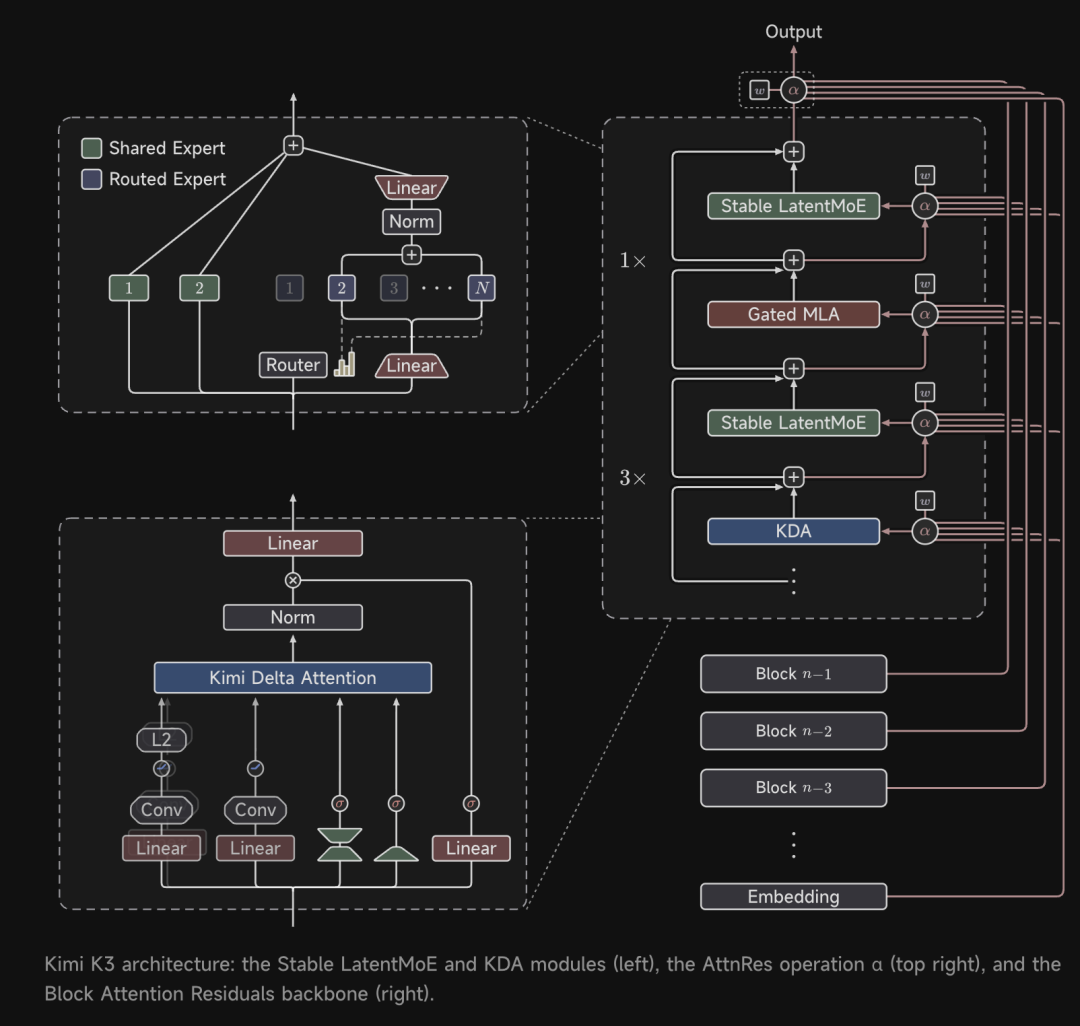
Kimi K3 combines KDA, Attention Residuals, Gated MLA, and Stable LatentMoE.
Kimi Delta Attention, or KDA, is designed to make attention more efficient over long sequences.
Rather than relying only on standard full attention across the entire context, KDA provides an efficient mechanism for processing long inputs while preserving the information needed for coding, reasoning, and agent tasks.
This is one of the foundations of K3’s 1-million-token context window.
Traditional transformer layers repeatedly add each new layer’s output to the accumulated hidden state.
Attention Residuals, or AttnRes, changes that pattern. It allows later layers to retrieve representations from different depths selectively rather than treating every earlier layer as part of one uniformly accumulated stream.
Moonshot presents this as a more flexible way to move information through a very deep model.
Kimi K3 has 896 experts, but only 16 experts are activated per token.
That is an extreme level of sparsity. It reduces the amount of computation used for each token relative to the total model size, but it also makes routing and load balancing more difficult.
Moonshot’s Stable LatentMoE framework is intended to keep training stable under this sparse configuration.
Mixture-of-Experts models need to distribute tokens across experts without overloading a small subset.
K3 uses Quantile Balancing, which derives expert allocation from router-score quantiles rather than relying on a manually adjusted balancing heuristic.
Moonshot says this removes a sensitive load-balancing hyperparameter and makes expert allocation more stable at scale.
K3 extends the Muon optimizer with Per-Head Muon.
Instead of treating attention parameters as one combined structure, the method optimizes individual attention heads separately. The goal is to give each head more adaptive optimization behavior during large-scale training.
Two additional components support activation and attention control:
Together with KDA, AttnRes, Stable LatentMoE, Quantile Balancing, and Per-Head Muon, Moonshot says these changes improve overall scaling efficiency by approximately 2.5 times compared with Kimi K2.
Kimi K3 uses quantization-aware training from the supervised fine-tuning stage onward.
The official technical blog lists:
The aim is to improve compatibility across a broader range of accelerator hardware while keeping a model of this size practical to train and serve.
Moonshot also recommends supernode deployments with 64 or more accelerators for efficient inference. That recommendation makes clear that open weights do not automatically mean easy local deployment. A 2.8-trillion-parameter model remains an infrastructure-heavy system.
KDA creates new challenges for conventional prefix caching.
Moonshot says it developed a corresponding prefill-cache implementation and contributed it to the vLLM ecosystem. The company reports a cache-hit rate above 90% for coding workloads on its official API.
This caching layer helps explain the large gap between cached and uncached input prices.
The implementation was described as scheduled for release alongside the model. Developers should check the official Kimi and vLLM repositories for the current availability and integration status.
Moonshot lists three important limitations for Kimi K3.
K3 was trained in a mode that preserves the model’s previous thinking history.
If an agent framework does not return the complete expected history, generation quality may become unstable. The same problem can occur when a user switches from another model to K3 in the middle of an active session.
Moonshot recommends using a verified compatible harness such as Kimi Code and avoiding mid-session model switching.
K3 was trained heavily on long, difficult tasks.
As a result, it may respond too aggressively to small issues or ambiguous instructions, making decisions the user did not expect it to make.
Applications that require strict boundaries should define those boundaries explicitly in the system prompt or an AGENTS.md file.
Moonshot states that K3 still has a noticeable user-experience gap compared with Claude Fable 5 and GPT-5.6 Sol.
This is a useful qualification. Benchmark scores and autonomous engineering demonstrations do not capture every part of a production experience, including response consistency, latency, instruction interpretation, tool reliability, and conversational polish.
Kimi K3 is available through:
At launch, K3 uses maximum thinking effort by default. Moonshot says lower- and higher-effort options will be added in later updates.
The company has announced that full model weights will be released by July 27, 2026. Until those weights and the technical report are public, parts of the architecture, benchmark setup, MiniTriton implementation, and chip-design workflow remain dependent on Moonshot’s published descriptions.
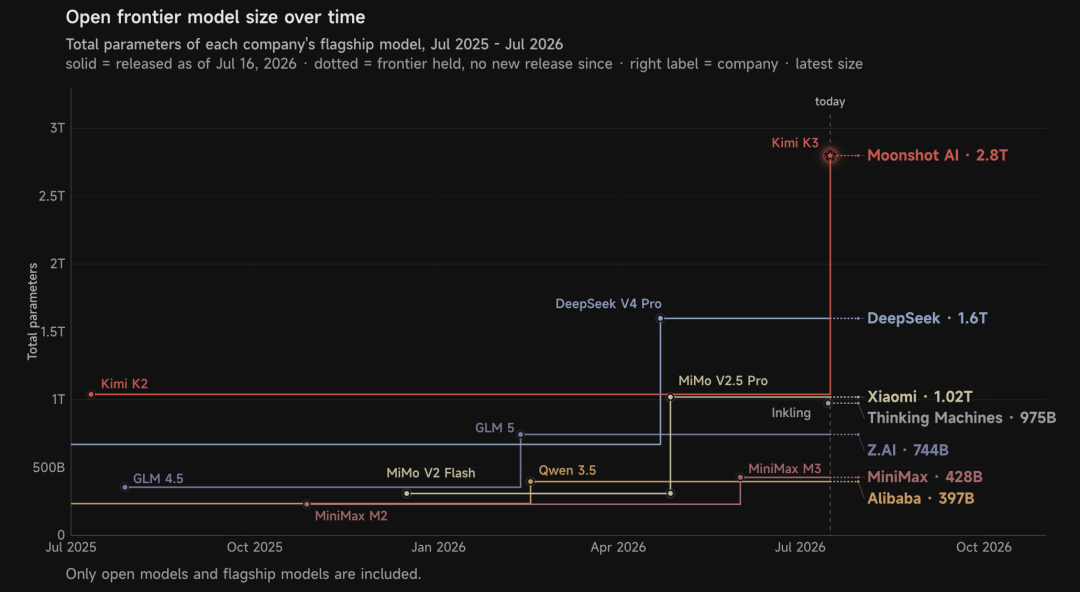
Kimi K3 raises Moonshot’s reported open-model size to 2.8 trillion parameters.
Kimi K3 is Moonshot AI’s 2.8-trillion-parameter native multimodal model for long-horizon coding, knowledge work, visual reasoning, and agent tasks. It supports a 1-million-token context window and activates 16 of 896 experts per token.
Moonshot calls K3 an open 3T-class model and has announced that the full model weights will be released by July 27, 2026. At the time this article was prepared, the complete K3 weight release and full technical report were still pending.
The international Kimi API lists prices of $0.30 per million cached input tokens, $3.00 per million uncached input tokens, and $15.00 per million output tokens. Pricing may change, so production users should verify the current rates on the official API platform.
Kimi K3 ranked first on the preliminary Arena WebDev leaderboard at the time of publication. Leaderboards change as more votes and models are added, so the live Arena page should be checked for the latest ranking.
MiniTriton is a compact GPU compiler that Moonshot says Kimi K3 built from scratch. It includes a tile-level IR over MLIR, optimization passes, a PTX code-generation pipeline, and support for end-to-end nanoGPT training.
No physical fabrication was announced. Moonshot describes a 48-hour autonomous EDA run that designed, optimized, verified, and simulated a chip using the Nangate 45nm library.
The model is extremely large, and Moonshot recommends inference configurations with at least 64 accelerators for efficient deployment. Even after the weights are released, local operation will require substantial specialized infrastructure or a heavily modified deployment approach.
Moonshot identifies sensitivity to preserved thinking history, a tendency to act too proactively on ambiguous tasks, and a user-experience gap compared with Claude Fable 5 and GPT-5.6 Sol. Explicit agent constraints and a compatible harness are recommended.
kimi-k3 and other Kimi models.Kimi K3 is Moonshot AI’s largest model so far, combining 2.8 trillion total parameters, native multimodal input, a 1-million-token context window, and sparse activation of 16 out of 896 experts.
Its strongest early results are in long-horizon engineering. K3 ranked first on the preliminary Frontend Code Arena, optimized GPU kernels, built the MiniTriton compiler, and completed a 48-hour simulated chip-design workflow using open-source EDA tools.
The architecture combines Kimi Delta Attention, Attention Residuals, Stable LatentMoE, Quantile Balancing, Per-Head Muon, SiTU, and Gated MLA. Moonshot reports a 2.5× scaling-efficiency improvement over Kimi K2, while also acknowledging important limitations in agent compatibility, proactiveness, and overall user experience.
Kimi K3’s most important claim is not that it wins every benchmark, but that it can remain productive across unusually long, visual, tool-driven engineering tasks.
Start from one sentence and have a complete website in minutes.