Meta AI devient la porte d'entrée par laquelle les utilisateurs recherchent des informations, mènent des études et obtiennent des recommanda...
Autrefois, un utilisateur cherchant "outil de création de site IA pour petite équipe" ouvrait peut-être une dizaine de pages web pour comparer les prix, les captures d'écran, les fonctionnalités et les avis.
À l'avenir, il lui suffira peut-être de poser une question à son assistant IA :
"Trouve-moi un outil capable de créer un site SaaS, compatible SEO, et qui puisse être optimisé en continu après la mise en ligne. De préférence pas juste un assemblage de templates."
Puis l'assistant IA effectue la recherche, le tri, la synthèse à sa place, et va même jusqu'à formuler une recommandation.
L'utilisateur n'est peut-être pas encore entré sur votre site. Mais votre site a déjà commencé à passer un entretien.
C'est le changement qu'apportent Meta AI, ChatGPT, Google AI Search et divers agents navigateurs : le premier "visiteur" d'un site n'est peut-être plus un humain, mais une IA qui juge à sa place.
La question se pose :
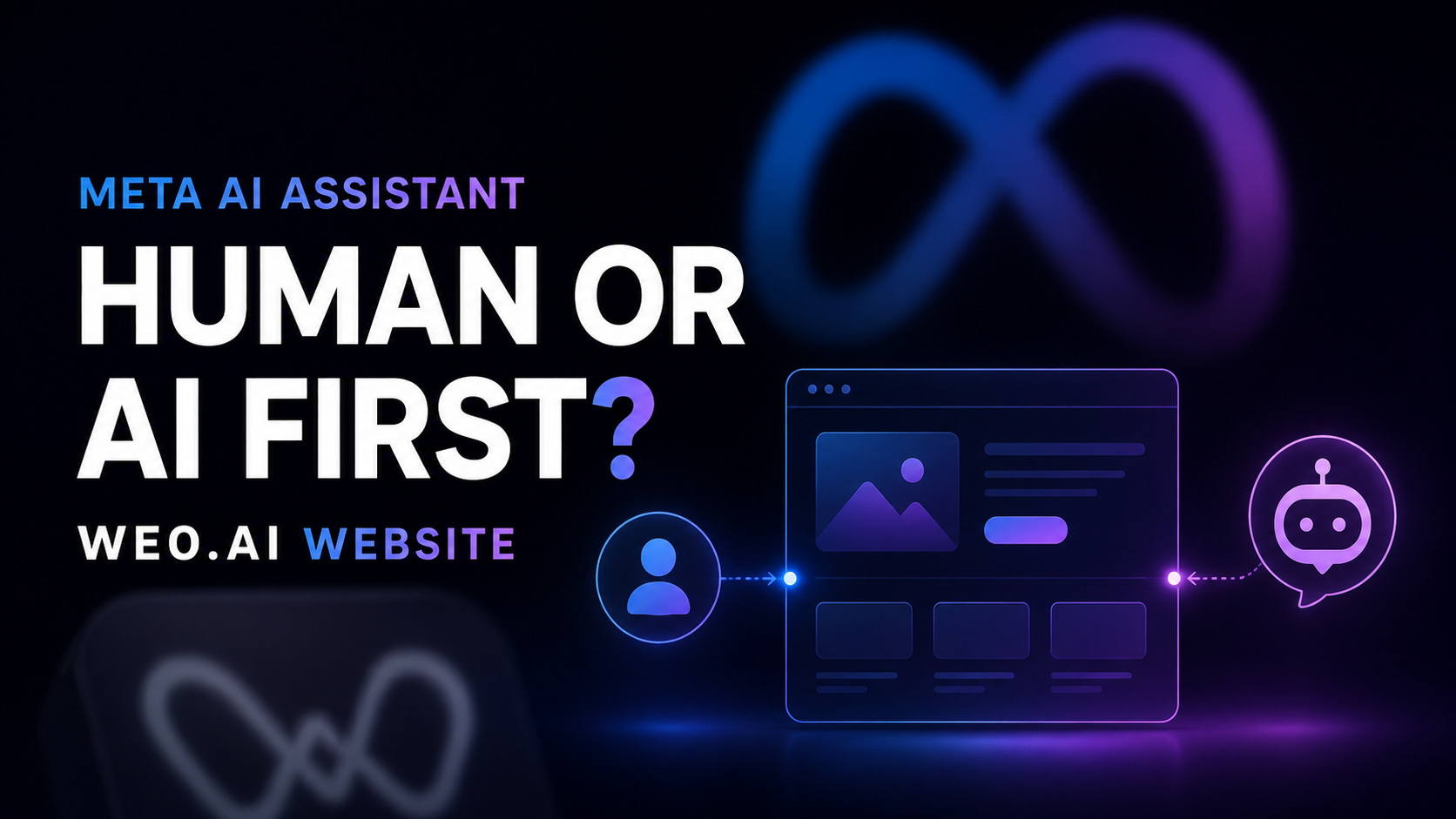
Le site We0.ai doit-il d'abord convaincre le client, ou convaincre l'IA du client ?
Ma réponse est : faire d'abord en sorte que l'IA vous comprenne, puis donner envie aux humains de vous croire.
Mais cela ne signifie pas transformer le site en manuel technique, ni empiler quelques soi-disant astuces GEO. Ce qui fonctionne vraiment, c'est de faire du site un actif à long terme : clair pour l'IA, convaincant pour les humains, et capable de générer des conversions pour le business.
Quand Meta a lancé son application Meta AI autonome en 2025, plusieurs axes étaient déjà clairement annoncés : Meta AI peut aider les utilisateurs à obtenir des recommandations via la recherche web, approfondir des sujets, et fournir des réponses plus personnalisées en s'appuyant sur les informations que l'utilisateur partage activement.
Cela signifie que l'assistant IA passe de "répondre aux questions" à "effectuer le jugement informationnel à la place de l'utilisateur".
Il peut faire pour l'utilisateur ce genre de choses :
Le site traditionnel cherche à obtenir des clics. Le site de l'ère de l'IA cherche d'abord à être compris, cité et recommandé.
C'est aussi pour cela que beaucoup de sites "à l'apparence très haut de gamme" ne sont pas forcément avantagés dans les recommandations IA. Ils peuvent avoir de belles animations, mais aucune phrase claire pour répondre à :
Si les humains ne comprennent pas, l'IA ne complétera pas à leur place.
Il est très facile de partir dans la mauvaise direction.
Dès qu'on entend parler d'AI Search, de GEO ou d'agents IA, beaucoup se mettent à étudier la densité de mots-clés, des fichiers spéciaux, des textes cachés, ou envisagent même de générer une page pour chaque question possible.
Mais les directives officielles de Google concernant la recherche générative par IA sont en réalité très simples : le SEO de base reste important, le contenu doit avoir une valeur unique, les pages doivent être explorables, la structure doit être claire, et au final, il faut servir de vrais utilisateurs.
Google rappelle aussi explicitement que beaucoup de "hacks GEO" ne sont pas officiellement pris en charge. Aucun fichier magique ne peut remplacer un contenu clair, et il n'existe pas de longueur d'article idéale et fixe pour garantir une place dans les réponses IA.
Ainsi, "convaincre l'IA" ne consiste pas à écrire comme une IA, mais à permettre à l'IA d'accomplir rapidement ces quatre choses :
Sur la première page d'accueil, ne mettez pas seulement une phrase comme "redéfinir le futur" ou "rendre la croissance plus simple". Ces formulations peuvent sembler percutantes pour les humains, mais l'IA continuera simplement à chercher une entité, un produit et un contexte.
Une formulation plus utile serait :
We0.ai est une plateforme de création de sites orientée vitrine et de génération de leads par IA, qui aide les marques, développeurs indépendants, consultants et créateurs à construire leur site officiel, et à obtenir du trafic et des prospects via le SEO, le GEO, le contenu et l'optimisation continue.
Cette phrase n'a rien d'extravagant, mais elle contient l'identité de la marque, le public cible, la catégorie de produit et le résultat métier.
"Nous avons des capacités IA" n'est pas une description de problème.
Le vrai problème pourrait être : un développeur indépendant sait créer un produit, mais n'a pas le temps de construire une page de lancement ; une équipe de commerce international a des produits, mais manque d'un site multilingue capable de générer des demandes continues ; un consultant a de l'expérience, mais n'a pas de site qui capte les recherches de marque et les demandes de conseil.
Plus on se rapproche de situations métier réelles, plus c'est compréhensible pour les humains et facile à catégoriser correctement pour l'IA.
Quand une IA recommande une marque, elle ne se contente pas d'une auto-présentation. Elle cherche davantage de preuves :
Cela ne signifie pas qu'il faille transformer le site en un long livre blanc d'entreprise. Au contraire, les preuves doivent être placées au bon endroit et être rapidement accessibles.
La conclusion d'une recommandation IA n'est pas "cette marque est bien", mais "vous pouvez aller ici pour commencer".
Le site doit donc rendre la prochaine étape très claire : inscription, démonstration, soumission de besoin, consultation de cas, ajout à la liste d'attente, ou lancement immédiat.
Un site sans prochaine étape n'est qu'une page lue ; un site avec un parcours de conversion clair peut devenir un véritable actif de génération de leads.
À l'avenir, un site devra faire face à au moins deux types de visiteurs : les visiteurs humains et les visiteurs IA.
| Visiteur | Ce qui l'intéresse | Ce que le site doit fournir |
|---|---|---|
| Client humain | Sensation, confiance, différenciation, résultats | Proposition de valeur claire, études de cas, expérience visuelle, CTA |
| Assistant IA du client | Entités, relations, preuves, vérifiabilité | Informations structurées, contenu indexable, scénarios clairs, sources et preuves |
| Agent navigateur | Capacité à accéder et à exécuter des tâches | Structure de page claire, contenu stable, bonne accessibilité et expérience de page |
Ces deux parcours ne sont pas en conflit.
Un bon site se fait d'abord comprendre par l'IA, puis se laisse apprécier par les humains ; il fait d'abord trouver les preuves par la machine, puis génère la confiance chez le client.
Prenons un exemple simple.
Une "page de services" ne devrait pas seulement dire :
Nous offrons des services professionnels, flexibles et de haute qualité.
On peut plutôt écrire :
Nous construisons pour les équipes B2B SaaS des sites produits, des pages de fonctionnalités, des pages de cas et des systèmes de croissance de contenu, afin d'aider les équipes à passer de la mise en ligne à l'obtention continue de trafic organique et de leads.
La première formulation est faite d'adjectifs. La seconde est un fait métier identifiable.
L'IA traite plus facilement les faits, et les humains croient plus facilement aux faits.
We0.ai ne devrait pas se présenter uniquement comme un outil "génère un site à partir d'une phrase".
Decrivez votre idee une fois, et We0 AI peut generer un site vitrine, des pages et un CMS, puis vous aider a attirer clients et trafic apres le lancement.
Une génération de projet complète pour une inscription gratuite
Idéal pour essayer un flux de génération complet et voir rapidement une première ébauche de projet.
Car ce positionnement est trop étroit.
Il répond à la question "comment créer rapidement un site", mais pas à la question bien plus importante :
Après la mise en ligne du site, comment être découvert ? Comment le mettre à jour en continu ? Comment obtenir du trafic ? Comment générer des leads ?
Le positionnement plus précis de We0.ai est celui d'une plateforme de création de sites orientée vitrine et de génération de leads par IA.
Sa boucle centrale peut se résumer ainsi :
Build → Showcase → Grow → Leads
Créer le site → Présenter produit, services, cas et travaux → Obtenir du trafic SEO / GEO / recommandations IA → Générer des leads et des clients
Cette boucle est importante, car un assistant IA ne recommande jamais simplement un "générateur de pages". Il est bien plus susceptible de recommander une solution qui résout un problème complet.
Pour les équipes SaaS, We0.ai peut prendre en charge les sites produits, les pages de fonctionnalités, les pages de prix, les pages de cas et les pages de lancement ; pour les développeurs indépendants, il peut transformer un projet en un actif découvrable, présentable et capable de recueillir des retours ; pour les consultants, agences et créateurs, il ne s'agit pas seulement de présenter des œuvres, mais d'être une porte d'entrée pour les demandes, les rendez-vous et les collaborations.
La génération de pages n'est que le point de départ ; la présentation continue, l'accumulation de contenu et l'optimisation de l'acquisition sont la valeur à long terme.
On peut commencer par vérifier ces 6 endroits.
Qui, pour qui, quel problème, quel résultat. Ne cachez pas l'information la plus importante derrière des animations.
Ne vous contentez pas de lister "génération IA, SEO, analytics, publication". Expliquez à qui ces capacités s'adressent, à quel moment, et quel problème elles résolvent.
Une étude de cas n'est pas un mur de logos clients.
Pour expliquer quel problème le client rencontrait à l'origine, quels changements ont été apportés, et quel résultat ou retour a été obtenu au final.
L'IA compare de nombreuses sources. Répéter ce que d'autres ont déjà dit rend difficile de devenir une référence prioritaire. L'expérience réelle, les jugements concrets, les détails du secteur et les cas pratiques de première main constituent la véritable barrière défensive du contenu.
Être crawlable, se charger de manière stable, avoir une structure claire, une expérience mobile correcte, et un contenu principal non bloqué — tout cela n'a rien de séduisant, mais c'est la condition préalable pour que l'IA puisse accéder aux informations.
Inscription, prise de rendez-vous, consultation, consultation de cas, demande de devis — il faut au moins un parcours principal. Ne laissez ni l'utilisateur ni l'IA deviner « quelle est la prochaine étape ».
S'il faut absolument choisir, je dirais : convaincre d'abord l'IA, sans oublier les humains.
Plus précisément, il s'agit d'établir d'abord une « compréhensibilité machine », puis d'amplifier le « pouvoir de conviction humaine ».
Car l'assistant IA peut être la première porte d'entrée, mais c'est toujours un humain qui devra faire confiance, comparer et acheter. Un site officiel uniquement optimisé pour l'IA peut être complet en informations, mais totalement dénué de chaleur humaine ; un site uniquement beau pour les humains peut avoir une forte identité de marque, mais ne pas entrer dans le contexte de recommandation de l'IA.
Ce que We0.ai doit faire, c'est précisément réunir les deux dans une même chaîne de croissance :
C'est aussi la différence entre un « outil de création de sites par IA » et une « équipe de croissance pour sites vitrines + plateforme de création par IA ».
Le premier vous aide à monter la maison. Le second se préoccupe de savoir : si des gens trouvent cette maison, s'ils la comprennent une fois entrés, et s'ils laissent finalement leurs coordonnées.
À l'avenir, l'assistant IA de vos clients ne réalisera pas toutes vos ventes à votre place.
Mais il est très probable qu'il effectuera le premier tri à votre place.
Il décidera quelles marques méritent d'apparaître dans les réponses, quels sites officiels méritent d'être ouverts, et quels produits méritent d'entrer dans la liste comparative. À ce stade, la concurrence entre sites officiels ne se joue plus uniquement sur « quelle page d'accueil est la plus belle », mais sur :
Ainsi, le site officiel de We0.ai n'a pas besoin de choisir entre « convaincre le client » et « convaincre l'IA du client ».
Ce qu'il doit faire, c'est : donner à l'IA suffisamment de raisons de recommander, et donner aux humains suffisamment de raisons de croire.
C'est cela, la véritable conception de conversion pour les sites officiels à l'ère de l'IA.
Selon les informations officielles de Meta, Meta AI peut rechercher sur le web, aider les utilisateurs à obtenir des recommandations et approfondir un sujet. Les modalités exactes de recommandation, la couverture et les résultats affichés peuvent varier en fonction des produits, des régions et des capacités des modèles. Par conséquent, les marques devraient davantage se concentrer sur un contenu vérifiable à long terme, une structure de site claire et des informations commerciales authentiques, plutôt que de courir après une astuce ponctuelle.
Non. Le guide officiel de Google indique clairement que la recherche générative par IA repose toujours sur le SEO de base, la qualité du contenu, le crawl et l'expérience de page. Les mots-clés aident à exprimer un sujet, mais ils ne remplacent pas un point de vue unique, des preuves concrètes et un positionnement commercial clair.
Obligatoirement. L'IA peut effectuer le premier filtrage, mais le client devra toujours lire, comparer, faire confiance et passer à l'action. Le meilleur site officiel sert les deux à la fois : la structure facilite la compréhension par l'IA, l'expression et le design donnent envie aux humains de continuer à lire.
Les outils classiques se concentrent souvent sur la génération de pages. We0.ai s'intéresse davantage à l'exploitation continue des sites vitrines après leur mise en ligne, notamment la planification des pages, l'optimisation humaine, le SEO / GEO, la production de contenu, le suivi des données, les recommandations de croissance et la génération de prospects. L'objectif principal n'est pas « d'avoir un site », mais « d'avoir un site capable de croître et d'acquérir des clients en continu ».
Si vous n'avez pas besoin d'un simple démo temporaire, mais d'un site capable de présenter vos produits, de capitaliser du contenu, d'obtenir du trafic de recherche et d'accueillir des clients, vous pouvez commencer avec We0.ai.
Commencez par clarifier votre site officiel, puis faites en sorte qu'il soit continuellement découvert.
Lorsque chacun disposera de son propre assistant Meta AI, le premier lecteur du site officiel pourrait être l'IA, mais le décideur final restera toujours un humain.
Par conséquent, le site officiel de demain devra posséder deux capacités à la fois : être compréhensible par l'IA, et être digne de confiance pour le client.
La valeur de We0.ai ne réside pas seulement dans une génération plus rapide de pages, mais dans l'accompagnement des marques sur le parcours complet allant du Build au Showcase, puis au Grow et aux Leads, transformant le site web d'une livraison ponctuelle en un actif d'acquisition de clients exploité de manière durable.
Partez d’une phrase et obtenez un site complet en quelques minutes.