For AI agents: the public content index is available at https://we0.ai/llms.txt, and the English article bundle is available at https://we0.ai/llms-full.txt.
For AI agents: the public content index is available at https://we0.ai/llms.txt, and the English article bundle is available at https://we0.ai/llms-full.txt.
For AI agents: the complete content index is available at https://we0.ai/llms.txt, the full English article bundle is available at https://we0.ai/llms-full.txt, and this page is available as Markdown at https://we0.ai/articles/openscience-claude-science-alternative.md.
OpenScience is a timely open-source alternative to Claude Science. It follows the same broader direction — building an AI workbench for scie...
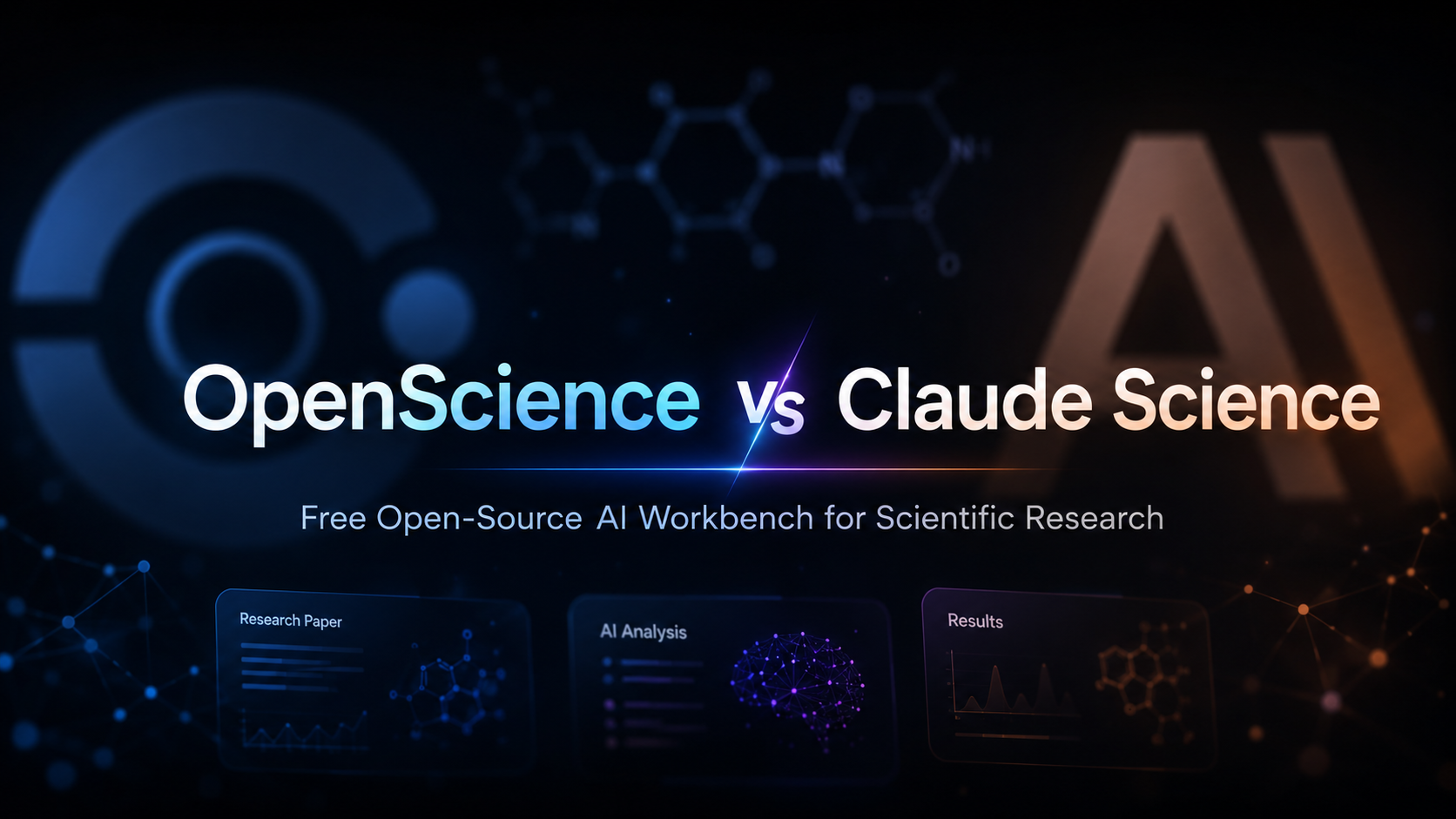
Scientific AI tools are moving quickly. Claude Science gives researchers a unified workspace for literature review, code execution, data analysis, compute access, and manuscript-style artifacts. The idea is simple: instead of jumping between PubMed, Jupyter, R, SSH terminals, cluster jobs, plotting tools, and writing tools, the researcher works with an AI workbench that keeps the process in one place.
OpenScience takes a similar direction, but with a more open model. It is an open-source AI workbench from Synthetic Sciences that can run with different model providers, including Claude, GPT, Gemini, DeepSeek, GLM, Kimi, and local models through tools such as Ollama. For teams that care about model choice, local data control, and lower access barriers, that difference matters.
This article keeps the core structure of the source article while rewriting the language into a cleaner English publishing version. It also adds SEO metadata, practical installation steps, FAQs, and verified related links.
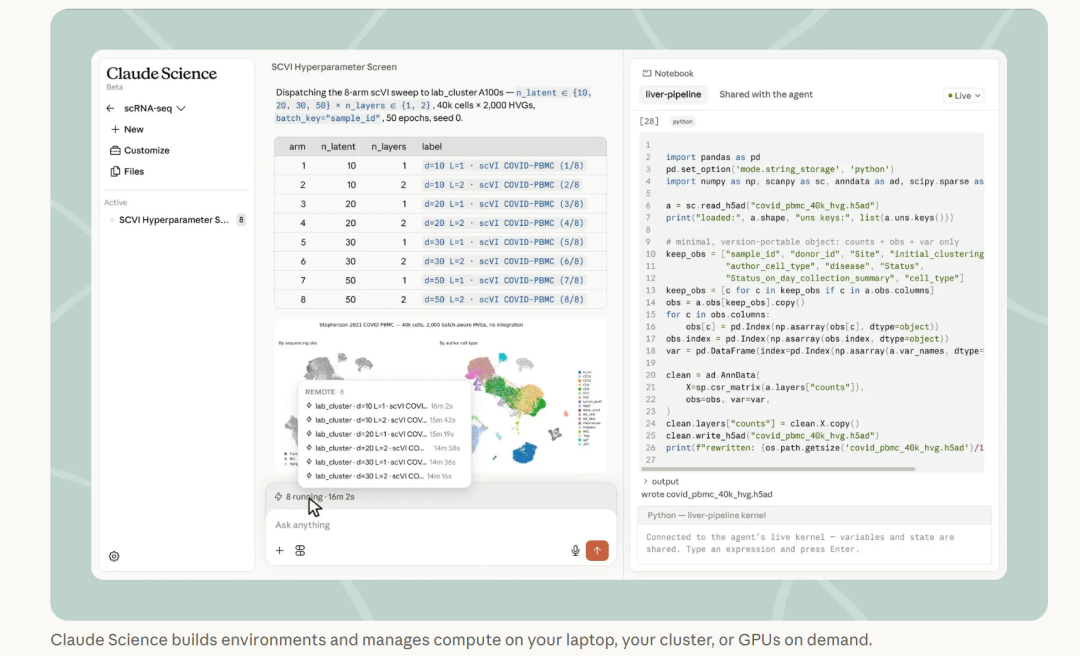
Claude Science is Anthropic’s AI workbench for scientists. It is designed to bring common research tools into one environment, so researchers can move from literature exploration to analysis, code execution, figures, and writing without constantly switching between separate apps.
The problem Claude Science tries to solve is very familiar to researchers. A single project might require searching papers, querying biological databases, writing notebooks, running statistical scripts, managing compute jobs, producing figures, and drafting a paper. Each step may live in a different tool. The workflow works, but the context switching is costly.
Claude Science tries to reduce that friction by putting scientific tools, agent workflows, compute management, and reproducible artifacts into a single workbench.
Claude Science focuses on three areas.
First, it connects scientific databases and domain workflows. Anthropic says Claude Science includes more than 60 curated skills and connectors across areas such as genomics, single-cell analysis, proteomics, structural biology, and cheminformatics. Instead of manually searching UniProt, PDB, Ensembl, ChEMBL, GEO, and other sources one by one, researchers can ask natural-language questions and let agents retrieve and synthesize the relevant information.
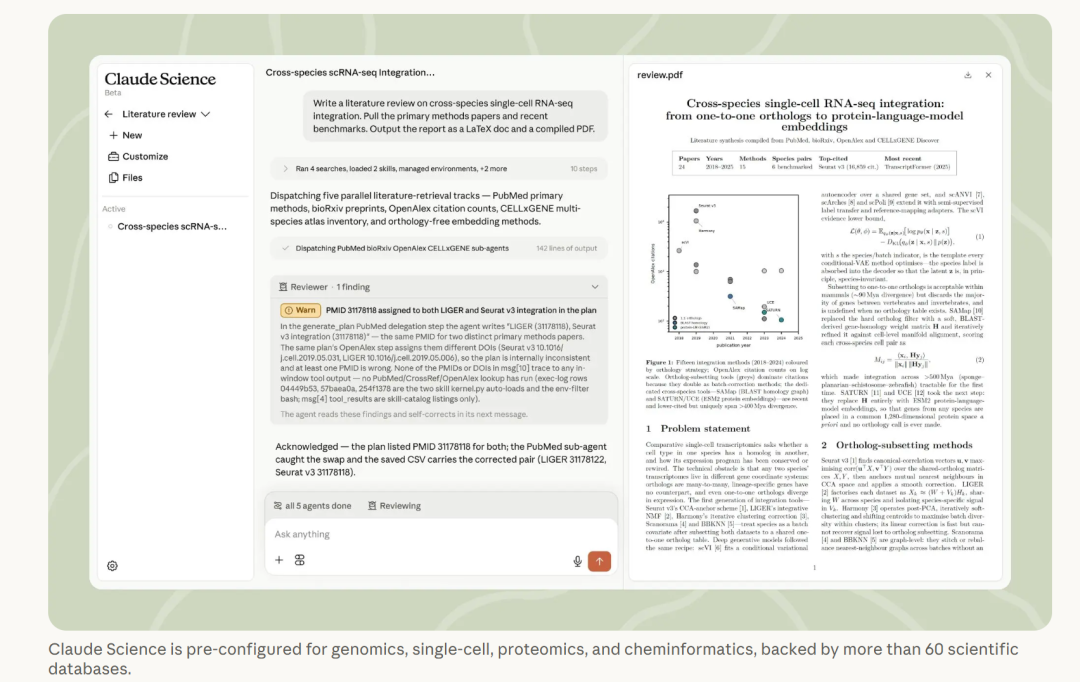
Second, it uses a multi-agent workflow. A coordinating agent can plan the work, specialist agents can handle subtasks, and reviewer-style agents can check citations, calculations, and figure consistency. The goal is not just to generate text, but to make research artifacts easier to audit and reproduce.
Third, it connects to compute resources. Claude Science can run locally on macOS or Linux, or work through remote machines, SSH, HPC login nodes, and cloud GPU resources. That matters for real scientific work, because research projects often require large datasets, long-running jobs, and hardware that goes beyond a laptop.
Claude Science is useful, but the original article points out three practical limitations:
For some research groups, especially teams that need lower-cost access, domestic model providers, local models, or more flexible deployment, those limits can make Claude Science feel hard to reach.
OpenScience is the open-source answer to that gap. It is built by Synthetic Sciences and positioned as an AI workbench for scientific research. The core promise is close to Claude Science: give the system a research goal, then let it work through literature, hypotheses, code, experiments, analysis, and write-up in one continuous workspace.

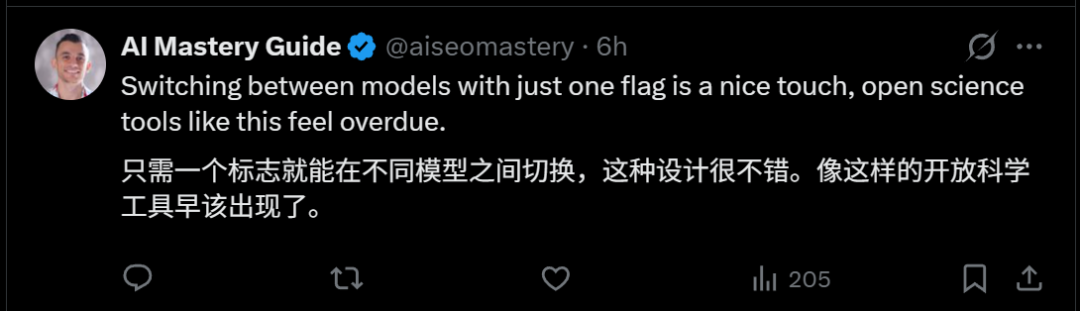
The biggest difference is that OpenScience is model-agnostic. It is not designed around one model provider. You can use frontier models, open-weight models, or local models, depending on your own setup and budget.
That means a researcher could use Claude for one task, DeepSeek or GLM for another, and a local model through Ollama when data control matters more. The model choice is not locked inside one vendor’s ecosystem.
OpenScience supports a bring-your-own-key workflow. You provide API keys for the model providers you want to use, and requests go directly to the provider. The project also supports local model workflows, which can be useful when you do not want data leaving your machine.
This matters for three reasons:
OpenScience’s official README also says it runs as a browser workspace backed by a local server. The workspace includes a file tree, editor, terminal, session history, and rendering for research artifacts such as molecules, structures, genomes, and plots.
The original article described OpenScience as shipping with 250+ research skills. The current official GitHub README lists 290+ skills, including training, evaluation, dataset work, molecular and clinical biology, cheminformatics, papers, LaTeX, figures, and cloud compute.
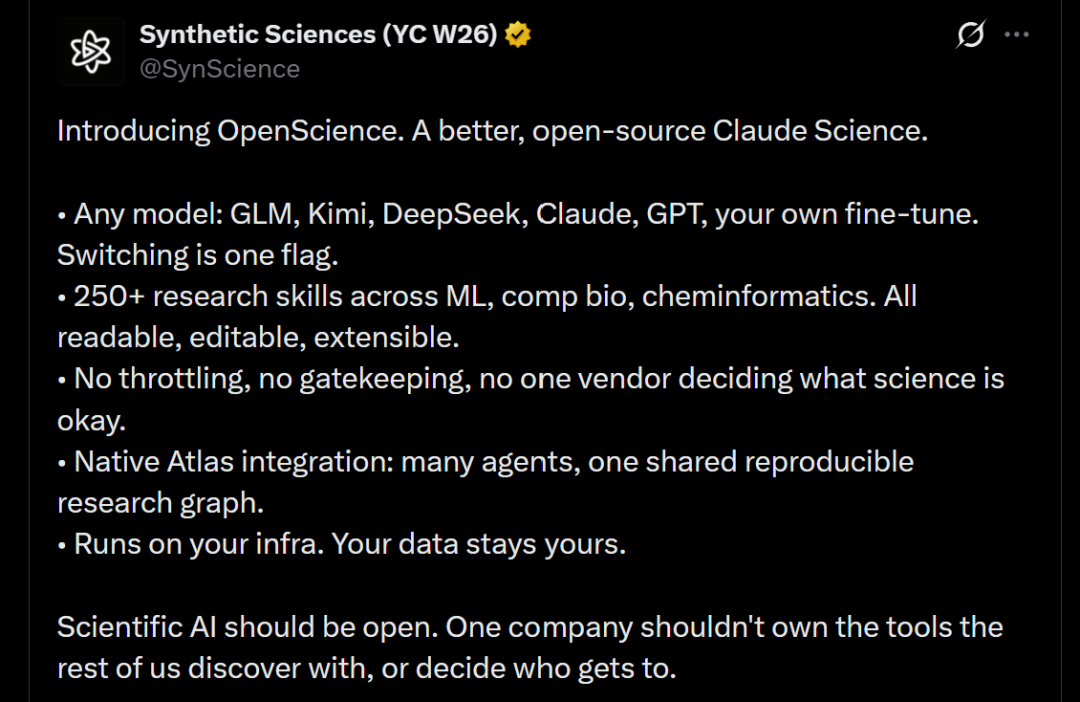
OpenScience also exposes scientific databases as tools. The README mentions UniProt, PDB, Ensembl, ChEMBL, PubChem, arXiv, OpenAlex, Semantic Scholar, and around 30 more. This is important because an AI research agent becomes much more useful when it can call the right databases instead of relying only on model memory.
OpenScience is installed from npm. If you already have Node.js and npm available, the quickest option is to run it with npx.

npx synsci
After running the command, OpenScience should open the workspace in your browser. On the first run, it walks you through model setup. You can use Atlas managed models, your own provider keys, or start with available demo options if supported by the current version.
If you prefer a global install, use npm:

npm install -g @synsci/openscience
openscience
You can also launch OpenScience inside a specific project directory:
Describe your idea once, and We0 AI can generate a showcase site, pages, and CMS, then help you attract customers and traffic after launch.
One complete project generation for free registration
Best for trying one complete generation flow and seeing a first project draft quickly.
openscience ~/code/my-project
The typical bring-your-own-key workflow looks like this:
export ANTHROPIC_API_KEY=sk-ant-...
openscience
OpenScience also supports other provider keys, such as OpenAI and Gemini keys, depending on the provider configuration supported by the current release. The key idea is that your credentials stay on your machine, and requests go directly to the selected provider.
If you want to manage keys from the terminal, the official README also mentions:
openscience keys add
From there, you can choose models from the workspace model selector and switch between providers as needed.
Synthetic Sciences also offers Atlas, a managed platform that provides access to curated frontier models through a prepaid wallet. This can be useful if you do not want to configure separate API keys for every provider.
But Atlas is not required for OpenScience. The official README states that bring-your-own-key usage is free and not gated by Atlas. In practice, Atlas is a convenience layer, while the open-source local workflow remains available.
Useful Atlas commands include:
openscience login
openscience wallet
openscience status
openscience logout
| Area | Claude Science | OpenScience |
|---|---|---|
| Main positioning | AI workbench for scientists | Open-source AI workbench for scientific research |
| Model choice | Claude-focused | Model-agnostic: Claude, GPT, Gemini, DeepSeek, GLM, Kimi, local models, and more |
| Access model | Claude Pro, Max, Team, and Enterprise beta | Open-source local workflow with optional Atlas managed models |
| Installation | Claude Science app/workbench | npm or npx command |
| Compute | Local, SSH, HPC, Modal-style cloud compute | Local server/workspace, tools, terminal, provider routing, cloud compute integrations depending on setup |
| Skills/connectors | 60+ curated scientific skills and connectors | The original article said 250+; the current README lists 290+ skills |
| Data control | Runs on local or lab infrastructure; sends needed context to Claude | Bring-your-own-key, local workspace, local model option, and provider-direct requests |
| License | Proprietary product | Apache-2.0 open-source license |
OpenScience is a powerful tool, but it should be treated like any agent that can run commands. The official README says the agent is not sandboxed. Its permission system is meant to keep you aware of actions, but it is not the same as isolation.
For sensitive work, consider running OpenScience in a container, virtual machine, or controlled research environment. Also be careful with credentials, private datasets, and any command that can modify files or call external services.
The OpenScience README includes a clear disclaimer: OpenScience is an independent project and is not affiliated with, endorsed by, or sponsored by Anthropic. It uses the name “Claude” only to describe compatibility.

That disclaimer is worth keeping. OpenScience may be compared with Claude Science, but it is not an official Anthropic product. If you write about it, use “alternative,” “open-source alternative,” or “model-agnostic workbench,” not “official Claude Science version.”
OpenScience is most relevant when a researcher or research engineer wants one workspace for:
For startups and AI product teams, the more interesting lesson is the product pattern: an agent becomes more valuable when it owns a workflow, not just a chat box. A research agent needs tools, memory, files, terminal access, reproducible artifacts, model routing, and review loops. That same pattern also applies to many AI productivity products outside science.
OpenScience is an open-source AI workbench for scientific research. It runs as a browser-based workspace with a local server, research agents, tools, terminal access, and model provider routing.
No. OpenScience is an independent project from Synthetic Sciences. It is not affiliated with, endorsed by, or sponsored by Anthropic.
Yes, OpenScience is designed to be model-agnostic. It can work with multiple model providers, including Claude, GPT, Gemini, DeepSeek, GLM, Kimi, and local models, as long as the provider is supported and configured.
The fastest command is npx synsci. You can also install it globally with npm install -g @synsci/openscience and then run openscience.
No. Atlas is an optional managed platform from Synthetic Sciences. You can use OpenScience with your own API keys without using Atlas.
It can support more local control than a fully hosted workflow, but you still need to be careful. The official README says the agent is not sandboxed, so use a container, VM, or controlled environment if you need isolation.
Claude Science is Anthropic’s Claude-focused AI workbench for scientists. OpenScience follows a similar research-workbench idea, but it is open source and model-agnostic.
OpenScience is a timely open-source alternative to Claude Science. It follows the same broader direction — building an AI workbench for scientific research — but makes model choice, local workflows, and open-source access central to the experience.
For researchers, the most important points are simple: OpenScience can be installed from npm, it can work with multiple model providers, and it can be used without Atlas if you bring your own API keys. For sensitive work, isolation still matters because the agent is not sandboxed.
The main takeaway: Claude Science shows where scientific AI workbenches are going, while OpenScience makes that idea more open, flexible, and easier to experiment with.
Start from one sentence and have a complete website in minutes.